
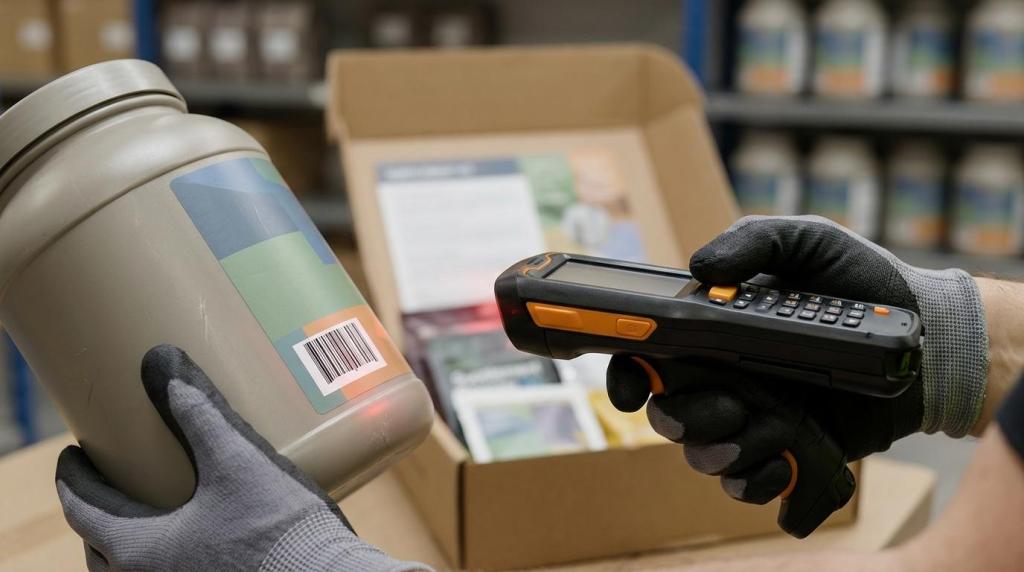
Getting a supplement kit right sounds simple until one order contains five moving parts, two flavour choices, one promotional insert and a subscriber expecting the same format every month—making accurate ecommerce fulfilment essential. That is why supplement bundle fulfilment UK operations need more than basic pick and pack. They need a disciplined system for kitting, stock control, traceability and repeatable packing rules.
A bundle might be a collagen starter set, a multivitamin plus shaker, a gummy duo with essential vitamins, or a monthly subscription with a welcome card. Each version adds commercial value, yet each version also creates more ways for an order to go wrong. The challenge is rarely storage alone. The real test is whether every component can be identified, located, checked and packed without confusion, while supporting accurate returns management.
When brands plan carefully, bundles become easier to scale and far less risky to run.
- Starter kits
- Multi-buy offers
- Flavour variants
- Subscription boxes
- Gift-with-purchase packs
Why supplement bundle fulfilment UK needs a different process
Supplements sit in a category where operational accuracy and product traceability matter at the same time. In the UK, food supplements are regulated as food and fall under general food law. That means the fulfilment process has to support more than fast dispatch. It also has to support records, batch awareness and compliant handling.
This is where many bundle projects become more complex than expected. A single ready-to-sell kit may be built from separate SKUs, each with its own batch tracking, quantity, date coding, expiry dates and storage note. If one scoop, leaflet or pouch is missing, the whole bundle may become unshippable.
A good warehousing process treats the kit as a sellable product while still keeping visibility of every part inside it, supporting product safety and consumer health.
GOV.UK guidance makes the logic clear. Businesses must be able to identify who they bought food supplements from and who they sold them to, while keeping delivery notes and invoices available for checks. Traceability rules exist so withdrawals and recalls can happen quickly and accurately if needed. In practice, that means bundle fulfilment needs systems that can connect a customer order to the right items and, where relevant, the right batch or lot records.
SKU mapping for supplement kitting services
Before the first order goes live, every bundle needs a map. This sounds obvious, yet it is often the stage that prevents most errors later. If the map is vague, warehouse teams end up guessing whether “Berry collagen kit” means a tub plus scoop plus leaflet, or the same set with a shaker and sample sachet added.
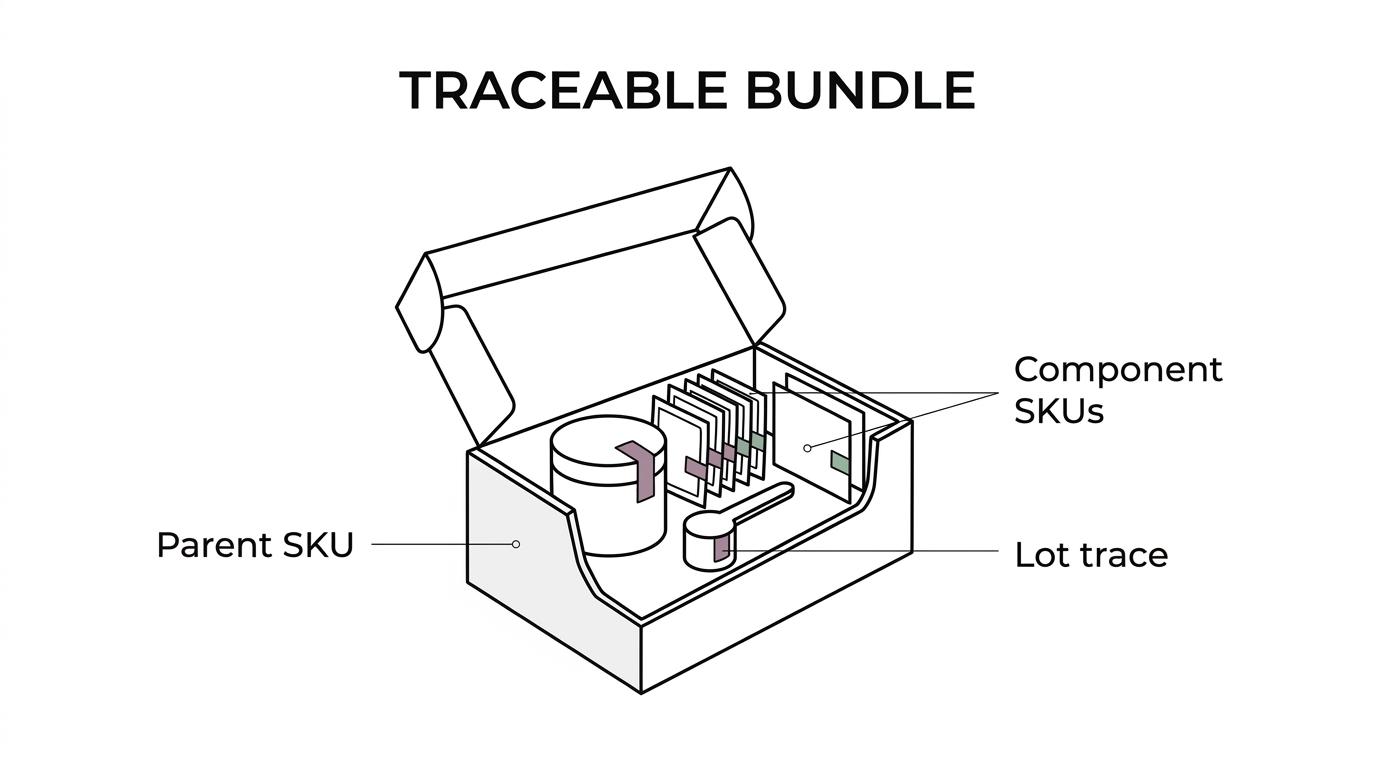
A precise kit map should show the parent bundle SKU and every child component SKU inside it. It should also define valid substitutions, if any, and state whether component shortages should trigger back orders, order holds or product swaps. Without that structure, the order system may show stock for the main bundle while one critical part is already exhausted.
Collagen bundle fulfilment often includes multiple taste variants, and those are easy to mix up when packaging looks similar. A brand may sell a “starter trio” with one neutral powder, one berry sachet and one citrus sample, while the site front end presents it as a single product. The warehouse still needs the full breakdown behind the scenes.
The same principle applies to accessories and printed items. Welcome inserts, measuring scoops, shaker bottles, coupons and educational cards may look minor, yet they are part of the customer promise. If they are not given their own identity in the fulfilment plan, accuracy slips.
Core bundle data for supplement starter kits
The simplest way to reduce errors is to define the operational detail early and keep it consistent across systems. Product listings, warehouse instructions and stock files should all reflect the same logic.
A useful bundle specification usually includes:
- Parent SKU: the code used for sale on the website or marketplace
- Component SKUs: every tub, pouch, sachet, accessory and insert in the kit
- Pack sequence: the order items should be picked and placed in the box
- Variant rules: flavour, size or promotional combinations allowed for that bundle
- Stock policy: whether to reserve components for kits or draw from shared inventory
- Exception handling: what happens when one component is short, damaged or expired
That level of detail feels strict, which is exactly why it works.
Traceability and compliance for UK food supplement bundles
Compliance is often treated as a separate topic from fulfilment. In reality, they overlap every day on the warehouse floor. If a product label needs a lot number, storage instruction or net quantity, the operation cannot ignore that just because the item is being sold inside a kit.
For packaged food, GOV.UK guidance sets expectations around the name of the food, warnings where needed, storage conditions, instructions for use where required, and quantity declarations over certain thresholds. For Great Britain, products should be labelled as “food supplement” rather than “dietary supplement”. These are label and product obligations, yet fulfilment teams still need to protect them by storing, picking and dispatching correctly.
That matters even more when kits are pre-assembled, because the warehouse must track components, batches and expiry dates. Once a bundle is built in advance, the warehouse should still be able to show what went into it and when. If a batch issue arises later, the brand needs clear records of affected stock and customer orders. A neat-looking kit is not enough if it cannot be traced.
The table below shows where bundle operations tend to need the most control.
| Bundle element | Operational risk | What good control looks like |
|---|---|---|
| Powder tubs and pouches | Similar packaging, flavour mix-ups | Scan-led picking, shelf separation, visual checks |
| Gummies and capsule bottles | Batch confusion across replenishment | Batch-aware stock records and rotation |
| Inserts and leaflets | Missing or outdated versions | Version-controlled print stock |
| Shakers and scoops | Accessory omission | Component-level pick checks |
| Pre-built kits | Weak visibility of contents after assembly | Assembly records linked to component SKUs |
| Subscription packs | Repeat errors over time | Locked packing specs and routine audits |
Packing instructions for collagen bundle fulfilment and promotional kits
Packing instructions should be written for the person doing the work, not just for the manager approving the process. If the kit is fragile, powder-heavy or promotion-led, the instructions need to say exactly how it should be packed.
That includes the box style, dunnage, item position, outer labelling and any presentation rules. A vitamins and collagen welcome kit might require the tub placed upright, sample sachets flat beneath the leaflet, scoop sealed inside the box and a specific insert on top. If the brand wants an unboxing experience, that can still be systemised.
Photos help. So do pack diagrams and exception notes.
Some supplement brands treat inserts as an afterthought, yet inserts often carry key educational or promotional messaging. If there are multiple campaigns running at once, warehouse teams need live dates and version controls. Sending last month’s offer in this month’s subscription box is not a dramatic failure, but it still weakens trust.
One UK fulfilment provider, 3PLWOW, states that its supplement workflow can include starter kits, multi-buy bundles, inserts, samples and batch-aware inventory processes. That reflects the wider reality of the sector: supplement kitting services are rarely just about putting two items in one carton. The process has to absorb marketing changes without losing picking discipline.
Stock control for subscription fulfilment UK programmes
Subscriptions bring recurring revenue, but they also magnify every small stock weakness. A one-off bundle can be corrected manually if needed, but recurring health kits require consistent processes. A monthly subscriber base cannot.
The main pressure point is shared inventory. A single collagen pouch might sit in a starter kit, a three-pack offer and a monthly subscription. If stock allocation is not planned properly, the fastest-selling channel can consume units promised elsewhere. The result is partial kits, order holds and customer service pressure.
This is why many operators separate available stock into logical pools or use system rules to protect subscription demand. The exact method varies, though the principle stays the same: do not let a bundle depend on stock that has already been quietly spent in another campaign.
The recurring nature of subscription fulfilment UK operations also makes forecasting more useful. Historic renewal rates, promotional spikes and flavour popularity can all be fed into purchasing and stock reservation decisions. Better forecasting will not remove all surprises, yet it gives the warehouse a cleaner runway.
Common subscription pressure points include:
- Renewal spikes after offers end
- Shared components across several kits
- Flavour imbalance
- Packaging changes mid-cycle
- Insert swaps by campaign date
Quality checks that keep every supplement kit consistent
Accuracy improves when quality checks happen at more than one stage. Relying on a final glance before dispatch is rarely enough when several components are involved.
A strong process usually starts with inbound checks, where the warehouse confirms quantities, packaging condition, dates and product identity before stock is put away. It then moves into location discipline, scan-supported picking, assembly checks and packed-order verification. Pre-built kits may also need routine sample inspections to confirm that presentation standards are still being met after storage and handling.
Single-batch control can matter too, especially where a brand wants all items in one order to come from compatible stock windows. That is not always essential, though it should be discussed early if date consistency matters for the customer experience or internal quality standards.
What to give a fulfilment partner before bundle launch
A warehouse cannot build reliable kits from loose email threads and changing screenshots. The handover needs structure. When the launch pack is clear, onboarding is faster and the risk of packing drift drops sharply.
The most useful launch pack usually contains:
- Bundle matrix: every live kit, flavour option and approved component
- Packing guide: box type, layout, inserts, presentation notes and checks
- Stock rules: batch handling, rotation method and low-stock triggers
- Service rules: cut-off times, back-order policy and returns treatment
- Label notes: any wording, sticker, lot or date visibility requirements
- Campaign dates: when promos, inserts or seasonal packs should start and stop
This is also the point where brands should clarify whether kits will be assembled to order or pre-built in advance. Both models can work well. Build-to-order offers more flexibility when variants change often. Pre-kitting can raise throughput when volumes are stable and the component mix is fixed.
Supplement bundle fulfilment UK as an operational advantage
Well-run kitting can do more than prevent mistakes. It can support product launches, improve average order value and make subscription formats easier to scale. A brand that knows its bundle logic, stock policy and packing standards can bring new combinations to market with much more confidence while supporting customer health.
That is why the best supplement bundle fulfilment UK setups are built around detail, whether bundles include protein powders, minerals or vitamins. Not glamour, not guesswork, and not broad promises. Clear SKU mapping, traceability records, batch-aware stock control and precise packing instructions are what keep every kit right, whether it contains one collagen tub or a full month-one starter box.