
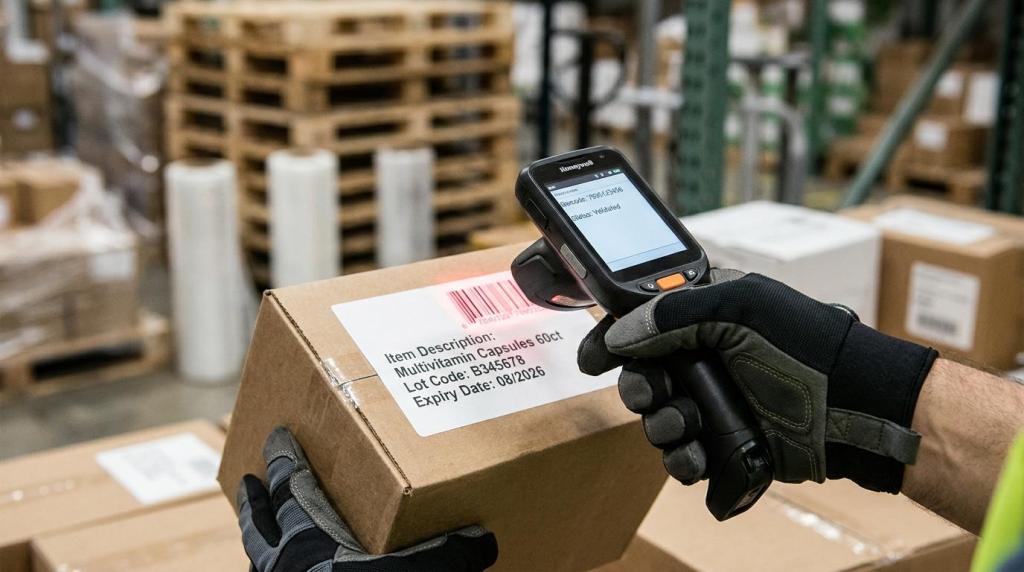
A warehouse move can look like a logistics project on paper. In practice, supplement stock transfers are wider than that. They affect traceability, expiry control, complaint handling, and the evidence trail that supports each order shipped after go-live.
That is why the most reliable handovers are treated as controlled transfers rather than simple stock relocations.
A strong plan gives the new 3PL enough structure to receive stock accurately, fulfil orders from day one, and maintain the records that regulators and retailers may expect to see later.
Supplement 3PL handover: why a warehouse move becomes a compliance event
Dietary supplements sit in a category where stock accuracy and recordkeeping carry extra weight. FDA compliance material makes clear that warehouse inspections can apply to firms that hold and fulfil dietary supplements, even where they do not manufacture, package, or label them. That changes the tone of a handover. The question is not only whether pallets arrive on time. The question is whether the stock remains fully traceable before, during, and after the move.
Lot-level visibility is the centre of that control. FDA guidance has long required batch, lot, or control numbers to support the complete manufacturing history and control of packaged and labelled supplement product through distribution. If a brand cannot show which lot was received, where it was stored, and which customer orders it entered, the warehouse switch has created risk rather than reduced it.
Expiry discipline matters just as much. Supplements are often managed to best-before or shelf-life dating, and many products move in multiple lot codes at once. A transfer that mixes lots, loses expiry dates, or skips checks on short-dated stock can create avoidable write-offs within weeks.
A practical way to frame the move is to treat it as a transfer of four connected controls:
- lot traceability
- expiry and FEFO picking
- distribution records
- complaints and quarantine
Pre-handover records for supplement inventory
Before any stock is booked in with the new 3PL, the core records should be assembled, reviewed, and matched against the physical inventory. This is where many projects either become stable or start drifting. If the opening files are weak, every later reconciliation becomes slower and more expensive.
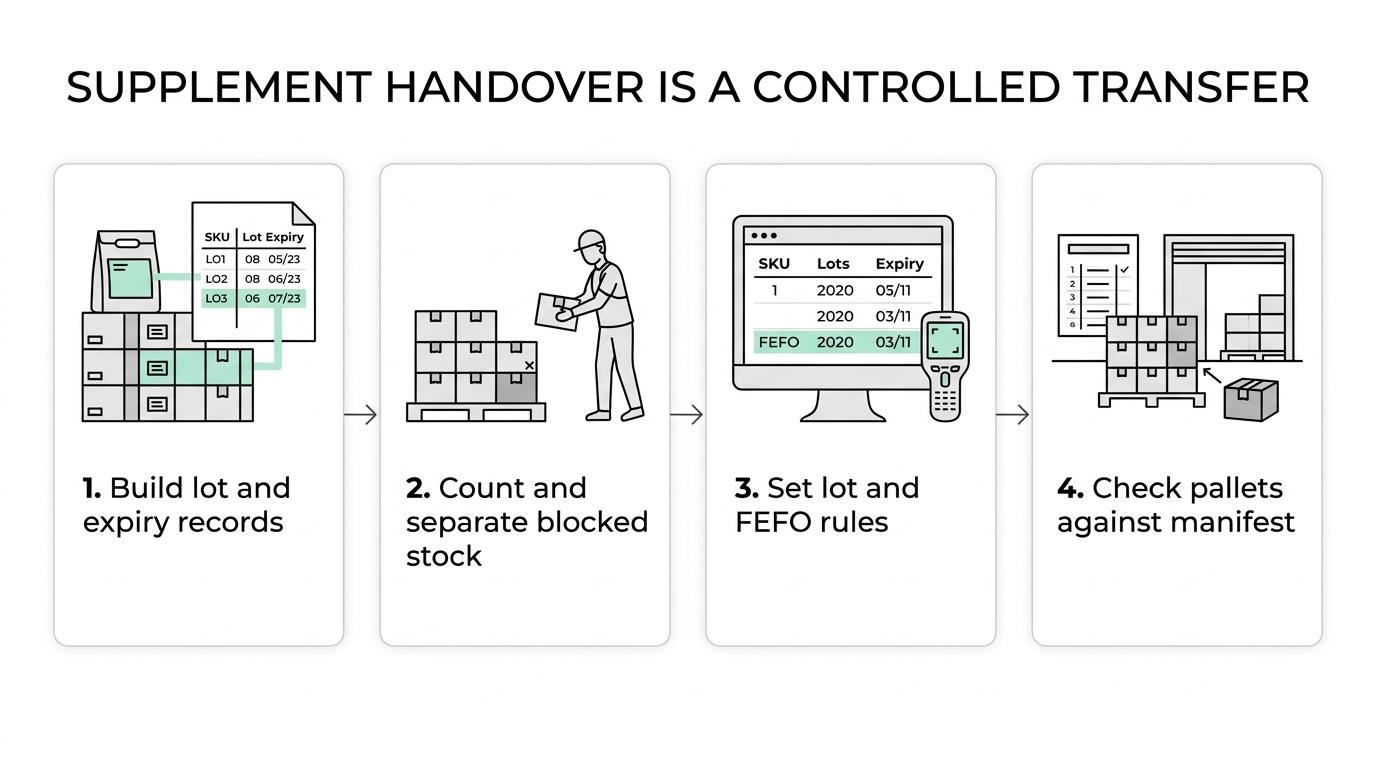
The minimum dataset should cover each SKU, each lot, each expiry date, and each storage location at the point of transfer. If there are holds, quarantined units, returns awaiting review, or retailer allocations, they should be shown as separate stock states rather than buried in a single on-hand number.
FDA guidance also places real emphasis on record retention. Where shelf-life dating is used, records should be kept for one year past shelf life. Where shelf-life dating is not used, records should be kept for two years beyond the date of distribution of the last batch. A warehouse handover is a poor time to learn that historical files sit across several disconnected systems.
The handover file should also link stock data to the documents behind it. A concise transfer pack often works better than a sprawling folder structure because the new 3PL can validate it more quickly and ask sharper questions.
| Handover record | Why it matters | Evidence to transfer |
|---|---|---|
| SKU master data | Prevents receiving and pick errors | SKU codes, descriptions, pack sizes, barcodes, storage notes |
| Lot and expiry register | Supports traceability and FEFO rules | Lot numbers, receipt dates, expiry dates, quantities by lot |
| Distribution history | Supports audit trail through fulfilment | Sales order exports, shipment logs, customer allocations |
| Quality status | Separates saleable from non-saleable stock | Quarantine logs, hold notices, returns status |
| Complaint and issue records | Helps manage repeat problems and investigations | Complaint summaries, corrective actions, lot references |
| Product documentation index | Speeds validation and exception handling | COAs if used operationally, specification references, labelling files |
Stock validation and expiry control before the warehouse move
The cleanest stock transfer starts with a count. Not a rough estimate, not a finance snapshot, and not a promise that the system is “about right”. A lot-level count, ideally close to the move date, provides the opening position that both warehouses can work from.
Where the stock profile is complex, cycle counts focused on high-volume SKUs and short-dated lots are often more useful than waiting for a full-wall count. The goal is confidence in the lots most likely to be shipped first or queried later.
This is also the right stage to decide what should not move. Dead stock, damaged units, recalled lots, and inventory with unresolved quality questions should be isolated before collection. Sending these items into the new 3PL without clear status codes creates confusion at goods-in and increases the chance of accidental release.
A disciplined pre-move review usually covers the following checks:
- Count method: full count, cycle count, or hybrid approach by SKU and lot
- Expiry review: identify short-dated stock, define minimum acceptable shelf life, confirm saleable status
- Quarantine status: isolate blocked, damaged, returned, or investigation stock
- Pallet integrity: confirm labels, quantities, and lot separation before dispatch
- Exception register: list mismatches that are known before the move begins
Supplement-focused 3PL guidance often puts FEFO picking near the top of the operational checklist, and with good reason. If FEFO rules are not agreed before stock lands, teams will improvise. That is when the wrong lot gets picked, old stock is left behind, and service teams end up explaining preventable errors.
System mapping for lot traceability and distribution records
Even a careful physical transfer will fail if the data model does not map correctly into the new warehouse management process. The new 3PL needs more than SKU codes and opening balances. It needs the logic behind those balances.
That means deciding, in advance, how the warehouse will capture and use lot data at receipt, storage, picking, packing, and dispatch. Many supplement brands assume traceability is in place because lot numbers exist in an ERP. The operational question is narrower and tougher: does the 3PL capture the lot at the scan point where it matters?
Distribution records are another key point. FDA compliance material instructs inspectors to verify that distribution records are kept. During handover planning, the brand and 3PL should agree what a complete distribution record looks like in practice. At minimum, it should show the product, lot, quantity, ship date, destination, and order reference. If marketplace, wholesale, and direct-to-consumer orders are handled differently, that distinction should be documented rather than left to habit.
Pick accuracy reporting deserves attention too. A capable 3PL should be able to explain its normal accuracy levels and how they are measured. That conversation is not about marketing numbers. It is about control design. If errors are tracked only at order level, a lot-selection mistake may disappear inside an otherwise complete shipment.
A short mapping workshop tends to surface the most useful questions:
- Can the WMS store multiple lots and expiry dates against one SKU?
- Is FEFO applied automatically or through user prompts?
- Are lot numbers captured again at dispatch, or only at receipt?
- How are replacement shipments linked to the original order record?
- What report can be produced within hours if a lot query appears?
Goods-in controls at the new 3PL for supplement stock
When the stock arrives, goods-in becomes the first real test of the handover plan. If the warehouse books pallets in only by SKU and total quantity, the traceability effort from earlier stages is weakened straight away. Goods-in for supplements should validate not just count, but identity and condition at lot level.
Each pallet or carton should be checked against the transfer manifest, with lot and expiry confirmed in the warehouse system. Any mismatch between the manifest and the received stock should be logged as an exception and resolved before product is made available for picking.
This is also where short-dated policy becomes operational rather than theoretical. The 3PL should know the minimum remaining shelf life allowed for saleable stock, what happens to items below that threshold, and who approves release when stock is close to the line.
A practical receiving routine often includes:
- manifest match by SKU, lot, and quantity
- expiry capture at goods-in
- FEFO slotting rules
- quarantine location for exceptions
- photographic evidence for damaged or unclear labels
A staged go-live can help here. Many brands move reserve stock first, validate system records, then release active order volumes once receipt accuracy is confirmed. That adds a little time, yet often removes far larger costs later.
Quality, quarantine and complaints handling after go-live
The handover is not finished when the final pallet is scanned in. The first few weeks after go-live often expose the gaps that planning did not catch, especially around complaints, returns, and inventory status changes.
FDA compliance material points inspectors towards complaint logs, and serious adverse event reports create an even higher threshold for discipline. Manufacturers and distributors of dietary supplements must record, investigate, and forward serious adverse event reports to the FDA. If a customer contact or safety issue arises after the move, the business needs to retrieve product details quickly, including lot codes and expiration dates where relevant to the investigation.
That only works if complaint intake, warehouse records, and lot traceability connect cleanly. A support team may log the issue, but the warehouse often supplies the underlying evidence. If the 3PL cannot isolate which orders contained the lot in question, response times slow at the exact moment speed matters most.
Quarantine design should be explicit. There should be a named process for stock placed on hold due to damage, returns assessment, temperature concern, complaint review, or regulatory query. “Do not use” is not a system status. It is a message. A usable control needs locations, permissions, and release steps.
This part of the handover usually benefits from defined ownership:
- Complaint intake: who logs the case and captures product details
- Lot lookup: who produces shipment history from warehouse records
- Quarantine decision: who can block or release stock
- Adverse event escalation: who receives serious cases and starts the formal process
- Disposition record: how destruction, return, or release is documented
Cutover week checklist for moving supplement inventory to a new 3PL
The final week should be calm, not heroic. That only happens when the key controls are turned into visible tasks with owners and deadlines.
A simple cutover checklist usually works better than a project plan full of dependencies that nobody checks on the warehouse floor. The best version is short enough to use during daily calls and detailed enough to protect the audit trail.
Here is a practical structure for that week:
- Freeze window: agree the final outbound point from the old 3PL and the first saleable inbound point at the new site
- Open orders: decide which orders ship from old stock and which are held for the new warehouse
- Transfer manifest: issue the final lot and expiry list for every pallet and carton moving
- Receipt priority: identify fast-moving and retailer-critical SKUs for first booking
- Reconciliation cadence: compare shipped versus received stock daily until all variances are closed
- Go-live reporting: confirm stock on hand, lot availability, blocked stock, and first dispatch accuracy
- Escalation path: name the people who can approve urgent decisions on shortages, damage, or lot mismatches
One more point is often missed. Historical records must remain accessible even after the new 3PL takes over. If a complaint arrives three months later about stock shipped by the previous warehouse, the business still needs the old distribution records, complaint notes, and transfer reconciliations.
A well-run handover leaves two outcomes behind. The first is operational confidence: the right supplement, the right lot, the right expiry status, shipped to the right customer. The second is documentary confidence: if a regulator, retailer, or customer asks what happened to a batch, the answer can be produced quickly and backed by records rather than memory.