Repeat orders are where a supplement subscription model either becomes dependable and profitable, or starts to lose trust one box at a time.
That is especially true for supplement subscription fulfilment, where customers often expect the same routine every month, yet still want room to change flavours, swap products, pause a shipment, or add a new bundle. A missed sachet, the wrong tub, or an insert from last month can make the service feel careless, even when the products themselves are strong.
For brands running vitamin subscription boxes in the UK, fulfilment is not just about getting parcels out quickly. It is about getting every recurring order right, with a repeatable process that can cope with bundle logic, stock pressure, and changing customer preferences without causing dispatch delays.
Why repeat-order accuracy matters in supplement subscription fulfilment
A single one-off ecommerce order can survive a minor slip. A subscription cannot.
When customers subscribe, they are buying a rhythm. They expect the right products, in the right quantities, on the expected date, with billing, packing, and delivery all working together. If that rhythm breaks, confidence drops quickly. Recent consumer research from McKinsey points in a helpful direction here: shoppers place more value on on-time delivery than on absolute speed. That matters for subscriptions, because reliability is what keeps the monthly habit intact.
The same pattern appears at checkout. DHL’s 2025 ecommerce trends research found that many shoppers abandon purchases when preferred delivery options are missing. For subscription brands, that means fulfilment choices affect conversion as well as retention. Delivery promises, order cut-offs, skip options, and returns policy all shape whether a customer signs up in the first place.
Case material published by 3PLWOW makes a similar point from an operational angle. Its subscription fulfilment examples connect tighter workflows with higher accuracy, stronger on-time performance, and better repeat subscription results. In a recurring model, fulfilment is not a back-office detail. It is a visible part of the product.
Managing bundles and flavour combinations in subscription box fulfilment UK
Supplements rarely ship as a single, static SKU. Brands often sell daily packs, starter kits, performance stacks, immunity bundles, and seasonal combinations. Add flavour options into the mix, and one subscription programme can become a matrix of variants very quickly.
A customer might want collagen in berry, protein in chocolate, hydration tablets in citrus, and a leaflet promoting a new sleep blend. Another might choose an unflavoured version of the same programme with no samples included. Both orders may look similar on the screen, but the pick and pack logic behind them is very different.
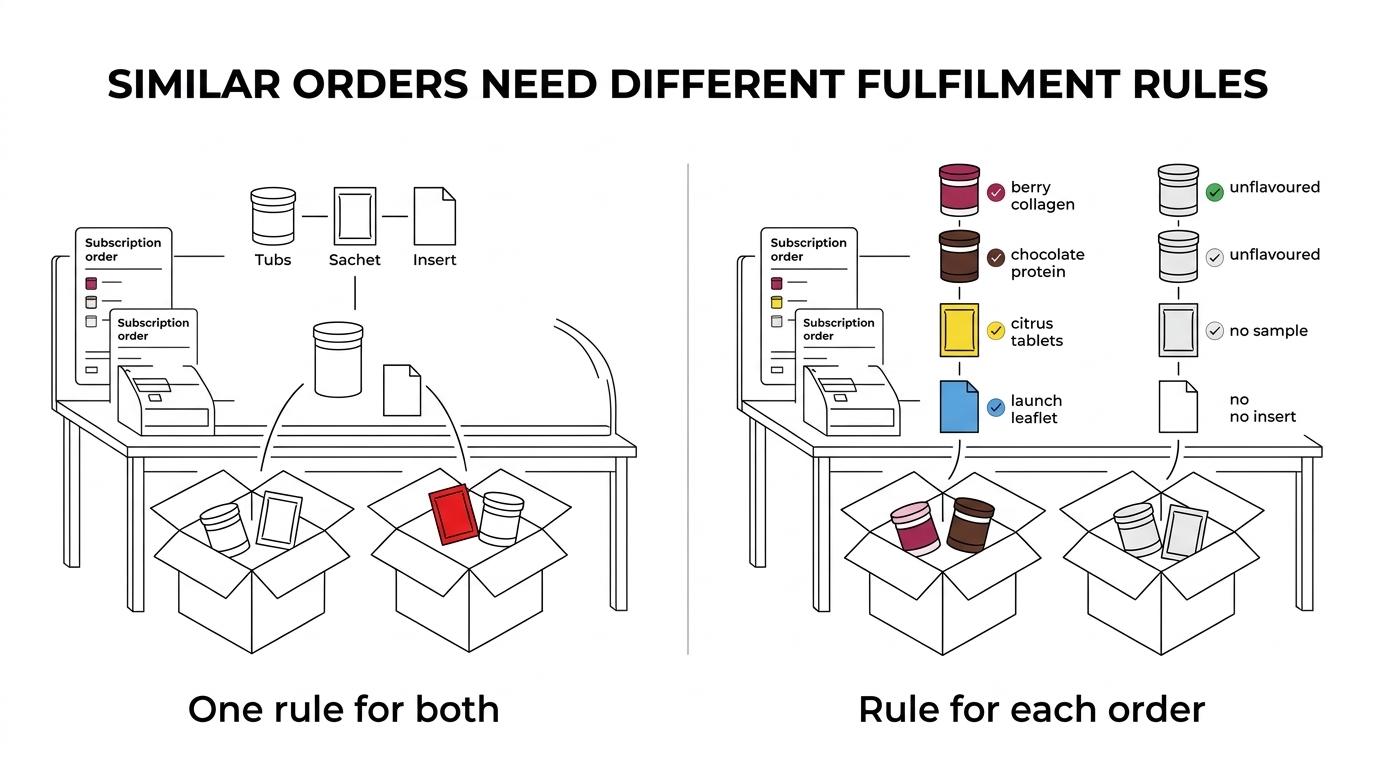
This is where subscription box fulfilment in the UK needs structure rather than improvisation. The most reliable operations separate commercial creativity from warehouse ambiguity. The offer can be flexible, but the fulfilment rules must be exact.
| Subscription element | Common customer expectation | Fulfilment requirement |
|---|---|---|
| Core bundle | Same products every cycle | Fixed bill of materials and repeat pick path |
| Flavour selection | Ability to choose or swap tastes | Variant control at SKU level |
| Trial add-on | Occasional sample or bonus sachet | Time-limited insert logic and version control |
| Upgrade box | Larger monthly plan or giftable set | Alternative packaging and carrier rules |
| Seasonal campaign | New mix for a fixed month | Date-based activation and stock reservation |
A practical setup usually needs a few non-negotiables.
- SKU discipline: every flavour, pack size, and bundle component should have its own clear stock identity
- Order mapping: subscription rules must translate cleanly from storefront to warehouse instruction
- Pick validation: barcode checks or equivalent controls reduce wrong-flavour and wrong-bundle errors
- Short, stable packing sequences
- Clear outer-box labelling
- Controlled version changes
Without that structure, a popular flavour combination can create a surprisingly large error rate.
Inserts and personalisation for vitamin subscription boxes UK
Inserts look simple because they are light, cheap, and easy to print. Operationally, they can be one of the easiest ways to create confusion.
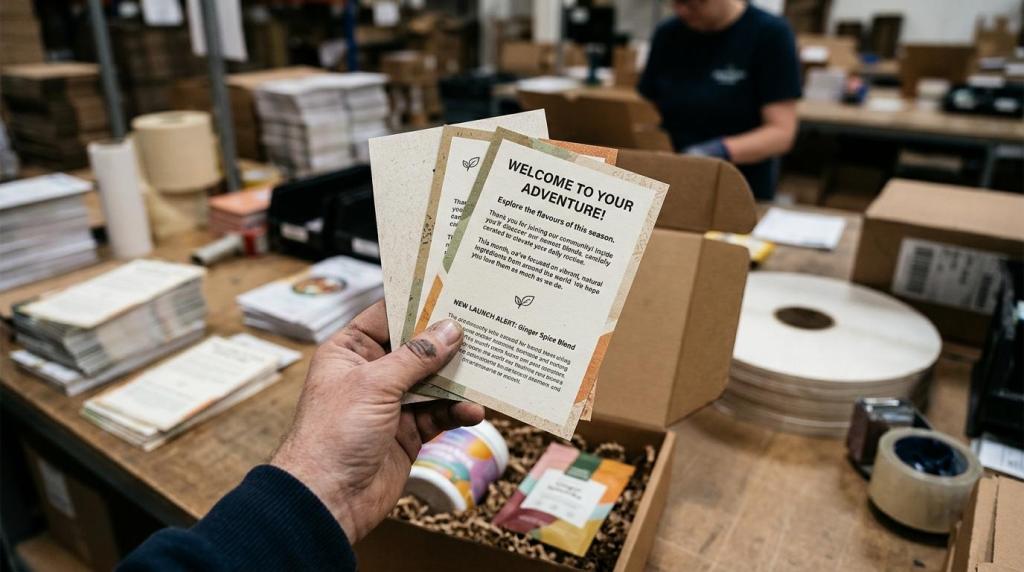
A supplement brand may use inserts for welcome messages, usage guidance, flavour launch cards, referral offers, educational leaflets, and compliance-friendly product information. If these pieces are not controlled like inventory, they often end up packed inconsistently. One customer gets two cards, another gets none, and a third receives last month’s promotion after the offer has expired.
That does not mean brands should avoid inserts. Quite the opposite. Inserts can make vitamin subscription boxes in the UK feel thoughtful, informed, and worth continuing. The key is treating them as part of the order logic, not as an informal extra added at the bench.
This is even more relevant when subscriber segments differ.
- New subscriber welcome card
- Existing subscriber loyalty note
- Flavour launch flyer
- QR code usage guide
- Limited-time referral insert
Where personalisation is part of the brand promise, fulfilment needs a version-controlled process. 3PLWOW’s case material refers to subscription projects using personalised touches, including survey-led variations in some sectors, and links that style of controlled customisation with better retention. The lesson is straightforward: personalisation works best when it is operationally tidy.
Stock availability and inventory accuracy in supplement subscription fulfilment
Stock pressure can quietly damage a subscription business long before it becomes visible in sales reporting.
Supplements often have batch dates, shelf-life considerations, and promotional spikes that affect the availability of specific variants. A protein flavour promoted by an influencer, a vitamin blend featured in winter campaigns, or a free-sample insert attached to a new product launch can all shift demand very quickly. If inventory planning is too broad, repeat subscribers feel the impact first.
The operational goal is not only stock accuracy, but stock suitability. It is not enough to know there are 5,000 units in the building if 2,000 are allocated to wholesale, 1,000 are reserved for a launch, and the remaining stock is split across flavours that do not match active subscription profiles.
That is why strong supplement subscription fulfilment for vitamin subscription boxes UK depends on allocation rules for upcoming billing cycles and reliable subscription box fulfilment UK. Subscription demand is more forecastable than many one-off ecommerce orders, so it makes sense to reserve stock against known renewals before open sales consume the available units.
A disciplined inventory model tends to include:
- Cycle forecasting: expected renewal volume by SKU, flavour, and bundle type
- Reservation windows: ring-fenced stock for billed subscribers before public promotions begin
- Exception handling: pre-agreed substitute, delay, or customer-contact rules when a variant runs short
- Batch rotation
- Expiry-date monitoring
- Live stock sync between sales channels
This is where on-time-in-full performance becomes a useful standard. If the parcel arrives on schedule but the flavour is wrong, the promise was not met. If the order is accurate but delayed because stock was oversold, the customer still sees a broken routine.
Published subscription fulfilment case material from 3PLWOW points to this link between process discipline and results, reporting high inventory accuracy and strong on-time delivery in subscription settings. Whether a brand uses an in-house warehouse or a specialist partner, the principle stays the same: repeat orders need protected stock logic.
Handling changing subscription orders without slowing dispatch
Flexibility is one of the strongest reasons people choose a subscription, yet flexibility is also one of the fastest ways to create warehouse complexity.
Customers want to skip a month, switch from capsules to powder, replace vanilla with chocolate, add a hydration pouch for training season, or send the next box to a different address. Those are sensible requests. The difficulty comes when these changes arrive late, enter different systems, or fail to reach the fulfilment team in a usable format.
The answer is not to block changes. It is to define when and how they flow into the order stream.
Subscription order cut-off rules and dispatch control
The best subscription operations create a clean point where an editable subscription becomes a locked fulfilment order. Before that cut-off, customers can change items. After it, the warehouse packs against a stable instruction set.
That sounds simple, yet it solves several problems at once. Pick lists become reliable. Stock can be reserved with confidence. Customer service teams know when a change can still be applied. Dispatch waves stay orderly.
A workable framework often looks like this:
- Before cut-off: customers can swap flavours, pause, skip, add products, or amend the address
- At cut-off: billing, stock reservation, and order creation are frozen into one approved record
- After cut-off: changes move to exception handling rather than standard pick flow
- Clear customer reminders before renewal
- Visible self-service account controls
- Fast internal escalation for urgent corrections
One missed dispatch cut-off can affect hundreds of subscribers at once. That is why recurring orders need a different level of control from normal daily ecommerce traffic.
Returns, reverse logistics, and customer confidence for repeat subscriptions
No fulfilment system is perfect, and subscription brands should plan for that reality rather than deny it.
Damaged tubs, duplicate shipments, wrong flavours, failed deliveries, and customer refusals all feed into reverse logistics. In a supplement model, the issue is not just the cost of the return. It is the risk of interrupting a routine product cycle. A customer who intended to take a daily supplement may cancel altogether if the replacement process feels slow or uncertain.
This is where flexibility can support conversion and retention at the same time. If a brand is clear about replacement rules, late-delivery handling, and what happens when a parcel goes missing, trust is easier to preserve. McKinsey’s findings suggest customers can tolerate slight lateness better than many retailers assume, but tolerance drops when expectations are unclear or the issue is mishandled.
Reliable repeat fulfilment is built on many small decisions done well: accurate bundle mapping, clean flavour control, insert versioning, realistic stock reservation, and disciplined cut-off management.
Get those right, and the monthly box stops feeling like a logistics task and starts feeling like a promise kept.