
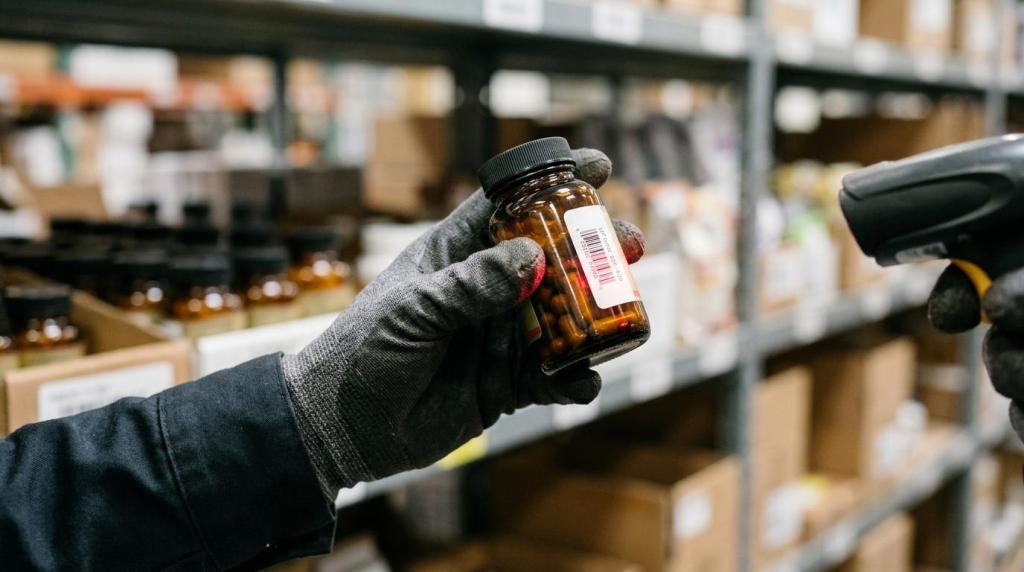
Selling supplements is not only about marketing, margins and margin-friendly packaging. Once orders begin to scale, fulfilment becomes a quality system in its own right. For brands in the UK, that matters even more because food supplements sit within food law, which means stock control, record keeping and storage conditions are not back-office extras.
A good fulfilment set-up protects the customer experience and the business at the same time. It helps prevent short-dated stock being sent out, keeps batch records accessible, supports repeat orders and returns, and reduces the risk of picking errors across capsules, powders, sachets, gummies and bundles. When a brand is choosing a fulfilment partner, those are the details that deserve the closest look.
Why UK supplement fulfilment is more than pick and pack
Supplement fulfilment UK should be treated as an operational discipline, not a warehouse add-on, whether a brand needs food supplement fulfilment, vitamin fulfilment or supplement subscription fulfilment. Orders may look simple on the surface, yet the underlying process has to account for traceability, product dating, storage conditions, exact SKU handling and the careful fulfilment of vitamins. That becomes even more important when the range includes multiple strengths, flavours, pack sizes or promotional kits.
UK guidance on food traceability expects businesses to identify suppliers and customers, often described as a one-step-back and one-step-forward approach. In practice, that means records should cover what product moved, in what quantity, on which date, and with which batch, lot or consignment code where available. Those records need to be accurate and readily available if requested by an authorised officer.
That expectation changes the way a supplement brand should assess fulfilment, including how its partner handles inventory management and stock management. A partner is not simply storing stock and printing labels; it is managing inventory distribution and logistics while helping support regulatory compliance. It is taking part in a chain of accountability and helping support regulatory compliance.

After that point, the most useful questions become very practical:
- Traceability: Can each outbound order be connected to a specific batch where required?
- Expiry control: Is stock rotated by agreed dating rules, not just first expired, first out by receipt date?
- Storage: Are products held in conditions suitable for the format and packaging?
- Accuracy: Are pick checks in place for similar-looking SKUs?
- Repeat-order capability
- Subscription workflow stability
Batch tracking and traceability in food supplement fulfilment
Batch control is one of the clearest dividing lines between a basic ecommerce warehouse and a fulfilment operation that is ready for supplements. If a product issue appears, a brand may need to isolate affected units quickly, identify where they were shipped, and confirm what unaffected stock remains. That can only happen if inbound goods, storage locations and outbound orders are tied back to batch data in a disciplined way.
This is especially relevant in vitamin fulfilment, where ranges often look deceptively similar. A magnesium capsule and a zinc capsule may use near-identical bottles. Different strengths of the same product can share the same brand design. Without batch-linked records, clear SKU handling and careful kitting, errors become easier to make and harder to investigate.
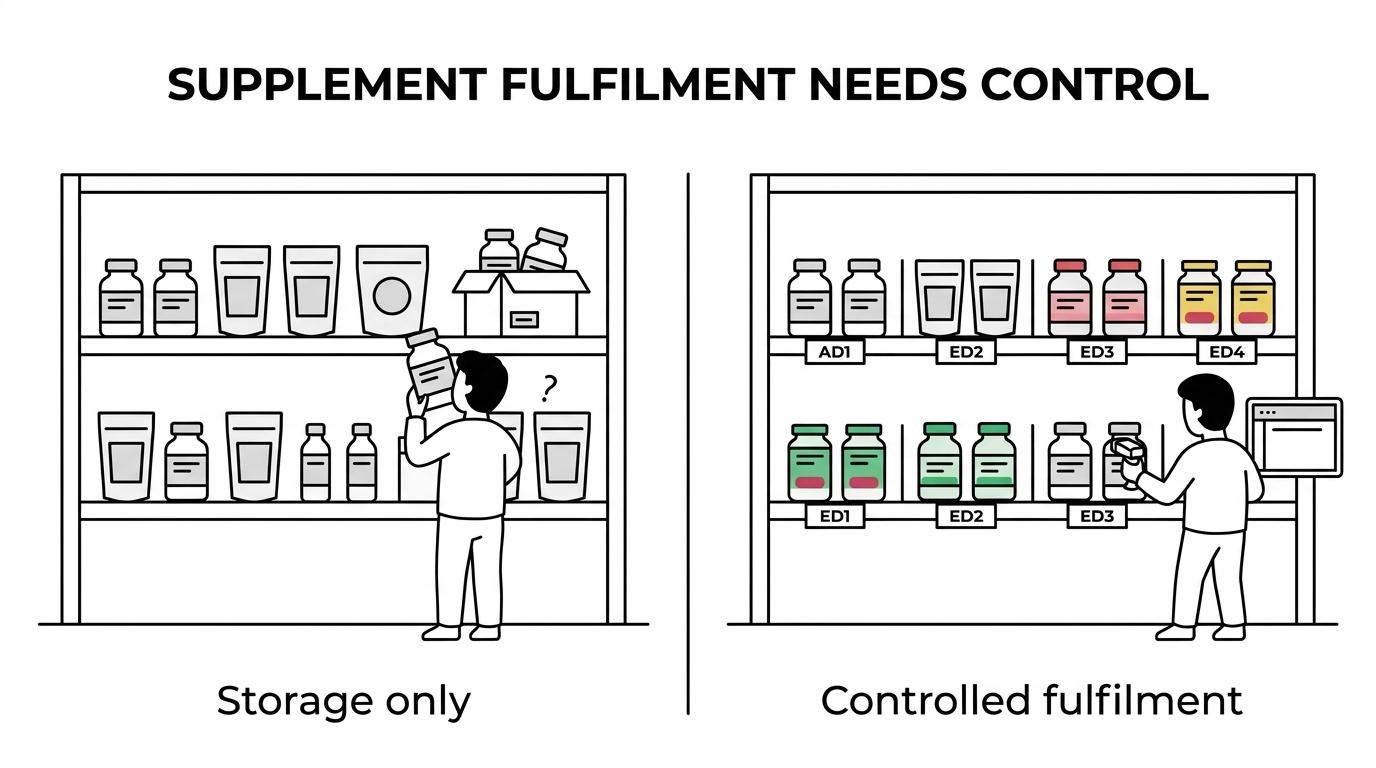
Some UK fulfilment providers now state openly that their supplement workflows include batch and expiry control, recurring orders, returns management and customs-ready dispatch information. That is a useful benchmark. If a provider never mentions batch handling, a brand should ask exactly how traceability is managed day to day.
| Fulfilment capability | Why it matters for supplements | What good looks like |
|---|---|---|
| Batch recording on goods-in | Creates a clear link between received stock and stored inventory | Batch data captured at receipt and tied to SKU records |
| Batch-aware picking | Supports targeted recalls and investigation | Outbound orders can be traced to the batch used |
| Customer and supplier records | Supports UK traceability expectations | Records show supplier, customer, quantity and dispatch details |
| Date visibility | Reduces risk of shipping short-dated stock | Expiry dates visible within stock records |
| Ready access to records | Speeds response to queries or incidents | Information can be produced quickly and accurately |
Expiry-date management in vitamin fulfilment
Expiry-date management is one of the first areas where supplement fulfilment either inspires confidence or raises concern. A warehouse can be accurate on order count and still perform badly if it sends products with poor remaining shelf life. That leads to complaints, cancelled subscriptions and wasted acquisition spend.
A stronger process starts at goods-in. Expiry dates should be captured, checked and linked to the relevant stock record. Stock rotation then needs to follow the agreed rule, which may be first expired, first out or another date-led method agreed in advance. What matters is that the rule is clear, consistent and visible.
This becomes more pressing with launches, bundles and influencer-led spikes. Slow-moving lines can sit beside very fast sellers, and mixed packs can pull stock from several date ranges at once. If the fulfilment operation does not actively manage that, one forgotten component can hold back a whole bundle or push short-dated units into active sale.
A sensible service model will also define what happens when stock approaches a dating threshold, supporting compliance with product-handling requirements. That decision should never be improvised after complaints begin.
- Goods-in checks: confirm expiry dates on arrival
- System visibility: show dating within stock records
- Rotation rules: apply the agreed method consistently
- Threshold alerts: flag stock nearing the minimum acceptable window
- Short-dated stock segregation
- Clear client approval steps
Storage controls for capsules, powders and gummies
Careful storage is not glamorous, though it says a great deal about how seriously a fulfilment operation treats supplement products. Labels commonly include storage instructions and use-by or best-before dates, and those details should reflect real handling conditions right through the warehouse process.
Capsules, tablets, powders and gummies do not all behave in the same way. Moisture sensitivity, heat exposure, fragile tubs, pouches prone to crushing, and outer cartons for multi-packs all need sensible handling. Even where a product does not require specialist temperature control, it still benefits from clean, orderly storage and strong stock discipline.
Storage quality also affects presentation. Crushed cartons, scuffed labels and leaking powder jars may still count as “picked”, yet they do not count as well fulfilled.
For brands reviewing a provider, a few basics matter most after the broader process has been discussed:
- Clean storage areas
- Logical SKU separation
- Protected pallet and shelf locations
- Quarantine process for damaged stock
- Clear handling rules for fragile formats
Accurate picking and packing for supplement orders
Picking accuracy is where operational quality becomes visible to the customer. One wrong bottle in a subscription, one missing sachet in a starter kit, or one mixed-up flavour in a wellness bundle can turn a loyal buyer into a refund request.
Supplement brands often carry product ranges with very similar packaging. That makes accurate picking harder than it looks. Strong fulfilment teams use precise SKU mapping, barcode checks where available, visual validation steps and pack instructions that leave little room for guesswork. If a range includes bundles, trial kits or gift sets, the assembly instructions also need to be exact.
Packing quality matters just as much as picking. Containers need to arrive intact, labels readable, seals protected and outer packaging fit for transit. This is where a specialist supplement fulfilment service can stand out. It knows that “accurate” means the right item, the right quantity, the right batch logic, and the right presentation.
A practical conversation with a provider should cover points like these:
- SKU controls: How are similar-looking products separated and checked?
- Bundle assembly: Are pack components verified against a live order rule?
- Damaged units: What happens if an item is marked, dented or leaking at pick stage?
- Packing method: Is the packaging matched to bottles, tubs, pouches and mixed kits?
- Order proof: What data is retained to confirm what was dispatched?
Supplement subscription fulfilment for repeat orders
Subscription growth can make a supplement brand far more predictable, yet it puts extra pressure on fulfilment. One-off ecommerce orders are forgiving by comparison. Recurring orders need consistency month after month, with little tolerance for missed dates or variable stock allocation.
The best supplement subscription fulfilment models are built around repeatability. Stock has to be available when renewal cycles hit. Picking rules have to stay stable. Packaging needs to remain consistent. Order files need to flow cleanly from the subscription platform into the warehouse system. If that chain breaks, the customer feels it immediately.
There is also a planning element. Subscription volumes are rarely flat. They rise after promotions, new product launches and paid acquisition pushes. They can dip with seasonality. A fulfilment partner should be able to cope with those swings while keeping date control and pick accuracy intact.
Some supplement operations also need more than a single repeat bottle. They may run monthly bundles, introductory packs that convert into recurring orders, or cross-sell items added to the next shipment. A provider used to recurring orders will usually be better placed to manage that without turning every cycle into a manual exercise.
Dispatch records and customs-ready information for UK and international orders
Many supplement brands begin with UK delivery, then widen into overseas markets once domestic demand is stable. At that stage, fulfilment has to cover more than carrier collection and tracking updates. International dispatch may require clear product information, consistent paperwork and a process that reduces avoidable customs friction.
Some UK fulfilment specialists now present customs-ready product information as part of their workflow. That is a sensible sign, especially for brands sending food supplements beyond the UK. Even when the destination rules differ, the operational principle stays the same: product data should be accurate, accessible and matched to what is actually being shipped.
This also links back to labelling. UK food supplement labels are expected to include defined information, including the business name and address, ingredients, conditions for use, storage instructions, a use-by or best-before date, and the amount of active substances present. The label should use the term “food supplement”. Fulfilment teams do not create all of that label copy, yet they do handle the labelled product, so process discipline still matters.
Questions to ask a supplement fulfilment partner in the UK
A short sales call can make many providers sound similar. The sharper test is whether they can answer specific operational questions clearly, without hand-waving.
That is where brands usually get the clearest signal of fit. If the answers on batch records, expiry handling and recurring orders are crisp, the service is more likely to hold up once order volume grows. If the answers stay vague, problems often appear later in stock control, support tickets and returns.
Useful questions include:
- How are batch numbers and expiry dates recorded at goods-in?
- Can outbound orders be traced back to a batch where needed?
- What stock rotation rule is used for dated products?
- How are short-dated units flagged and approved?
- What checks protect against picking similar-looking SKUs?
- How are subscription and repeat orders handled during volume spikes?
- What records can be produced quickly if a product query arises?
- How is international shipping data prepared for supplement orders?
A brand that asks these questions early is far more likely to choose a fulfilment model that supports growth, protects traceability and keeps repeat customers confident in every order.