
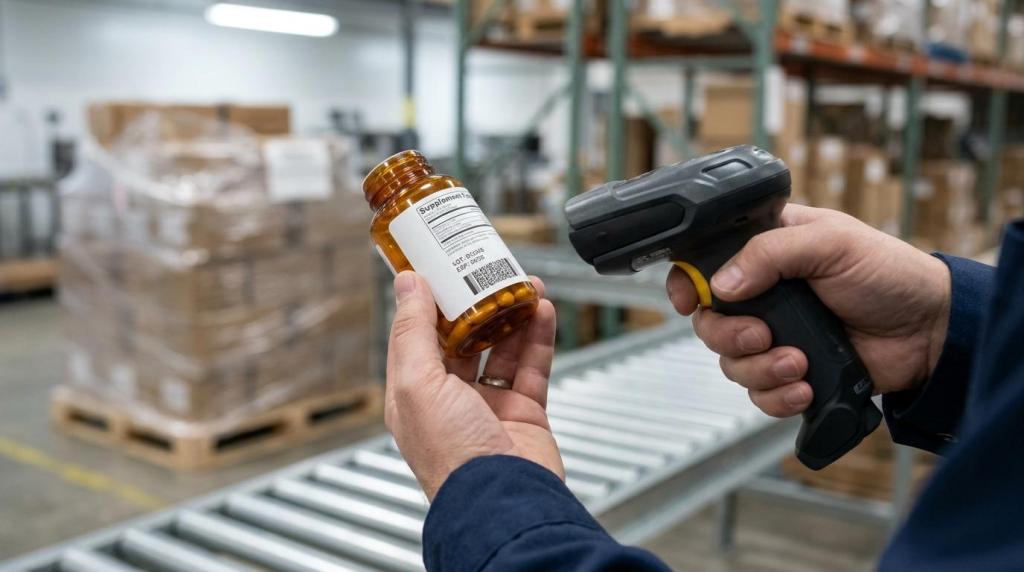
Dietary supplements, including products containing vitamins, may look like standard e-commerce stock, yet the warehouse reality of supplement fulfillment is very different. A bottle of capsules or a sachet box sits inside a food supply chain, not just a parcel network. That means fulfilment has to protect traceability, labelling, product condition and stock rotation at every stage through careful inventory management.
In the UK, the process is shaped by food-law expectations as much as customer service targets. Fast shipping still matters. So do clean pick accuracy, low damage rates and fast dispatch. Still, a supplement operation only works properly when it can also show where stock came from, which batch was sent, when it was dispatched, and what needs to happen if a withdrawal or recall becomes necessary.
Why food supplement fulfilment needs tighter warehouse controls
A normal retail workflow is often built around SKU accuracy, delivery speed and efficient order processing, while a robust food supplement order fulfilment process also prioritises batch traceability, product condition, stock rotation and the careful handling of vitamins. Supplement fulfilment needs more than that. Batch numbers and expiry dates may need to be captured on receipt, stored against stock records and linked to outbound orders. If that chain breaks, stock may still leave the building, but the business loses a level of control that matters when questions arise about safety, shelf life or product identity.
Labelling is part of the picture too. UK rules require food supplements to carry specified particulars before sale, which means fulfilment cannot treat packaging as a minor detail. The operation has to preserve the correct product in the correct pack with the correct label, right through to dispatch and returns, including during any contract packing work. That sounds simple until high order volumes, bundles and multiple similar SKUs start moving through the same site.
A well-run supplement workflow usually depends on a few non-negotiables:
- batch-level stock visibility
- FEFO stock rotation
- intact and accurate labelling
- allergen-aware handling
- recall-ready records
The broad shape of the process is straightforward, but each stage carries a different control point.
| Stage | Operational focus | Why it matters |
|---|---|---|
| Goods-in | Check quantity, condition, SKU, batch and expiry | Stops unidentified or damaged stock entering saleable inventory |
| Storage | Put-away by product type, velocity and shelf-life rules | Protects stock quality and supports FEFO picking |
| Pick and pack | Correct product, quantity and presentation | Preserves label accuracy and order integrity |
| Dispatch | Carrier booking, tracking and shipment confirmation | Links stock movement to customer delivery records |
| Traceability and recall | Supplier, customer and batch records kept up to date | Allows fast withdrawals and recalls if needed |
Goods-in checks and stock intake for food supplements
The process starts long before the first customer order is picked. Goods-in is where supplement stock either enters a controlled system or creates trouble that sits hidden until much later. When pallets or cartons arrive, the receiving team needs to match what is physically present against booking data, purchase records or inbound notifications. Product names, variants, quantities and packaging formats all need to match.
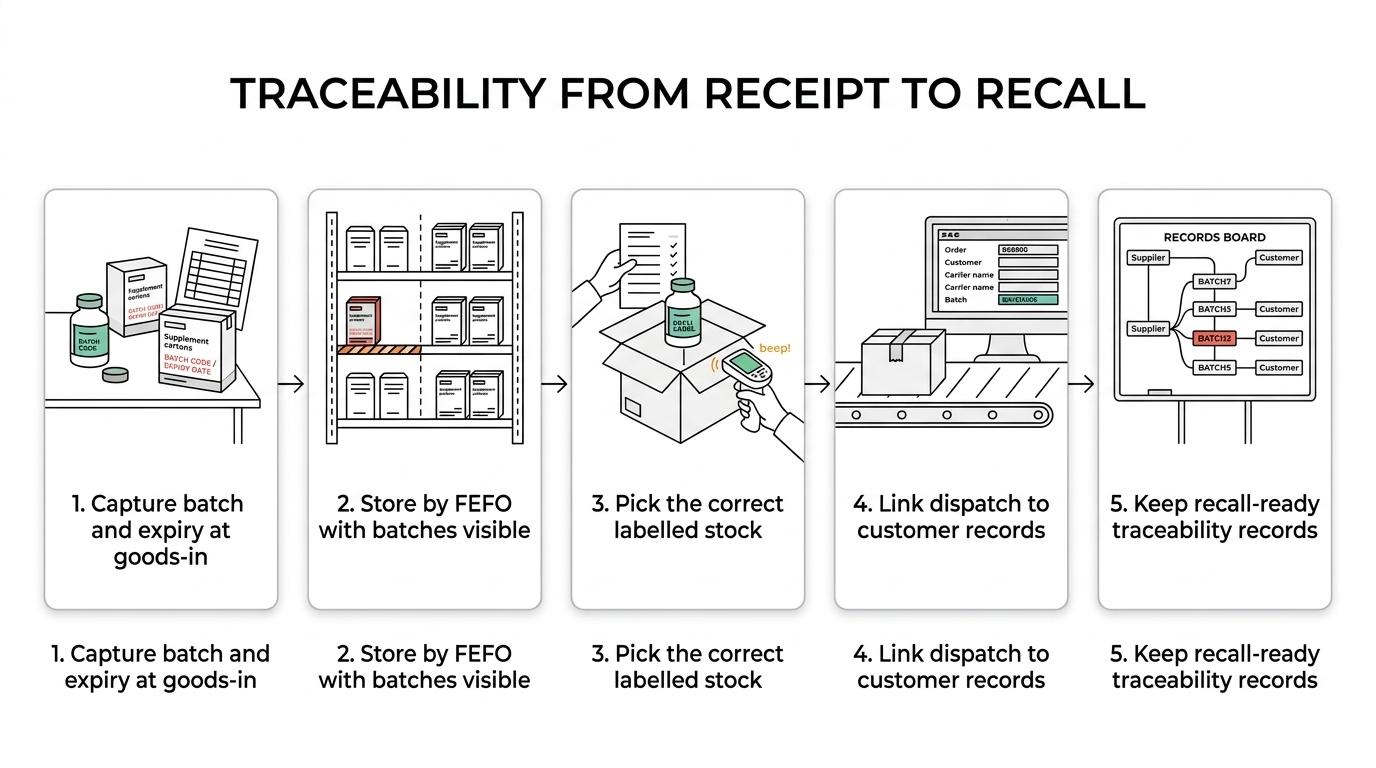
This is also the point where batch and expiry control begins. If the operation records those details only after put-away, errors creep in. Strong supplement fulfilment workflows capture lot or batch data at receipt, along with expiry dates where required, then connect that data to the warehouse record before stock is made available for sale. Any damaged, mislabelled or questionable stock should be held aside in quarantine until reviewed.
A disciplined goods-in routine usually covers the following checks:
- Quantity check: units received are matched to booking or purchase records
- Identity check: SKU, product name, flavour, size or variant is verified
- Batch capture: lot or batch code is recorded against the inbound stock
- Expiry capture: shelf-life data is logged where required for rotation control
- Condition review: packaging, seals and labels are checked before put-away
The value of this stage is not only accuracy. It is confidence. When the first order goes live, the business should already know exactly what entered the building and in what condition.
Batch and expiry control in supplement storage
Once stock is booked in, storage rules determine whether the warehouse can pick it correctly day after day. Supplements often come in a wide mix of formats: tubs, pouches, blister packs, cartons and glass bottles. Some lines, such as popular vitamins, are fast-moving hero products. Others are slower specialist items with shorter remaining shelf life. A generic shelving plan rarely gives the best result.
This is why specialist operators tend to organise storage around SKU velocity, pack size and handling needs. Fast lines go in easy-access pick locations. Fragile products may need more protective placement. Products with similar packaging but different strengths or flavours should be clearly separated to reduce the chance of a wrong pick. Where allergens are relevant, handling procedures need to reflect that risk as well.
FEFO, meaning first-expired, first-out, is often the preferred stock rotation method for supplements. FIFO may keep stock moving in date order, but FEFO is more precise because it prioritises the earliest expiry, not simply the earliest receipt. That matters when multiple deliveries of the same SKU arrive with different shelf lives.
Storage discipline is what turns traceability from theory into a daily habit.
It also supports cleaner exceptions management. If a batch is put on hold, the system should be able to isolate it quickly. If a customer asks for shelf-life criteria on an order, the warehouse should be able to apply that rule before the pick. Those details separate a food-grade fulfilment setup from a standard parcel warehouse and help ensure accurate, compliant order fulfillment.
Pick and pack accuracy for food supplement orders
Picking and shipping are where compliance and customer experience meet. The order must contain the right product, the right quantity and the right batch rotation logic. It must also arrive in packaging that protects the item and preserves its label. A supplement bottle with a crushed carton, a missing sleeve or an obscured batch mark can become a service issue and a compliance concern at the same time.
Many supplement brands also need more than plain unit picking to support e-commerce orders. Certain orders may need inserts, dosage guides, retail-ready presentation, tamper-aware packing, or channel-specific packaging rules. The warehouse therefore needs documented pack instructions, not just a pick list, as part of its logistics process. A clear process reduces the chance of wrong combinations, missing components, returns or presentation failures.
Scanning, barcode checks and pack verification steps are especially useful where products look alike. Magnesium 200 mg and magnesium 400 mg may sit in nearly identical packaging. Vanilla and chocolate protein pouches can be mistaken at speed. Accuracy controls have to be built around those realities, not assumed away.
Label integrity should never be treated as a cosmetic issue. If required particulars are on the label, then protecting that packaging through pick and pack is part of the operational standard. The same applies to any relabelling or over-labelling process. It needs clear approval, accurate content and reliable execution.
Kitting, bundles and recurring supplement orders
Supplements are often sold as systems rather than single lines. Starter kits, goal-based bundles, seasonal promotions and cross-sell packs are common. These offers are commercially attractive because they raise average order value and simplify the customer choice. Operationally, though, they introduce more moving parts.
Bundles add commercial flexibility to ecommerce, but they also multiply the record-keeping.
Each kit can contain several SKUs, each with its own batch and expiry details. If the warehouse assembles kits in advance, the component batches need to be recorded at the point of assembly. If the bundle is built live during order fulfilment, the system still needs to preserve traceability across every included item. The more complex the offer, the more valuable a structured kitting process becomes.
Recurring orders introduce a different discipline. Subscription customers expect consistency, yet the warehouse must still rotate stock correctly and keep records current for each shipment cycle. A repeat order is not a repeat event from a traceability point of view. It is a fresh outbound movement that should be linked to the exact stock sent on that date.
Dispatch tracking, traceability records and recall readiness
Dispatch is more than printing a label and handing over cartons to a carrier; it also includes coordinating shipping details and preserving traceability records. At this stage, the warehouse connects physical stock movement with traceability records. Order number, customer details, quantities, dispatch date, carrier reference and, where relevant, batch information all need to be available in a usable format. If the records are fragmented across emails, spreadsheets and manual notes, response times slow down when a problem appears.
UK food guidance is clear on the wider principle. Food businesses need traceability systems that identify suppliers and business customers, along with product details, quantities and dates. Batch numbers are often part of effective control, especially where withdrawals and recalls may be needed. Records should be up to date and available for inspection.
That matters most when something goes wrong, including managing returns of affected products. If affected stock is still in the supply chain, a withdrawal may be required to stop further distribution. If it has already reached consumers, a recall calls for direct, accurate communication. The product details, batch code, reason for recall and the next step for the customer all need to be clear.
Reliable recall readiness usually rests on four record sets:
- Supplier traceability: who supplied the stock, what was supplied, how much and when
- Customer traceability: which business customer or end customer received the stock
- Product traceability: SKU, batch code, quantity and key dates linked to each movement
- Action records: what was withdrawn or recalled, when communication was issued, and what response followed
Strong dispatch controls also improve everyday service. Tracking links reduce customer contact volume. Export paperwork, if needed, is easier to manage when product data is structured. Claims are easier to investigate when shipment history is easy to retrieve.
What strong supplement fulfilment operations look like
The strongest operations do not treat compliance as a layer placed on top of fulfilment and logistics. They build it into receipt, storage, picking and dispatch from the start. That is why specialist food supplement warehousing often centres on goods-in checks, batch and expiry recording, controlled storage, pick and pack discipline, kitting capability and dispatch tracking in one connected workflow.
When reviewing an internal setup or a third-party provider, practical questions usually reveal the real standard quickly. How are batch numbers captured? Is FEFO active in daily picking? How are holds and quarantines handled? What happens if a label is damaged? Can the warehouse trace stock from supplier receipt to customer shipment without manual reconstruction?
Good supplement fulfilment feels calm because the hard work has already been done in the process design. Orders move quickly, labels stay accurate, batches remain visible, and records are ready when needed. That is what keeps products moving with confidence through the supply chain.