
How Influencer Marketing Can Create Fulfillment Challenges
Influencer marketing can transform an e-commerce brand in a matter of hours, significantly boosting brand awareness. A single creator post, a well-timed product mention, or a viral clip can push a product from steady seller to sudden sensation before the warehouse has even finished the morning pick wave.
That kind of momentum is exciting, but it can also expose challenges and weak points fast. Sales teams may celebrate a spike in demand, while the operations team is already dealing with stock discrepancies, packing bottlenecks, missed cut-offs and a returns queue that grows by the day.
The commercial upside is clear, especially when coupled with effective audience engagement and a focus on maintaining credibility. Industry research has shown how widely brands now use influencer campaigns on social media, and how many consumers buy based on creator recommendations, leveraging social proof to highlight the importance of analyzing marketing effectiveness. What matters for e-commerce leaders is this: demand can arrive in bursts, not smooth curves, and in-house fulfilment operations are often built for the second pattern rather than the first, necessitating strong consumer trust to navigate inconsistencies.
Influencer marketing demand spikes can outpace in-house fulfilment capacity
Most in-house operations are planned around a sensible baseline. There is a normal order volume, a known staffing model, fixed packing benches, routine carrier collections and stock locations arranged for regular throughput. Influencer activity can break that rhythm almost instantly.
One case study from 3PLWOW described a direct-to-consumer brand moving from roughly 4,000 monthly orders to more than 14,000 after sales accelerated through seasonal activity and creator partnerships. Peak days reportedly reached nearly a week’s worth of orders in 24 hours. That type of surge is not just “more orders”. It is a completely different operating environment.
A warehouse team that performs well on ordinary days can still struggle when order volume multiplies without warning. Pick paths become crowded. Packing materials run low. Supervisors shift from managing flow to firefighting. Carrier cut-offs become harder to hit, and once the backlog rolls into the next day, service levels can slip quickly.
The first signs are usually operational rather than strategic, making it crucial to reassess and adapt the underlying strategy accordingly.
- Missed dispatch cut-offs
- Picking queues at popular SKU locations
- Packing stations running at full stretch
- Backlog carried into the next shift
- Customer service inboxes filling with “Where is my order?” messages
A fast-growing brand does not need to fear demand spikes, but it does need fulfilment capacity that can absorb them without losing control.
Stock control problems during creator campaigns can damage margin and trust
High-volume campaigns do not only create a labour problem. They also test stock accuracy and product delivery processes.
Demand does not rise neatly.
An influencer may feature one hero product, but customers often buy linked products, bundles, size variants or complementary items at the same time. If stock files are not current across the website, marketplaces, social shops and warehouse records, a business can end up selling units it cannot physically ship. Research from MIT’s Centre for Transportation and Logistics has pointed to demand-side variables as a major driver of stockout events in e-commerce, which fits the reality many brands see during creator-led promotions.
When this happens, the financial cost is only part of the story. A stockout means cancelled orders, split shipments, refund processing, replacement conversations and avoidable pressure on customer care. It can also mean leftover stock in the wrong variant or format, even while the promoted product disappears.
Several stock control issues appear again and again during influencer campaigns:
- Fast movers: hero SKUs sell through first, while slower variants remain on hand
- Disconnected systems: website, marketplace and warehouse stock figures drift out of sync
- Overflow stock: urgent replenishment arrives without clear slotting or disciplined put-away
- Inventory accuracy: small count errors become major service issues during sharp demand spikes
This is where stronger warehouse management matters. Clean goods-in processes, disciplined cycle counts, accurate location control and live inventory visibility can make the difference between a profitable campaign and an expensive scramble.
Dispatch speed and pick and pack quality often suffer at the same time
A busy warehouse can usually protect either speed or quality for a short period, but challenges arise when trying to protect both.
When influencer demand surges, pressure builds on the pick and pack process first, impacting product delivery schedules. Teams move faster, temporary staff may be added, packing benches become crowded and managers start making trade-offs to clear the queue. Under those conditions, mis-picks, labelling errors and damaged presentation become more likely. If the product is premium, giftable, highly visible on social channels, or frequently discussed on social media, those mistakes can be especially costly, potentially affecting consumer trust by undermining social proof.
The same 3PLWOW case study noted issues after fulfilment was moved in-house, including inconsistent dispatch cut-offs, higher pick and pack errors, overflow stock and slower returns. Those problems are common when a business outgrows the physical setup and process discipline of its internal warehouse.
A specialist fulfilment partner can help here because the operation is built around a strong strategy focusing on throughput, accuracy, and repeatable standards, thereby enhancing brand awareness and marketing effectiveness. A 3PL like 3PLWOW offers a large team trained in order fulfilment and pick and pack to an exceptional standard, alongside stock control and warehouse management processes designed for volume, thereby enhancing the credibility of brand operations.
| Operational area | In-house pressure during influencer spikes | How a 3PL like 3PLWOW can help |
|---|---|---|
| Labour capacity | Fixed team size, overtime pressure, reactive hiring | Larger trained workforce that can absorb higher order volume |
| Pick and pack quality | Error rates rise when speed becomes the priority | Standardised fulfilment processes and trained pick and pack teams |
| Dispatch cut-offs | Backlogs make same-day dispatch harder to maintain | Structured workflows built around carrier deadlines |
| Stock control | Manual checks and poor visibility create oversell risk | Warehouse management discipline and tighter inventory control |
| Warehouse space | Overflow stock blocks picking efficiency | Professional storage layout and location management |
| Returns handling | Slow processing ties up stock and customer refunds | Dedicated returns workflows that keep inventory moving |
The value is not only extra hands. It is the operating method behind those hands.
Influencer marketing forecasting needs campaign data, not just sales history
Forecasting for normal trade is difficult enough. Forecasting for influencer-led demand is a different task.
Trend-driven products often show a sharp initial spike followed by a quick taper. Academic work on volatile retail demand has shown how short-lived promotional events can produce exactly this pattern. Relying on average weekly sales alone can leave a business understocked on the way up and overstocked a week later.
That means e-commerce brands need planning inputs that reflect how influencer campaigns actually work, with a focus on maximizing audience engagement throughout the process. Marketing calendars, creator launch dates, audience fit, promotional windows and replenishment lead times all matter. So do practical warehouse limits, including the number of orders that can be picked, packed and manifested in a single shift.
A stronger forecasting routine often includes:
- Creator launch dates and embargo timings
- Historic conversion by channel and campaign type
- Expected SKU and variant mix
- Replenishment lead times from suppliers
- Daily warehouse throughput limits
- Returns patterns after major promotions
A 3PL relationship can improve this planning cycle because fulfilment teams see demand patterns from an operational angle. That view is useful. It links campaign ambition to stock positions before a promotion goes live.
Returns and customer service pressure can build after the sales spike
The fulfilment challenge does not end when the orders leave the warehouse, as various challenges can arise during the entire process.
Large creator and influencer campaigns often bring in first-time buyers. Some are highly motivated, while others are curious impulse purchasers. That can increase the rate of returns, exchanges, delivery queries and sizing questions after dispatch. If the in-house operation is already stretched by outbound orders, returns processing may fall behind.
Slow returns create a second wave of problems. Refunds take longer, available stock remains trapped in cages or returns bins, and customer service teams have less clarity on what can be resold. In a fast-moving campaign, that delay matters. Returned inventory may be needed for back orders, replacement orders or the next promotional push.
This is another area where warehouse management discipline supports growth. A fulfilment provider with established returns handling can process inbound items faster, update stock records more reliably and reduce the lag between product coming back and becoming available again.
Why third-party fulfilment gives growing brands more room to scale
The strongest case for outsourced fulfilment is flexibility and enhanced credibility.
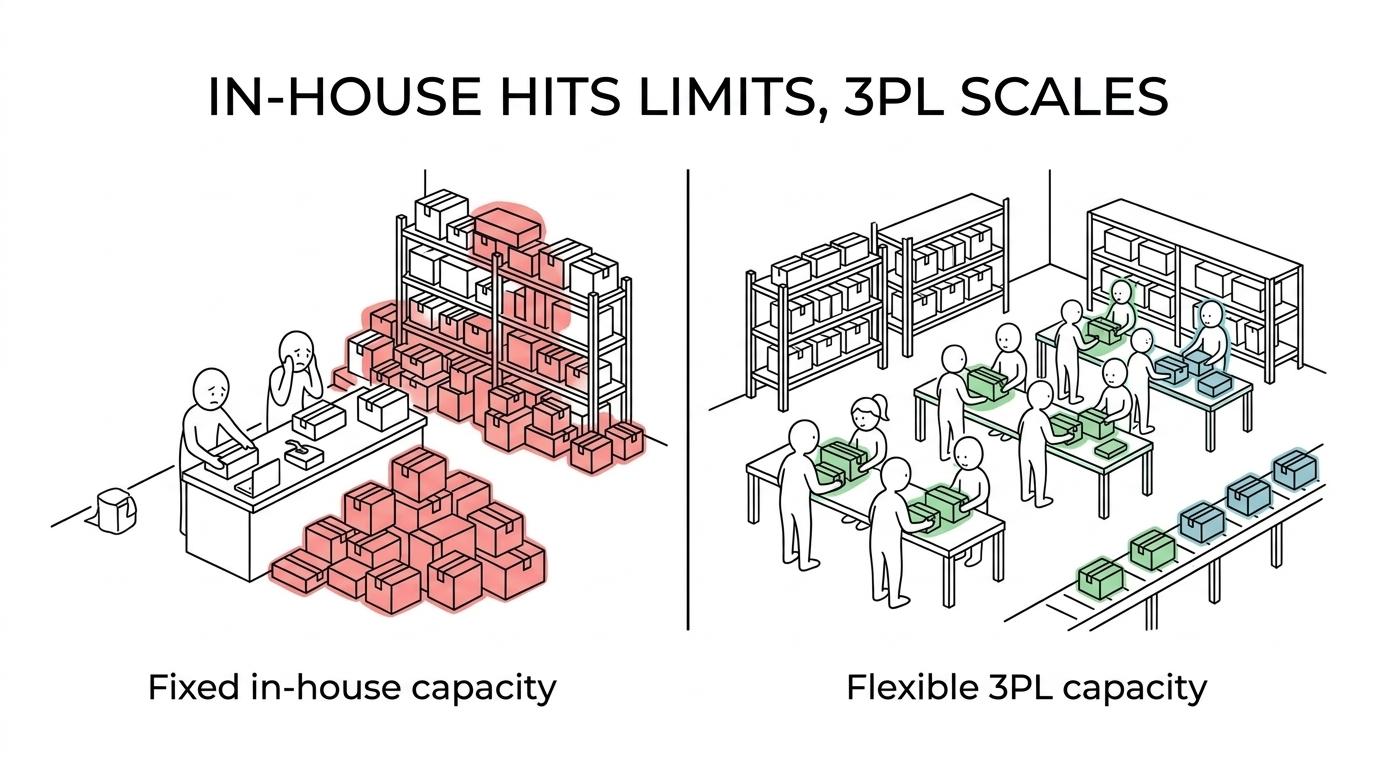
In-house operations are rarely weak because the team lacks commitment. The issue is usually structural. The business has finite space, a limited labour pool, fixed workflows and only so many hours in a day. Influencer marketing can compress a month of commercial activity into a weekend, and the warehouse feels every minute of that compression.
A specialist 3PL brings variable capacity and efficient product delivery. That matters for seasonal campaigns, limited drops and creator partnerships where demand may jump sharply and then settle just as quickly. Instead of hiring, training and reorganising at speed every time a campaign lands, a brand can plug into an operation built for fluctuating order volume.
For a provider like 3PLWOW, the practical support includes a large trained team, strong order fulfilment capability, high pick and pack standards, stock control and warehouse management. Those basics sound simple, yet they are exactly what influencer success tends to test.
There is also a strategic gain in assessing marketing effectiveness. When the warehouse stops consuming management time through daily firefighting, internal teams can focus on product, marketing, retention, and channel growth as part of a broader fulfillment strategy. That shift is often where scale becomes more sustainable.
Building fulfilment processes around creator-led growth
Brands planning bigger influencer campaigns should treat fulfilment as part of the marketing plan, integrating brand awareness efforts, not a task that begins after orders arrive.
That means stock thresholds should be agreed before launch. Product availability needs a single reliable source of truth. Dispatch promises should reflect real warehouse capacity. Campaign teams should know what happens if demand beats forecast by 20 per cent, 50 per cent or more.
A few practical disciplines can change the picture quickly:
- Campaign calendars: shared across marketing, buying, customer service and fulfilment
- Stock buffers: set for top-performing SKUs and key variants
- Cut-off rules: realistic dispatch promises based on actual throughput
- Escalation plans: clear actions when orders exceed forecast
Influencer marketing is at its best on social media when it creates momentum, leverages social proof, and enhances audience engagement that a brand can actually fulfil, building consumer trust along the way. When the warehouse is ready, a sales spike feels like progress rather than pressure. That is why many e-commerce businesses reach a point where specialist fulfilment support is not a luxury, but a sensible next step for growth. A partner like 3PLWOW can give that growth a stronger operational base, with trained staff, disciplined pick and pack, tighter stock control and warehouse management built to cope when creator demand suddenly takes off.