
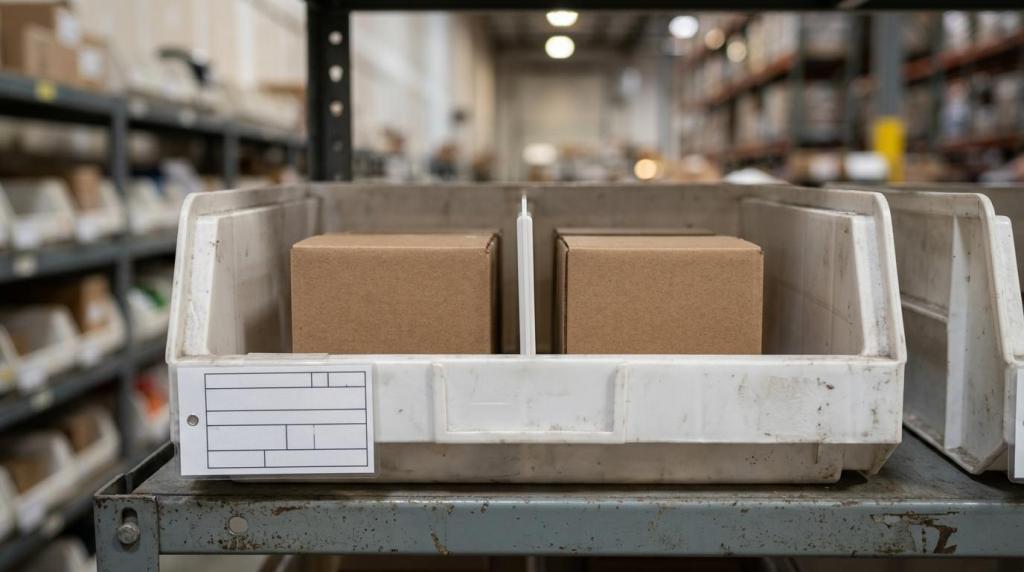
Accuracy in a warehouse rarely comes down to luck, but is often a result of effective inventory control. It is usually the result of structured logistics, discipline, and routines that make every product easy to receive, store, count, pick, and dispatch.
When a warehouse is well organised, the improvement in warehouse efficiency means people spend less time searching, second-guessing, or correcting mistakes. Stock sits in clearly assigned locations, incoming goods are checked properly before putaway, and order pickers follow a logical path through the building. That sounds simple, yet it has a major effect on day-to-day performance.
This matters even more for businesses that handle manual stock counts without barcode scanning. In that setting, physical organisation is not just helpful. It becomes one of the main safeguards against stock discrepancies and fulfilment errors.
Warehouse layout and storage control improve order fulfilment accuracy
A warehouse works best when its layout supports the flow of stock from goods-in to storage, then from storage to picking and dispatch. Research on warehouse operations has long shown that order picking is one of the most labour-intensive and costly activities in warehousing. That means small gains in organisation can create large gains in accuracy and productivity.
Clear layout design reduces confusion. Fast-moving products can be stored in the most accessible areas, slower lines can sit in secondary locations, and bulky or awkward stock can be kept where it can be handled safely. When stock is placed according to a sensible storage plan, pickers are less likely to grab the wrong item or waste time moving through congested aisles.
Storage control matters just as much as layout. A product should not simply be placed wherever there is space. Controlled putaway means each item is assigned to the right location, recorded correctly, and stored in a way that matches its size, turnover, and handling needs. That keeps the physical warehouse aligned with the stock record, which is one of the foundations of accurate fulfilment.
After a warehouse has a sound structure, several operational choices make accuracy more dependable:
- Layout design: clear zones for receiving, storage, picking, packing, and exceptions
- Storage assignment: fixed or controlled locations for each SKU
- Routing methods: logical picker paths that reduce backtracking and missed lines
- Order batching: grouping work in a way that limits congestion and confusion
- Zoning: assigning staff to specific areas so they become familiar with the stock
These choices do more than tidy the building. They remove the small points of friction that often cause wrong picks, duplicate picks, and stock recorded in the wrong place.
Controlled putaway and picking routes reduce order errors
Many warehouse errors begin long before an order is picked. If received stock is checked in poorly, labelled inconsistently, or placed in the wrong location, the picking team inherits a problem that may not be spotted until a customer opens a parcel.
That is why receiving discipline is so important. Quantities should be checked against inbound paperwork, discrepancies should be flagged straight away, and every pallet, carton, or case should be traceable to a product record. Good recordkeeping is not just paperwork. It creates confidence that what the system shows is what is actually on the shelf.
Picking routes also shape accuracy. In a disorganised warehouse, pickers may cross the same aisle several times, search multiple bins for one item, or work around temporary overflow stock left in access routes. Each extra movement adds another chance to make a mistake. A better-organised warehouse creates direct routes, clear bin labels, and enough space for staff to work without interruption.
A simple comparison shows how warehouse organisation changes the result:
| Warehouse activity | Poor organisation | Organised warehouse |
|---|---|---|
| Receiving | Stock checked in late or placed in spare gaps | Stock checked, labelled, and assigned to set locations |
| Putaway | Mixed products in the same area | Clear location control and product separation |
| Picking | Longer walks, more searching, more mis-picks | Shorter routes and easier item identification |
| Packing | More exceptions and order queries | Faster checking and cleaner dispatch flow |
| Manual stock counts | Recounts and unexplained variances | More reliable counts and quicker reconciliation |
When order volumes rise, these differences become even sharper. A warehouse that feels manageable at 50 orders a day can become error-prone at 500 if logistics, stock locations, walkways, inventory control, and pick processes are not tightly controlled, impacting overall warehouse efficiency.
Manual stock counts without barcode scanning need disciplined organisation
Manual stock counting places greater weight on physical order. Without barcode verification, the team relies on location labels, SKU descriptions, packaging recognition, and written count procedures. If any of those elements are inconsistent, count accuracy drops quickly.
The first requirement is location discipline. Every shelf, bay, pallet position, and bin needs a clear identifier. Every product needs a defined home. If staff are allowed to place stock in temporary gaps without updating records, manual counts become slower and less reliable because the count team is never fully sure where to look.
The second requirement is stock separation. Similar items, colour variants, product bundles, and seasonal lines should not be mixed loosely together. Even a skilled team can miscount when products with near-identical packaging sit side by side without clear dividers or labels. Good organisation reduces visual ambiguity, which is vital when counts are done by eye.
The third requirement is count routine. Manual counts are strongest when there is a structured method, not a casual walk-around with a clipboard. Count sheets should reflect the warehouse layout, teams should count by zone, and discrepancies should be reviewed against receiving records, dispatch records, and any recent stock moves.
Before a manual count begins, the warehouse usually benefits from a short preparation stage:
- Tidy pick faces
- Return loose stock to the correct bins
- Isolate damaged goods
- Separate customer returns
- Pause unnecessary stock moves
- Check handwritten location changes
That preparation can save hours later. A neat warehouse is faster to count, easier to reconcile, and less likely to produce unexplained variances.
Better storage solutions improve business performance
Storage solutions are often discussed as a space issue, yet they are just as much an accuracy issue. The right racking, shelving, binning, and pallet layout can make stock easier to identify and easier to protect.
Products that fit the storage method are less likely to be crushed, split, misplaced, or mixed with similar lines.
A business also gains flexibility. When the warehouse has suitable storage for pallets, cartons, pick bins, and oversize goods, stock can be placed where it belongs rather than where there happens to be room. That means fewer temporary workarounds, fewer hidden items, and fewer fulfilment delays.
There is a commercial benefit too. Better storage supports faster order turnaround, cleaner stock visibility, and more confidence in purchasing decisions. If stock records and physical stock stay close together, buying teams can reorder with greater certainty and sales teams can promise availability with less risk.
A well-organised warehouse often supports these logistics outcomes, enhancing overall warehouse efficiency:
- fewer customer complaints
- lower cost from reships and corrections
- stronger stock confidence for manual counts
- faster dispatch during busy periods
- better use of floor space
Those gains build quietly, then become very visible during promotions, peak seasons, and rapid growth.
3PLWOW warehouse organisation benefits for growing brands
For businesses that want stronger warehouse accuracy without building the operation alone, 3PLWOW offers practical advantages tied directly to organisation, inventory control, and control. Its large warehouse space, reported as a 15,000+ pallet order fulfilment facility, gives brands room to store stock properly rather than forcing products into crowded or temporary areas. Space itself does not guarantee accuracy, though the right amount of space makes disciplined storage far easier.
A dedicated and well-trained team is another major benefit. Stock accuracy depends on consistent habits across receiving, counting, checking in, location management, and order fulfilment. When those tasks are looked after by trained staff with clear routines, errors are reduced at the source. This is especially helpful for businesses that rely on manual counting methods, where disciplined handling and location control matter every day.
3PLWOW also brings greater operational capacity for peak seasons and sales surges. That matters because accuracy often slips when order volume jumps and a warehouse becomes crowded, rushed, or overextended. Extra capacity supports cleaner workflows, faster replenishment of pick locations, and steadier dispatch performance when demand rises sharply.
Published figures from 3PLWOW point to the impact that tighter warehouse processes can have. The business reports a case in which monthly order capacity rose from 15,000 to more than 35,000 orders over 90 days, while order accuracy improved from 96.2% to 99.4% and same-day dispatch increased from 71% to 94%. Those numbers reflect what strong organisation can deliver when layout, process discipline, and team execution work together.
For a brand assessing outsourced fulfilment, the practical value can be grouped clearly:
- Large warehouse space: more room for structured storage, cleaner zoning, and less overflow risk
- Trained warehouse staff: careful stock counting, checking in, location management, and accurate picking
- Peak season capacity: support for sales spikes without the usual drop in control
- Operational consistency: repeatable routines for receiving, putaway, fulfilment, and stock checks
This kind of support can be especially useful for growing ecommerce businesses. Rapid growth often exposes weaknesses in storage planning and stock control. A partner with warehouse space, process discipline, and experienced staff can help keep fulfilment accurate while order volumes rise.
Accuracy gains reach customer service, planning, and profitability
Warehouse organisation is often viewed as an internal operations issue, yet the effect reaches far beyond the warehouse floor. Better accuracy in picking means fewer incorrect parcels arriving with customers. Better accuracy in manual stock counts means fewer stockouts caused by record errors. Better storage solutions mean less damaged product and less time lost searching for missing lines.
The customer notices the outcome even if they never see the warehouse. Orders arrive correctly. Dispatch happens when promised. Availability is more reliable. Returns linked to picking errors start to fall.
Finance and planning teams notice it as well. When stock counts are more dependable, purchasing decisions become steadier. When fulfilment mistakes reduce, margin erosion from refunds, reships, and reactive labour starts to ease. A tidy warehouse can have a surprisingly direct effect on profit quality.
That is why warehouse organisation should be treated as a driver of accuracy, not as a background housekeeping task. In order fulfilment, manual stock counts, and day-to-day stock control, the structure of the warehouse shapes the quality of every result that follows.