
UK Ecommerce Growth Trends for 2026
The UK ecommerce market is moving into 2026 with real momentum. Growth is not only visible in consumer demand, but also in the sales forecast and the share of retail spending happening online. For ecommerce brands, that is encouraging news. It also raises the bar. More orders, faster delivery expectations, tighter competition, and sharper service standards now sit side by side.
That matters because growth does not always feel calm when it arrives. A brand can be selling well while operations start to strain in the background. Stock rooms fill up, picking slows down, dispatch cut-off times come under pressure, and customer service teams spend more time fixing avoidable errors.
For many UK ecommerce businesses, 2026 looks like a year where operational strength will decide how much of that market opportunity they can actually convert.
UK ecommerce growth data for 2026
Official data gives a strong starting point. The Office for National Statistics reported that online spending values in Great Britain rose by 3.8% in Q2 2026 compared with Q1 2026, and by 11.7% compared with Q2 2025. In June 2026 alone, online sales values increased by 2.8% against May and by 14.4% year on year.
That is not a marginal shift. It suggests that online demand kept building through the first half of the year, even after several years in which many commentators expected ecommerce to settle into a flatter pattern.
The online share of sales also moved higher. According to the same ONS release, the proportion of online sales rose from 28.9% in May 2026 to 29.4% in June 2026, the highest level since April 2021. When the internet sales ratio rises at the same time as online spending values, it points to more than simple month-to-month noise. It shows online retail is strengthening its position within the wider market, driven by shifts in consumer behavior.
A wider retail view supports that picture. House of Commons Library figures show that retail sales in Great Britain were worth £517 billion in 2024, up 1.4% on 2023. Retail sector economic output reached £114.7 billion in 2024, equal to 4.4% of total UK economic output. The sector also accounted for 2.6 million jobs and 304,560 retail businesses at the start of 2025. Ecommerce growth is happening inside a very large, economically significant market.
| UK retail and ecommerce signal | Latest figure | What it suggests for ecommerce brands |
|---|---|---|
| Q2 2026 online spending growth vs Q1 | 3.8% | Online demand continued to rise through the quarter |
| Q2 2026 online spending growth vs Q2 2025 | 11.7% | Year-on-year growth remained strong |
| June 2026 online sales growth vs May | 2.8% | Monthly momentum stayed positive |
| June 2026 online sales growth vs June 2025 | 14.4% | Online retail outpaced a flat-growth narrative |
| Online sales share in June 2026 | 29.4% | Online channels took a larger slice of retail spend |
| Great Britain retail sales value in 2024 | £517bn | Ecommerce is growing within a large addressable market |
Key UK ecommerce growth trends shaping 2026
One clear trend is that online retail growth is becoming more quality-sensitive, requiring thorough analysis to identify consumer expectations. It is not enough to generate traffic and convert orders; enhancing the shopping experience is equally crucial. Brands also need reliable stock accuracy, fast dispatch, clear delivery communication, and returns handling that does not damage margin. Consumers have become used to speed, but they also expect consistency.
A second trend is that fulfilment is becoming a board-level issue for growing brands. Marketing can create demand very quickly. Operations often need longer to catch up. That gap is where many scaling problems start.
A third trend is channel complexity. Many UK ecommerce businesses are no longer relying on a single web shop. They are selling through their own site, marketplaces, social channels, and sometimes wholesale or retail partnerships as well. Each route brings a slightly different order profile, pack requirement, cut-off time, and stock allocation challenge.
Then there is seasonality. Peak periods have always mattered, yet promotions now appear across more of the calendar. Flash offers, payday spikes, influencer campaigns, and product launches can create sudden surges that feel like mini-peak events.
These pressures often show up in a familiar pattern:
- Rising order volumes
- Tighter customer delivery expectations
- Greater stock visibility demands
- More SKU complexity
- Higher returns handling workloads
Why fulfilment capacity matters in UK ecommerce growth
When order volume rises faster than fulfilment capacity, growth can start to work against a business. Picking accuracy slips. Packing benches become congested. Temporary labour is added, but training gaps create mistakes. Warehouse space becomes fragmented, and stock is stored wherever it will fit rather than where it can be moved efficiently.
That is why 2026 growth should not be read only through a sales lens. The stronger online numbers from the ONS are also a signal about back-end pressure. If more spend is shifting online, more brands will hit the point where in-house fulfilment stops being the best use of management time, warehouse space, or working capital.
A 2026 case study offers a practical example. It reported that a direct-to-consumer brand had grown from roughly 4,000 monthly orders to more than 14,000 before moving to outsourced fulfilment. Within 90 days of switching, monthly order capacity rose from 15,000 to more than 35,000. The same case study stated that order accuracy improved from 96.2% to 99.4%, while same-day dispatch increased from 71% to 94%.
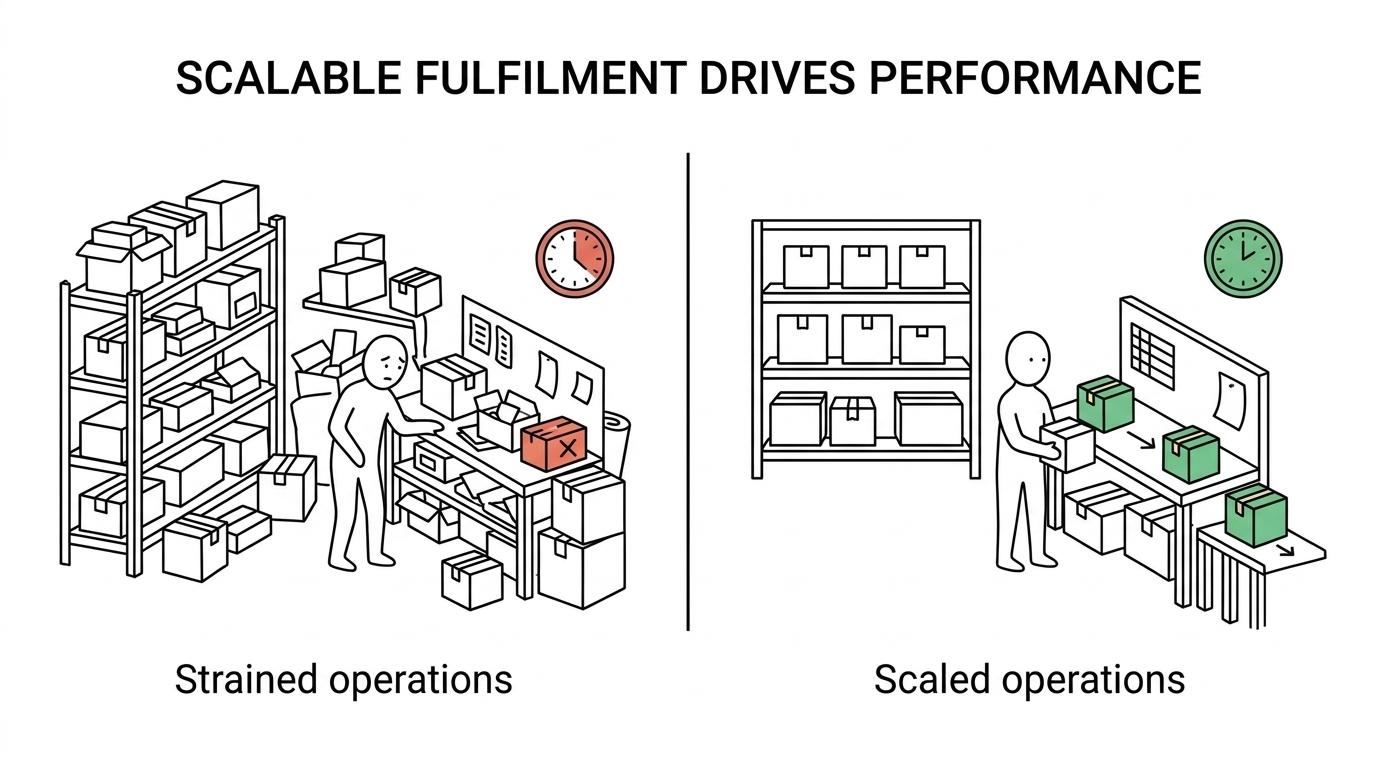
Those numbers are striking because they point to a simple truth: sales growth is only valuable when operations can keep pace.
There are a few signs that a growing ecommerce business may be reaching that point, as indicated by the sales forecast:
- Late dispatches: cut-off times start slipping during busy periods
- Space pressure: more stock arrives than the warehouse can handle comfortably
- Error rates: pick mistakes, wrong items, or missing items appear more often
- Management drag: founders and senior staff spend too much time fixing fulfilment problems
- Peak anxiety: promotions feel risky because operations may not cope
How 3PLWOW supports ecommerce order fulfilment growth
For brands facing those signals, outsourced fulfilment can shift operations from reactive to planned. 3PLWOW supports ecommerce businesses with order fulfilment services designed around actual trading patterns, product mix, and growth stage, rather than forcing every client into the same model.
That tailored approach matters. A cosmetics brand, a subscription business, a fashion retailer, and a consumer electronics seller may all have very different requirements. One might need careful batch control. Another may need kitting, inserts, or gift packaging. A third may need high-SKU storage with rapid daily dispatch. Good fulfilment support should adapt to those realities.
Order fulfilment support usually starts with the essentials: receiving inbound stock, storing it efficiently, managing inventory, picking and packing orders accurately, and dispatching them against agreed service levels. The real value comes when those tasks are done in a way that gives the brand room to keep growing without rebuilding operations every few months.
It also helps protect focus. When fulfilment is stable, ecommerce teams can give more attention to product development, customer acquisition, retention, and margin improvement.
3PLWOW pick and pack services for speed and accuracy
Pick and pack performance, including detailed analysis, has a direct effect on customer experience, and consequently, on the overall shopping experience. Fast websites and strong advertising do not compensate for the wrong item arriving late. In 2026, that part of the operation is no longer back-office detail. It is visible to the customer and tied closely to repeat purchase behaviour, which is an essential aspect of understanding consumer behavior.
3PLWOW’s pick and pack services can support growing businesses by building process discipline into daily order handling. That includes accurate order picking, suitable packaging choices, and faster movement from order placement to dispatch. For brands handling a rising number of SKUs, bundles, or promotional inserts, a structured pick and pack operation can reduce error rates and improve consistency at scale.
This is especially valuable during peaks, when small inefficiencies become expensive very quickly.
3PLWOW warehousing services for stock control and flexibility
Warehousing is often where growth friction first appears, highlighting the importance of thorough analysis and a reliable sales forecast. A business may have enough sales demand, but not enough organised space to receive stock properly, store it logically, and move it through the operation without delays. Overflow areas become normal. Replenishment becomes manual. Stock counts take longer. Accuracy weakens.
A specialist warehousing service can remove that bottleneck. With 3PLWOW, growing ecommerce businesses can access warehousing support without taking on the full cost and complexity of managing extra space themselves. That can be attractive for brands that want room to scale but do not want to commit too early to larger premises, extra equipment, or permanent warehouse staffing.
Flexible warehousing also helps when stock profiles and consumer behavior change during the year. Launch periods, peak retail events, and seasonal ranges all affect how much space is needed and how quickly stock must move.
That kind of support can help brands manage:
- Inbound stock receipts
- SKU organisation
- Faster replenishment to picking locations
- Space for peak trading periods
- Better stock accuracy
Tailored fulfilment services for different ecommerce business models
No two ecommerce growth stories look exactly the same. Some businesses are dealing with steady month-on-month increases. Others see sharp spikes after media coverage, paid social campaigns, or marketplace wins. Some need standard single-item picking. Others need subscription builds, bundles, inserts, or branded packaging.
Tailored fulfilment support should reflect those differences. It can include storage arrangements suited to stock profile, pick methods matched to order volume, service levels based on dispatch promises, and warehousing capacity that can expand when demand rises.
For ecommerce businesses in the UK, that flexibility can be commercially useful in several ways:
- Cost control: avoid investing too early in extra fixed warehouse overheads
- Service quality: keep dispatch performance high as order volume grows
- Scalability: build room for promotions, seasonality, and channel expansion
- Operational focus: free internal teams to work on sales, brand, and customer growth
What strong ecommerce operations look like in 2026
The most successful ecommerce businesses in 2026 are unlikely to be the ones that only chase top-line growth. They are more likely to be the ones that pair demand generation with operational control. They know their stock position. They can dispatch reliably. They can cope with busy days without service quality dropping.
That is where fulfilment partners can make a serious difference. With UK online spending values rising and the online share of retail climbing again, many brands will need more than warehouse space to enhance their shopping experience. They will need a fulfilment setup that is accurate, flexible, and ready for higher order volumes.
3PLWOW’s focus on order fulfilment, pick and pack, and warehousing services fits that need well. For a growing ecommerce business, the right support can turn fulfilment from a limit on expansion into a platform for it.