

Home Storage vs Warehouse Storage
For many ecommerce businesses, stock storage starts in the most practical place available: home. A spare room, garage, loft, or even a hallway cupboard can feel like a sensible way to keep costs low while orders are still manageable. In the earliest stage, that approach can work well enough.
The challenge appears when a business stops behaving like a side project and starts operating like a growing retail operation.
What home storage means for a small ecommerce business
Home storage usually means keeping saleable stock at a residential address and handling all related tasks there as well. That includes receiving deliveries, checking quantities, storing products, picking orders, packing parcels, printing labels, and arranging collections or drop-offs. For very small volumes, it can maintain efficiency because everything is close at hand and there is full visibility over every item.
This setup is often attractive because the upfront cost appears low. There may be no warehouse rent, no pallet fees, and no need to commit to a longer-term logistics arrangement. If a business has a narrow product range and only a modest number of weekly orders, home storage can act as a short-term solution.
The pressure points begin to show when stock levels rise. Shelves fill up, packaging materials spread into living space, and the line between home life and business operations becomes blurred. Time is then spent searching for items, moving boxes around, and reacting to stock issues instead of focusing on sales, marketing, product development, or customer retention.
Home storage tends to fit best when a business has:
- low order volume
- limited SKU count
- stable stock levels
- minimal packaging complexity
- no immediate need for rapid scale
The practical limits of home storage for ecommerce growth
A home environment is rarely designed for structured inventory control. Products may be stacked wherever space is available rather than stored by bin location, shelf code, or batch reference. That makes it harder to keep stock records accurate and easier to oversell, misplace items, or reorder too late.
Security is another clear difference. Residential storage may rely on standard locks and general household precautions. A warehouse, by contrast, is built around stock protection. Industry guidance on warehouse management points to secure storage, accurate inventory tracking, and timely order fulfilment as core functions of warehouse operations. Those are not minor operational details. They affect customer experience, profitability, and brand trust.
There is also the cost that many founders miss at first: time. Storage decisions are not only about rent or space. They also involve staff time, labour cost, and the overhead of running the storage area. Even a low-cost home setup can become expensive when the founder spends hours each day picking, packing, and correcting stock errors.
How warehouse storage supports business operations at scale
Warehouse storage is not simply “more space”. It is an operating model built for receiving goods, storing them properly, tracking them accurately, and dispatching them efficiently. That matters when an ecommerce business begins processing stock at scale or shipping directly to customers every day.
A structured warehouse operation normally includes inventory systems that track products from receipt to dispatch. Modern warehouse management systems can support barcode scanning, RFID labelling, and links with transport or business software. The practical result is simple: better visibility, fewer errors, and faster handling.
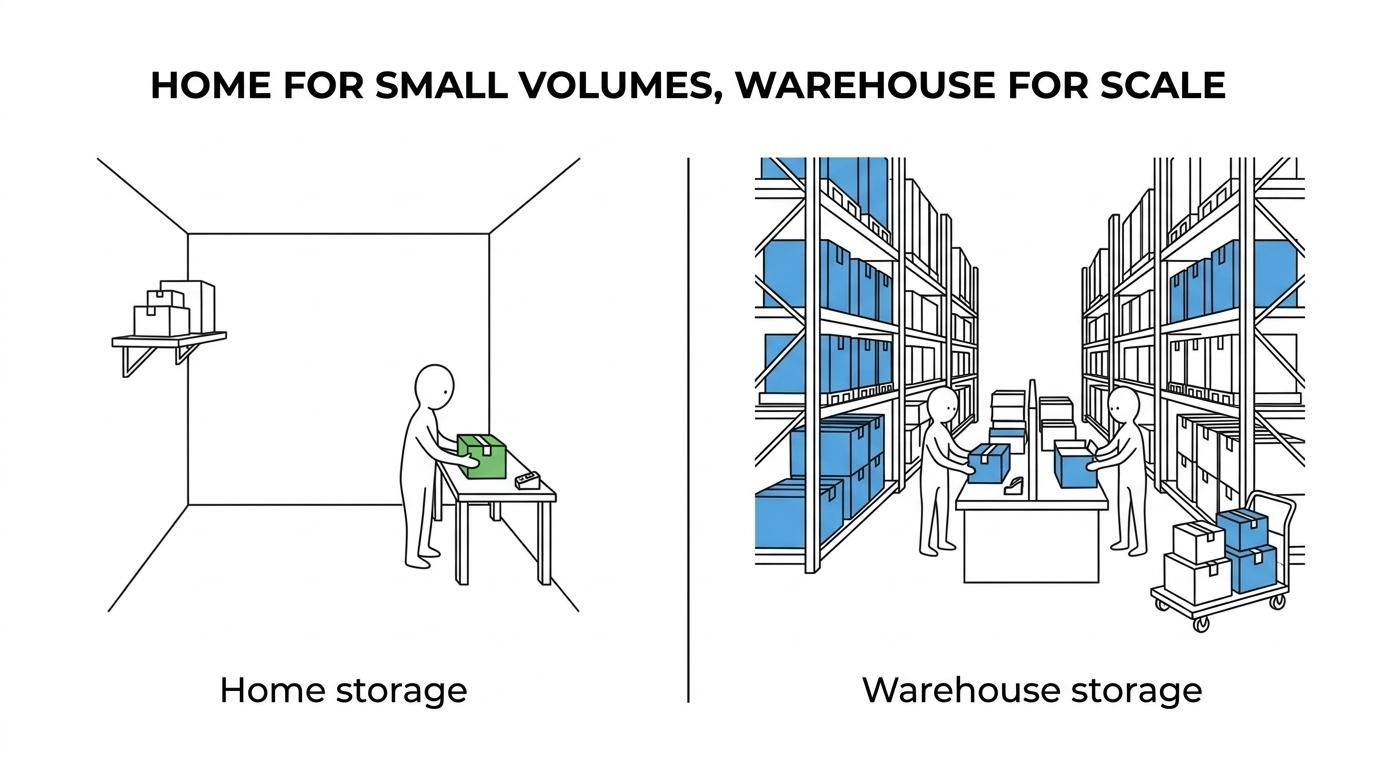
A warehouse also makes fulfilment easier to standardise through effective space optimisation and better organisation. Goods can be placed in defined locations, reorder points can be monitored, and packing workflows can be organised around speed and accuracy rather than convenience. That creates a stronger base for growth, seasonal peaks, promotions, and new product launches.
Warehouse storage typically brings four immediate operational gains:
- Inventory control: clearer stock counts, location tracking, and reduced risk of overselling
- Security measures: controlled access, monitoring systems, and safer storage conditions
- Fulfilment speed: a process designed for daily picking, packing, and dispatch
- Scalability: room for more SKUs, more stock, and more outbound orders
Home storage vs warehouse storage comparison for ecommerce brands
The difference becomes easier to see when both options are compared side by side.
| Area | Home storage | Warehouse storage |
|---|---|---|
| Space | Limited to domestic rooms, garage, loft, or outbuildings | Built for stock holding, shelving, pallets, and operational flow |
| Stock control | Often manual or partly manual | Usually system-led with organised receiving and dispatch |
| Security | Household security only in many cases | Access control, surveillance, and fire-prevention measures are common |
| Order volume | Best for low and steady volume | Better suited to rising or fluctuating demand |
| Professional fulfilment | Usually handled by owner or small internal team | Can be handled by trained warehouse staff |
| Growth capacity | Restricted by physical home space and time | Designed to support scaling sales |
| Work-life split | Business can take over living space | Business stock and operations remain off-site |
| Customer service impact | Slower dispatch or occasional mistakes can become more likely | Faster, more consistent service is easier to maintain |
That table captures an important truth. Home storage is often a workaround. Warehouse storage is a system.
Why warehouse storage is usually the better option for a growing ecommerce business
A growing ecommerce business needs more than somewhere to stack boxes. It needs reliability. Stock must be available when customers buy, visible when teams check inventory, and easy to access when orders need to go out quickly.
Warehouse storage supports that reliability because it is tied to fulfilment capability and operational efficiency. Stock can be received in larger shipments, stored in a more structured way, and picked with greater consistency. This reduces the friction that appears when order numbers rise from a few per day to dozens or hundreds.
There is also a customer-facing benefit. Faster dispatch and fewer fulfilment mistakes can improve reviews, reduce support tickets, and strengthen repeat purchase rates. Those outcomes are commercially valuable. A missed item in a parcel is not just a packing error. It can lead to refunds, replacement costs, and lost confidence.
Growth also tends to bring complexity rather than just volume. A business may add bundles, fragile products, branded inserts, subscription orders, marketplace sales, or international shipping requirements. Home storage often struggles at that stage because the process depends too heavily on memory and manual effort. Warehouse storage gives the business a stronger operating base, which is exactly what scaling requires.
How a 3PL provider like 3PLWOW can handle warehouse storage and fulfilment
A third-party logistics provider offers a practical route into warehouse storage without requiring a business to open and run its own facility. Instead of leasing space, hiring warehouse staff, setting up systems, and managing dispatch in-house, the ecommerce brand places those operations with a specialist partner.
That model is attractive because storage and fulfilment sit together. A provider like 3PLWOW can supply warehouse storage solutions, Order Fulfillment, and Pick and Pack Services through a large team of trained staff. Rather than treating storage as a passive service, the warehouse, with its emphasis on space optimisation, becomes part of the daily sales operation.
3PLWOW states that its warehouse has more than 30,000 square feet of storage space. It also states that the facility uses 24/7 surveillance, access controls for authorised personnel, and fire-prevention systems. Those details matter because they address the exact areas where home storage is weakest: capacity, stock protection, and professional handling.
The service picture becomes even stronger when fulfilment is included. If storage is in the same place as the pick and pack operation, orders can move from inventory to dispatch without extra handling stages. That is especially useful for ecommerce businesses aiming to keep delivery performance consistent as volume rises.
A 3PL arrangement can cover several needs at once:
- Warehouse storage: stock held in a purpose-built facility rather than a domestic space, allowing for effective space optimisation.
- Order Fulfillment: orders processed and dispatched by an operational team
- Pick and Pack Services: individual items selected, packed, and prepared for shipment
- Labour capacity: a larger trained staff base to support daily volume and peak periods
Cost, control and the real value of outsourced warehouse storage
Some businesses hesitate because home storage appears cheaper on paper. That is understandable. Yet the visible cost is only part of the picture. A founder’s time has value. So does the risk of poor stock counts, slow dispatch, and avoidable fulfilment errors.
When a warehouse partner already has the infrastructure in place, the cost of access can be more approachable than expected. 3PLWOW states that storage starts from £2.00 per week, pick and pack starts from £0.40 per order, and next-day delivery starts from £2.00. Exact suitability depends on stock profile and order pattern, though these figures show how outsourced logistics can be structured in a way that supports smaller brands as well as larger ones.
Control is often raised as an objection too. Many founders feel safer when stock is physically close to them. Yet real control is not only about proximity. It is about visibility, process, and dependable execution. A well-run warehouse with clear inventory records often gives a business more control than piles of cartons in a spare room ever could.
Signs it is time to move from home storage to warehouse storage
The tipping point is rarely dramatic. More often, the signs build gradually until the current setup is clearly holding the business back.
A business or organisation may be ready for warehouse storage when stock starts taking over living space, dispatch runs late because packing takes too long, or incoming deliveries become difficult to receive and organise, affecting overall efficiency. Another common sign is when promotions or seasonal spikes create operational strain that a home setup cannot absorb.
There is also a strategic signal. If the owner is spending too much time on manual fulfilment, growth work gets delayed. Marketing campaigns, supplier negotiation, merchandising, customer retention, and product range planning all compete with parcel packing. That is usually the moment when logistics stops being a background task and becomes a real barrier.
Useful triggers to watch for include:
- regular stock discrepancies
- repeated packing delays
- rising order volume week by week
- lack of space for incoming shipments
- more customer queries about dispatch times
- plans to add new sales channels
Choosing the right storage model for the next stage of growth
The right storage choice depends on order volume, product type, space pressure, labour needs, and growth plans. A low-volume startup with a narrow catalogue may still be perfectly fine using home storage for a while. There is no need to rush into a warehouse before the numbers justify it.
Once growth begins, though, the case for warehouse storage becomes much stronger. It provides structure, security, inventory control, and room to scale. With a 3PL provider like 3PLWOW, that storage can sit alongside Order Fulfillment and Pick and Pack Services, supported by a large trained team and warehouse processes built for daily ecommerce operations.
For a business that wants to move from improvised storage to a more professional fulfilment model, that shift can free up space, protect stock, and give the brand a firmer platform for the sales growth it is working towards.