
Why Supplement Brands Need Accurate Inventory
Inventory accuracy rarely gets the same attention as branding, product formulation, or paid acquisition. Yet for a supplement ecommerce business, it sits underneath all three, demanding a robust strategy to ensure accuracy and align inventory with market demand. If stock figures are wrong, a fast-growing brand can oversell a best seller, under-order a core line, dispatch the wrong batch, or leave ageing units sitting in the warehouse while newer stock goes out first.
That is why accurate inventory management is not just an operations metric. It is a commercial control, a compliance tool, and a protection for customer trust.
Accurate inventory supports supplement compliance and traceability
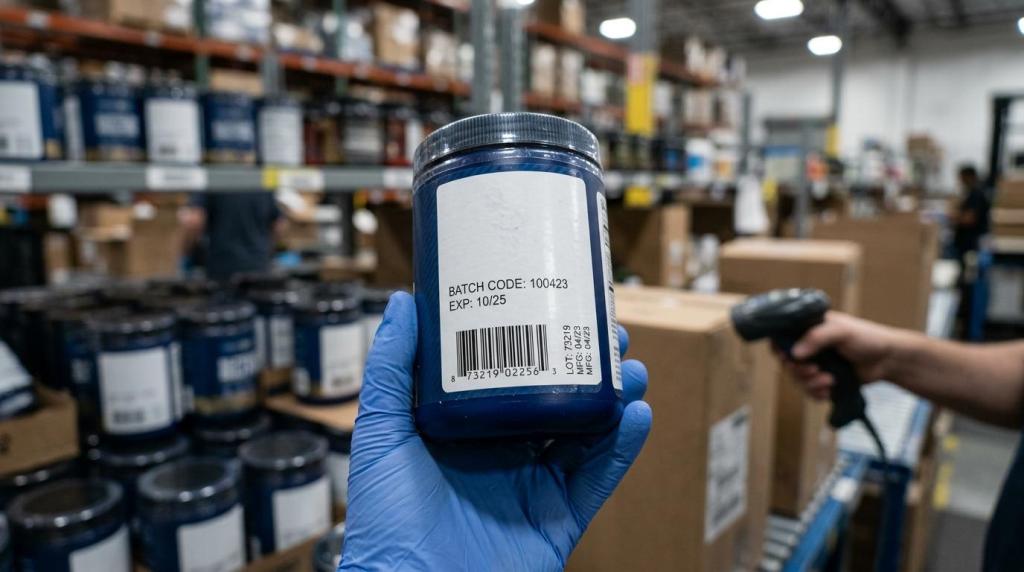
Supplements carry extra operational pressure because stock is not just stock. Each unit may need to be linked to a batch, lot, or control number, an expiry date, and a record of where it moved through the supply chain. That matters for routine quality control, and it matters even more if a brand ever needs to isolate an issue quickly.
FDA dietary supplement CGMP guidance makes this point clearly. The guidance states that a batch, lot, or control number is one way to satisfy the requirement to determine the complete manufacturing history and control of a dietary supplement through distribution. It also states that reserve samples of packaged and labelled supplements must be identified with the relevant batch, lot, or control number.
That changes what stock control needs to do.
A supplement inventory system should not only tell you how many tubs, pouches, or blister packs are on the shelf, but also incorporate forecasting to predict future stock needs accurately. It should also tell you which batch is where, what expires first, and which orders were fulfilled from which stock pool. If a quality question appears, speed matters. Brands do not want staff searching spreadsheets, inboxes, and warehouse notes to piece together what happened.
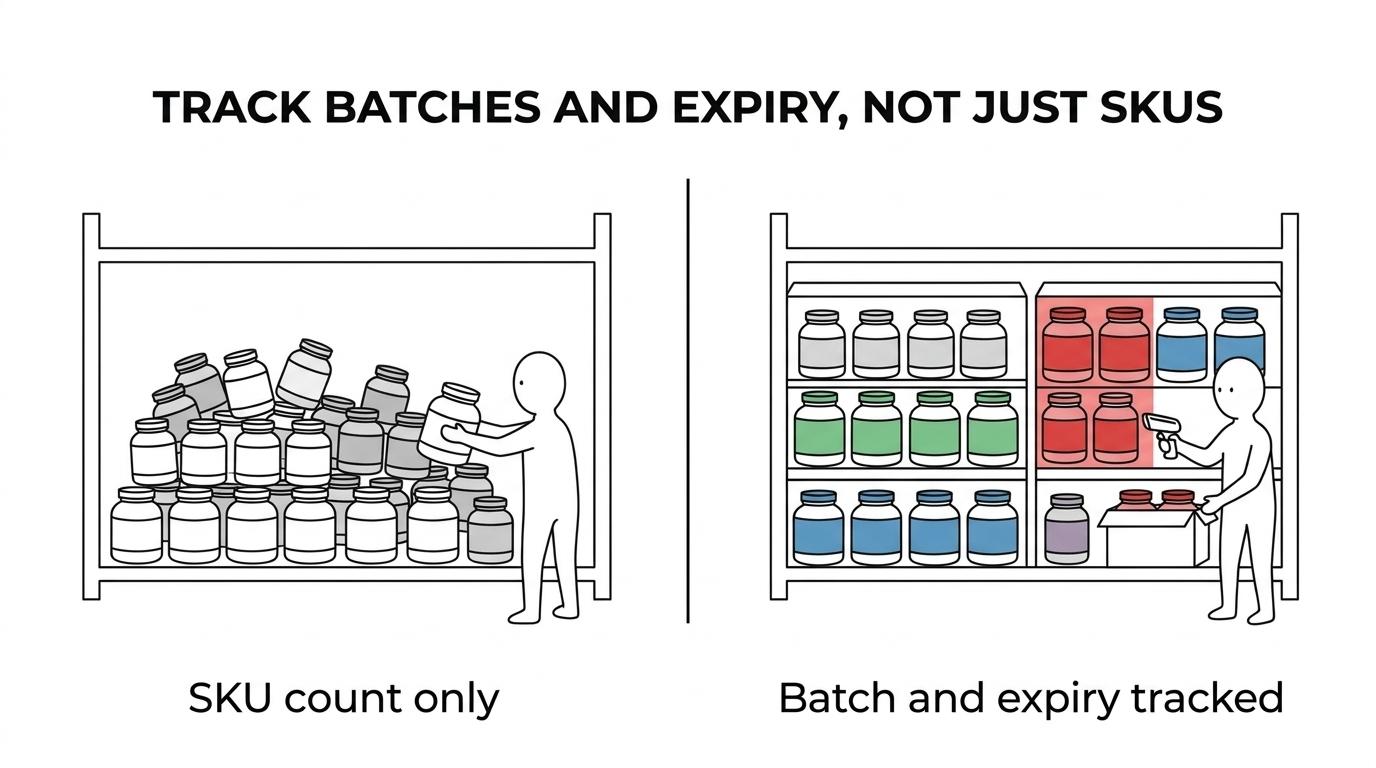
After that baseline, stock levels and expiry management become another serious issue. The FDA guidance does not require an expiration date on a dietary supplement, but if a date is placed on the label, that date must be supported by data. So once a date exists, inventory records need to respect it. A business cannot treat dated stock as generic inventory and hope the warehouse sorts it out later.
A reliable setup usually needs a few things working together:
- Batch traceability: stock linked to the correct batch, lot, or control number
- Expiry visibility: dated stock monitored from receipt to dispatch
- Reserve sample identification: retained samples connected to the right production records
- Distribution history: a clear record of where each batch went
Even for brands based in the UK, these standards matter. Many supplement businesses sell across borders, work with contract manufacturers, or plan to enter the US market later. Building clean inventory discipline early makes future growth much easier.
Stock accuracy protects revenue and customer trust
There is a simple commercial truth here. If the website says a product is available, but the product availability is inaccurate and it is not, money is lost twice. The first loss is the missed order. The second is the cost of acquiring that shopper in the first place.
Broader consumer-goods data shows how expensive poor availability can become. McKinsey has estimated that the US food retail sector loses around $15 billion to $20 billion each year because items are out of stock or otherwise unsaleable, roughly 2% to 3% of total sales. NielsenIQ has also reported major sales losses tied to weak on-shelf availability. Those figures are not supplement-specific, but the lesson carries across neatly: when stock is missing, revenue leaks quickly.
For supplement brands, the damage can be sharper because repeat purchase behaviour matters so much. Customers who rely on a magnesium blend, probiotic, collagen powder, or sleep aid often expect continuity. If a subscription renewal fails or a core SKU goes out of stock during a promotion, the customer may not wait patiently. They may switch brands.
Common outcomes of inaccurate stock records include:
- Overselling fast-moving SKUs
- Paid traffic sent to unavailable products due to inadequate product availability tracking
- Subscription failures
- Split shipments and higher fulfilment costs
- Customer service pressure stemming from inaccurate stock levels
- Lower repeat purchase rates
There is also the trust issue. Supplements are intimate products. People take them daily and often build routines around them. A brand that repeatedly cancels lines, ships substitutions, or delays dispatch can weaken confidence far faster than it would in many other retail categories.
Expiry tracking and FEFO matter more for supplement inventory
Many supplement products are shelf-stable, though that does not mean shelf life can be treated casually. Gummies can be heat-sensitive. Softgels may need careful handling. Powders can arrive in multiple production batches with different remaining shelf life. Functional drinks, sachets, and specialist formulations may have tighter dating windows than a standard vitamin tablet.
That is why expiry-aware stock rotation matters. A warehouse can be highly organised on paper and still create waste if operatives keep reaching for the nearest pallet rather than the stock that expires first. Good supplement fulfilment usually relies on first expiry, first out. This helps move the right stock at the right time and reduces the risk of older inventory being forgotten.
3PLWOW states that supplement fulfilment needs to implement a strategy to manage inventory management, short shelf-life pressures, batch-sensitive inventory, market demand, and forecasting packaging requirements without slowing the customer experience. It also highlights batch and expiry tracking as a way to protect traceability and stock accuracy, with FEFO workflows helping reduce waste.
The difference between generic stock control and supplement-ready stock control is easy to see:
| Area | Basic ecommerce inventory | Supplement-ready inventory |
|---|---|---|
| Stock visibility | SKU-level quantity only | SKU, batch, lot, expiry, location |
| Stock rotation | First in, first out or manual picking | FEFO with expiry-based logic |
| Recall readiness | Slow, manual record checks | Batch-level isolation and reporting |
| Product dating | Often tracked outside the system | Integrated with receiving and dispatch |
| Quality control | Limited link to reserve samples | Records support batch investigation |
| Waste control | Aged stock spotted late | Expiry risk visible earlier |
This is where many growing brands get caught out. A simple inventory app may be enough at launch, but once batch complexity grows, the cost of manual work rises quickly.
Accurate inventory improves recall readiness
No supplement brand wants to think about recalls, quality holds, or customer complaints tied to a specific batch. Still, a serious operation plans for that possibility well before it happens.
If a customer reports an issue, the first questions are immediate: which batch was involved, how many units remain, where were they stored, and which customers received the same batch? If the answer depends on handwritten notes or disconnected systems, response time slows at exactly the wrong moment.
Regulated supply chains keep moving towards faster traceability expectations. GS1 US has noted that certain FDA traceability requirements for listed foods require the full traceability dataset needed to support a recall to be available to the FDA within 24 hours. Supplements are not the same category, but that benchmark shows how quickly regulators and supply chain partners may expect records to be produced when risk is involved.
Accurate inventory gives a brand a fighting chance to act with confidence instead of scrambling.
How a 3PL can improve supplement inventory accuracy
A strong third-party logistics provider can take inventory accuracy and stock levels from a manual admin task to a disciplined warehouse process. That shift matters because accuracy is usually won on the warehouse floor, not in the monthly reporting pack.
A capable 3PL will receive stock against clear records, store it by batch and expiry, maintain system accuracy through scanning and checks, rotate stock correctly, and feed reliable availability data back into the ecommerce stack. When this works well, marketing, customer service, finance, and operations all make better decisions from the same numbers.
For supplement brands, the most useful 3PL support often includes:
- Receiving controls: booking in stock by SKU, batch, and expiry
- Warehouse logic: location control that stops mixed or mislabelled stock from drifting
- FEFO dispatch: the system guides pickers to the stock that should ship first
- Cycle counts: regular checks that catch errors before they become customer-facing problems
- Returns handling: inspected stock flows that protect resale rules and traceability
3PLWOW positions its supplement fulfilment service around these operational needs, including batch and expiry tracking and FEFO workflows. For a brand that has outgrown basic self-fulfilment, that kind of structure can remove a lot of silent risk.
There is also a scaling benefit. In a published case study, 3PLWOW reports monthly order capacity rising from 15,000 to more than 35,000 within 90 days after outsourcing. The same case study reports order accuracy improving from 96.2% to 99.4%, with same-day dispatch moving from 71% to 94%. Those figures are specific to that published example, yet they show the direction of travel a better fulfilment system can create.
That matters because inventory accuracy is tied to service quality. A business cannot hit strong dispatch performance consistently if stock records are unreliable. Pickers waste time checking shelves, support teams chase missing items, and managers start making purchasing decisions from distorted data.
What supplement brands should expect from an inventory system
The best inventory setup for supplements is not simply one that counts product, but also ensures product availability. It should support how supplements are actually sold, regulated, and replenished.
A brand should expect real-time stock visibility across channels, batch-level records, expiry tracking, FEFO picking, usable reporting, and a clean process for quarantined or non-saleable stock. It should also expect integration with storefronts and marketplaces, so online availability reflects what the warehouse can genuinely ship.
One practical test is this: if a brand manager asks, “How many units of batch X are available, how many are already committed to orders, and which orders received batch Y last week?”, the answer should be quick and reliable.
Another test is more commercial. If a paid campaign doubles demand on a hero SKU, the system should help the team see depletion risk early enough to reorder, throttle spend, or shift focus before the product drops out of stock.
Why accurate inventory becomes a growth advantage
At the early stage, inventory strategy often feels like a back-office issue, yet understanding market demand and incorporating forecasting, alongside effective inventory management, can transform it into a strategic advantage. As order volume rises, it becomes a growth issue. Better stock accuracy means cleaner launches, fewer stockouts, tighter expiry control, lower waste, stronger recall readiness, and a more dependable customer experience.
That is why supplement brands often move inventory management closer to specialist fulfilment. A 3PL with supplement-specific controls can bring together batch traceability, expiry awareness, FEFO rotation, and day-to-day warehouse discipline in one operating model. For businesses looking at providers like 3PLWOW, the real value is not just storage and dispatch. It is the ability to turn inventory from a point of friction into a source of control.