

Repeat purchases are where subscription brands prove whether their operation is built for scale or only for launch month. In health supplements, where customers rely on consistent quality and nutrition, that test arrives quickly. Customers expect a monthly vitamin or protein order to arrive on time, whether purchased directly or through Amazon, in the right flavour, with the right leaflet, and from the right batch. If any of those pieces slip, customers may question the quality of the product and the service behind it.
That is why Shopify supplement fulfilment and fulfilment services for subscriptions need more than a standard ecommerce workflow, whether orders come through D2C or other channels. A one-off sale of health supplements can absorb the odd manual check. Recurring order fulfilment cannot.
When the product is regulated, replenished, and often personalised, the gap between “paid” and “dispatched” matters just as much as the gap between “marketed” and “sold”.
Shopify subscription order flow in UK supplement fulfilment
Shopify’s subscription workflow already introduces a distinction that matters operationally. Pay-per-delivery subscription orders are created at regular intervals and can be fulfilled like normal orders. Prepaid subscription orders behave differently: the order can sit in Scheduled status and only become actionable when the fulfilment date arrives.
That timing affects warehouse planning, stock allocation, logistics, customer communication, and stock management. If a brand treats every subscription order as immediately live, it can reserve stock too early, distort availability, and create avoidable exceptions. If it waits too late, dispatch windows get compressed and service levels suffer.
For UK supplement fulfilment, this is where process design needs to match the Shopify logic and protect product health, quality, and nutrition rather than work against it.
| Subscription order type | How it appears in Shopify | Fulfilment implication | Supplement-specific concern |
|---|---|---|---|
| Pay-per-delivery orders | Created at each billing interval | Treated much like a normal ecommerce order | Maintain stock availability across recurring cycles |
| Prepaid subscription orders | Future fulfilments remain Scheduled until due | Pick and dispatch only when fulfilment date is reached | Plan future volume without releasing stock too early |
| Split subscription fulfilments | Can be split by location or shipping profile | May create multiple operational workflows | Keep inserts, batch control, and packing consistency across locations |
A good setup turns this into a routine rhythm rather than a constant exception queue.
Why recurring supplement order fulfilment is more complex than standard ecommerce
A repeat supplement order is rarely just sending the same lot of products again; customers may pause, swap flavours, add supplements, or upgrade to a bundle. Customers pause, swap flavours, add a trial sachet, upgrade to a bundle, or ask for a monthly insert to change with the campaign calendar. Each change touches stock, picking rules, and account-level logic.
That is why vitamin subscription fulfilment needs clear operational rules upstream, including how subscription stock is managed across warehousing and fulfilment. The warehouse should not be deciding, line by line, whether a customer’s vanilla protein can be swapped for chocolate, whether a two-bottle multivitamin offer ships as a pre-kitted bundle, or whether a welcome insert still applies on month three.
The cleanest operations build those decisions into the order data before the pick list is released, streamlining order processing and using FIFO (first in, first out) stock rotation to help ensure older supplement batches are dispatched first.
After that foundation is in place, the key rules for managing subscription changes, returns, and fulfilment usually look like this:
- Order trigger: when the subscription becomes actionable for pick and pack
- SKU logic: whether flavour swaps replace a line or create a new line
- Bundle method: pre-kitted stock or pick-and-assemble at dispatch
- Insert rule: which leaflet, offer card, or compliance insert goes into which order cycle
- Dispatch promise: same day, next day, or date-led release
Without those rules, recurring orders start to behave like custom projects.
Handling flavour changes, bundles and inserts in Shopify supplement subscriptions
Flavour changes are one of the most common sources of avoidable friction. They look small in the customer account, yet operationally they can be messy. A “change to strawberry next month” instruction needs to feed through to the correct upcoming fulfilment, not to the order that is already in progress, and not to every future order if the customer only wanted a one-off swap.
That calls for disciplined SKU handling and cut-off times when managing nutrition supplements. Brands that sell powders, gummies, hydration sachets, or functional drinks usually benefit from a simple rule set: changes made before the cut-off apply to the next dispatch; changes after the cut-off move to the following cycle. Clear logic protects both service and stock control, supporting the health of the fulfilment process.
Bundles add another layer. Some subscription offers are fixed, like a three-month wellness stack. Others are dynamic, where one core subscription item is paired with a rotating add-on. If the bundle exists only in marketing language and not in the fulfilment setup, picking accuracy can fall very quickly.
Inserts matter more than they first appear in the customer health experience. In supplement fulfilment, inserts can include product guides, compliance leaflets, campaign cards, introductory material, or cross-sell messages. They can also change by subscription month, product family, or customer segment. The right insert process keeps the customer experience consistent without slowing dispatch.
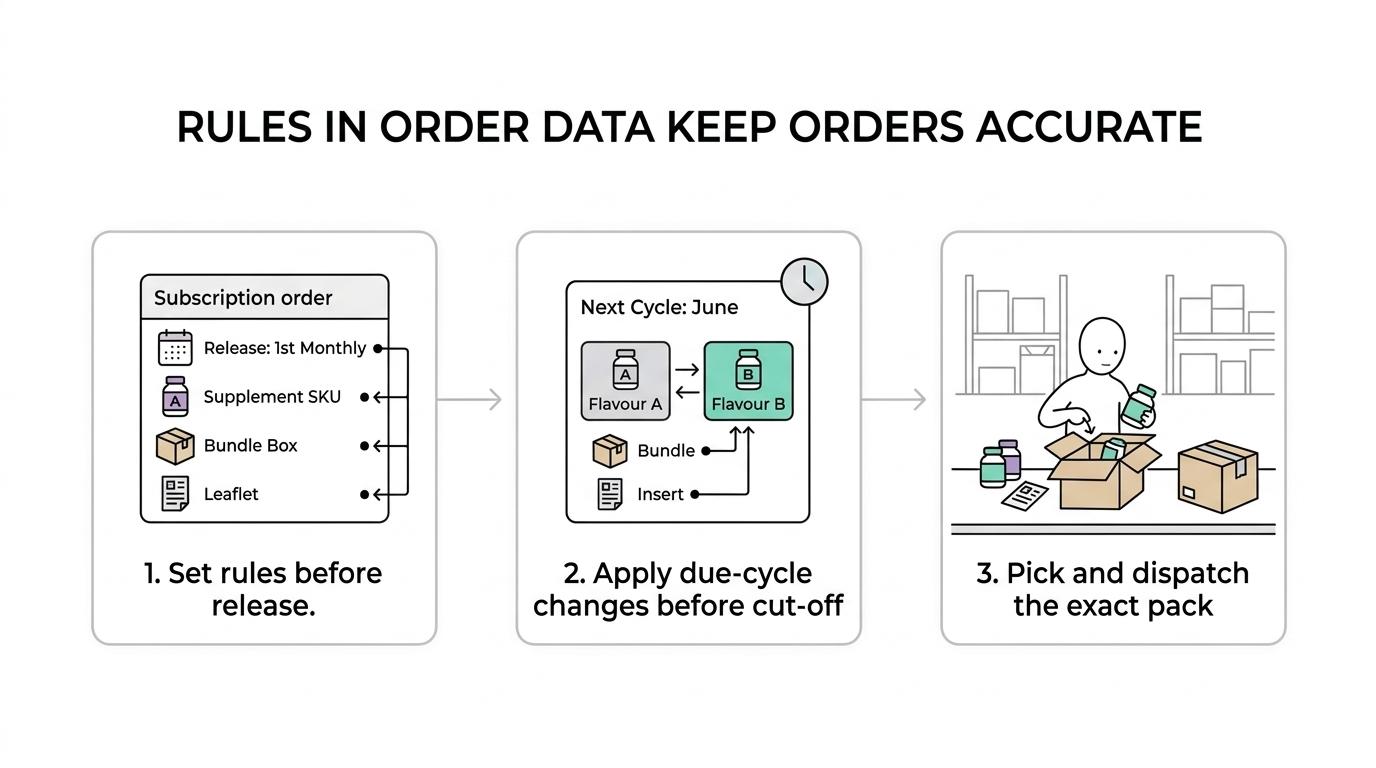
A practical way to think about these moving parts is this:
- flavour swap timing
- bundle assembly rules
- insert version control
- pick-face organisation
- exception handling for late changes
Stock planning and batch traceability in UK supplement fulfilment
Inventory planning for nutrition subscriptions is not only about average monthly volume. It is about predictability by date, by SKU, and by variant. If 2,000 subscriptions renew between the 1st and 5th of the month, stock needs to be ready before that surge lands in the warehouse queue. If half of those customers can switch flavour within a defined window, the forecast must account for expected mix changes rather than rely on a static split.
This is where Shopify supplement fulfilment becomes closely tied to replenishment planning and managing stock for recurring supplements. Operations teams need a forward-looking view of what is committed, what is merely scheduled, and what can still change. That helps purchasing and production avoid both stockouts and overstock, especially on shorter-dated health products.
For supplements in the UK, traceability also sits at the centre of the process. GOV.UK food safety guidance makes clear that traceability systems are part of the food supply chain obligation. In practice, that means batch-aware stock control, goods-in checks, and the ability to trace what was received, stored, and dispatched.
Batch and expiry control are not optional admin layers. They support customer safety, product rotation, and recall readiness.
The warehouse workflow should usually cover these checkpoints before the subscription dispatch cycle gets busy:
- Goods-in checks: count verification, packaging condition, and intake records
- Batch capture: batch or consignment details linked to stock records
- Expiry control: sensible rotation rules to protect shelf life on arrival
- Label review: correct product presentation for the UK market
- Dispatch traceability: a clear line from outbound order to the stock used
When this is handled well, recurring supplement orders can move quickly, with fewer delays and returns, without losing control.
Dispatch timing, shipping profiles and service consistency
Dispatch timing is where customer expectation and warehouse reality meet. The customer sees a renewal date. The operation sees payment events, fulfilment release rules, cut-offs, courier collections, and weekend constraints.
Shopify also allows subscription fulfilments to be split within a single order based on fulfilment location or shipping profile. That can be useful, especially when nutrition brands hold stock in more than one location or use different services for ambient products and heavier bundles. Yet split fulfilment needs careful governance in supplements. If part of a monthly wellness pack ships separately, the customer may read that as an error unless communication is very clear.
Service consistency often comes from a few disciplined decisions rather than a long list of promises. Protect the dispatch calendar. Keep cut-off rules visible. Reduce manual interventions. Make exceptions rare and deliberate.
A strong recurring order operation tends to focus on these service markers:
- release orders only when they are genuinely actionable
- batch work by shipping method and order type
- maintain clear cut-offs for subscription changes
- use tracking events to reassure customers early
- review failed payments and address exceptions quickly
That approach can raise both speed and order accuracy without compromising customer health or turning the warehouse into a firefighting exercise.
A practical setup for Shopify supplement subscription fulfilment
Most brands do not need a complicated framework. They need a clear one.
Start by mapping every subscription product family. A daily multivitamin, a collagen sachet, and a sports nutrition stack may all sit inside the same Shopify store, yet they rarely behave the same way operationally, particularly when health-related product requirements differ. One may have simple monthly repeats. Another may have frequent flavour swaps. A third may rely on multi-SKU bundle assembly and campaign inserts.
Then define the fulfilment logic around those products, not around a generic ecommerce template. That includes how upcoming orders are forecast, when stock is allocated, how batch data is recorded, what happens when a customer edits the next cycle, and which inserts belong in each order sequence.
A sensible setup often includes three linked layers: subscription platform rules, Shopify order data, and warehouse execution. When those layers agree, recurring order fulfilment becomes predictable. When they do not, teams spend time correcting preventable mismatches.
What to review if your vitamin subscription fulfilment feels manual
If a subscription operation feels more hands-on than it should, there is usually a small number of root causes. The order data may be incomplete. Bundle logic may sit in staff knowledge instead of system rules. Stock planning may be based on historic averages rather than upcoming renewal dates. Batch traceability may exist, but only through manual lookups.
These are fixable issues.
A review is often most useful when it looks at the full path from repeat order to dispatch, including:
- Recurring order logic: how renewals are created, scheduled, and released
- Customer edits: how flavour changes, skips, and swaps are handled
- Bundle execution: whether products are pre-kitted or assembled at pick
- Insert control: how campaign or compliance materials are assigned
- Stock planning: how future subscription demand feeds purchasing and allocation
- Traceability: how batch and expiry information is captured and retrieved
If you are reviewing your Shopify supplement fulfilment setup, including how supplements are packed and shipped to support customer nutrition, it helps to bring real examples rather than only process notes. A late flavour swap, a bundle with a missing insert, a prepaid order sitting in Scheduled status, or a stock conflict across subscription and one-off sales will usually reveal where the workflow needs tightening.
If you would like to discuss your setup, focus the conversation on the operational details that shape recurring order fulfilment every day: order timing, flavour rules, bundle assembly, inserts, stock planning, and batch-aware dispatch. That is where subscription performance is won.