
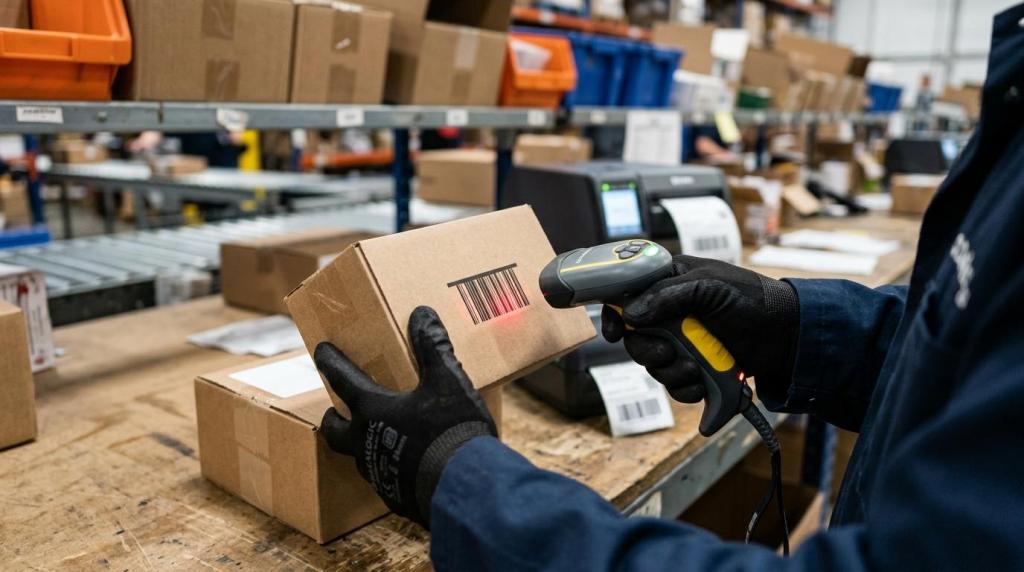
A product can move from a short social clip to a packed parcel in a remarkably short space of time. That shift is changing how brands think about stock, systems, carrier choice and warehouse capacity.
The UK market shows why this matters. TikTok has reported a 131% annual increase in UK shoppers on TikTok Shop and a 180% year-on-year rise in revenue at the end of 2024. It has also said more than 6,000 TikTok Shop LIVE sessions take place in the UK every day. At the same time, the Office for National Statistics reported that internet sales made up 27.1% of total retail sales in Great Britain in 2024. Social commerce is now tied directly to fulfilment performance.
TikTok Shop fulfilment and UK social commerce demand
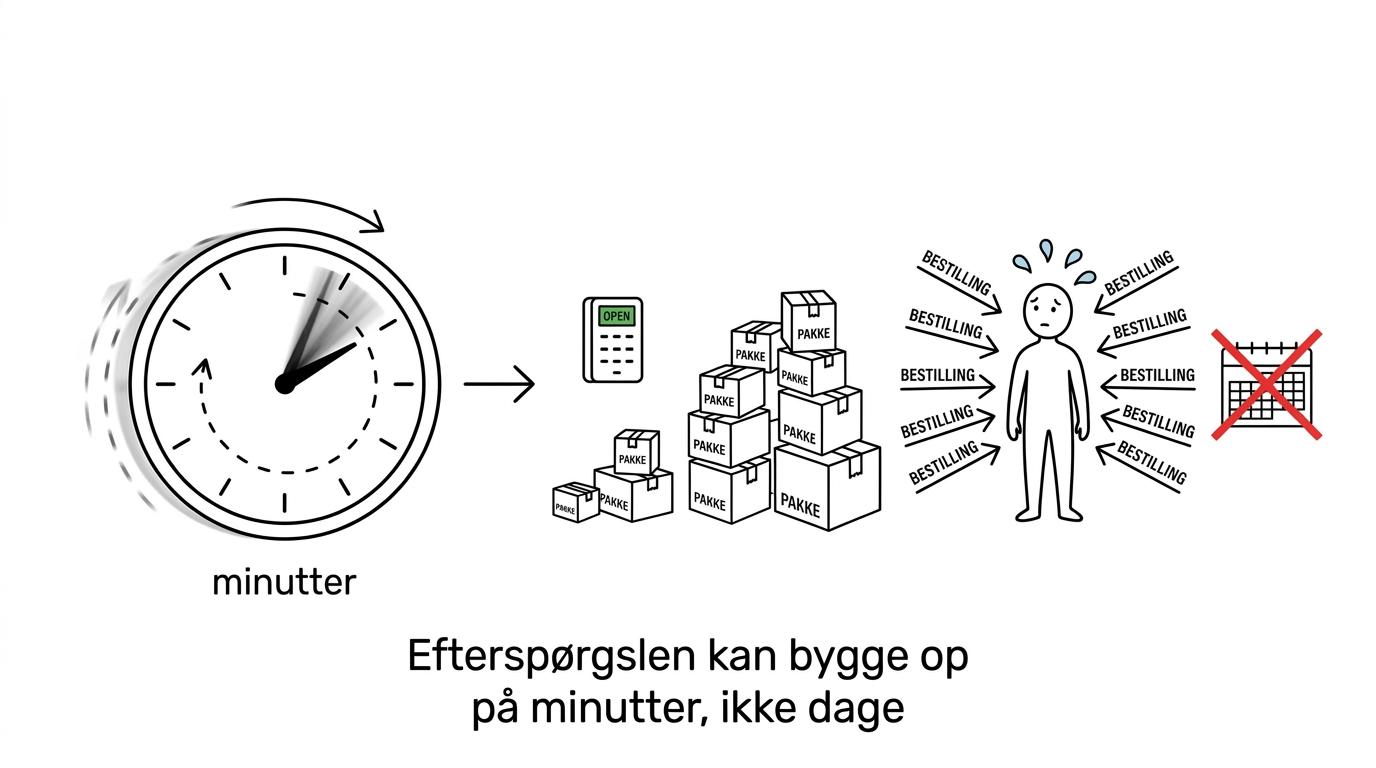
TikTok Shop works differently from many traditional ecommerce channels. Demand can build in minutes, not days. A creator mention, a paid ad, a well-timed live shopping session or a sharp price point can trigger a rush of orders that would normally be spread across a longer period on a standard web shop.
That creates a new pressure point for operations. Marketing can generate momentum very quickly, yet the sale is only completed when the content is engaging, supply and stock are available, the order data is clean, the parcel is packed correctly, and the carrier network keeps moving. A slow back end turns a high-performing campaign into cancelled orders, poor seller metrics and unhappy customers.
For that reason, many brands connect TikTok Shop to a third-party logistics provider that can absorb sudden volume changes. A provider such as 3PLWOW positions its service around this kind of fast-moving ecommerce workflow, with warehousing, order processing, pick and pack, dispatch and agreed returns handling built into one operation.
How a TikTok Shop order is created and captured
The process starts with attention. A shopper sees a product in a feed post, a Spark Ad, a creator video or a live selling session. The buying path is short. Rather than clicking away to a separate store, the customer can often place the order inside TikTok Shop itself.
Once the customer checks out, the real operational chain begins. The order details need to move from TikTok Shop into the fulfilment system, stock needs to be allocated, and shipping options need to be ready without delay. If any part of that chain is manual, response times slow down and error rates usually rise.
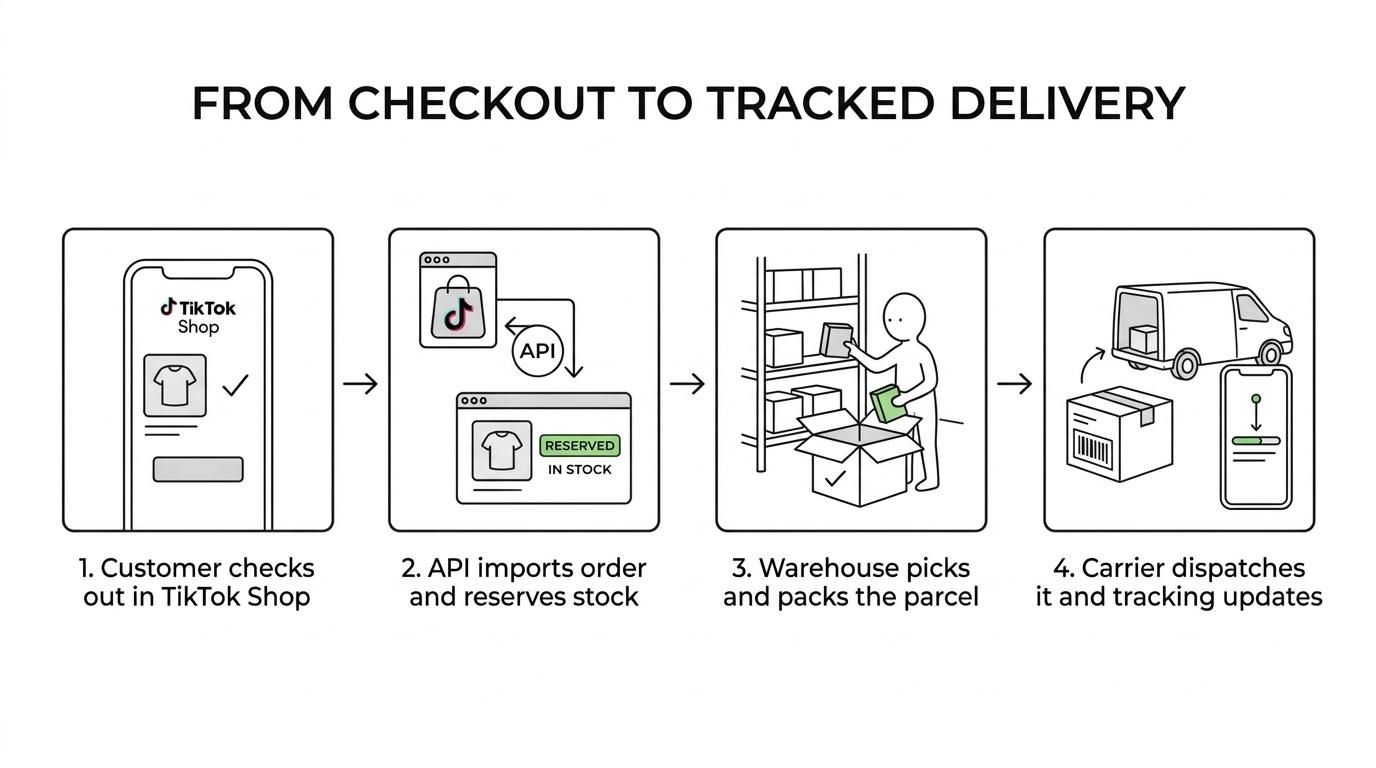
That is why direct system integration matters so much in social commerce.
| Stage | What happens | Why it matters |
|---|---|---|
| Product viewed | Customer sees an ad, post or LIVE session | Demand can scale very fast |
| Order placed | Customer checks out in TikTok Shop | Speed and accuracy become critical |
| Order imported | API sends order data to the 3PL system | Removes manual rekeying |
| Stock allocated | Inventory is reserved against the order | Helps prevent overselling |
| Pick and pack | Warehouse team prepares the parcel | Accuracy protects reviews and repeat sales |
| Dispatch | Carrier label is created and parcel leaves site | Tracking and delivery performance affect channel metrics |
| Status update | Tracking data flows back to TikTok Shop | Customer visibility improves trust |
Direct API integration with TikTok Shop orders
A direct API integration into TikTok Shop turns what could be a fragmented handoff into a connected workflow. Orders can be pulled into the fulfilment platform automatically, often within moments of purchase. Stock updates can move back the other way so available inventory and supply on TikTok Shop reflects what is actually in the warehouse.
This reduces friction in several places at once. Warehouse teams are not waiting for spreadsheets. Customer service teams are not chasing dispatch status manually. Brands are less exposed to overselling during a spike because the stock picture updates more quickly.
A well-configured integration usually handles more than simple order import. It can support status changes, tracking details uploads, cancellations, and in some cases inventory sync across multiple sales channels. For brands selling on TikTok Shop alongside Shopify, Amazon or marketplaces, that joined-up view of content is especially valuable.
After the integration is in place, the operational gains are easy to see:
- Automatic order flow: orders move from TikTok Shop into the fulfilment system without manual entry
- Inventory sync: stock levels are kept closer to real-time across connected channels
- Tracking feedback: dispatch and carrier details can be pushed back to the sales channel
- Faster response times
- Fewer avoidable errors
Stock preparation before a TikTok campaign goes live
Strong fulfilment starts well before the first sale. Stock has to arrive at the warehouse, be checked accurately and be stored in a way that supports rapid picking. 3PLWOW says deliveries are checked against agreed goods-in information before items are placed into warehouse locations. That step matters because social commerce does not leave much room for inbound mistakes.
If the product range includes batch-controlled items, expiry-sensitive products or promotional bundles, these rules need to be set during onboarding. Clear SKU data, barcode consistency and agreed packing instructions all make later order processing quicker and more reliable.
Storage capacity also shapes how much room a brand has to grow. 3PLWOW says it operates from Newcastle and offers more than 30,000 square feet of storage space. For a TikTok-led seller, that kind of flexible capacity can support both regular replenishment and short bursts of campaign stock without forcing a fixed warehouse overhead onto the brand.
Inventory visibility is just as important as physical space. 3PLWOW says clients can access stock information through agreed systems and its client portal. That means a brand team can review inventory status, plan replenishment and spot pressure points before a best-selling item runs out.
Pick and pack operations for TikTok Shop orders
Once an order enters the queue, the warehouse moves into execution mode. The system releases the order for picking, a location is identified, and the item is retrieved from storage. The pack stage then checks that the right product, quantity and packaging are used before the shipping label is applied.
That may sound simple. At volume, it is highly disciplined work.
Accuracy is the standard that protects growth. A popular product with a low average selling price can lose margin very quickly if mis-picks, split orders or repacking issues start to rise. A capable 3PL uses process control to keep that risk low while maintaining dispatch speed.
Typical pick and pack priorities include:
- order accuracy
- packaging consistency
- barcode checks
- dispatch cut-off performance
- carrier label compliance
The value for TikTok Shop sellers is straightforward. Marketing can create a surge, yet repeat sales depend on the parcel that reaches the customer. If the unboxing experience is clean, the item is correct and delivery lands when expected, the fulfilment operation supports the brand rather than sitting invisibly behind it.
Flexible warehouse storage for TikTok-driven order spikes
Social commerce rarely follows a neat demand curve. A product may sell modestly for weeks, then jump sharply after one strong video or one successful live session. That is where flexible warehousing becomes commercially useful, not just operationally convenient.
A 3PL built for ecommerce can shift storage allocation, labour focus and dispatch workflow around these changes more easily than an in-house team with fixed space and a limited staff roster. 3PLWOW presents its TikTok Shop fulfilment service around exactly this need, with content and workflows designed for brands facing campaign-led spikes and sudden changes in order volume.
The warehouse supply model matters here. If stock can be received, located and released quickly, the brand is better placed to keep selling while momentum is high. If the storage model is rigid, the business may end up capping campaigns, delaying stock-in, or watching conversion slip because popular items move out of stock too soon.
There is also a financial angle. Flexible storage helps a brand avoid paying year-round for the kind of warehouse footprint only needed during peak trading, product launches or creator-driven bursts of demand.
Cheaper shipping rates through pooled carrier volume
Parcel cost is one of the clearest reasons many brands use a 3PL. A fulfilment provider shipping across multiple clients can often access lower carrier rates than a smaller brand could secure alone. Those savings may come from total parcel volume, established carrier relationships or better matching between parcel profile and service level.
The result is not only cheaper labels. It is a better shipping model overall. Orders can be routed to the most suitable service based on destination, weight, dimensions and required speed, rather than being forced into one default carrier option.
That commercial advantage usually shows up in several ways:
- Volume pricing: pooled shipping spend can improve carrier rates
- Rate shopping: orders can be matched to the best-fit service for cost and speed
- Service range: tracked, next-day and economy options can be chosen more selectively
- Lower cost per parcel
- Better delivery performance
For a TikTok Shop seller, that matters twice over. Lower fulfilment cost protects margin, while reliable delivery protects seller performance and customer satisfaction.
Order tracking, returns handling and inventory visibility
The process does not stop when the parcel leaves the site. Dispatch confirmation and tracking details need to flow back into the channel so the customer can see progress. With direct integration, that update can happen automatically, which reduces customer service queries and keeps the post-purchase experience cleaner.
Returns also need a clear path. 3PLWOW says agreed returns handling can form part of the service, which is useful for brands that do not want returned stock landing back at an office or retail site with no proper inspection process. A structured returns flow helps determine what can be restocked, what needs review and what should be written off.
For operations teams, the ongoing value is visibility. A connected fulfilment setup makes it easier to monitor stock by SKU, review dispatch volumes, prepare for upcoming campaigns and respond before service levels come under pressure. In a channel shaped by fast attention and faster buying, that clarity is a serious advantage.