
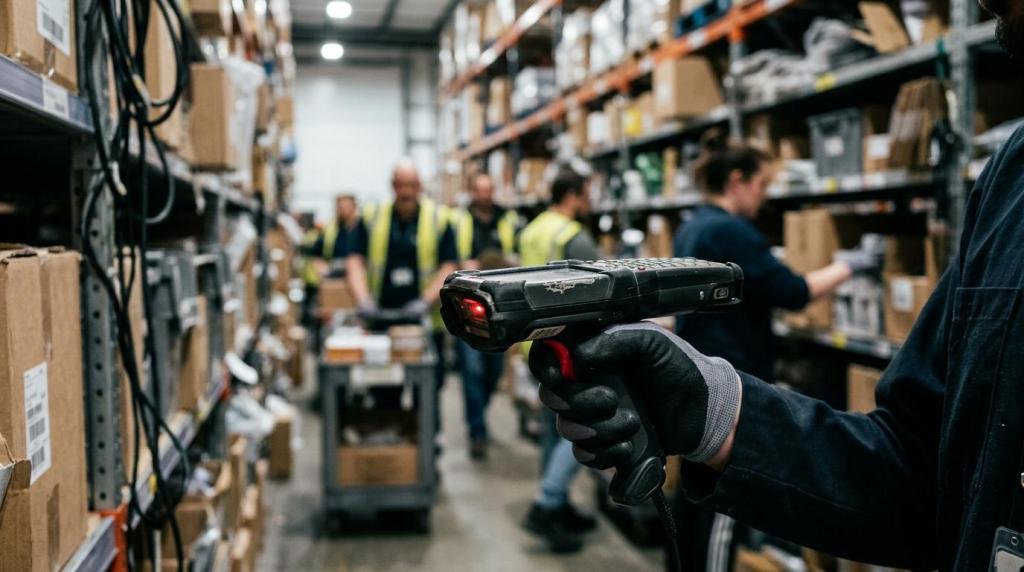
A product can sit quietly for weeks, then sell out before lunch because one video took off.
That is no longer an edge case. It is a normal feature of modern e-commerce. Social platforms compress the time between awareness and purchase, leading to a significant social impact as demand can rise far faster than many warehouse operations were built to handle. A post, a paid campaign, or a creator recommendation can turn a steady order flow into a same-day spike in the supply chain, affecting picks, packing, labels, stock movements, customer queries, and returns.
For online retailers, that shift matters even more because e-commerce is already a major part of the market. According to the Office for National Statistics, online sales accounted for 27.0% of Great Britain retail spending in December 2024. When social media changes demand, it is not nudging a niche channel. It is hitting a large share of retail activity.
Social media demand spikes in UK e-commerce
Social media used to sit near the top of the funnel. It built awareness, shaped perception and maybe sent traffic to a website later. Now it can trigger purchases on the spot. People see a product in use, read comments, watch reactions, save a post, click through and buy within minutes.
That speed matters operationally, significantly influencing efficiency and productivity. Traditional forecasting often assumes demand changes in patterns: payday lifts, seasonal peaks, promotional weekends, or planned email campaigns. Social demand behaves differently. It can arrive outside office hours, spread internationally, and keep growing while the warehouse is still working through the first wave.
Research and market data back up that shift. A 2025 U.S. International Trade Commission report found that 37% of Facebook and Instagram users and 44% of TikTok users made at least one purchase through those platforms in 2024. While those figures are from the US, they point to a broader pattern in social commerce: platforms are not just influencing demand, they are converting it.
Influencer campaigns and paid social advertising increase purchase intent
The mechanism behind these spikes is straightforward. Social media collapses social proof, product demonstration and urgency into one screen. A customer sees the item in context, hears a recommendation from someone they trust, reads other users’ reactions and acts while the post is still circulating.
Academic research helps explain why that works so quickly and how certain trends amplify this behavior. A Penn State study found that purchase intent rose when followers saw influencers as trendy and relatable, with perceived authenticity acting as an important link between identification and buying intent. In plain terms, people are more likely to buy when the recommendation feels credible and close to their own tastes or status.
Community effects strengthen that behaviour. The University of Florida summary on social commerce research highlights enjoyment, interactivity, social support and identification as significant predictors of buying intent. That means a product does not need to be introduced through a polished brand campaign alone. It can gain momentum because people are reacting to each other.
A few common triggers tend to move demand very quickly:
- Creator product mention
- Flash discount code
- Retargeting ad burst
- Limited-stock messaging
- Viral user-generated content
- Payday or weekend promotion
Paid advertising can make the effect even sharper. A brand might test a creative on TikTok or Instagram, see a strong return within hours, then increase spend immediately. Demand does not rise gradually in that scenario. It jumps.
What social media demand surges do to warehouse operations
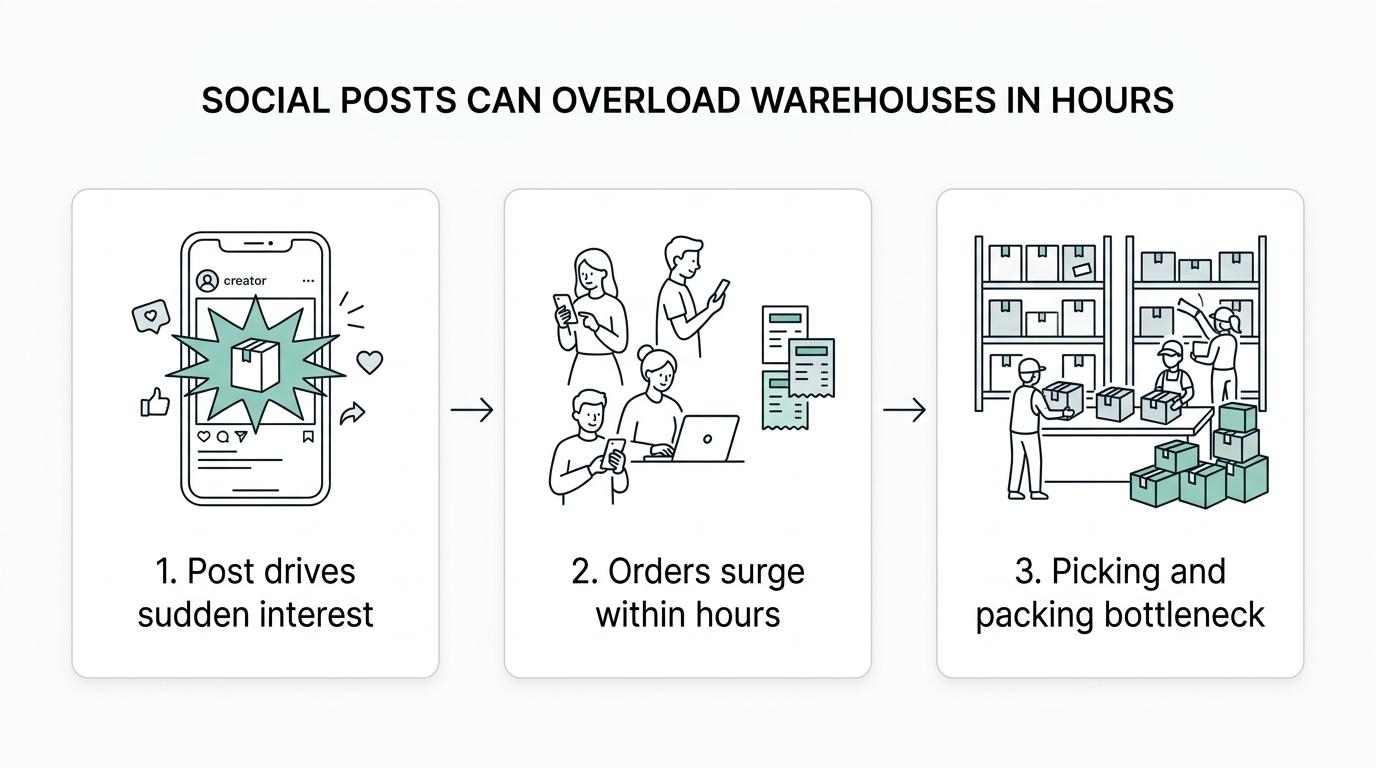
When orders double or triple in a short window, the warehouse feels the impact everywhere at once. Picking routes become congested. Packing benches back up. Carrier cut-off times become more difficult to hit. Stock that looked sufficient in the morning can become fragmented across locations by mid-afternoon.
The issue is not just volume. It is volatility. Teams can usually cope with planned peaks because labour, stock placement and carrier bookings were prepared in advance. A social-led surge arrives without the same runway.
The table below shows how a digital event quickly turns into a physical fulfilment problem.
| Social media trigger | Customer response | Warehouse effect |
|---|---|---|
| Influencer post gains traction | Rapid surge in site traffic and orders | Picking queues rise within hours |
| Paid ad budget is increased | Sustained volume over 24 to 72 hours | More labour needed across shifts |
| Flash sale or limited code | Compressed demand into a short window | Packing stations and labels become bottlenecks |
| Viral product video | Best-seller stock drains unexpectedly | Replenishment pressure and stock imbalance |
| Community sharing and comments | Follow-on purchases after the original post | Spike lasts longer than forecast |
A published 3PLWOW case study gives a clear picture of the scale involved. In that example, a direct-to-consumer brand grew from roughly 4,000 monthly orders to more than 14,000 after a seasonal campaign and creator partnerships. Peak days reached nearly a week of previous order volume in 24 hours.
That kind of jump changes the warehouse maths immediately.
Why in-house fulfilment often struggles with overnight peaks
Many growing brands start with an in-house setup because it gives close control, enhances productivity, and improves efficiency at lower volume. The challenge appears when social activity creates bursts that exceed normal staffing and space assumptions, highlighting trends in social impact on business operations. A packing area built for a predictable afternoon rush is very different from one built to absorb a viral hit at 9.30 am and maintain an efficient supply chain to still dispatch on time.
The first signs of strain are often easy to miss. Orders are still going out, but later. Teams stay longer. Temporary fixes appear sensible in the moment. Then service quality starts to slip.
In the same 3PLWOW case study, in-house fulfilment during rapid growth led to late dispatches, rising pick-and-pack errors, overflow stock, higher labour costs during peaks and slower returns processing. Those are common symptoms when demand becomes less predictable than the warehouse model.
A sudden spike can create several operational risks at once:
- Labour pressure: more hands are needed immediately, not next week
- Space pressure: inbound stock, pick faces and packed parcels compete for room
- Accuracy pressure: speed rises, but mistakes rise with it if processes are stretched
- Carrier pressure: missed collections can turn one busy day into a two-day backlog
- Service pressure: support tickets rise as customers ask about dispatch and delivery
For the customer, that experience can feel simple. They clicked “buy now”. For the business, it can mean a full operational reset before the next morning.
How a 3PL such as 3PLWOW adds warehouse flexibility
A third-party logistics provider is valuable here because flexibility is built into the operating model. Instead of running a warehouse sized only for average daily demand, a retailer can use a fulfilment partner with more scalable labour, storage, systems and carrier capacity.
That does not mean every peak becomes easy. It means the business has a better chance of absorbing demand without damaging customer experience.
A 3PL such as 3PLWOW can help in several practical ways. Extra labour can be added around spikes. Order cut-offs and carrier options can be managed more dynamically. Storage can expand without the brand having to sign for more premises or buy more equipment. Returns can also be processed without taking staff away from outbound fulfilment.
This matters because speed is only one part of the challenge. Accuracy has to hold up as volume rises. A social media win is far less valuable if the warehouse responds with stockouts, mis-picks and apologetic emails.
There is also a planning benefit. A strong 3PL relationship gives the brand room to be more ambitious with marketing because operations are less brittle. A business can push an offer, brief creators, or scale paid social with more confidence that fulfilment will not be the weak point.
What flexible fulfilment looks like during a viral sales window
The most useful kind of flexibility is operational, not theoretical. It should show up in the hours before, during and after the spike.
Before the campaign or creator drop, a 3PL can help place stock sensibly, identify likely fast movers, review packaging supply, enhance productivity, and plan carrier cut-offs. During the spike, the focus shifts to throughput and visibility. After the peak, returns, exchanges and late-wave orders need to be cleared quickly so the brand does not carry disruption into the next trading cycle.
That often looks like this:
- Pre-peak readiness: stock profiling, replenishment planning, packaging checks
- Live peak control: scalable picking and packing, dispatch monitoring, carrier coordination
- Post-peak recovery: returns handling, backlog clearance, reporting on bottlenecks
For brands running social-led promotions, this is especially useful because peaks rarely arrive in a neat monthly pattern. One week might be calm. The next might be driven by a creator mention, then amplified by paid spend, then extended by customer sharing.
A flexible fulfilment setup turns that uncertainty into something manageable rather than damaging.
Warehouse capacity planning for advertising bursts, influencer drops and sales events
Not every social spike is the same. A planned sale creates one shape of demand. A creator campaign creates another. A viral customer video can create a third, often with less warning than either of the first two.
Advertising bursts tend to produce a sharper curve. Spend increases, traffic rises, conversion follows, and the warehouse sees concentrated order intake. Influencer campaigns can be more uneven. One post might underperform while another triggers days of follow-on sales through comments, shares and stitched content. Sales events sit somewhere in the middle, especially when countdowns or limited-time codes bring urgency.
This is why warehouse planning should be linked closely to marketing calendars and real-time campaign performance. A fulfilment partner that can respond to same-day changes in the supply chain is valuable because the brand can act on commercial opportunity without fearing operational collapse.
It is also why visibility matters. If marketing can see stock position and fulfilment can see campaign intent, better decisions get made. Spend can be increased when the operation is ready, or moderated when a product is likely to run too close to stock limits.
The case for scalable fulfilment in social commerce growth
Social commerce is not only about selling on a platform. It is about the way demand now forms: publicly, quickly, and with strong social proof, making it crucial to consider the social impact of sales strategies and current trends. Brands that win in that environment tend to be the ones that pair bold marketing with resilient fulfilment.
The encouraging part is that this is solvable. Overnight demand swings do not have to result in delay, overtime and avoidable mistakes. With the right warehouse model, a sudden surge can be treated as a sign of healthy demand rather than an operational threat.
For businesses that expect traffic from ads, influencer activity or fast-moving promotions, working with a 3PL like 3PLWOW can provide the room needed to scale fulfilment up when attention turns into orders. That room matters because social media can move customers very quickly, and the warehouse has to be ready to move with them.