
A flash sale can create exactly the kind of momentum a growing ecommerce business wants: a burst of traffic, a sharp rise in conversions, a significant price drop, and a strong reason for customers to buy now rather than later. Yet the same campaign that lifts revenue can also expose weak fulfilment, poor stock visibility, and carrier limits within a matter of hours.
That tension matters because customer expectations do not relax just because your promotion is working. Shoppers still want fast delivery, clear communication, and easy returns. Recent survey work from DHL points to the same pattern: speed, convenience, and trust remain central to online buying decisions, with many shoppers wanting ever faster delivery. In the UK, official retail data has also shown that promotional activity can pull demand forward, changing normal order patterns and making peak days less predictable than they appear on paper.
A flash sale is not only a marketing event. Flash sales are a live operational stress test.
Flash sale demand planning for ecommerce growth
Many brands plan a flash sale around ads, email, sales, discounts, and discount levels for a limited time, then treat fulfilment as a secondary task. That is where trouble starts. A flash sale compresses demand into a short window, which means stock, people, packing space, courier collections, and customer service all come under pressure at the same time.
Even a well-run store can struggle when order volume jumps far beyond the weekly average. A business that usually processes 150 orders a day may suddenly face 800 before lunch. If product is stored across multiple shelves with inconsistent labelling, if inventory is not synchronised across channels, or if packing benches are already at capacity, delays begin almost at once.
The Office for National Statistics has highlighted how promotions can influence non-store retail volumes and even shift demand from one period into another. That matters because historic averages alone may not tell the full story. A business may think it is planning for a “busy Friday” when the reality is a condensed week’s demand in six hours.
A sensible starting point is to review the strategy and the parts of the operation most likely to fail first.
- Stock accuracy
- Picking speed
- Packing capacity
- Courier cut-off times
- Returns handling
Flash sale stock control and SKU readiness
Stock problems during a flash sale are expensive in more ways than one. The obvious risk is overselling. The less visible risk is loss of trust when customers place an order, receive a dispatch delay notice, then find the item is no longer available.
That is why preparing for a flash sale should begin with realistic forecasting and SKU analysis. A growing business needs to know which lines are likely to dominate volume, which products are sold in bundles, which items have packaging quirks, and which SKUs tend to create picking errors. Guidance from 3PLWOW places this kind of review near the top of the preparation list, along with system checks and a close look at current dispatch performance.
A good stock plan should answer several practical questions before the sale goes live.
- Best sellers: confirm exact on-hand quantity and replenishment timing
- Slow movers in the promotion: decide whether to cap availability or exclude them
- Bundles and multipacks: verify component stock and packing instructions
- Returns-sensitive lines: prepare for a likely post-sale increase in reverse logistics
This is also the point where many in-house teams realise their warehouse layout is working against them. If the fastest-moving flash sale lines are stored in awkward locations, every extra second per pick multiplies across hundreds of orders.
Why a 3PL can reduce flash sale pressure
A Third Party Logistics Provider like 3PLWOW is useful not simply because it stores goods off-site, but because it gives a growing ecommerce brand operational elasticity. That is the real advantage during a flash sale, as it can significantly boost sales.
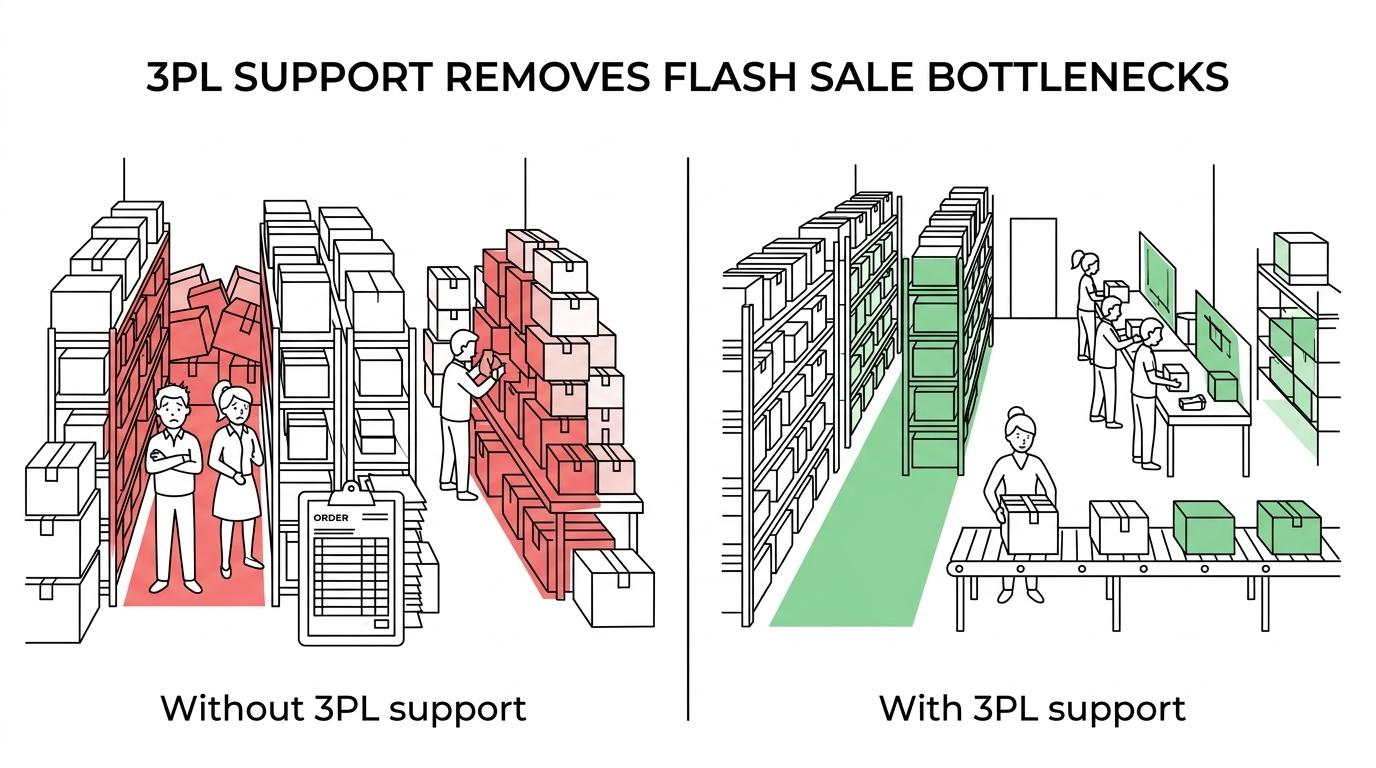
When order volume rises sharply, an in-house setup often hits physical and staffing limits very quickly. A business may have enough stock to sell, yet still fail to dispatch on time because the warehouse is too small, the aisles are congested, or the team is already stretched. A 3PL is built to absorb these spikes more effectively, especially during flash sales when a targeted strategy for promotional surges is expected.
Flexible warehouse space is one of the first benefits. If a sale requires more inbound stock in the weeks before launch, or if a brand wants to expand the range of promotional lines, extra storage capacity can make that possible without forcing a costly move to larger premises. For a growing retailer, that can be the difference between running a bold campaign and scaling back the offer to fit available space.
The second advantage is labour, as well as the ability to offer discounts due to economies of scale. A large team of staff trained to a high standard gives a business access to picking, packing, goods-in, stock management, and dispatch capability that would be difficult to build internally at short notice. Instead of pulling founders, marketers, and customer service staff onto packing benches, the fulfilment workload sits with a team whose core job is warehouse execution.
That matters more than many businesses expect. High order volume combined with a sudden price drop often drags management attention away from sales activity and into operational firefighting. A 3PL helps prevent that shift, keeping internal focus on promotion performance, customer communication, and retention.
Comparing in-house fulfilment and 3PL support for flash sales
The gap between a small internal operation and a specialist fulfilment partner becomes obvious during compressed demand.
| Area | In-house setup during a flash sale | 3PL support during a flash sale |
|---|---|---|
| Warehouse space | Fixed and often tight | Flexible storage for pre-sale build-up |
| Staffing | Limited team, hard to scale quickly | Larger trained workforce available |
| Stock control | May rely on manual checks or partial sync | Structured inventory processes and controls |
| Carrier rates | Often retail or modest business rates | Lower shipping rates through volume buying power |
| Dispatch speed | Can slow once order queue builds | Same day dispatch capability where cut-offs are met |
| Management focus | Team pulled into packing tasks | More time kept for trading and customer activity |
The point is not that every business must outsource everything. It is that flash sales punish bottlenecks, and 3PL support can remove several of them at once.
Flexible warehouse space for flash sale inventory build-up
Space is easy to underestimate because it tends to become a problem gradually, then suddenly. One week the operation feels manageable. The next, pallets are blocking walkways, replenishment is late, and best-selling SKUs are split across multiple temporary locations.
Preparing for a flash sale often requires stock to arrive early, be checked quickly, and be positioned for rapid picking, all within a limited time to capitalize on demand. If the warehouse cannot handle that inbound surge, the sale starts with friction. 3PLWOW’s guidance refers to inbound receiving constraints and replenishment bottlenecks for good reason. These are common weak points when a promotion is planned around sales ambition rather than operational capacity.
With flexible warehouse space, a growing brand can bring in extra inventory ahead of the campaign without forcing inefficient storage decisions. Fast movers can be placed in accessible pick faces, reserve stock can sit close to replenishment zones, and packing materials can be stocked in enough volume to support the event. This is a practical gain, not a theoretical one. Better space planning leads directly to quicker picks and fewer errors.
Sometimes the smartest move is simply giving stock room to move.
Trained warehouse staff and same day dispatch performance
A flash sale can double or triple the number of touchpoints in the warehouse: receiving, put-away, pick waves, pack checks, label generation, manifesting, and handover to carriers. Each touchpoint carries a risk of delay when the team is small or inexperienced.
This is where a large, well-trained warehouse team changes the picture. Rather than relying on temporary fixes or asking office staff to help on the floor, a 3PL can deploy people who already work within standardised processes. That means clearer quality checks, better pace control, and more consistent output across the day.
Same day dispatch becomes far more realistic in that environment. Customers do not measure your effort. They measure when their parcel moves. If your sale drives excitement but dispatch slips by 48 hours, confidence can fade quickly, particularly among first-time buyers.
To protect same day dispatch during a promotion, several elements need to be in place.
- Pick path design: best-selling SKUs should be the fastest to reach
- Pack accuracy: speed cannot come at the expense of order correctness
- Carrier collection planning: late collections need confirming before launch
When these parts are managed well, same day dispatch becomes a credible promise rather than a hopeful one, even during a limited time promotion.
Lower shipping rates and customer conversion during peak promotions
Delivery cost has a strong effect on conversion, especially when the sale itself has already reduced margin. A growing brand may want to offer free delivery, discounted shipping, or upgraded service during the event, but carrier prices can limit what is commercially sensible, even when additional discounts are offered.
A 3PL can help by giving access to lower shipping rates secured through larger parcel volumes. That buying power may allow a retailer to structure a delivery strategy with more attractive offers without eroding profitability as sharply as it would under a smaller direct courier account. For businesses trying to balance growth and margin, that can open better promotional options.
There is also a service angle here. Customers tend to judge the entire purchase, not just the product discount. A sharp offer paired with slow or expensive delivery feels less compelling, especially when seamless sales are the primary aim of the promotion. A strong fulfilment setup supports the promotion by making the post-purchase experience match the urgency of the sale.
Reliable returns matter as well. Fast shipping may drive conversion, but easy returns help protect confidence, especially when customers are buying quickly under time pressure.
Flash sale operational checks before go-live
The strongest flash sales are usually the least dramatic behind the scenes, because the risks have already been tested. That includes order flow, stock counts, packaging availability, courier allocation, and system behaviour under pressure.
3PLWOW’s own preparation advice points in a practical direction: review order patterns, inspect storage limits, assess bottlenecks, and run test orders before launch. That approach suits growing brands because it turns flash sales from a gamble into planned events.
Before go-live, a business should check:
- Forecast range: base case, strong case, and stretch case volume
- SKU readiness: barcodes, locations, bundle logic, and stock caps
- System sync: website, marketplaces, warehouse, and shipping tools
- Dispatch promise: realistic cut-offs communicated to customers
- Returns plan: labels, process, and customer messaging
A short stress test can save a long recovery. If a business cannot process a batch of test orders cleanly before launch, it is unlikely to handle a real surge once traffic arrives.
Using a 3PL to protect brand experience during a flash sale
Flash sales are often judged on top-line revenue and any accompanying price drop, yet the brand impact lasts longer than the campaign window. A first-time customer who receives rapid, accurate fulfilment is more likely to buy again at full price. A customer who waits too long, receives the wrong item, or gets poor communication may never return.
That is why fulfilment should sit close to commercial planning, not behind it. A Third Party Logistics Provider like 3PLWOW can give a growing ecommerce business room to run ambitious promotions with more control over storage, staffing, stock accuracy, shipping cost, and dispatch speed. Those are not background details. They shape whether the sale feels polished or chaotic from the customer’s side.
The best flash sale operations tend to look calm because the pressure has been moved into preparing for a flash sale. When space is available, staff are ready, stock is controlled, carrier rates are competitive, and same day dispatch is achievable, the promotion can do what it is meant to do: create demand without breaking the business that generated it.