
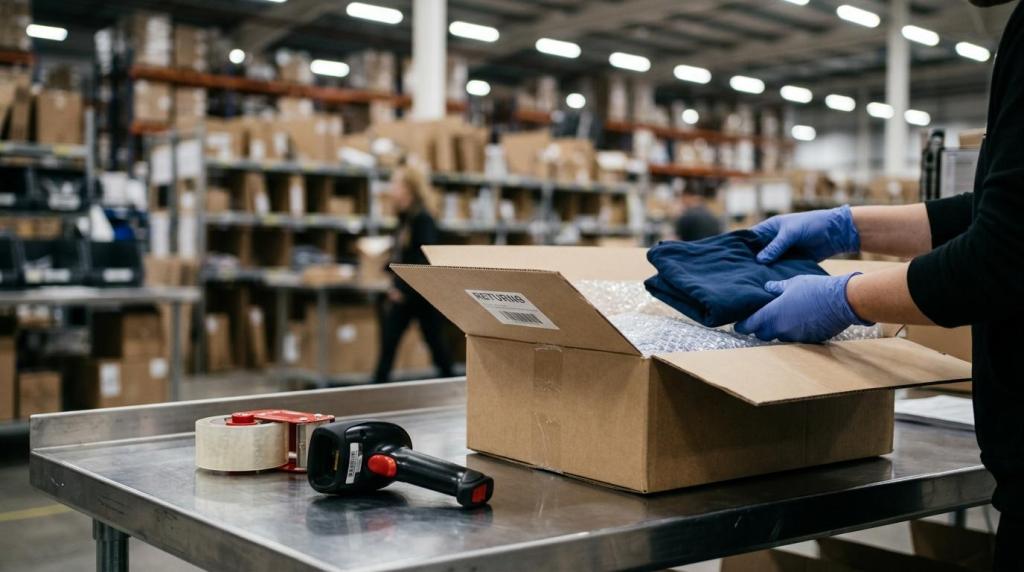
A high-performing marketing campaign can feel like a breakthrough right up to the moment the warehouse starts falling behind.
Paid social, search, email and influencer activity can generate demand far faster than an in-house operation can absorb it. That gap matters more now because ecommerce is still running at a strong pace in the UK. The Office for National Statistics reported that the internet sales ratio rose to 29.4% in June 2026, its highest point since April 2021, while online spending values in Quarter 2 2026 were 11.7% higher than the same quarter a year earlier. More orders are available. The pressure is deciding whether your fulfilment setup can keep up.
Campaign success is only half the job; evaluating marketing effectiveness is crucial to ensure that the operations strategy keeps pace with the demand generated.
Why ecommerce marketing success can overwhelm in-house warehousing
A warehouse rarely fails all at once. It tightens, stretches, and then starts missing small things that soon become expensive things. Picking takes longer. Packing benches stay full. Carrier cut-off times become harder to hit. Customer service tickets rise because delivery promises slip, tracking is delayed, and returns take too long to be booked back into stock.
This is especially tough when a brand has built its warehousing around normal trading patterns rather than campaign peaks, as this can severely impact overall performance. A team that performs well at 100 orders a day may struggle badly at 350, even if the products are simple and the systems are familiar. The problem is not only space; it is also about staffing constraints that can impact operations. It is labour, process discipline, stock visibility, bench capacity, goods-in flow, and dispatch timing all moving under strain at the same time.
The labour market adds another challenge. ONS vacancies data for June to August 2026 still showed open roles in transport and storage, which means scaling an internal team at short notice is rarely straightforward. Even if temporary staff can be found, training them to the right standard quickly enough is another matter.
When a warehouse is under pressure after a campaign, the warning signs are usually easy to spot:
- pick queues
- late dispatches
- packing errors
- missed carrier collections
- slower returns receipt
- stock discrepancies
- rising support tickets
Warehouse readiness for ecommerce demand spikes
Being ready for a surge in ecommerce orders is not about having a little spare room and a few extra cartons; it’s about preparedness to handle the operational demands efficiently, while managing costs effectively. It means having enough operational depth to expand without losing accuracy. That includes trained pick and pack labour, flexible warehouse storage, live stock control, clear order routing, dependable carrier handover, and a clean process for returns receipt.
A Third Party Logistics Provider can give an ecommerce business that depth without forcing it to build a bigger internal operation. This is where a provider like 3PLWOW fits well. Its own service pages describe a Newcastle-based fulfilment operation that supports growing ecommerce brands with storage, pick and pack, dispatch, returns workflows, and portal visibility. For brands that want to keep the commercial team in London or elsewhere, that creates a practical split: marketing and growth stay close to the brand, while fulfilment runs from a warehouse designed for the work.
The difference becomes clearer when warehouse strain is mapped against fulfilment capability.
| Pressure point after a campaign | Typical in-house impact | How 3PLWOW can help |
|---|---|---|
| Order spike in a few days | Backlog builds quickly | Larger fulfilment team can absorb higher order volumes |
| Limited storage space | Overflow stock, poor slotting, slower picks | Flexible storage options support fast growth and seasonal shifts |
| Temporary labour shortage | Slow onboarding, inconsistent accuracy | Trained picking and packing staff already in operation |
| Weak stock visibility | Oversells, mis-picks, uncertain replenishment | Stock control systems and client portal visibility |
| Carrier cut-off pressure | Orders miss same-day dispatch window | Structured dispatch workflow built around daily carrier handover |
| Returns pile-up | Delayed refunds and lost resale opportunity | Returns receipt and agreed workflows to get stock back into circulation |
How 3PLWOW supports picking and packing at scale
One of the fastest ways a campaign can break an internal operation is through staffing and labour intensity. A hundred extra orders in an ecommerce environment rarely mean a hundred extra motions. They can mean hundreds of additional picks, checks, packaging actions, labels, inserts, and dispatch scans, all compressed into a few hours.
3PLWOW’s value here is straightforward: it provides access to a larger warehouse team trained to a high standard in ecommerce picking and packing. That matters because fulfilment quality depends on routine, not improvisation. Accurate picking, neat presentation, correct paperwork, carton choice, fragile handling, and dispatch compliance are habits built through repetition and supervision.
A strong fulfilment partner also reduces dependence on emergency recruitment, ensuring operations continue smoothly. In-house teams often respond to spikes by asking office staff to help on the floor, extending shifts, or bringing in temporary workers with minimal training. That may work for a short burst, but it is hard to sustain, and accuracy usually suffers.
Where 3PLWOW becomes especially useful is in translating demand spikes into managed throughput rather than panic. A published 3PLWOW case study cited an increase in monthly order capacity from 15,000 to more than 35,000 within 90 days. That does not mean every brand will need the same scale, though it does show the type of capacity planning a specialist fulfilment operation can support.
The practical gains often look like this:
- Trained warehouse labour: picking and packing staff who already work to fulfilment standards
- Volume resilience: more people available when campaigns, launches, or seasonal peaks hit
- Operational consistency: less risk of quality dropping when order counts rise suddenly
- Faster onboarding: growth supported without building a larger permanent in-house team
- Dispatch discipline: stronger odds of meeting daily carrier cut-off times
Flexible warehouse storage and stock control with 3PLWOW
Storage pressure is usually the hidden problem behind dispatch delays. When a campaign lands well, stock receipts can accelerate at the same time as outbound orders. Pallets arrive with little room to spare. Overflow stock ends up in aisles, on benches, or split across locations. Travel time increases, replenishment becomes patchy, and picking errors follow.
A 3PL model gives an ecommerce business more room to grow without signing for another building or reconfiguring its current one, enhancing operational preparedness. 3PLWOW presents its operation as one built around flexible warehouse storage and inventory receipt, which is important for brands with uneven demand patterns. A product line that sits quietly most of the year can move very quickly after the right advert, creator mention, or promotion.
Good stock control and marketing effectiveness are just as important as physical space. If the marketing campaign works, the commercial team needs confidence in what is actually available to sell. That means clean goods-in processes, accurate booking of inventory, sensible stock placement, and ongoing visibility. 3PLWOW’s client portal visibility is useful here because it gives a brand a clearer view of inventory and fulfilment activity without having to stand in the warehouse to get answers.
For ecommerce leaders, that changes decision-making. Paid media can be adjusted with fuller knowledge of stock position. Replenishment can be planned earlier. Customer service teams can respond with more confidence. The warehouse stops being a black box.
Order processing and dispatch speed after an advertising surge
Speed matters, though speed without control is expensive.
When order volumes jump, the internal bottleneck is often not the number of sales but the sequence and associated costs required to turn those sales into dispatched parcels. Orders need to flow from storefront to warehouse system, into a pick wave or task list, through checking and packing, into labels, then to carrier handover. If any part of that chain slips, the performance strategy for maintaining same-day promises starts to weaken.
3PLWOW’s service offer covers order processing, pick and pack, and dispatch. For a growing ecommerce brand, that means the post-purchase operation can move into a workflow built around daily fulfilment rather than borrowed space, stretched staff, and inadequate staffing, enhancing overall operations. It also helps protect the customer experience. A campaign might win the first order, though fast and accurate dispatch does much of the work in earning the second.
The usual in-house weak points after a demand spike tend to follow a familiar pattern:
- Order import delays: sales arrive faster than internal systems or teams can release work
- Packing bench congestion: completed picks wait too long to be packed and labelled
- Carrier cut-off pressure: parcels are ready too late for planned collections
- Customer communication gaps: tracking and delivery expectations become less reliable
Returns receipt and returns workflows matter more than most brands expect
Returns are often treated as a secondary process until growth exposes how central they are.
If a brand receives a rush of orders after a campaign, it should expect a related rise in returns activity shortly afterwards, highlighting the importance of preparedness in handling increased returns efficiently. That is normal ecommerce physics. Sizes do not fit, gifting choices change, duplicate purchases happen, and some customers simply change their mind. If returns receipt is slow or disorganised, two problems appear at once: customer satisfaction falls and stock stays unavailable longer than necessary.
3PLWOW includes agreed returns workflows and returns receipt within its fulfilment offer. That gives a brand a more reliable way to receive returned items, assess them according to the agreed process, and move saleable stock back into available inventory. For businesses selling fast-moving lines, that can protect margin as much as service quality. Returned stock that is processed promptly has a better chance of being resold while demand is still active.
This is also where outsourcing can take pressure off customer support. Faster warehouse receipt of returns supports quicker internal decisions on refunds, exchanges, or restocking. That removes a common source of friction right after a major campaign, when support inboxes are already busy.
When an ecommerce business should move from in-house fulfilment to 3PLWOW
The right time to change is usually earlier than people think. Many brands wait until the warehouse is clearly failing, though the smarter strategy is to act when strain first becomes visible and before service levels slip badly.
A business is often ready for a 3PL partner when ecommerce order growth stops feeling exciting and starts feeling operationally risky. That might be after a successful paid campaign, during a seasonal trading spike, or when new channels are added and order volume becomes less predictable.
Common signals include:
- regular overtime just to stay current, increasing operational costs
- stock stored in temporary overflow areas
- office staff helping with picks
- growing dispatch errors
- returns accumulating faster than they are processed
For brands in London and other high-cost areas, there is another practical point. 3PLWOW states that businesses can keep their team where the brand operates while stock and day-to-day fulfilment run from Newcastle. That creates a sensible division of labour. Creative, marketing, merchandising, and leadership functions stay close to the brand. The physical handling of inventory and parcels sits with a team built for warehouse execution.
That kind of structure enhances marketing effectiveness by giving marketing room to keep working. Campaigns do not need to be softened because the warehouse is already close to breaking point. Product launches can be planned with more confidence. Strong demand becomes something the business can welcome rather than fear, by maintaining high performance standards throughout the operation.