
Strong marketing is meant to create demand. That is the point of the spend, the content, the offers, the creator partnerships, and the paid campaigns. Yet for many ecommerce brands running fulfilment in house, success on the front end can expose weaknesses in the supply chain at the back end very quickly.
A campaign that performs above target rarely arrives with extra warehouse space, more pickers, cleaner stock data, or a longer carrier cut-off. Orders rise first. Operational pressure follows a few hours later. If the business is not ready to address operational challenges, what looked like a growth moment can turn into delayed dispatch, stock confusion, overselling, and frustrated customers.
This matters even more in a market where online retail is already a large part of normal buying behaviour. The Office for National Statistics reported that online sales accounted for 27.0% of total retail sales in Great Britain in December 2024, up from 26.5% in November. When such a large share of e-commerce trade depends on fulfilment, logistics is not a back-office detail. It is a core part of brand performance.
Marketing growth can outpace in-house fulfilment capacity
Marketing teams often work in short cycles. A new ad set is launched, a promotion goes live, a product gets picked up by creators, or a TikTok Shop listing starts to move. Results can change within hours. Warehousing does not move at the same speed.
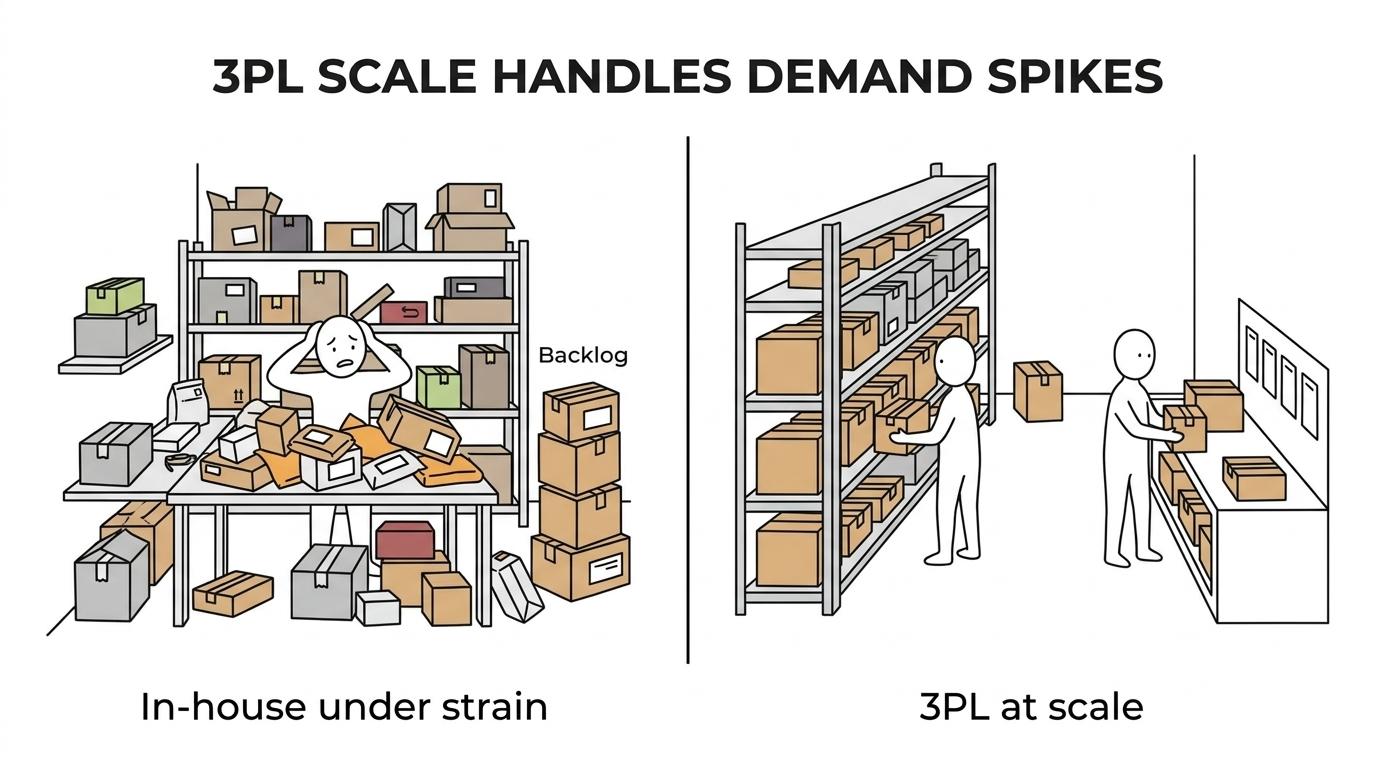
An in-house fulfilment operation is usually built around normal daily volume. It may cope well with steady demand, known repeat orders, and a predictable staffing pattern. Trouble begins when order volume jumps by 40%, 80%, or 200% over a short period. The systems that felt efficient at 150 orders a day can break down at 400 without proper implementation strategies in place.
That is why demand spikes should be treated as an operational event, not just a sales win. The UK Government’s supply-chain strategy highlights demand spikes, supply disruptions, and logistics disturbances as forms of supply-chain shocks. It also points to surge capacity, stock buffers, and data visibility as practical ways to reduce risk. Those ideas are directly relevant to ecommerce brands that have outgrown their original packing bench and shelving layout.
The logistics problems that marketing success often creates
When campaigns land well, the first signs of strain are usually easy to miss. A few later dispatches here, a temporary stock discrepancy there. Then the backlog starts to build.
Common pressure points include:
- stock counts drifting out of sync
- slower order picking
- packing errors
- missed same-day dispatch cut-offs
- customer service queues growing
- returns piling up
These issues are connected. If stock is not accurate, pickers spend longer searching. If picking takes longer, cut-offs are missed. If orders arrive late or incomplete, support tickets rise, impacting customer satisfaction. If customer service is busy, the brand has less time to manage the next campaign properly, impacting customer loyalty.
There is also a less visible cost. Marketing efficiency falls when logistics cannot keep pace. A campaign may still generate orders, but if returns rise, reviews weaken, and repeat purchase drops, the true value of that campaign starts to slip.
Why in-house fulfilment struggles during demand spikes
Most in-house operations are not weak. They are simply narrow by design. They are built for today’s volume, often with a bit of spare room, rather than for aggressive peaks triggered by viral content or paid social success.
Space is one common limit. Fast-moving products need accessible pick faces. Slower lines need storage. Promotional bundles need assembly space. Returned items need checking and restocking areas. Once a growing brand begins adding more SKUs and more channel activity, a small warehouse can become congested. Congestion leads to longer walking time, misplacements, and lower pick speed.
Labour is another issue. Packing 100 extra orders in a day sounds manageable until those orders contain multiple line items, gift inserts, custom packaging, or channel-specific paperwork. Temporary help can ease some of the burden, though short-notice labour rarely matches the speed and accuracy of trained warehouse teams.
The final constraint is process discipline. Under pressure, shortcuts creep in. Stock may be moved without being booked in properly. Orders may be batch printed with less checking. Returns may be set aside “for later”. Those habits create fresh problems even after the peak has passed.
The stock control problem behind fast ecommerce growth
Stock visibility is often where growth pain becomes most expensive. If marketing pushes a hero product hard and supply chain data is not current, a brand may oversell. That creates cancellation risk, customer frustration, and wasted acquisition spend.
Even when overselling does not happen, weak inventory control and operational challenges can still hurt performance. Teams may hold too much of the wrong line and too little of the item the campaign is actually moving. Purchase planning becomes reactive. Replenishment becomes rushed. Margin comes under pressure through emergency freight or poor buying decisions.
A solid fulfilment set-up needs implementation of live or near-live inventory accuracy, clean receiving processes, location control, and regular cycle counts. It also needs confidence that stock shown as available really is available across every selling channel.
A practical comparison makes the gap clear:
| Area | In-house pressure during growth | 3PL support at scale |
|---|---|---|
| Stock accuracy | Manual checks, spreadsheet work, delayed updates | System-led inventory control and regular counts |
| Order release | Batch processing and backlog risk | Automated flow from sales channels into fulfilment |
| Dispatch timing | Cut-offs missed during peaks | same-day dispatch capacity built around volume swings |
| Picking speed | Long walks, ad hoc layouts, temporary labour | Fast pick-and-pack processes with trained teams |
| Channel expansion | Extra admin for each new platform | API integration across ecommerce and social selling |
| Returns handling | Returns build up in busy periods | Structured returns processing and restocking workflows |
Same-day dispatch and fast pick-and-pack rates protect customer experience
Customers rarely separate marketing from fulfilment. They see one brand. If the advert is strong but the delivery promise slips, customer satisfaction and customer loyalty are affected, and the brand experience slips with it.
That is why same-day dispatch matters so much once order volume grows. It keeps delivery expectations realistic, protects conversion after purchase, and supports stronger feedback across marketplaces and social commerce channels. For brands selling through fast-moving environments like TikTok Shop, speed is not a luxury. It is part of staying competitive.
Fast pick-and-pack rates are the engine behind that promise. Speed only helps when it comes with accuracy, though. Sending the wrong item quickly still creates cost and disappointment. The aim is disciplined speed: efficient picking, quality checks, correct labelling, and consistent handover to carriers before cut-off.
Published 3PLWOW case material gives a useful example of what this can look like after an outsourced move. In one case, order accuracy improved from 96.2% to 99.4%, while same-day dispatch rose from 71% to 94%. Capacity also increased significantly within a short period. The wider point is not the individual percentages. It is that operational structure can catch up with marketing growth when fulfilment is designed for scale.
API integration with TikTok Shop and social selling channels reduces friction
One of the newer pressures on ecommerce operations is channel complexity. A brand might sell through its website, Amazon, marketplaces, and social commerce channels at the same time. Each e-commerce channel creates its own flow of orders, stock updates, dispatch expectations, and customer communication.
Without strong integration, operations teams end up doing manual work that should never be manual. They export orders, import tracking numbers, update stock in batches, and try to reconcile inventory after the fact. That is slow and risky, especially when campaigns are actively pushing demand.
API integration changes that picture. When a fulfilment partner can connect directly with major selling platforms, orders flow into the warehouse faster, stock visibility improves, and tracking moves back to the channel cleanly. For brands using TikTok Shop, this matters because sales velocity can change very quickly. The operational response has to be just as quick.
A connected set-up also helps marketing teams. They can scale a campaign with greater confidence when the fulfilment side is not relying on manual intervention to keep up.
How a 3PL like 3PLWOW supports ecommerce scaling
A specialist 3PL gives growing brands access to capacity, systems, and warehouse discipline that would take time and capital to build in house. That does not just solve today’s backlog. It can create room for better decision-making across sales, stock purchasing, and customer service.
Research from the 2025 CSCMP Third-Party Logistics Study supports that broader value. It found that 82% of shippers said 3PLs contribute to improved customer service, 66% said they help reduce overall supply-chain costs, and 68% said they bring new and innovative ways to improve logistics effectiveness. Those results fit the reality many e-commerce teams face: logistics support is not only about storage and postage, but also about resilience and control.
For a brand currently fulfilling orders itself, the implementation of support from a provider like 3PLWOW can include:
- Same-day dispatch: Orders received before cut-off can move out on the day, helping the business keep pace with campaign-led demand.
- Fast pick-and-pack rates: Trained warehouse teams and process-led layouts reduce delays during peaks.
- Accurate stock control: Better inventory discipline lowers the risk of overselling, stockouts, and hidden discrepancies.
- Channel integration: API connections with ecommerce platforms and social selling channels, including TikTok Shop, reduce manual handling.
- Scalable capacity: The operation can absorb seasonal spikes, product launches, and creator-led demand surges more comfortably.
- Returns handling: Returned stock can be processed, checked, and restocked with more consistency.
There is also a strategic benefit that often gets overlooked. When fulfilment moves into a stronger operating model, internal teams can spend less time firefighting. Marketing can plan with more confidence. Customer service can focus on enhancing customer satisfaction and building customer loyalty rather than apology. Founders and operators can spend more time on growth choices instead of chasing late parcels.
Signs that a growing ecommerce business may be ready for outsourced fulfilment
Many brands wait too long because they assume outsourcing is only for very large operations. In practice, the right point is often when growth becomes unpredictable rather than when volume reaches a specific magic number.
A business may be ready when a few of these patterns start appearing:
- Frequent stock corrections: Inventory numbers need manual fixing every week.
- Dispatch inconsistency: Some busy days run smoothly, while others miss cut-offs badly.
- Campaign caution: Marketing holds back spend because operations may not cope.
- Space pressure: Stock, packing materials, and returns are competing for the same room.
- Founders in the warehouse: Leadership time is regularly pulled into picking, packing, and chasing carriers.
None of those symptoms means the business has failed. They usually mean the business has succeeded beyond the limits of its original fulfilment set-up.
Better logistics gives marketing more room to work
The strongest ecommerce brands treat fulfilment as part of commercial performance, not as a separate function that just needs to “keep up”. When logistics and the supply chain are stable, marketing has more freedom to test, push, and scale. When logistics is fragile, every successful campaign carries a hidden operational penalty due to various operational challenges.
That is why the relationship between marketing and fulfilment deserves more attention in growth planning. Demand generation works best when stock visibility is reliable, pick-and-pack rates are strong, returns are controlled, and same-day dispatch is realistic at volume. A 3PL like 3PLWOW can help create that foundation through scalable warehousing, accurate inventory control, and direct API integration with channels including TikTok Shop.
For ecommerce teams feeling the strain of their own success, that shift can turn fulfilment from a bottleneck into a growth asset.