
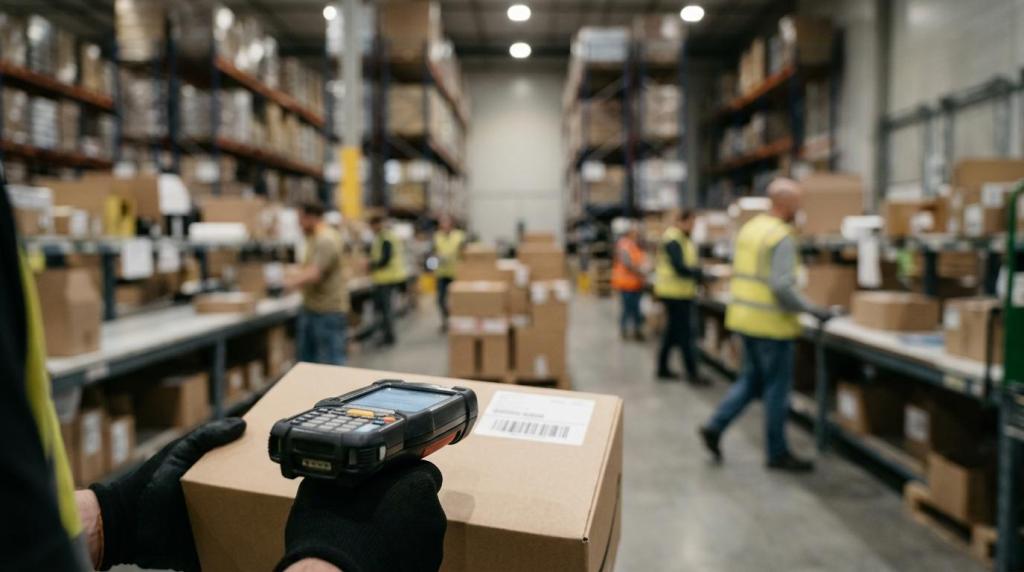
A product launch, particularly when aligned with current market trends and tailored to the right audience, can turn products from a quiet performer into a runaway success in a matter of hours. One trending content clip catches attention on TikTok, social influencers post enthusiastic reviews, or a paid campaign lands at exactly the right moment. Sales spike, the website lights up, and the brand gets the kind of traction every ecommerce founder hopes for.
What happens next is far less visible than the social post that triggered it. Viral demand puts pressure on inventory, warehouse space, picking speed, packing quality, carrier collections, customer service, and returns. The real test is not whether a brand can sell more units. It is whether it can keep order accuracy, dispatch speed, and stock control intact while demand scales fast.
Viral product demand creates an operations challenge
Viral products put strain on a business in a very specific way. Demand does not rise in a neat line. It arrives in a wave, often concentrated into a narrow window, and it can be difficult to predict when the peak will hit or how long it will last. That creates a mismatch between marketing success and operational capacity.
A small in-house fulfilment setup may cope well at 100 orders a day and then begin to struggle badly at 400. Space runs short. Packing benches become bottlenecks. Temporary staff need training. Customer emails build up because parcels are late or tracking has not updated yet.
This is why fulfilment should be treated as a strategy-driven system, not a chore.
Industry data supports the shift towards outsourced logistics when growth becomes less predictable. The 2025 29th Annual Third-Party Logistics Study from CSCMP found that 82% of shippers said 3PLs contribute to improved customer service, while 66% said 3PLs help reduce overall supply chain costs. The same study reported that 87% of shippers had increased their use of outsourced logistics services to improve customer engagement. That tells a clear story: brands are moving fulfilment to specialist partners because speed alone is not enough. Consistency matters just as much.
After a viral campaign, the pressure points tend to appear in the same places:
- Inventory availability
- Pick and pack speed
- Order accuracy
- Carrier handoff
- Returns processing
- Customer communication
The logistics chain behind a viral ecommerce product
When a product suddenly takes off, the logistics chain becomes visible very quickly. Every step needs to work in sequence, and weakness in one area soon affects the others.
A TikTok campaign may create thousands of orders in a short burst, yet those orders only become a positive customer experience if the stock is available, visible in the system, allocated correctly, picked accurately, packed to the right specification, labelled properly, handed to the correct carrier, and delivered on time. If returns start flowing back a week later, the same chain continues in reverse.
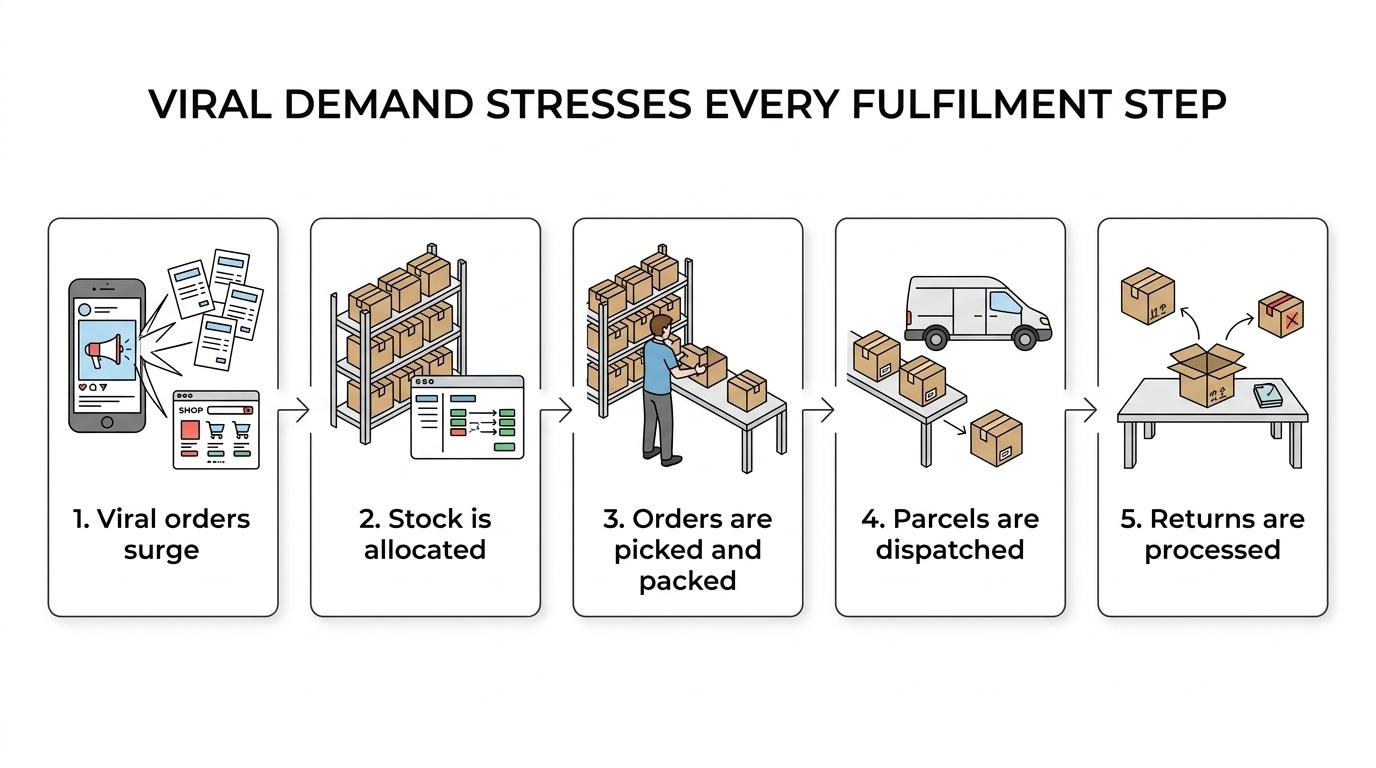
The table below shows where the pressure usually builds.
| Logistics stage | What needs to happen | Common risk during a viral spike | How a 3PL can help |
|---|---|---|---|
| Inbound stock | Goods received and booked in quickly | Stock delays or inaccurate counts | Dedicated goods-in process and faster receiving |
| Inventory management | Live stock levels kept accurate | Overselling or hidden shortages | Real-time stock control across channels |
| Order routing | Orders flow from store to warehouse | Manual exports and delays | API integration with ecommerce platforms |
| Pick and pack | Orders assembled to spec | Mis-picks, missed inserts, poor presentation | Trained warehouse staff and documented SOPs |
| Dispatch | Parcels handed to carriers on time | Missed same-day cut-offs | Carrier booking discipline and dispatch planning |
| Customer service support | Tracking and issue handling | Complaints rise as volume rises | Cleaner order data and faster status visibility |
| Returns and reverse logistics | Returned items inspected and processed | Refund delays and stock losses | Structured returns workflows and resale decisions |
That is why a viral product is really an end-to-end operations event. The visible sale is only the first movement in the journey of content and logistics.
Flexible warehouse space and trained fulfilment staff during order surges
The most immediate problem after a products launch goes viral is physical capacity. A growing ecommerce brand may have enough stock on paper, yet still lack the warehouse room and labour capacity to process orders at the required speed. Pallets arrive, aisles tighten, workstations become crowded, and the team begins working reactively.
A third-party logistics provider can change that picture fast. Large flexible warehouse space allows stock to be received, stored, replenished, and picked without the same spatial limits found in small private units. Capacity becomes something a brand can access when needed, rather than something it must build from scratch under pressure.
Staffing is just as important. A surge in order volume is not solved simply by adding hands. Those hands need to follow documented processes, use the warehouse system correctly, understand packaging rules, and maintain pace without letting accuracy drop. Well-trained fulfilment staff make the difference between a growth moment and a service problem.
One 3PLWOW case study describes a direct-to-consumer home and lifestyle brand that grew from roughly 4,000 monthly orders to more than 14,000 before moving fulfilment to a 3PL. After outsourcing, reported monthly order capacity rose from 15,000 to more than 35,000 within 90 days. The same case study reports order accuracy improving from 96.2% to 99.4% and same-day dispatch rising from 71% to 94%.
Those figures matter because viral growth often exposes a hidden trade-off. When teams race to ship more parcels, mistakes usually follow. A capable 3PL aims to break that trade-off by pairing labour scale with process discipline.
Good execution at this stage usually includes:
- Documented packaging rules: photos, inserts, labelling positions, and presentation standards
- Flexible labour planning: the ability to add trained staff during campaigns and peaks
- Warehouse slotting discipline: high-demand items positioned for faster picking
- Cut-off management: clear same-day dispatch windows and carrier collection timing
Another 3PLWOW case study says a small ecommerce brand scaled to 10,000 orders a month after moving to a 3PL arrangement, with packaging specifications documented using photos before the ramp-up. That detail sounds modest, yet it is exactly the kind of operational preparation that protects a brand when volume jumps suddenly.
API integration, stock control, and control tower visibility
A viral campaign, perhaps propelled by influencers on platforms like TikTok, can expose weak systems within hours, highlighting the importance of a solid social strategy to handle rapid growth effectively and engage the audience. If orders need to be exported manually from Shopify, WooCommerce, Amazon, or another sales channel, delays begin almost at once. If stock levels are not updating correctly, the brand may oversell. If tracking data is slow to sync back, support tickets rise.
API integration is one of the strongest arguments for using a 3PL during rapid growth. When the store, warehouse, and shipping workflows are linked properly, orders can flow automatically into fulfilment queues, stock can update in near real time, and key statuses can return to the storefront and customer service teams without rekeying information.
That creates something close to control tower visibility. A brand can see what has landed, what is available, what has been allocated, what has shipped, and what is delayed. During a viral spike, that visibility supports better decisions about reordering, ad spend, and customer engagement messaging.
The commercial value is easy to miss at first. Better stock control is not only about avoiding embarrassment from overselling. It also helps brands protect profitable momentum. If one SKU is running low while another has strong depth, campaigns can be adjusted before a stockout damages conversion.
The wider ecommerce market is large enough that trending market trends and these system demands are not going away. The U.S. Census Bureau estimated retail ecommerce sales at $340.2 billion in the second quarter of 2026, up 12.2% from the same quarter in 2025. More online purchasing means more transactional complexity, more fulfilment traffic, and less tolerance for slow manual processes.
Dispatch speed, carrier performance, and peak mailing season pressure
A viral product can be packed perfectly and still disappoint customers if products aren’t dispatched promptly. Buyers now expect quick movement from checkout to carrier scan, especially when the social campaign that drove the purchase created urgency.
Same-day dispatch is a meaningful performance marker because it reflects the health of the warehouse operation. It tells you whether cut-offs are being met, whether order queues are being cleared, and whether labour has been matched to volume. The 3PLWOW case study figures mentioned earlier, rising from 71% to 94% for same-day dispatch, show how much room there often is for improvement when a specialist fulfilment operation takes over.
Carrier coordination also becomes more demanding when volume spikes. A single viral moment can push parcel counts above agreed collection assumptions. Labels still need to be generated correctly, sortation needs to stay clean, and collections need to happen on time. If the campaign lands during the peak mailing season, the pressure rises again. The U.S. Postal Service Office of Inspector General has noted that package volume increases from Thanksgiving through New Year’s Eve can significantly strain processing and distribution networks. A social media surge layered on top of seasonal volume is a serious stress test.
This is where an experienced 3PL adds practical resilience:
- pre-planned dispatch windows
- Carrier handoff routines
- volume forecasting based on live order flow
- contingency options when collections tighten
Returns management and reverse logistics after the campaign
The sale is not the end of the logistics chain. If anything, viral products promoted by influencers on TikTok, especially if they’re trending on social media, can trigger a second wave of operational work once parcels start arriving with customers.
Online return rates remain materially higher than store purchases. The National Retail Federation reported that retail returns rose from 8.8% in 2012 to 14.5% in 2023, and that online purchases had a 17.3% return rate in 2023 compared with 10% for in-store purchases. That creates real reverse logistics pressure for retailers, especially when a campaign brings in many first-time buyers who may not be familiar with the product.
Returns need structure. Parcels must be received, inspected, categorised, refunded, and either returned to saleable stock, quarantined, or written off. If this process is slow, the strategy to maintain customer trust fails and can be adversely affected by shifting market trends. If it is inconsistent, inventory accuracy degrades. Both outcomes are expensive.
A 3PL with Returns management capabilities can give a brand much better control of this part of the cycle. Returned inventory can be assessed against set rules, stock can be updated quickly, and reporting can help identify product issues or campaign mismatches. That matters because returns are not just a customer service matter. They feed directly back into stock control, margin, and replenishment decisions.
Strong reverse logistics usually depends on a few clear disciplines:
- Fast intake: returned parcels booked in without sitting untouched for days
- Condition grading: resale, rework, quarantine, or disposal decisions made to rule
- Refund triggers: prompt status updates back to the brand or platform
- Stock recovery: saleable units returned to available inventory quickly
How a 3PL like 3PLWOW supports ecommerce growth after a viral hit
For a growing brand, the appeal of a provider like 3PLWOW is not only extra warehouse space, but also advanced content management that streamlines communication and branding. It is the combination of space, people, systems, and process control in one operating model.
Flexible warehouse capacity gives the brand room to hold more stock and process more orders, especially during a product launch, without taking on a new lease, fitting out additional racking, or recruiting a larger warehouse team at short notice. A large trained workforce makes it easier to maintain pace during rapid growth. API integration supports faster order flow and clearer stock visibility. Returns management keeps reverse logistics from becoming an afterthought. Stock control keeps the business grounded in reliable numbers when campaign excitement is at its highest.
That combination, along with improved customer engagement strategies, can be especially valuable for brands moving from founder-led fulfilment to a more mature operating rhythm, ensuring their processes are robust enough to accommodate a growing audience. Many businesses do an impressive job early on with a small team and plenty of energy. Viral growth changes the rules. Once the order queue expands sharply, the business needs repeatable processes and measurable service levels.
The strongest 3PL relationships tend to be built around a few practical expectations:
- Service level clarity: dispatch targets, accuracy targets, and escalation rules are defined early
- Data visibility: inventory, orders, and exceptions are easy to monitor
- Campaign readiness: inbound stock, staffing, and cut-offs are reviewed before promotions launch
- Brand consistency: packaging instructions and presentation standards are documented and followed
When those pieces are in place, a viral campaign becomes less of a gamble. The brand can keep marketing with confidence because the fulfilment engine has room to absorb success, not just survive it.
That shift is often what turns a single viral product into a stronger business rather than a brief online moment, by ensuring products are consistently available and efficiently managed throughout the logistics process.