
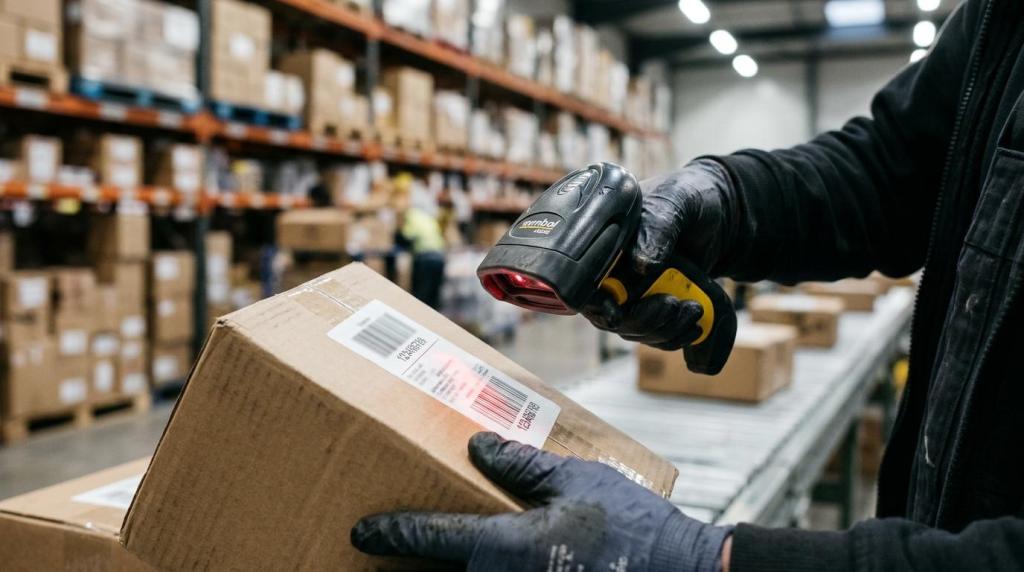
Order fulfilment often looks manageable right up to the point when it stops being manageable. A growing ecommerce brand can move from packing a few hundred parcels a week to dealing with late cut-off times, stock discrepancies, customer chasers and rising labour pressure in what feels like a very short span.
That is where a 3PL, or third-party logistics provider starts to make real commercial sense—and helps explain why chose a 3pl to do your order fulfilment? Choosing a 3PL is not only about outsourcing pick, pack and dispatch. It is about creating enough operational capacity to support growth, protect the customer experience and give the business room to focus on sales, product and brand building.
3PL order fulfilment solves the scaling gap for growing brands
Many brands reach a point where sales growth outpaces warehouse capability. Shelving becomes cramped, temporary staff become a regular cost, and dispatch performance starts to drift. The issue is rarely effort. It is usually that the operational model no longer matches the volume.
A capable 3PL gives a business access to warehouse space, trained teams, carrier relationships, warehouse technology and established processes that support accurate stock management, efficient order processing, inventory management, logistics infrastructure, distribution and scalability, without the brand having to build all of that alone. That can shorten the time between growth plans and practical execution.
Published case study data shows what this can look like in practice. One 3PLWOW case study reported a brand increasing monthly order capacity from 15,000 to more than 35,000 within 90 days of moving to a 3PL model. The same case study reported order accuracy improving from 96.2% to 99.4%, while same-day dispatch rose from 71% to 94%.
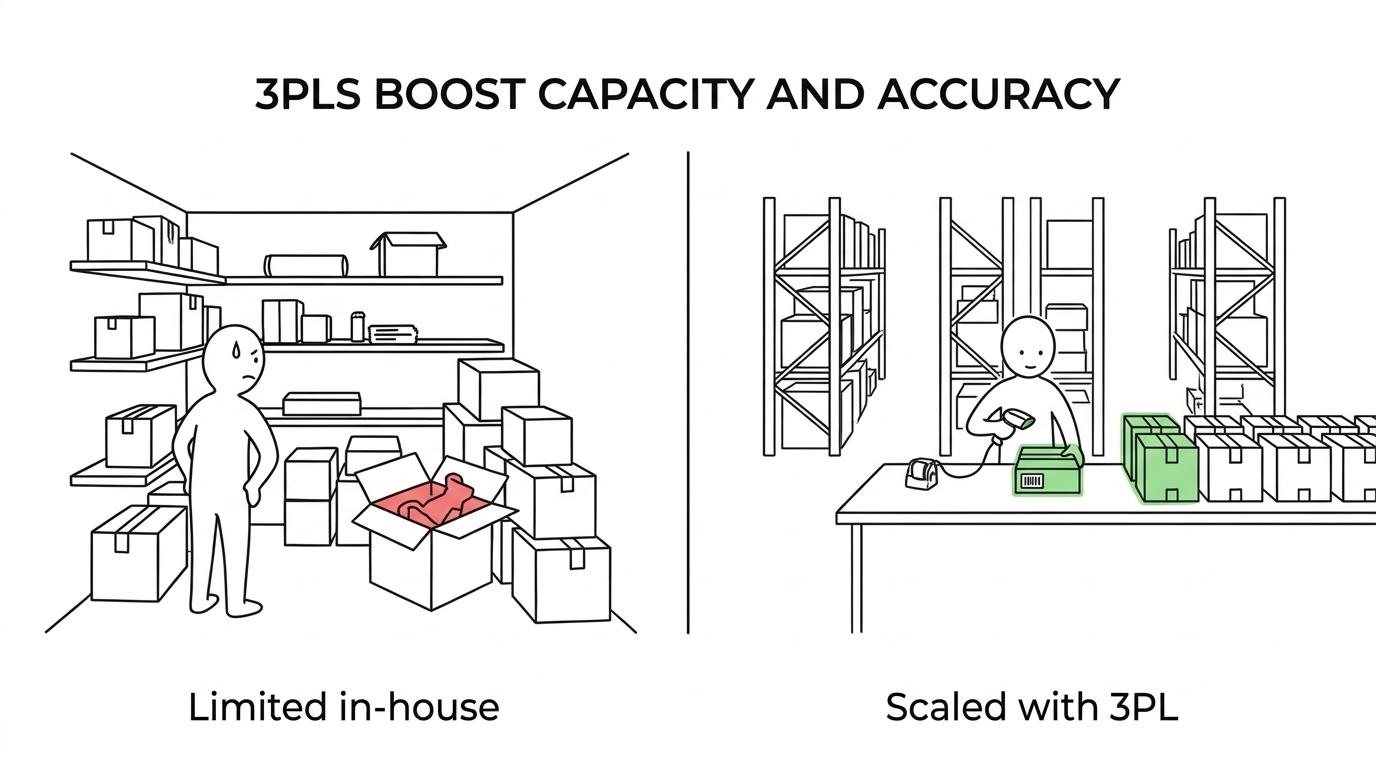
Those numbers matter because fulfilment performance has a direct effect on revenue quality. It is not only about how many orders can be shipped. It is also about how many are shipped correctly, how quickly they leave the warehouse and how much customer effort is required afterwards.
A few signs usually show that in-house fulfilment is reaching its limit:
- Stock stored in overflow areas
- Dispatch cut-offs becoming harder to hit
- Packing errors rising during peak periods
- Founder or management time being pulled into warehouse issues
- Customer service teams spending more time on delivery queries
3PL customer service improves when delivery speed and accuracy improve
For ecommerce brands, customer service is often discussed as though it sits in a separate department from logistics. For e-commerce brands, that is rarely true. A large share of customer frustration starts with slow dispatch, unclear tracking, split shipments or missing items.
That link appears clearly in the market data. A 2025 industry study from Penske Logistics found that 82% of shippers agreed that using a 3PL contributes to improved customer service. That is a strong signal that fulfilment quality shapes the wider brand experience.
Speed is part of that expectation. The same industry source noted that roughly half of respondents expect customers to want delivery in under two days. For direct-to-consumer brands, that expectation changes the fulfilment standard. A warehouse model that worked well when customers were patient can feel slow once the market moves.
3PL providers are often better placed to meet that standard because they already manage logistics around dispatch windows, carrier hand-offs and peak-volume workflows, making them a strong option for brands comparing 3pl providers. Their systems are built for daily throughput rather than occasional bursts. That helps brands offer a more reliable promise to customers without rebuilding operations from scratch.
There is also a quieter gain. When fulfilment improves, support demand usually drops. Another published 3PLWOW case study reported that shipping-related customer support contacts fell by 38% after the move to outsourced fulfilment. Fewer “where is my order?” messages means faster response times for more valuable customer conversations.
| Business pressure | What a 3PL changes | Why it matters |
|---|---|---|
| Order spikes | Adds labour and process capacity | Fewer backlogs during promotions and peaks |
| Slow dispatch | Uses established cut-off and carrier workflows | Faster shipment movement |
| Picking errors | Applies standardised warehouse controls | Better accuracy and fewer replacements |
| Delivery complaints | Improves tracking and dispatch consistency | Lower customer service strain |
| Growth into new channels | Supports marketplace and D2C order streams | Simpler multi-channel expansion |
3PL cost savings come from total operating efficiency
Cost is one of the main reasons brands consider a 3PL, yet it is often assessed too narrowly. The question should not be “is a fulfilment fee cheaper than doing it ourselves?” The better question is “what is the total cost of serving each order well?”
That wider view includes warehouse rent, labour management, packaging procurement, software, equipment, training, error correction, carrier negotiation, returns handling and the management time spent keeping everything on track. When those costs are added together, in-house fulfilment can be more expensive than it first appears.
The same Penske Logistics study found that 66% of respondents said 3PLs contribute to reducing overall costs. That does not mean every outsourced model is cheaper in every case. It does suggest that many businesses see financial value once they look beyond the surface line items.
A 3PL can also shift fixed cost into variable cost. That matters when order volumes fluctuate. Rather than carrying a warehouse set-up sized for peak demand all year round, a brand can pay more in line with actual throughput. That usually brings healthier cash discipline and lowers the risk of underused space and staffing.
The cost gains often come from several operational areas working together:
- Labour model: shared warehouse teams reduce the need to recruit, train and cover absence internally
- Carrier buying power: larger shipping volumes can support better rate structures and service options
- Space efficiency: storage is paid for more precisely than leasing extra room “just in case”
- Error reduction: fewer wrong picks and late shipments cut replacement, refund and support costs
- Management focus: internal teams spend more time on revenue growth and less time firefighting warehouse issues
3PL fulfilment performance improves speed, accuracy and returns handling
Speed and accuracy tend to get the most attention, yet returns handling can be just as important. A poor returns process ties up stock, delays refunds and creates friction at exactly the moment a customer is deciding whether to buy again.
Many 3PLs bring more discipline to reverse logistics than smaller in-house teams can maintain consistently. Returned stock can be checked, graded, restocked or quarantined to a clearer timetable, which improves stock visibility and shortens refund cycles. That protects both customer trust and inventory availability.
Published case material points to the operational effect. One 3PLWOW case study reported return processing time falling from six days to two days after outsourcing. In categories with higher return volumes, that sort of change can have a material impact on cash flow and stock control.
There is also a compounding benefit here. Better forward fulfilment reduces avoidable returns caused by wrong items, incomplete packs or damaged delivery outcomes. Better reverse fulfilment deals with the returns that still happen. Together, they produce a more stable operation.
Choosing a 3PL for order fulfilment makes most sense at key growth stages
Some ecommerce brands ask, “Why choose a 3PL to do your order fulfilment?” The better test is operational complexity and logistics needs rather than ego or company size.
A fast-growing brand doing 4,000 to 10,000 orders a month with strong seasonality may need a 3PL sooner than a steadier business shipping more than that from a simple product range. Channel mix matters too. Selling across a D2C website, marketplaces, retail replenishment and subscription orders creates a far more demanding fulfilment picture.
The timing is often right when a business faces one or more of these realities:
- Rapid monthly order growth
- Seasonal peaks that strain internal teams
- Delivery promises becoming harder to keep
- A move into new sales channels
- International shipping complexity
- Too much leadership time spent on warehouse operations
There is another trigger worth taking seriously: customer expectations rising faster than warehouse capability. Once that gap opens, it tends to widen.
What to ask when selecting a 3PL fulfilment partner
Not every 3PL is the right fit for every brand. The strongest partnerships come from matching the provider’s operating model to the brand’s product mix, order profile, customer promise and growth plans.
A good selection process for an ecommerce business should test more than price. Service levels, systems connectivity, reporting clarity and problem resolution are just as important. A low fulfilment fee loses its appeal quickly if stock data is unreliable or if peak season performance drops at the worst time.
When assessing a potential partner, the most useful questions are often the simplest ones:
- System integration: how will orders, stock levels and tracking data move between platforms?
- Service levels: what accuracy, dispatch and returns targets are standard, and how are they reported?
- Peak readiness: what changes during promotions, holidays and sudden demand spikes?
- Carrier options: which delivery services are available for standard, express and international orders?
- Stock control: how are cycle counts, discrepancies and damaged goods handled?
- Support model: who speaks to the brand when issues need urgent action?
It is also sensible to ask for evidence rather than promises. Operational dashboards, live reporting examples, onboarding plans and relevant case studies will usually tell you more than broad sales language.
The best 3PL relationships feel like a practical extension of the brand’s own operation. Customers may never know the fulfilment has been outsourced, and that is often a positive sign. The experience still feels consistent, reliable and fast.
A strong provider should also help a brand think ahead. According to the same Penske Logistics study, 68% of respondents said 3PLs provide new and innovative ways to improve logistics effectiveness. That matters because fulfilment is no longer a back-office function. It shapes customer retention, review quality, working capital and the confidence to scale.
Choosing a 3PL, then, is less about handing work away and more about building a fulfilment model that can keep pace with ambition.