

Selling collagen well is not only about demand generation, product formulation or attractive packaging. Once orders start moving, the daily pressure shifts to operations: keeping flavours separate, assembling kits correctly, recording batches, and sending subscription parcels on time without swapping one sachet or tub for another.
That is why collagen fulfilment tends to need a more disciplined workflow than standard pick-and-pack. A warehouse handling supplements is not simply storing cartons and printing labels. It is managing product variants, date-sensitive stock, food information, and recurring order patterns that can change by flavour, bundle, format and customer preference.
Why collagen fulfilment needs variant control
Collagen ranges often look simple from the outside. A brand may have only a few core products, yet each one can multiply into several operational variants: flavour, tub size, sachet format, single unit, starter bundle, subscription offer, promotional pack, and international pack version. Those differences matter at shelf level and they matter even more at dispatch level.
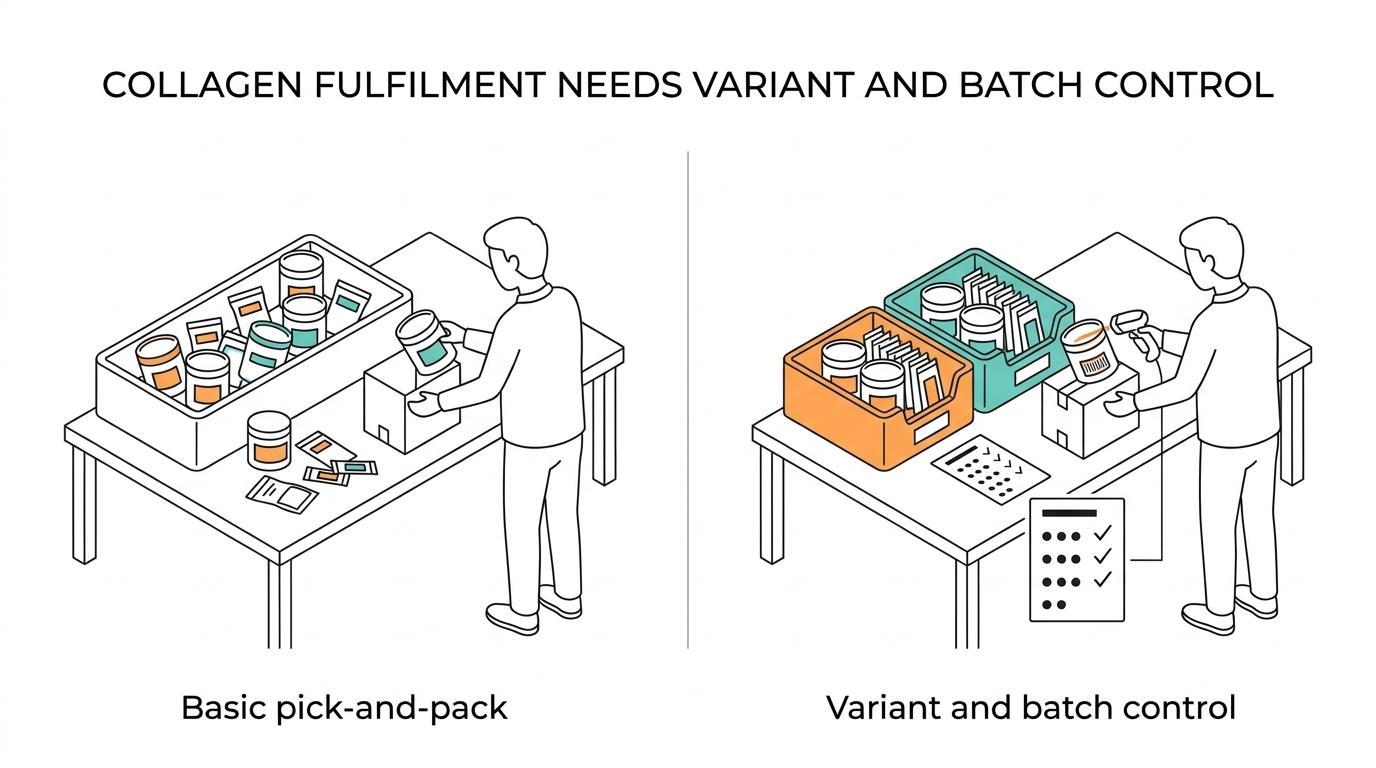
A generic fulfilment setup can struggle here. If inventory is stored too broadly, strawberry can sit too close to unflavoured, marine collagen can be mixed with bovine variants, and promotional sleeves can be picked as though they were standard stock. The result is not just customer disappointment. It can also create stock inaccuracies, subscription errors and traceability gaps.
A collagen workflow works better when stock is identified and stored by clear product attributes, including SKU, flavour, format and agreed batch or expiry data. That makes picking faster, but it also gives the warehouse a dependable structure for stock rotation and order checking.
Typical variant points include:
- flavour
- tub or sachet format
- starter kits
- multi-buy offers
- subscription frequency
- batch and best before profile
SKU, flavour and batch management in collagen warehouses
For collagen brands, the warehouse map should reflect how customers actually buy. If vanilla tubs and chocolate sachets are sold both as one-off orders and as part of trial kits, those units need location logic that supports both single picks and kit assembly. A smart layout reduces walking time, lowers mis-picks and keeps busy subscription runs under control.
Batch-aware inventory handling is just as important. UK food traceability guidance expects businesses to keep records covering supplier and customer details, product information, quantities, dispatch or delivery dates, and batch, lot or consignment codes where available. Best practice is to keep all lot or batch codes where available, and to be able to provide that information promptly if requested. That makes traceability a live warehouse task, not an office-only responsibility.
In practice, this means fulfilment teams need to know not only what stock is on hand, but which stock is being picked. If the system records a SKU but not the relevant lot or batch, the operation may look tidy while carrying avoidable risk.
| Fulfilment area | Standard e-commerce approach | Collagen-specific approach |
|---|---|---|
| Product identification | Basic SKU only | SKU plus flavour, format, batch and date profile |
| Storage logic | General bin location | Segregated locations by variant and stock profile |
| Order assembly | Single-item focus | Single units, bundles, accessories and recurring packs |
| Stock rotation | Broad FIFO practice | Date-aware rotation with batch visibility |
| Traceability records | Parcel and SKU record | Parcel, SKU, quantity, batch and dispatch history |
| Exception handling | Replace with similar item | Strict variant control to avoid flavour or label mismatch |
When operations are set up this way, fulfilment becomes easier to scale. A higher order volume does not automatically mean higher confusion, because the warehouse has a consistent method for variant control built into everyday work.
Starter kit assembly and bundle rules for supplement orders
Starter kits are often where collagen fulfilment becomes noticeably more complex. A new-customer box may include a tub or sachets, a scoop, a frother, a tin, printed guidance, samples, and marketing inserts. Every extra component adds value to the customer experience, yet each one adds a potential failure point in the warehouse.
That is why bundle rules matter. A kit should not exist as a vague instruction on a spreadsheet or a note in a customer service inbox. It needs a defined packing recipe: exact components, quantities, presentation order, and any version differences by flavour or offer type.
Some bundle requirements are straightforward, while others need a tighter control method:
- Core product: one tub, sachet sleeve or mixed trial pack
- Accessory item: frother, shaker, scoop or storage tin
- Printed content: welcome card, dosage guidance or offer insert
- Promotional logic: free sample, launch gift or seasonal extra
- Presentation rule: tissue wrap, carton format or branded packing sequence
When this is handled properly, kit assembly stops being an awkward exception and becomes part of the normal fulfilment flow. That matters because starter kits often perform two jobs at once: they bring in first-time customers and they set the tone for future repeat orders.
A well-built first box can make the brand feel organised before the customer has even opened the product.
Subscription fulfilment and recurring dispatch planning
Subscription orders ask for a different style of warehouse planning. One-off e-commerce parcels are reactive by nature. A customer buys, the order appears, and the parcel goes out. Recurring collagen orders are more structured. They arrive in waves, follow a dispatch calendar, and often need repeat accuracy over many months.
That changes staffing, packing schedules and stock allocation. If several hundred monthly subscription orders are due across a narrow dispatch window, the warehouse needs stock positioned and reserved in advance. If the brand allows flavour swaps or alternative kit combinations, those rules need to be captured in the order feed rather than corrected manually at the bench.
Recurring dispatch also affects packaging consistency. Subscribers notice changes quickly. If the first three orders arrive in a tidy branded presentation and the fourth arrives missing an insert or packed in a larger substitute box, the sense of routine weakens. For subscriptions, consistency is part of retention.
Subscription order handling for collagen brands
A reliable recurring-order process often includes a few practical controls. These are not glamorous, but they are where performance is won.
- subscription date planning
- stock reservation for upcoming runs
- flavour-specific picking waves
- repeat insert control
- tracked dispatch status
- exception review before cut-off
Subscription fulfilment also benefits from batch visibility. If a warehouse can see incoming date profiles and outgoing subscription demand together, it can allocate stock more sensibly and reduce the chance of short-dated units creating avoidable service issues.
Food supplement labelling requirements in UK fulfilment
Collagen products sold as food supplements in Great Britain must meet general food labelling rules as well as supplement-specific requirements. That is not just a packaging design matter. It has direct operational impact because the fulfilment team is handling the physical units that carry those labels, along with any relabelled bundles, outer cartons or inserts used in saleable kits.
UK guidance on food labelling requires relevant packaged food information to include items such as the name of the food, a best before or use-by date where required, the lot number or use-by date, net quantity, ingredients where applicable, special storage conditions, and instructions for use where necessary. Labels must also show the name and address of the business under whose name the food is marketed, or the importer where relevant.
Supplement-specific labelling adds more operational points. Products should include ingredients and emphasised allergens, the recommended daily dosage, a warning not to exceed that dosage, storage instructions, a use-by or best-before date, and a statement that supplements should not replace a varied diet.
For fulfilment teams, these requirements shape everyday checks:
- Label presence: saleable stock should carry the required product information before pick release
- Date visibility: best before or use-by details need to be readable and matched to batch records
- Net quantity accuracy: tubs, sachet cartons and mixed packs must match the declared quantity
- Storage instruction handling: products needing particular conditions should be stored and packed accordingly
- Bundle integrity: kits should not obscure required information on the saleable unit
This is one reason supplement fulfilment cannot be treated as a simple parcel operation. The warehouse sits close to compliance, even if the brand owner remains responsible for the product information itself.
Traceability records and stored documentation for collagen orders
Traceability is often discussed in abstract terms, yet the operational meaning is concrete. A brand should be able to show what product came in, from whom, in what quantity, under which batch or lot, where it went, when it was dispatched, and to which customer or trade account. If records are spread across disconnected systems, that task becomes slower than it should be.
The good news is that UK guidance does not force a single technical model. Records can be paper-based, electronic, stock-management based or handled through traceability software, provided the information can be produced promptly when requested. That gives brands room to choose a setup that fits their scale, as long as discipline is maintained.
Invoices and delivery notes also matter. Businesses selling food supplements are expected to keep records showing who they bought from and who they sold to, and to retain relevant documents for enforcement authorities if requested. In other words, traceability is not only about warehouse scans. It is the full chain of stock movement and supporting paperwork.
This tends to reward a fulfilment partner or internal operation that treats documentation as part of daily process rather than an afterthought.
Choosing a collagen fulfilment workflow that supports growth
As collagen brands widen their catalogue, operational strain rarely appears all at once. It usually starts with a few small signs: a flavour mix-up here, a starter kit shortage there, a late subscription wave, or uncertainty over which batch went into which dispatch run. Those signals are useful. They show where the fulfilment model needs to mature.
A stronger setup is built around three ideas. First, variant control must be tight enough to separate flavours, formats and bundle versions without slowing the floor. Second, batch traceability needs to be embedded into stock handling and dispatch records. Third, subscription logic should be planned as a recurring service model, not treated as ordinary daily parcel traffic.
When those pieces are in place, fulfilment starts to support brand growth in a very direct way. New flavours become easier to launch. Trial kits become easier to repeat accurately. Subscription volumes become easier to forecast and pack with confidence. And compliance-related tasks stop feeling like interruptions because they are already part of the workflow.
For collagen and supplement brands, that is where operations begin to feel less reactive and far more ready for scale.