

Selling food supplements online can look similar to selling cosmetics, clothing or homeware. A customer places an order, a parcel is picked, packed and sent, and the brand focuses on marketing and growth.
That surface view is misleading.
Food supplements sit in a different category because they are ingested, regulated as food in the UK, and expected to move through a supply chain that can show clear records, correct labelling and proper storage conditions. Once a brand reaches any meaningful order volume, generic fulfilment often stops being good enough. This is the point where a specialist third-party logistics provider, or 3PL, becomes a smart operational decision rather than a simple outsourcing choice.
UK food supplement fulfilment is governed by food law
In the UK, food supplements are regulated as food. That changes the fulfilment conversation straight away. A warehouse is not just moving stock from shelf to parcel. It is handling products that must be stored and dispatched in a way that supports food-law obligations around traceability, labelling and record keeping.
Government guidance on food traceability uses a simple principle: one step back and one step forward. A business should be able to identify who supplied a product and who it was supplied to. For supplement brands, that means records need to stay organised and accessible, not buried in spreadsheets, inboxes and courier exports spread across several systems.
A capable 3PL helps turn those requirements into daily process rather than admin panic.
After all, traceability records are not limited to a product name on an invoice. They should capture practical information that matters if there is a quality issue, a customer query or a recall.
- supplier details
- customer details
- product type and quantity
- delivery and dispatch dates
- batch, lot or consignment codes where available
That is one reason supplement fulfilment deserves more care than generic ecommerce fulfilment. If a business cannot quickly isolate where a batch came from, where it went, and how much of it moved through the warehouse, the risk is not just operational. It is commercial and reputational as well.
Labelling matters too. UK guidance for food supplements covers more than branding and claims. Storage instructions, recommended daily dosage, allergen information where relevant, and a use-by or best-before date all sit within the wider expectation that products are correctly presented to the customer. A 3PL does not write the label, but it does influence whether the right labelled unit goes to the right buyer in the right condition.
Traceability requirements make specialist 3PL systems valuable
A generic parcel warehouse is usually built for speed across many product types. That model works well for T-shirts or phone cases. It is less convincing for vitamins, powders, capsules and gummies where batch control and stock rotation can matter every day.
A specialist 3PL is usually set up with those details in mind from the start. The warehouse management system, receiving process, location controls and pick rules can all be shaped around supplement requirements. That creates a stronger fit between legal duty and warehouse reality.
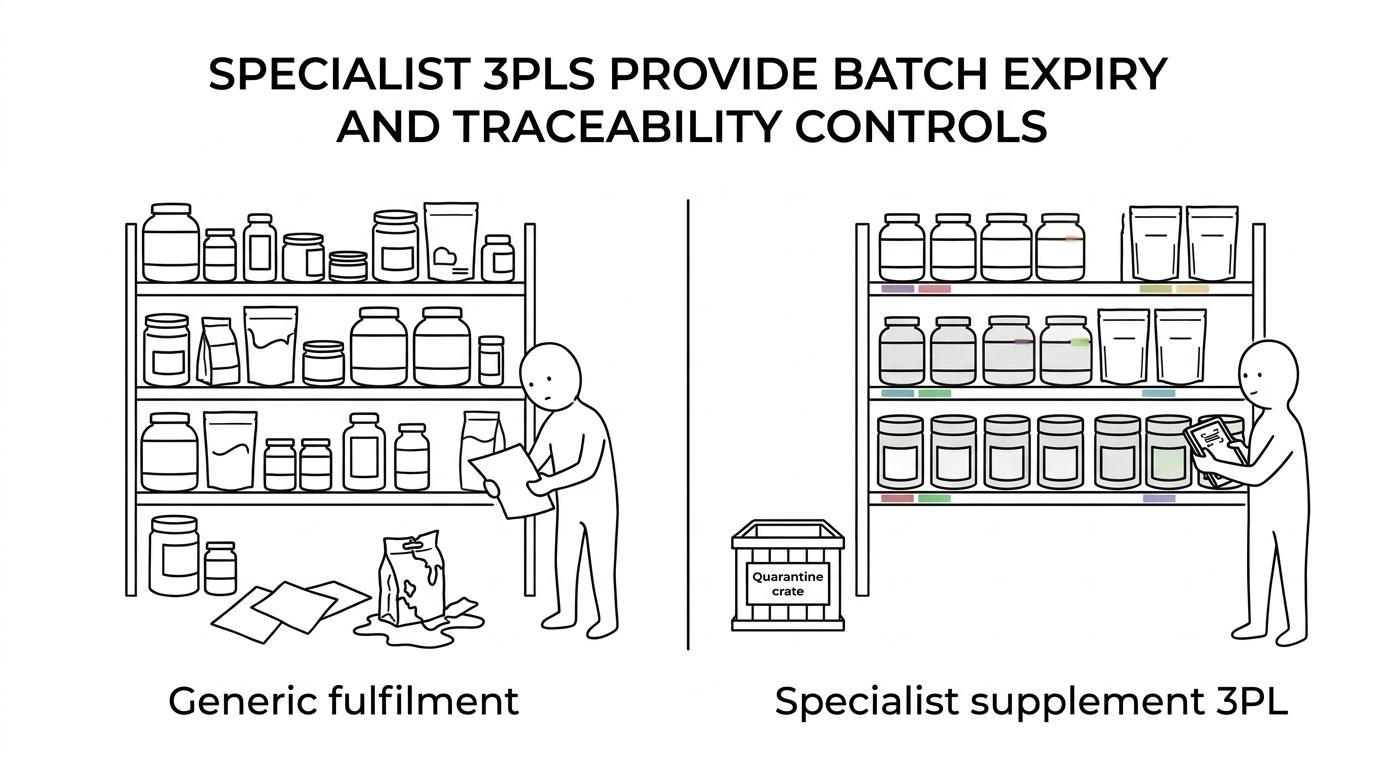
The gap between a generalist and a specialist can be seen clearly in day-to-day operations.
| Area | Generic ecommerce warehouse | Specialist supplement 3PL |
|---|---|---|
| Goods receiving | Focus on unit counts and SKU checks | Focus on SKU checks plus batch and date records |
| Stock storage | Standard shelving approach | Controlled storage with food-related hygiene routines |
| Order picking | SKU accuracy first | SKU accuracy plus batch and expiry logic where needed |
| Traceability | Basic order history | One step back and one step forward record support |
| Incident response | Manual digging through records | Faster isolation of affected stock and orders |
This is where outsourcing becomes practical rather than theoretical. A brand does not need to build every control in-house, train a warehouse team from scratch, audit food-related routines and buy software capable of meaningful traceability. A well-chosen 3PL already operates that environment.
One market example is 3PLWOW, which says its supplement fulfilment service includes batch and expiry tracking, same-day dispatch before cut-off, and warehouse controls shaped around food safety practice. That kind of service positioning reflects a wider truth in the sector: supplement brands need more than storage and courier rates. They need handling that fits the product category.
Storage and handling controls for vitamins, powders and gummies
Supplements are not a single product type. A protein powder in a tub, a collagen sachet, a gummy vitamin and a capsule bottle can all behave differently in storage and dispatch. Some are more sensitive to heat. Some are more vulnerable to packaging damage. Some have shorter shelf-life pressure than others. A warehouse handling supplements needs routines that recognise those differences.
Cleanliness is an obvious issue, though it is often treated too casually until problems appear. Any ingestible product should be handled in a warehouse that takes hygiene seriously. That means documented cleaning schedules, sensible handling methods, pest monitoring and a clear process for dealing with damaged stock. These are not luxuries. They are part of responsible food-related warehousing.
Stock rotation is just as important. If short-dated stock sits behind newer receipts because locations are unmanaged, the brand pays twice. First through waste. Then through customer dissatisfaction when old stock reaches the market too close to its best-before date.
The operational controls that matter most are usually straightforward.
- Temperature discipline: helps protect products that can be affected by warm or unstable conditions
- Batch and expiry tracking: reduces the chance of sending the wrong stock or losing visibility during a recall
- Hygiene controls: supports safer handling for goods that are swallowed rather than merely used
- Pest monitoring: expected in food-related storage environments and part of sensible warehouse governance
- Sealed handling processes: lowers the risk of contamination or avoidable packaging damage
This is another area where specialist providers stand out. 3PLWOW, for example, says its service follows HACCP food safety principles and includes pest control, hygiene monitoring and sealed handling. Whether a brand chooses that provider or another, the broader point remains the same: supplement operations need warehouse rules built around product integrity, not just parcel output.
Order accuracy and same-day dispatch matter in supplement ecommerce
Supplement brands often live on repeat custom. A shopper who buys magnesium, creatine or a daily multivitamin is not making a one-off impulse purchase in the same way someone might buy a decorative item. Reliability shapes retention.
That makes order accuracy more valuable than it may first appear. A wrong flavour, a damaged tub, a leaking pouch or a short-dated bottle can turn a regular buyer into a lost customer very quickly. A 3PL that understands supplements is more likely to treat picking accuracy, packaging suitability and date-sensitive stock rotation as connected issues rather than separate tasks.
Fast fulfilment only matters when it remains traceable.
The strongest 3PL setups combine service speed with control. Same-day dispatch before a cut-off time is attractive, though it should not come at the cost of poor checks or rushed handling. When the operation is designed properly, both can sit together. Orders move out quickly because processes are disciplined, not because corners are cut.
There is also a customer service angle. When a buyer asks about a batch, an expiry date, or whether an order contained the newest packaging revision, a good 3PL-backed operation can answer with confidence. That saves time for the brand team and builds trust with the customer.
Food supplement recalls and risk management are easier with a 3PL
No brand likes to think about recalls, stock holds or quality investigations, yet serious operators plan for them anyway. Supplements may be perfectly well made and still face a problem later, whether that involves a packaging issue, a labelling correction, or a supplier concern linked to a specific batch.
When that happens, the business needs speed, calm and records.
A specialist 3PL can make a difficult day far more manageable because the stock is already structured in a way that supports isolation and reporting. If the warehouse can identify affected batches, locate remaining inventory, stop dispatch and produce dispatch history quickly, the brand has a far better chance of handling the issue professionally.
This is where the one step back, one step forward principle stops sounding like a policy phrase and starts proving its worth.
Without that foundation, a recall can become a scramble across spreadsheets, inboxes, courier portals and manual stock counts. With it, the response can be focused and evidence-based.
Choosing a UK 3PL for food supplements
Not every 3PL that accepts supplement clients is equally prepared for supplement fulfilment. The decision deserves proper due diligence, especially for brands moving from a small in-house setup to outsourced warehousing for the first time.
A useful first check is whether the provider talks clearly about food-related controls rather than only ecommerce speed. Low storage rates and attractive shipping deals are welcome, though they should never be the main signal of suitability in this category.
The best questions are practical and direct.
- Can stock be tracked by batch and expiry date at goods-in, storage and dispatch?
- What hygiene, cleaning and pest monitoring routines are in place?
- How are best-before dates and stock rotation managed?
- What happens if a batch needs to be quarantined or recalled?
- Can the warehouse support storage instructions that suit the product range?
It also helps to ask how the 3PL handles growth. A brand may begin with a few SKUs and modest order volume, then add bundles, subscription orders, influencer spikes, marketplace sales and retail replenishment. The warehouse partner should be able to absorb that complexity without losing traceability discipline.
A strong supplement 3PL gives a brand room to scale without weakening control. That is the real value. The provider is not only shipping boxes; it is supporting a food product supply chain that needs precision, consistency and dependable records.
For ambitious supplement businesses, that support can become part of the brand promise itself. When every order goes out accurately, in good condition, with the right stock controls behind it, operations stop being a hidden risk and start becoming a visible strength.