
FIFO is one of those ideas that sounds obvious the moment you hear it. Stock comes in, stock goes out, and the oldest stock should leave first. Yet that simple rule sits behind some of the most practical decisions in inventory management, warehouse layout, stock valuation, and customer satisfaction.
For ecommerce brands, FIFO is rarely just a tidy warehouse habit; it plays a critical role in optimizing the supply chain. It affects product freshness, write-offs, batch control, and the ability to trace what was shipped to whom. That matters even more in categories like multivitamin supplements and collagen, where expiry dates, lot tracking, and product integrity are part of day-to-day operations.
FIFO definition in inventory and accounting
FIFO stands for First In, First Out. In plain terms, it means the stock received first should be the stock shipped or sold first. In warehousing, this is a physical stock rotation method. In finance, it is also an accounting cost formula.
Under IAS 2, inventories are measured at the lower of cost and net realisable value, and the cost of ordinarily interchangeable items can be assigned using FIFO or weighted average. In the accounting sense, FIFO assumes the earliest purchased or produced items are sold first, leaving the newest cost layers in closing inventory.
That accounting use is related to warehouse practice, but it is not identical.
| Aspect | FIFO in accounting | FIFO in warehouse operations |
|---|---|---|
| Main purpose | Assign cost to goods sold and closing inventory | Rotate stock physically so older goods leave first |
| Core assumption | First purchased items are sold first | First received stock is picked first |
| Main records used | Purchase costs, stock valuation records | Receipt dates, locations, batch data, scans |
| Common benefit | Clear costing method for interchangeable items | Less ageing stock, less waste, fresher inventory |
| Main risk if weakly managed | Inaccurate cost reporting | Old stock trapped in the warehouse |
For an ecommerce business, the warehouse meaning is usually the urgent one. If goods are not picked using a FIFO method, the system can still look correct on paper while the shelves tell a different story, especially in manufacturing settings where precise inventory management is critical.
Why FIFO improves ecommerce warehouse control
Online retail moves fast. Products arrive in waves, promotions change demand, and best-sellers can be replenished several times in a month. Without a reliable rotation method, older stock can sit unnoticed while newer deliveries keep getting picked.
That leads to expensive habits. A brand may assume stock is healthy because the total unit count looks fine, while older units are quietly drifting closer to expiry or becoming harder to sell because packaging has changed.
FIFO helps reduce that drift.
After strong process control is in place, FIFO tends to support several practical gains:
- fresher outbound stock
- fewer aged units
- cleaner stock rotation
- more reliable batch management
- lower risk of avoidable waste
For categories with repeat customers, it can also shape trust.
FIFO and FEFO for multivitamin supplements and collagen
FIFO is a strong default, but it is not always the final rule for date-sensitive products.
The closely related method is FEFO, which means First Expired, First Out. WHO guidance separates the two clearly: FEFO applies to items with an expiry date, while FIFO applies to items without one. In practice, that means a warehouse may receive one batch later than another, yet still pick it first if its expiry date comes sooner.
For multivitamin supplements and collagen products, that distinction matters.
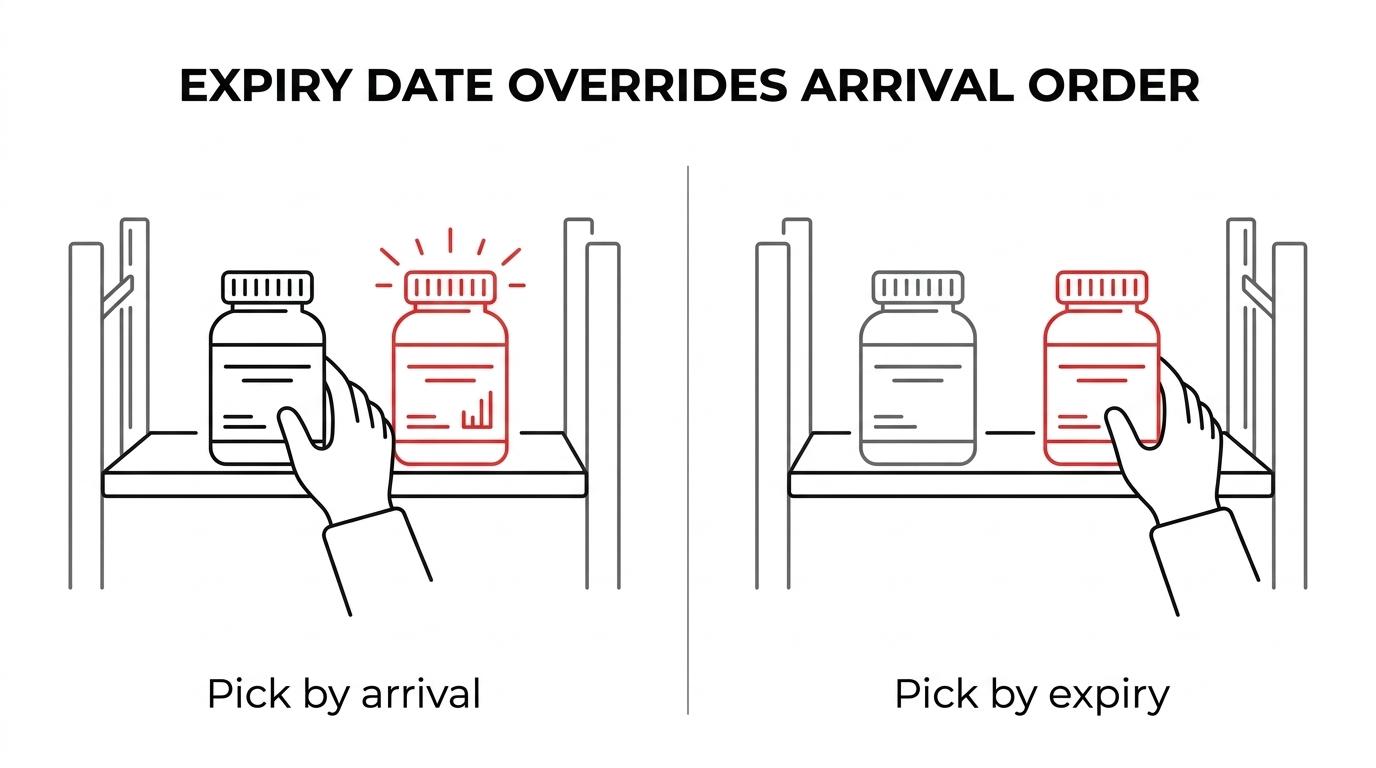
A brand may import or manufacture several batches during the manufacturing process that look identical at SKU level while carrying different lot codes and expiry dates. If the warehouse only follows receipt order and ignores shelf life, stock rotation can fail even when everyone believes FIFO is being followed.
A sensible way to think about it is this:
- FIFO: Use the oldest received stock first when products are equivalent and shelf life does not disrupt the sequence.
- FEFO: Use the stock with the earliest expiry first when expiry dates differ from arrival order, while FIFO ensures the earliest received products are used first regardless of expiry.
- Batch control: Keep lot and batch numbers attached to every movement so rotation can be checked later.
- Traceability: Maintain records that show what arrived, where it was stored, and which batch was shipped.
This is where supplement fulfilment becomes more exacting than general merchandise. A T-shirt in two cartons is easy to rotate by arrival date. A collagen powder or multivitamin bottle may need receipt-date control, expiry-date control, and batch traceability all at once.
FIFO warehouse steps used by third party logistics providers
FIFO only works when warehouse routines support it from the first scan to the final parcel label. A third party logistics provider, or 3PL, has to build that discipline into receiving, put-away, storage, picking, and stock checks.
Receiving is the first control point. When stock lands, the warehouse needs accurate receipt dates and, where relevant, batch numbers, lot codes, and expiry dates. If these details are not captured cleanly, FIFO becomes guesswork later.
Put-away comes next. Older and newer stock cannot be mixed carelessly in the same pick face if the business expects reliable rotation. Location control matters here. The warehouse management system should know exactly where each batch sits, and the physical layout should make it easy for staff to pick the correct units rather than the most convenient ones.
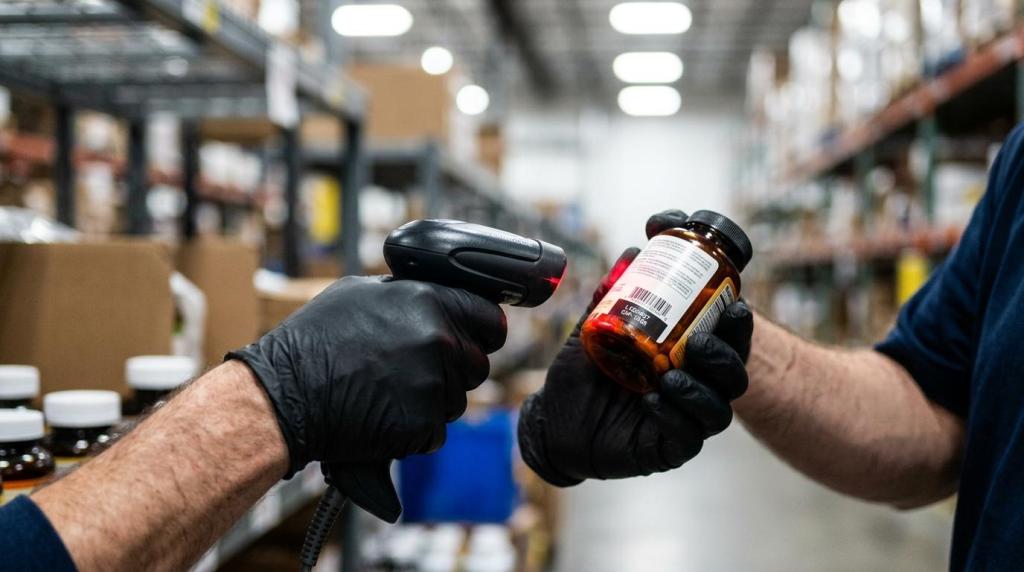
The FDA has noted that many distribution centres use warehouse management systems to track inventory and aid traceability, and that some systems rely heavily on barcode scanning to track product movement. That is highly relevant to FIFO. Barcode scanning creates a more dependable record of what was received, moved, picked, and despatched.
In day-to-day operations, the process often looks like this:
- Stock is booked in with product, quantity, date, and batch or lot details.
- The warehouse system assigns or confirms storage locations.
- Put-away keeps older stock accessible for earlier picking.
- Picking rules direct staff to the oldest valid stock, or the earliest expiry where FEFO applies.
- Cycle counts and stock checks confirm the physical flow still matches the system record.
A 3PL that handles supplements well does not treat FIFO as a one-off warehouse instruction. It treats FIFO as a rule supported by data, location discipline, and routine checking.
3PLWOW’s FIFO process for supplement ecommerce fulfilment
As a company case, 3PLWOW describes FIFO in straightforward terms: the stock received first should be the stock that leaves first. It also states that FIFO in warehouse operations affects receiving, put-away, storage layout, picking rules, stock checks, and the overall efficiency of the supply chain. That is a useful description because it reflects how stock rotation really works in practice.
The company also says FIFO is especially useful for supplement products, including food supplements and goods with batch codes or packaging changes over time. That fits the needs of multivitamin and collagen sellers. In both product groups, brands often need confidence that older stock is dispatched before newer receipts, while still preserving visibility over lot numbers and shelf life.
What stands out in this approach is that FIFO is not presented as a lone rule. It sits beside expiry dates, batch numbers, and lot numbers.
For supplement ecommerce operations, 3PLWOW says it uses FIFO management within the supply chain for expiry-date-sensitive products and also notes that FIFO or FEFO may be used where shelf life is a factor. That is the sensible balance. A collagen sachet or multivitamin tub is not just a stock unit; it is a result of precise manufacturing and comes with a dated life, a production batch, and a traceability requirement. It is a stock unit with a dated life, a production batch, and a traceability requirement.
That leads to a more disciplined fulfilment model:
- Receiving data: Stock records capture receipt timing and relevant batch details.
- Organised put-away: Older stock is positioned so it can be picked before newer stock of the same item, following the FIFO (First In, First Out) principle.
- Picking logic: The warehouse follows FIFO, or FEFO where expiry dates require it.
- Traceability records: Batch and lot control support checks, issue handling, and stock visibility.
For ecommerce brands, this matters beyond warehouse neatness. A supplement subscription business may sell the same SKU every day, with multiple replenishments crossing over in storage. If stock rotation is weak, newer replenishment can leapfrog older units, leaving ageing inventory buried in reserve locations. FIFO, backed by location control and system rules, reduces that risk.
Why FIFO matters so much for multivitamin and collagen brands
Supplements can look simple on the front end. A customer clicks, pays, and expects fast delivery. Behind that short transaction sits a product category with more operational sensitivity than many general ecommerce lines.
Multivitamins and collagen are often purchased for ongoing personal routines. Customers expect consistency, good shelf life, and packaging that matches the listing they saw online. If warehouse rotation slips, the effects can show up quickly: short-dated stock, outdated packaging, mixed batches, or more wastage than the brand expected.
There is also a stock value issue. Products that are date-sensitive can lose saleability as time passes, even if they remain technically in stock. FIFO helps protect stock value by reducing the chance that older units remain stranded while newer inventory gets sold first.
This is one reason 3PLWOW links FIFO to protecting stock value and reducing waste in supplement fulfilment. That claim is sensible when the process is actually enforced on the warehouse floor, not just mentioned in a standard operating document.
Questions to ask about FIFO, batch control and traceability
A brand choosing a fulfilment partner should not stop at asking, “Do you use FIFO?” Almost every provider will say yes. The better question is how that claim is supported in daily operations.
A useful conversation usually gets into system rules, exception handling, and proof.
You can ask things like:
- How are receipt dates recorded: manually, by scan, or both?
- How are batch numbers and lot codes captured: at goods-in only or through every stock movement?
- When does FEFO override FIFO: especially for short-dated supplement stock?
- How are pick faces replenished: in a way that preserves rotation or simply for speed?
- What checks prove compliance: cycle counts, audit trails, and despatch records?
Good answers tend to be specific, calm, and operational. They refer to barcode scanning, warehouse management systems, stock checks, and traceability records rather than broad promises.
For a collagen or multivitamin brand, that level of control is not overkill. It is what keeps stock rotation reliable when sales rise, batches overlap, and customer expectations stay high.