

A monthly box can look simple from the outside. A subscriber clicks “join”, chooses a plan, and expects a well-packed delivery to land on time every month. Behind that promise sits a much more demanding operation.
Subscription box fulfilment UK operations, including subscription order fulfilment, subscription box packing, and kitting services UK, are rarely a matter of sending the same parcel again and again; partnering with a 3pl provider can help manage these complexities at scale. Product combinations change. Customers pause, skip, upgrade, and restart. Packaging needs to feel branded and considered, yet still work at scale. Stock has to be available in the right quantities, at the right time, with the right batch and expiry controls. When any of those pieces drift out of sync, the subscriber notices immediately.
That is why strong subscription order fulfilment depends on clear rules, disciplined workflow design, and packing instructions that go right down to SKU level. The monthly delivery is the visible moment. The real work happens much earlier.
Why subscription box fulfilment UK operations need a different model
Recurring commerce has its own rhythm. A standard e-commerce order is often processed as a one-off transaction. subscription box fulfilment UK operations work in cycles, with fixed dispatch windows, repeat billing points, variable contents, and a much tighter link between customer expectation and operational accuracy.
This matters because not every recurring order is the same order repeated. One subscriber may receive a starter kit in month one, a refill in month two, and a themed bundle in month three. Another may skip a cycle, add a gift item, or switch product preference after an onboarding quiz. If the fulfilment process treats all of these as identical monthly packs, error rates rise quickly.
A practical model usually separates order logic into distinct fulfilment paths:
- Starter kits: first shipment with onboarding materials, tools, welcome inserts, or branded accessories
- Refills: repeat replenishment without introductory items
- Bundles: recurring core products plus one-off add-ons
- Limited editions
- Gift-with-purchase campaigns
That separation sounds operational, yet it has a direct effect on customer retention. Research published in 2023 analysed 22,551 customer reviews across 676 curated subscription boxes and found that both practical benefits and enjoyment influenced satisfaction, with enjoyment carrying the stronger weight. In plain terms, subscribers care about whether the box is useful, but they also care about whether it feels thoughtful and exciting. Fulfilment has to protect both.
Managing recurring deliveries in subscription order fulfilment
Recurring deliveries need calendar control before they need packing speed. If billing dates, order cut-offs, stock bookings, and dispatch waves are not planned together, the warehouse inherits confusion that should have been removed upstream.
A strong subscription order fulfilment setup usually starts with a service calendar. That calendar sets when subscriptions renew, when edits close, when stock is allocated, when kitting begins, and when parcels leave. It also defines what happens when a subscriber pauses, changes address, or edits product preferences after the cut-off.
The most useful controls are often the simplest:
- Billing cut-off: the last point at which subscribers can change their next box
- Stock reservation: inventory held against paid or confirmed orders before general sale
- Dispatch window: the agreed send period for each monthly cycle
- Exception queue: paused orders, failed payments, address issues, and manual reviews
- Reactivation rule: how restarted subscriptions re-enter the monthly run
This is where testing matters. A recurring programme should be checked against real scenarios, not just ideal ones. Month one orders, skipped renewals, incomplete payments, reactivations, mixed bundles, and promotional inserts all need their own expected outcomes. The cleaner the order flow, the calmer the dispatch week.
Subscription box packing rules for changing product combinations
Changing combinations are where many brands feel strain. A monthly theme, seasonal variation, or subscriber choice can turn a predictable process into a fragile one unless the packing instructions are explicit.
Subscription box packing should never rely on tribal knowledge. If the operation depends on one experienced team member remembering that vanilla subscribers get leaflet A while berry subscribers get leaflet B and an extra sample on month three, the process is already exposed.
A better method is to treat every live configuration as a defined pack build, with approved components, quantities, and packing order. This is where kitting discipline and warehouse system logic meet.
| Order type | Typical contents | Packing rule | Key control |
|---|---|---|---|
| Starter subscription | Core product, welcome insert, accessory, leaflet | Full introductory build | First-order flag |
| Standard refill | Replenishment product only | Reduced pack format | Renewal cycle rule |
| Personalised box | Selected variants based on preferences | Variant-specific assembly | SKU-level order mapping |
| Themed monthly box | Core items plus campaign insert or gift | Campaign kit build | Dispatch date by monthly wave |
| Re-activated subscription | Refill or re-entry pack depending on lapse length | Conditional pack type | Reactivation logic |
A table like this is not just useful for planning. It becomes the reference point for training, quality checks, and exception handling. Teams can pack faster when they do not need to interpret the order on the fly.
There is also a branding benefit here. When product combinations change, consistent packing structure gives the subscriber a stable experience. The box can still feel fresh while the operation remains controlled.
Kitting services UK and branded packaging at scale
Kitting services UK providers are often brought in when a brand reaches the point where hand-building boxes internally is no longer practical. That shift is about more than labour. It is about repeatability.
Branded packaging, inserts, tissue, samples, QR cards, promotional vouchers, and gift items can all add value. They can also add variation. Good kitting makes those extras part of a controlled process rather than a last-minute flourish.
In practice, kitting for subscription boxes works best when there is agreement in advance on:
- assembly instructions
- packaging hierarchy
- approved substitutions
- insert versions
- quality checks
- dispatch timing
One benefit of a kitting-led model is that it protects presentation while keeping throughput stable. If pre-assembled components are prepared before the main dispatch window, the packing line can move with much less interruption. That is particularly useful for campaign-heavy boxes where monthly themes change but the dispatch deadline does not.
Custom packaging also needs to be operationally realistic. A beautiful unboxing moment loses value if the box size increases shipping cost unnecessarily, or if the inserts slide around and create damage in transit. Good subscription box packing balances brand feel with parcel performance.
Stock availability and batch control in subscription box fulfilment UK
Stock pressure builds differently in subscription models. A normal online shop can often absorb uneven demand over a longer period. subscription box fulfilment UK operations create concentrated demand at fixed points in the month. That makes inventory accuracy more important, not less.
A recurring programme needs visibility into inbound stock, reserved stock, available stock, and campaign stock. It also needs clarity on whether substitutions are allowed and, if they are, under what rules. Without that structure, the monthly cycle can drift into a series of manual fixes.
Where products have shelf-life or compliance requirements, batch recording and expiry checks should sit inside the standard workflow. This is especially relevant for food, supplements, cosmetics, and health-related products. In many subscription models, FEFO logic, first-expiry first-out, is more useful than basic FIFO because it protects both freshness and stock rotation.
The stock controls that tend to make the biggest difference are straightforward:
- batch recording
- expiry-date verification
- safety stock by top SKU
- reserved inventory for billed subscriptions
- inbound checks against monthly forecast
- clear substitution permissions
A recurring programme should also separate promotional ambition from stock reality. If a campaign insert promises a bonus item for all active subscribers, that item should be forecast and booked as a core component, not treated as a nice extra to find later.
Personalisation in subscription order fulfilment and subscriber expectations
Personalisation is often sold as a growth tool. Operationally, it is also a discipline. The moment a subscriber answers an onboarding quiz, selects preferences, or gives profile information, they begin to expect future boxes to reflect that input.
That expectation is powerful. It can also be fragile.
Academic work on curated subscription services suggests satisfaction is shaped by both utilitarian attributes, meaning practical value, and hedonic attributes, meaning enjoyment and excitement. The same research found that these effects are moderated by subscription time and the amount of information disclosed. A new subscriber may respond strongly to novelty. A long-term subscriber may judge the box more on fit, consistency, and whether the curation still feels relevant.
This makes accurate fulfilment rules essential. If the order data says fragrance-free and the box contains scented product, the problem is not only a pick error. It is expectation failure. A subscriber who believes the brand “knows” them is likely to react more strongly when the parcel suggests otherwise.
Another piece of research on subscription boxes notes a gap between what businesses think they personalise and what consumers feel they receive. It also links failed personalisation to waste, unused products, and unnecessary packaging and shipping. That point matters commercially and operationally. Poor preference matching does not merely create disappointment. It creates returns, churn, and wasted stock.
The practical lesson is simple: personalise where the data is reliable, the rules are clear, and the warehouse can execute repeatedly. Personalisation should be chosen with operational honesty.
Technology and workflow controls for subscription box packing
Technology does not fix a weak process, yet it can make a strong process much easier to run. Subscription order fulfilment benefits from connected systems because recurring commerce creates a constant movement of status changes: active, paused, billed, pending, failed, edited, shipped, returned.
A useful setup keeps product data, order data, and tracking data in sync across each cycle. That may involve API connections between the subscription platform, the order management layer, and the warehouse system. What matters most is not the architecture on paper but the integrity of the order flow in practice.
Before launch, teams should test the edge cases that create most support tickets later:
- First order versus renewal order
- Skip or pause before cut-off
- Preference change after cut-off
- Add-on item with standard monthly box
- Out-of-stock trigger and approved substitution path
- Failed payment and reprocessing
These tests should then feed into packing rules, customer messaging, and support scripts. When the warehouse knows exactly what a paused order looks like, and customer service sees the same status logic, fewer issues need manual investigation.
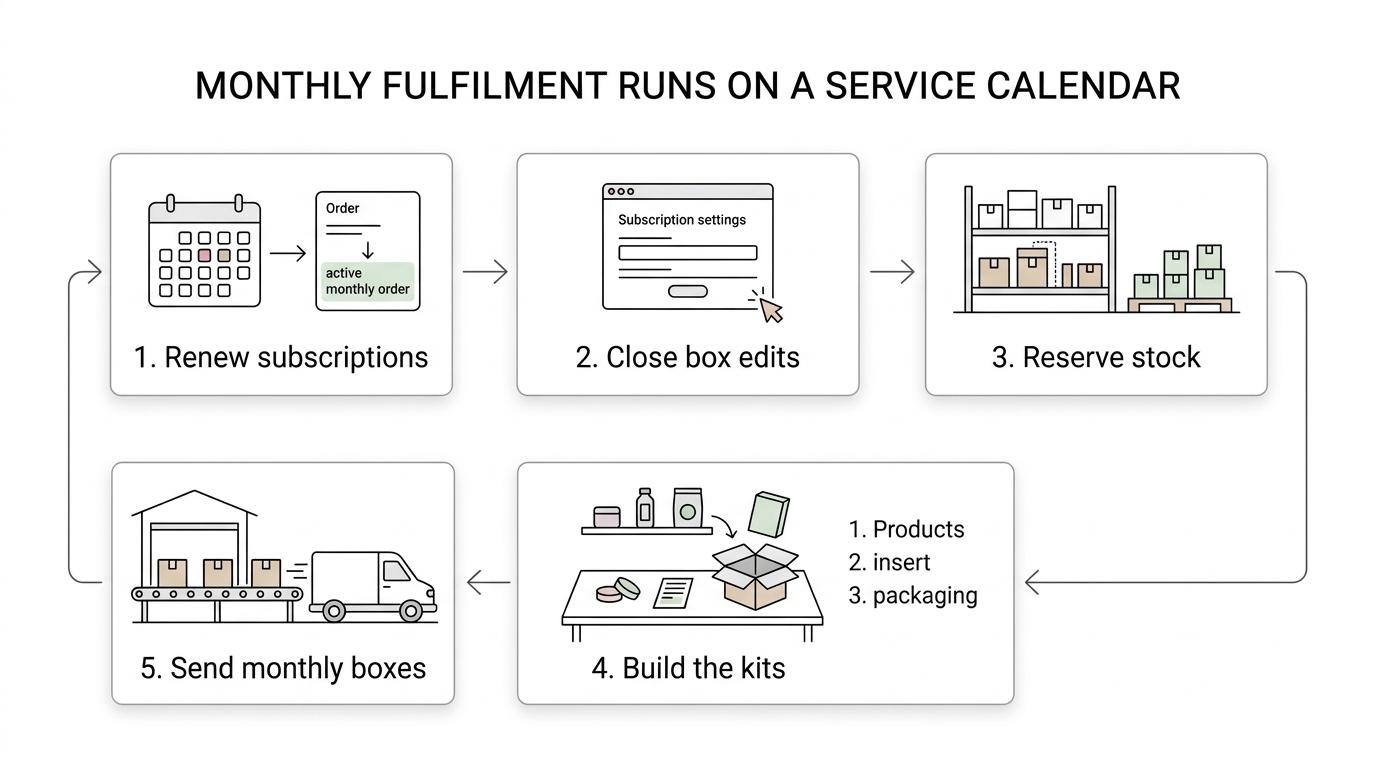
Quality control also deserves a place in system design. Subscription box packing is not only about whether the correct SKU was picked. It is about whether the right insert, branded element, promotional sample, and variant combination were included for that subscriber and that cycle. Scanning, kit sign-off, and image-based checks can all help, depending on the product mix and scale.
Kitting services UK for growth without losing consistency
Growth tends to expose weak habits. A team can often manage fifty carefully packed boxes with memory, spreadsheets, and goodwill. Five hundred or five thousand monthly boxes demand something firmer.
That is where Kitting services UK operations add real value. They turn repeat work into standard work. They document pack builds, pre-assemble recurring elements, support custom inserts, and create a cleaner path from campaign plan to packed parcel.
The strongest subscription models treat fulfilment as part of the product, not a back-office afterthought. The subscriber does not separate curation from delivery quality. They experience both at once, each month, at the doorstep and at the moment of opening the box.
When recurring deliveries are mapped properly, stock is controlled at SKU and batch level, and subscription box packing rules are specific enough to cope with changing combinations, consistency stops feeling difficult. It becomes the standard the operation is built to produce.
Planning your next subscription cycle? Explore our UK subscription box fulfilment service for component checks, assembly instructions, changing inserts and agreed dispatch windows. Tell us about your box and planned volume for a tailored quote.