

Growth in supplements can look healthy on the surface: more orders, stronger repeat purchase rates, wider product ranges, new bundle ideas. Then the packing table starts to tell a different story. Staff stay late to clear the day’s orders. Batch notes sit on paper. Stock checks drift further from reality. Subscription dispatches begin to feel risky rather than routine.
That is usually the point when fulfilment stops being a back-office task and becomes a growth decision.
For supplement brands selling through Shopify, outsourcing fulfilment is not only about freeing up floor space. It is about building an operation that can cope with regulated products, recurring orders, traceability requirements and rising customer expectations, without turning every sales spike into operational strain.
Signs your in-house supplement fulfilment is limiting growth
A small in-house set-up can work brilliantly at the beginning. It keeps costs visible, offers direct control, and helps founders stay close to the customer experience. Yet the same set-up can become restrictive once order volumes rise, product lines expand, or retail and subscription channels start to overlap.
The most common breaking point is not a dramatic failure. It is a slow build-up of friction. More manual checks. More exceptions. More time spent fixing avoidable issues. When that happens, fulfilment starts to absorb energy that should be going into product, marketing, retention and forecasting.
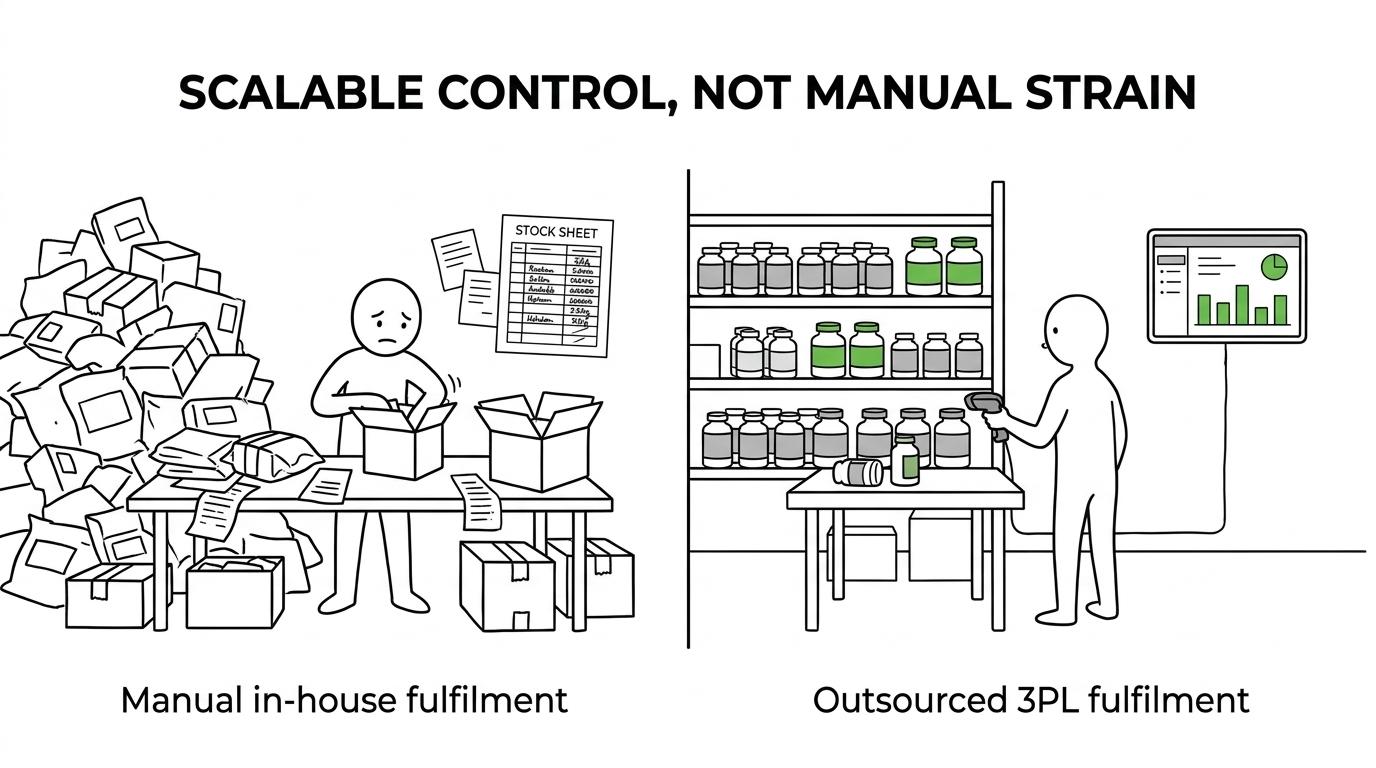
You can usually spot the shift through a few patterns:
- Late order cut-offs
- Stock counts that need constant correction
- Batch or expiry data managed outside the main system
- Subscription days causing operational disruption
- Returns and reships eating into margin
- Team members switching from growth work to packing work
A busy packing bench is not always a sign of efficiency. Sometimes it is proof that the business has outgrown its current method.
How Shopify supplement fulfilment outsourcing works
At its simplest, a third-party logistics provider, or 3PL, takes over warehousing, inventory management, picking, packing, shipping and often returns. For Shopify merchants, the strongest set-ups allow orders to pass automatically from Shopify into the fulfilment system once the integration is connected. That removes rekeying, reduces manual handling and gives the warehouse a live order stream.
The mechanics matter here. Shopify states that retailers should confirm how inventory, order and warehouse systems connect, whether through an app, an API, or file-based methods like EDI or FTP. For supplement brands, that integration should do more than pass an order number across. It should map variants correctly, support bundles, account for multi-pack offers, and return tracked shipment updates promptly.
When that infrastructure is in place, fulfilment becomes much more predictable.
| Fulfilment area | In-house pressure point | Outsourced 3PL approach |
|---|---|---|
| Order flow | Manual export or re-entry | Automated order transfer from Shopify |
| Inventory control | Spreadsheet checks, delayed updates | Live or near-live stock visibility |
| Pick and pack | Staff pulled from other work | Dedicated warehouse team and processes |
| Traceability | Batch notes handled manually | Batch and expiry recording within workflow |
| Shipping updates | Tracking added late or inconsistently | Tracked dispatch updates fed back to Shopify |
| Scaling | Extra volume needs extra space and labour | Capacity flex within warehouse operation |
A well-run outsourcing model does not remove control. It changes the type of control you hold. Instead of personally packing every parcel, you set rules, service levels, packaging standards, stock policies and reporting requirements.
Why supplement fulfilment needs batch and expiry control
Supplements are not ordinary general merchandise. Customers may see a bottle or pouch; the operation behind it needs to see batch numbers, expiry dates, storage discipline and lot-level accuracy.
That changes the fulfilment brief quite a bit.
If stock arrives in multiple batches, the warehouse should be able to record the relevant batch and expiry information and rotate stock according to the agreed process. If a query, complaint or recall issue ever arises, traceability is no longer a nice-to-have. It becomes part of risk control.
US guidance from the FDA ties dietary supplement traceability to batch, lot or control numbers as a way to determine the complete manufacturing history and control of packaged products through distribution. In practical terms, that means a supplement business selling into or operating around the US market needs fulfilment processes that can support proper record-keeping, not just fast dispatch.
In the UK, supplements are regulated as food and sit under general food law, with labelling requirements applying as well. One important detail is terminology: the product should be described as a “food supplement” in Great Britain, not a “dietary supplement”. That sounds minor until stock is moving across channels and markets. The warehouse may not write the label, but it does need to ship the right stock to the right destination, in the right configuration, with the right controls.
This is why general ecommerce fulfilment is not always enough for a supplement brand. Speed matters, but controlled handling matters too.
UK and US compliance points in Shopify supplement fulfilment
Compliance is often treated as a separate topic from fulfilment. In reality, the two are closely tied. A product can be manufactured correctly and still create problems if storage, labelling, dispatch records or stock rotation are handled poorly.
For UK operations, the starting point is clear. Supplements are regulated as food, so the fulfilment process should support food-related controls, accurate stock handling and compliant product movement. For businesses shipping internationally, the picture becomes broader. The warehouse may need to manage country-specific SKUs, channel-specific labels, or stock pools split by market.
Here is a practical view of what brand teams should keep in mind:
- UK position: food supplements fall under general food law and standard food labelling requirements
- UK label wording: products sold in Great Britain should be described as “food supplement”
- US traceability: batch, lot or control numbers are tied to distribution history and product control
- Operational impact: warehouse records should support stock rotation, trace-back and accurate order history
A reliable fulfilment partner should be able to explain exactly how goods-in checks are handled, how stock is recorded, how batches are tracked where required, and what information is retained against each shipment. Vague answers are a warning sign.
A second point often missed is change control. Supplement brands update labels, reformulate SKUs, launch new flavours and introduce promotional bundles quite often. If the fulfilment operation cannot manage old and new stock carefully during those transitions, mistakes become expensive very quickly.
What to ask before you outsource Shopify fulfilment for supplement brands
Switching to a 3PL is easier when the questions are practical. The right provider should welcome detail, especially for supplements, where operational clarity is part of quality control.
Start with integration, then move outward into warehouse process, stock discipline and service support. It is not enough to ask whether a provider “works with Shopify”. The key question is how well it works with your exact order profile.
A useful shortlist might include the following:
- Shopify integration: how are orders imported, how are variants mapped, and how are tracked shipment updates returned?
- Batch and expiry handling: can the warehouse record batch numbers and expiry dates against inbound stock and outbound orders where needed?
- Bundles and kits: can multi-SKU offers, gift packs and free-sample inserts be built accurately?
- Subscription peaks: how is labour planned for recurring dispatch dates and high-volume runs?
- Multi-store support: can one operation manage more than one Shopify store or channel without stock confusion?
- Returns process: what happens to returned stock, and what rules determine whether it can go back into inventory?
It is also worth asking about onboarding. Some providers test the Shopify connection and map products before going live, which is a very sensible step. A rushed switch can create duplicate orders, stock mismatches or delayed dispatches just when the new model is meant to create stability.
Published case studies from specialist fulfilment providers show what good execution can look like: strong gains in order capacity within a few months, better accuracy, and fewer customer contacts linked to shipping. Those results are not automatic, though. They depend on clean setup, disciplined stock data and realistic service design.
Supplement subscription fulfilment needs a different rhythm
Subscription sales are often the moment when in-house fulfilment starts to crack. Daily DTC orders may feel manageable; one large monthly subscription run can expose every weakness in process, labour planning and packaging control.
Supplements are especially exposed here because subscribers expect consistency. They want the same product, the right quantity, dispatched on time, with no batch confusion and no broken routine. One failed subscription cycle does more than trigger a refund request. It can damage trust in the habit the brand is trying to build.
That is why supplement subscription fulfilment should be treated as its own operating pattern, not just “more orders”. The warehouse needs to plan around billing cycles, forecast batch demand, reserve stock for recurring customers, and handle inserts or personalised pack rules without slowing the line.
A 3PL set-up can help a lot if it supports:
- fixed-cycle dispatch planning
- reserved inventory for subscription demand
- kitting for bundles and introductory packs
- reliable shipping updates back into Shopify
This becomes even more valuable when a brand runs one-off sales alongside subscriptions, or when it has wholesale, Amazon or TikTok Shop activity competing for the same stock. Multi-channel strain is where many in-house teams lose confidence in their numbers.
When outsourcing makes financial sense in Shopify fulfilment UK
Many brands wait too long because they compare only the visible warehouse fee against the visible cost of in-house packing materials and labour. That is too narrow.
The fuller cost picture includes management time, space constraints, recruitment, training, error rates, re-shipments, delayed dispatches, stock write-offs, and the opportunity cost of founders or commercial staff spending hours on operations. Once those costs are counted properly, outsourcing often starts to look less like an extra expense and more like a different cost structure.
There is also a quality-of-growth point. If marketing can drive demand but operations cannot absorb it, the business is carrying a hidden ceiling. Removing that ceiling has value. It allows new product launches, retail campaigns, seasonal promotions and subscription expansion to happen with less strain.
This does not mean every supplement brand should outsource immediately. If volumes are modest, SKUs are simple and batch control is easy to manage internally, in-house fulfilment may still be the right fit. The stronger case for outsourcing appears when three pressures arrive together: batch-aware stock handling, automated Shopify order flow, and a clear need for more capacity than the current set-up can provide.
At that stage, the packing table is no longer the centre of the business. It is the bottleneck. And once a supplement brand can see that clearly, the move to specialist fulfilment becomes much easier to justify.