

Getting fulfilment right early can shape a startup’s reputation faster than almost any advert, social post, or pricing experiment. A customer may forgive a plain box or a modest website. They rarely forget a late parcel, a missing item, or a return that turns into a week of silence.
That matters even more in the UK, where online retail remains a major part of shopping behaviour. Office for National Statistics data shows internet sales accounted for 27.5% of total retail sales in 2025, up from 27.1% in 2024. At the same time, Ofcom reported total parcel volumes of 4.2 billion items in 2024-25, with 68% of parcel recipients saying they had faced at least one delivery issue in the previous six months. Startups are entering a large market, though not an easy one.
Why order fulfilment matters for UK startups
Order fulfilment is the operational link between a sale and a satisfied customer. For a startup, that link is rarely neutral. It either builds trust or chips away at it.
In larger businesses, weak fulfilment can sometimes be cushioned by brand familiarity, wider customer service teams, or generous retention budgets. Startups rarely have that luxury. A single poor delivery week can trigger refund requests, chargebacks, poor reviews, and awkward messages on social media, all while the founder is still trying to source stock and manage cash flow.
The market itself gives a clear signal. Parcel volumes are rising, online sales remain strong, and customers now treat accurate delivery windows, clean packaging, and fast issue resolution as normal, not premium. That shifts fulfilment from back-office admin into a central part of growth.
A useful way to think about fulfilment is to link it to stage, not just volume.
| Startup stage | Typical fulfilment pressure | Main priority |
|---|---|---|
| Pre-launch to first 100 orders | Manual packing, uncertain demand, changing product mix | Build a repeatable process |
| Early growth | Stockouts, packing errors, customer email volume | Improve inventory accuracy and dispatch speed |
| Scaling | Carrier complexity, returns volume, peak trading strain | Standardise systems and reporting |
| Multi-channel growth | Website, marketplaces, wholesale orders | Keep stock visibility and service levels consistent |
Common UK order fulfilment risks in parcel delivery
A startup does not need thousands of orders to feel the strain of fulfilment problems, whether it handles orders in-house or uses dropshipping. A handful of missed or mishandled parcels can create a disproportionate workload because each problem tends to generate several tasks at once: customer contact, carrier chasing, stock checks, refunds, replacements, and internal investigation.
Ofcom’s recent findings are a helpful reminder that these problems are not rare edge cases. The most common issues reported by parcel recipients included delays, parcels left in inappropriate locations, drivers not knocking loudly enough, and customers not being given enough time to answer the door. Those may sound small, yet they shape the entire perception of a brand.
Startups should treat delivery exceptions as a normal operating condition, not a surprise, whether they use in-house operations, dropshipping, or hybrid fulfilment.
- Delivery delays: customer confidence drops quickly when tracking updates stall or estimated dates slip
- Safe-place errors: a parcel marked as delivered can still become a customer service issue if it is left poorly
- Missed doorstep contact: failed delivery attempts often lead to more support tickets than damaged parcels
- Complaints handling: a weak response process can make a minor carrier problem feel much worse
There is also a subtle financial risk. When a founder spends hours each week checking tracking pages and replying to “where is my order?” emails, that time is not spent on product, sales, or supplier terms. Fulfilment friction does not only affect the customer. It can stall the whole business.
Building a startup order fulfilment process from day one
The best fulfilment systems feel boring in the right way.
That usually starts with disciplined basics, including inventory management, rather than advanced software. A clear stock location system, consistent SKU naming, standard packing instructions, and a reliable cut-off time for same-day dispatch can streamline warehouse operations, improve picking and packing, and remove a surprising amount of chaos. When orders are still low, many founders assume they can rely on memory rather than using a fulfilment centre. That works until product variants multiply, bundles are introduced, or a small promotion sends volumes up for three days straight.
A sound startup process usually includes order verification before picking and packing, not after it. It also includes packaging rules that balance cost and protection. Cheap packaging that leads to damage is rarely cheap in the round. By the same token, premium unboxing is only worthwhile if margins support it and pack times remain sensible.
Returns need structure as well. A return without a written process often creates confusion across customer service, warehouse handling, refunds, and resale decisions. That confusion shows up in cash flow and stock accuracy.
A practical first framework for picking and packing often includes:
- Clean SKU structure
- Daily stock reconciliation
- Defined carrier collection times
- Return reason tracking
- Packing quality checks
Most startups do not need a perfect warehouse operation. They need one that is stable, measurable, and easy to train.
In-house order fulfilment vs 3PL for startup growth
At some point, founders face a familiar question: whether to keep fulfilment in-house, use a hybrid fulfilment model, or hand it to a third-party logistics provider. The right answer depends less on ambition and more on product profile, order pattern, and management bandwidth.
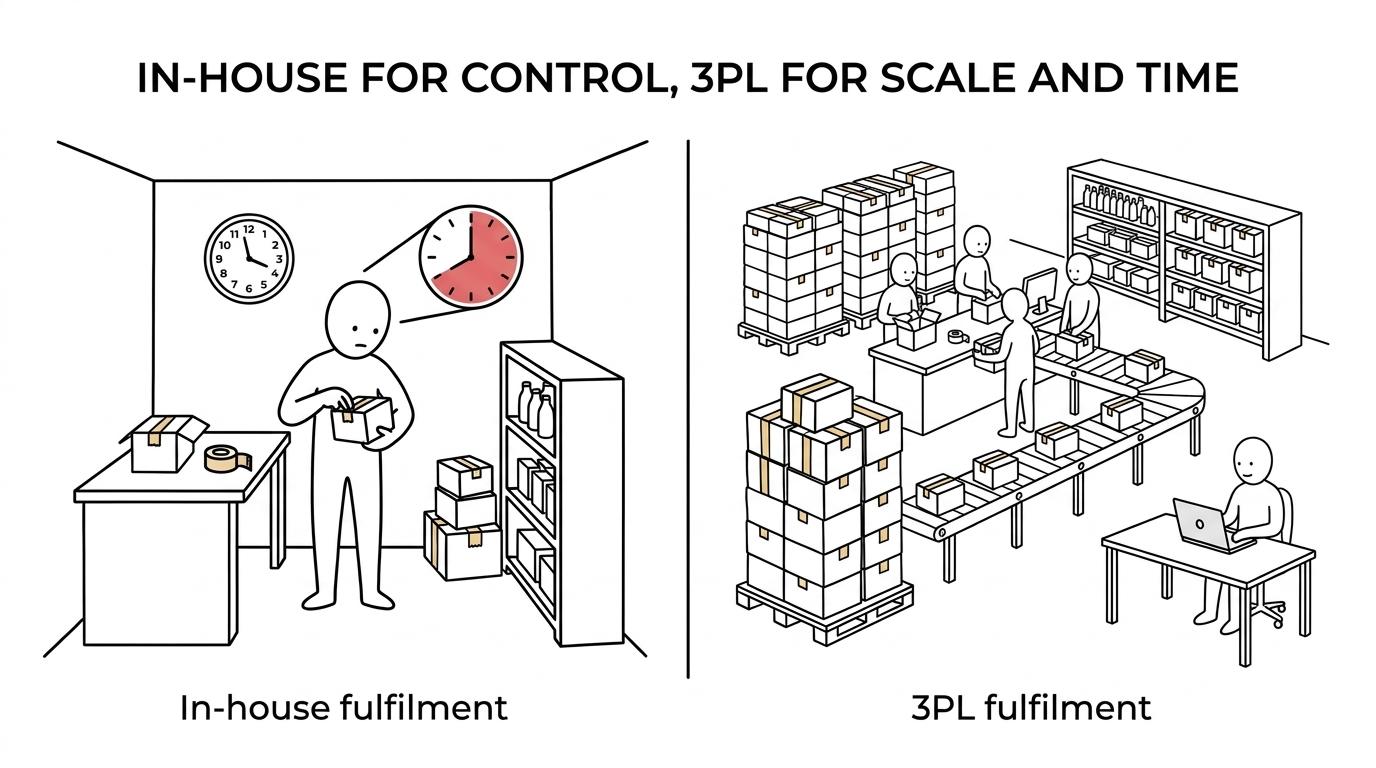
In-house fulfilment can work very well when orders are still manageable, product ranges are tight, and the brand values close control over packaging or product handling. It is often the lower-cost route at the beginning because labour is absorbed by the founding team and space may already be available. It also gives direct visibility into recurring issues.
A 3PL starts to look attractive when storage pressure grows, dispatch deadlines tighten, or carrier management becomes too time-consuming. A capable partner can offer more structure around inventory management, pick and pack workflows, returns processing, and peak capacity. That said, the fit matters. Startups need clear service levels, transparent pricing, and reporting they can actually use.
One provider, 3PLWOW, says a fashion startup using its service achieved a 45% increase in delivery speed, and it also points to inventory management support for a skincare brand facing rising demand. Claims like that show why outsourced fulfilment appeals to founders, though they should still be tested against real service terms, references, and operational detail.
| Area | In-house fulfilment | 3PL fulfilment |
|---|---|---|
| Control | High day-to-day control | Lower direct control, stronger process if partner is good |
| Setup cost | Often lower at first | Usually includes onboarding and storage fees |
| Scalability | Can become strained quickly | Better suited to sudden volume changes |
| Brand customisation | Easier to manage closely | Possible, though usually within agreed rules |
| Systems and reporting | Depends on internal tools | Often stronger, though quality varies |
| Founder time | Heavy operational load | Frees time if the relationship is well run |
For startups using dropshipping, a sensible trigger point is not “we are busy”. It is “fulfilment problems are starting to distract the business from growth”.
Order fulfilment metrics every startup should track
Startups often track revenue before they track operational accuracy. That is risky because fulfilment quality often predicts future revenue more clearly than one strong sales week.
A short scorecard is usually enough at the start. What matters is consistency. Review the same measures each week, spot trends early, and act before customer complaints pile up. If a 3PL is involved, these measures should appear in monthly reporting without a struggle.
The most useful metrics tend to be:
- Order accuracy: percentage of orders sent without pick, pack, or labelling errors
- Dispatch speed: time from order confirmation to carrier handover
- Delivery issue rate: share of orders that generate delay, damage, or non-delivery contact
- Return rate: percentage of orders sent back, grouped by reason
- Inventory accuracy: match between recorded stock and physical stock
- First-response time: speed of reply when a customer reports a delivery problem
Ofcom’s data on complaints handling is a warning here. While satisfaction with contacting parcel operators and complaint handling has improved, there is still a sizeable gap between parcel delivery and the service customers receive when something goes wrong. Startups should not assume the carrier will protect the customer experience on their behalf.
Delivery communication and complaints handling for better customer trust
Clear communication can soften operational friction, even when the parcel itself is running late. Silence rarely does.
Customers want a few simple things: confirmation that the order is real, clarity on when it will leave, tracking that works, and a human response when something goes wrong. Startups that set realistic dispatch times usually fare better than those that promise too much and then apologise. Speed matters, though predictability matters almost as much.
This is also where tone matters. A short, direct message saying a parcel is delayed and action is being taken feels far more credible than generic wording that avoids responsibility. If the issue sits with the carrier, the customer should still feel that the retailer owns the resolution.
A strong exception-handling flow usually includes three parts. First, identify the issue quickly through tracking alerts or customer contact. Second, decide the commercial response, whether that is a replacement, refund, or wait-and-monitor approach. Third, record the issue category so patterns become visible over time. Without that record, the same carrier or packaging issue can repeat for months.
Order fulfilment systems that support scaling
Growth often exposes weaknesses that were invisible at low volume. A manual spreadsheet may cope with twenty daily orders. It can become fragile at eighty, especially when orders are coming from a website, a marketplace, and a wholesale email thread at the same time.
That is why system choice should be linked to process maturity. Inventory data should update quickly enough to prevent overselling. Shipping rules should reduce manual clicks. Order statuses should be visible to the team without chasing one person for answers. None of this needs to be expensive from the start, though it does need discipline.
Packaging stock should be part of the same operational picture. Startups sometimes track saleable inventory closely but forget cartons, labels, tape, inserts, or return materials. Then a busy day arrives and dispatch slows because the warehouse has run out of a basic input.
When fulfilment is treated as a growth system rather than a daily scramble, several benefits usually follow:
- better stock confidence
- fewer support tickets
- cleaner weekly reporting
- stronger repeat purchase potential
Order fulfilment review questions for founders
A startup does not need a full operational overhaul to improve fulfilment. Often, the smartest next step is a blunt internal review with hard questions and honest answers.
- Are dispatch promises based on real capacity, or on what sounds competitive?
- Can stock accuracy be checked quickly without stopping the whole operation?
- Is there a written process for damaged, delayed, or missing parcels?
- If order volume doubled next month, what would break first?
Those questions tend to reveal whether fulfilment is ready for growth or still relying on goodwill, memory, and late nights. In a market where parcel volumes are high and delivery issues are common, that clarity gives startups a genuine edge.