
If you sell capsules, powders, gummies or sachets online, the price of fulfilment is rarely one neat number. A UK supplement brand might look at two warehouses offering “pick and pack”, yet still receive quotes that differ by a wide margin.
That happens because supplement fulfilment cost is built from several moving parts: how many orders you ship, how many items sit in each parcel, how much stock you store, which carrier service you use, and whether your products need extra controls around batch and expiry. Delivery often sits on top as a separate, and very significant, cost line.
Why UK supplement fulfilment cost in the UK varies
A useful way to think about fulfilment is this: you are not buying shelf space alone, and you are not buying postage alone. You are buying a workflow.
For supplement brands, that workflow can be more involved than standard general merchandise. Products may need batch and expiry control, careful storage organisation, accurate lot-aware picking, bundle assembly, subscription packing, promotional inserts and UK or international dispatch. Those are real handling tasks, and handling tasks turn into cost.
Industry guidance on warehousing supports this structure. Receiving, handling and dispatch are often priced per pallet. Storage is commonly priced per pallet and tied to time in storage. Picking charges depend on how many SKUs are stored, how many SKUs appear in each order, and how many units are picked for each order. That means a brand shipping one bottle per order looks very different from a brand shipping three-SKU wellness bundles.
A quick quote that looks cheap at first glance can become less attractive once the order profile is mapped properly.
After all, “300 orders a month” tells only part of the story.
The main drivers tend to be:
- monthly order volume
- average items per order
- SKU count
- storage footprint
- carrier service level
- UK versus international mix
- subscription and bundle complexity
- batch and expiry requirements
Typical UK supplement fulfilment cost lines
Most UK fulfilment quotes separate charges into distinct lines rather than wrapping everything into a single all-in fee. That is useful because it shows where money is really going.
Published examples from a UK fulfilment provider show pick-and-pack starting at £0.80 per order for the first 500 monthly orders, with a 10% discount for each further 500-order block. The same example pricing shows £0.30 for the first additional item and £8 per month for each additional pallet above the first. On the carrier side, Royal Mail’s public online prices show Tracked 48 from £3.65 and Tracked 24 from £4.65, while also stating that business customers sending more than 20 parcels a week should ask about account rates.
That gives a solid frame for worked examples, even though real business rates and warehouse tariffs may differ.
| Cost line | Common pricing basis | Example figure where publicly available | What usually changes it |
|---|---|---|---|
| Inbound receiving | Per pallet received | Varies | Delivery frequency, pallet count, booking requirements |
| Storage | Per pallet per week or month | £8 per month for each additional pallet above the first in one example pricing model | Pallet count, stock turn, oversize goods |
| Pick-and-pack | Per order | £0.80 per order for first 500 monthly orders in one example pricing model | Order volume, sales channel setup, handling method |
| Additional item pick | Per extra item in the order | £0.30 for the first additional item in one example pricing model | Average units per order, bundle composition |
| Packaging | Per parcel or per packaging type | Varies | Plain versus branded packs, inserts, samples |
| Delivery | Per parcel by service | Royal Mail Tracked 48 from £3.65, Tracked 24 from £4.65 | Weight, size, service speed, business account pricing |
| Returns handling | Per return or per item | Varies | Inspection rules, restock process, customer policy |
Worked example for a small UK supplement brand
Let’s build a simple model for a young brand shipping mostly single-channel DTC orders.
Assumptions first. The brand ships 300 orders per month, with an average of 2 items per order. It stores 2 pallets of stock. All orders go to UK customers using a Tracked 48 service. This example excludes inbound receiving fees, branded packaging extras, returns fees and VAT. It uses public reference pricing where available, so it should be treated as an illustration rather than a quote.
Here is the maths:
- Pick-and-pack: 300 orders × £0.80 = £240
- Additional item charge: 300 extra items × £0.30 = £90
- Storage: 1 additional pallet × £8 = £8
- Delivery: 300 parcels × £3.65 = £1,095
That gives a total monthly fulfilment and shipping cost of £1,433.
Per order, the total is £4.78.
Now split that number in two. Handling and storage alone come to £338, or about £1.13 per order. Delivery alone comes to £1,095, or £3.65 per order. So in this model, the carrier cost is by far the largest element.
That pattern is common. Many supplement brands focus first on the warehouse handling rate, yet the bigger saving often sits in shipping method, parcel profile and access to business account rates.
Worked example for a growing supplement brand with mixed shipping
Scale can lower some handling costs, though it does not automatically produce a cheaper all-in order cost.
Take a brand shipping 1,200 orders per month, again with an average of 2 items per order. This time it stores 4 pallets and uses a mixed carrier service: 80% of orders on Tracked 48 and 20% on Tracked 24. We will use the same exclusions as the first example.
Because published example pricing applies a 10% discount to each further 500-order block, the pick-and-pack portion can be modelled like this:
- First 500 orders at £0.80 = £400.00
- Next 500 orders at £0.72 = £360.00
- Final 200 orders at £0.648 = £129.60
Pick-and-pack total: £889.60
Now add the rest:
- Additional item charge: 1,200 extra items × £0.30 = £360
- Storage: 3 additional pallets × £8 = £24
- Tracked 48 delivery: 960 parcels × £3.65 = £3,504
- Tracked 24 delivery: 240 parcels × £4.65 = £1,116
Total monthly cost: £5,893.60
Per order, that works out at £4.91.
That result surprises some founders. The brand is larger, and its handling cost per order is lower than in the smaller example, yet the all-in figure per order is slightly higher. The reason is simple: a proportion of faster Tracked 24 shipments pushes delivery spend up.
Handling and storage in this second model come to £1,273.60, or about £1.06 per order. So the warehouse side has become more efficient. Still, total shipping spend reaches £4,620, which is about £3.85 per order.
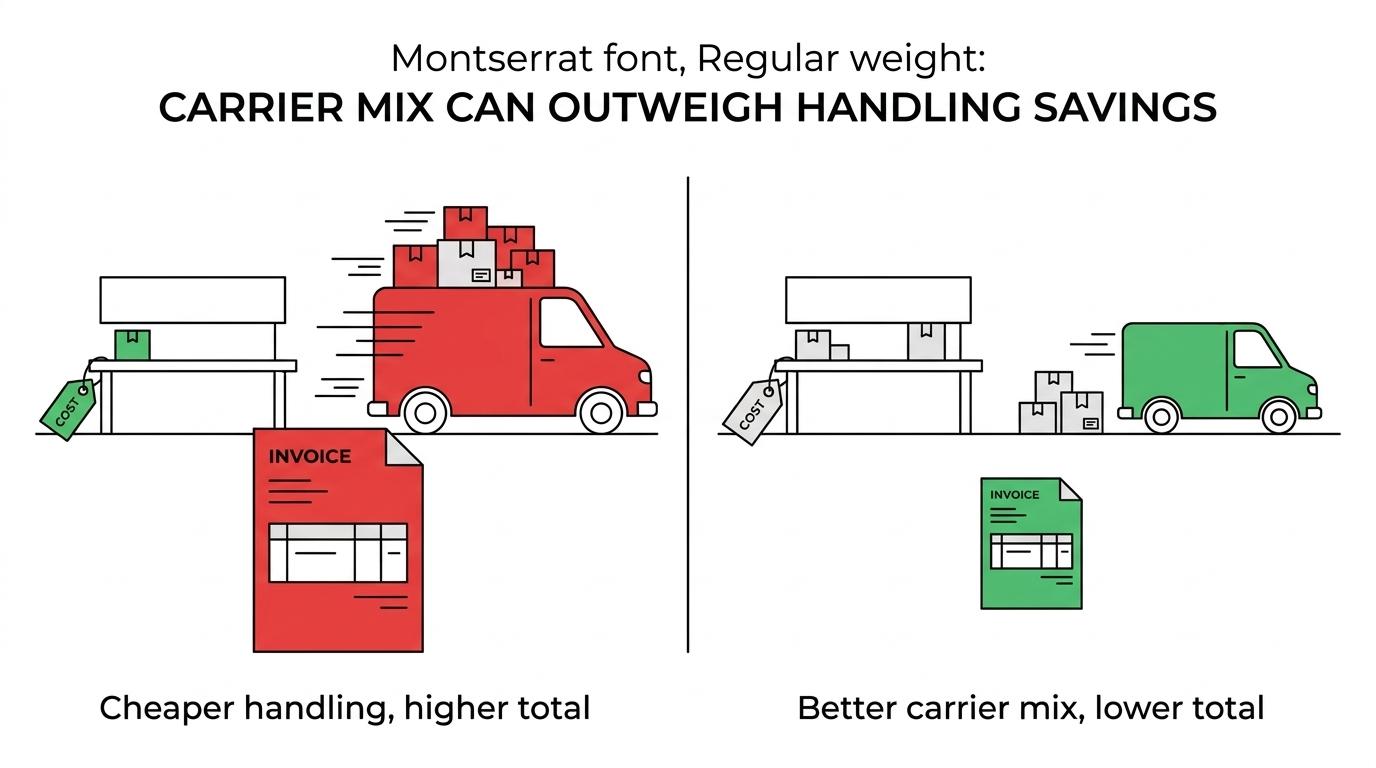
The lesson is clear. Volume discounts on fulfilment help, but carrier mix still shapes the final number.
Supplement-specific fulfilment factors that change the quote
A supplement business is not always priced like a standard beauty or lifestyle brand, even when parcel sizes look similar.
Bundles and subscription orders can add touches that slow the line. International dispatch may require different customs data, paperwork and carrier rules. Promotional inserts, free samples and branded packaging all add handling steps, even if the product itself is lightweight.
These are the kinds of quote shapers that matter most:
- Batch and expiry control: more disciplined inventory handling and stock rotation
- Bundles and subscriptions: more picks per order and more pack bench time
- Promotional inserts: extra materials plus an extra action in packing
- International dispatch: customs data, service selection and added admin
- SKU growth: more pick locations and more opportunities for order complexity
One extra SKU in the basket does not look dramatic on a storefront. In a warehouse, multiplied across hundreds or thousands of monthly orders, it absolutely matters.
How to estimate your supplement fulfilment cost before asking for quotes
A useful internal estimate starts with six inputs: monthly orders, average items per order, storage footprint, parcel service mix, return rate and any special handling needs.
A simple version looks like this:
Estimated monthly cost = receiving + storage + pick-and-pack + additional item charges + packaging extras + delivery + returns
If your brand sells mainly one-bottle orders, the model will be quite different from a brand selling a morning stack, evening stack and a shaker in the same basket. If you send most parcels on economy tracked services, your shipping profile will differ from a brand that promises next-day delivery.
The estimate does not need to be perfect. It needs to be honest enough to compare providers on like-for-like terms.
What to ask when comparing UK supplement fulfilment quotes
A fulfilment quote becomes far more useful when you can see the line items and the assumptions behind them.
Ask for the quote to show whether prices change by order volume block, whether extra items are charged separately, how storage is measured, and what delivery service assumptions have been used. If a provider uses its own carrier account, ask whether the rates shown are public tariffs or business account rates. Royal Mail itself makes clear that business parcel pricing depends on volume and can be lower than standard postage.
These questions help keep comparisons fair:
- Order profile: what average items per order has the quote assumed?
- Storage basis: per pallet per week, per month, or bin location?
- Carrier pricing: public tariff, discounted account rate, or pass-through cost?
- Supplement controls: are batch and expiry processes included in the base fee?
- Extras: branded packaging, inserts, samples, subscription builds, returns
A good next step is to ask each provider for a sample invoice built around one real month of your orders. That tends to expose the practical cost of fulfilment far better than a headline rate ever can.