
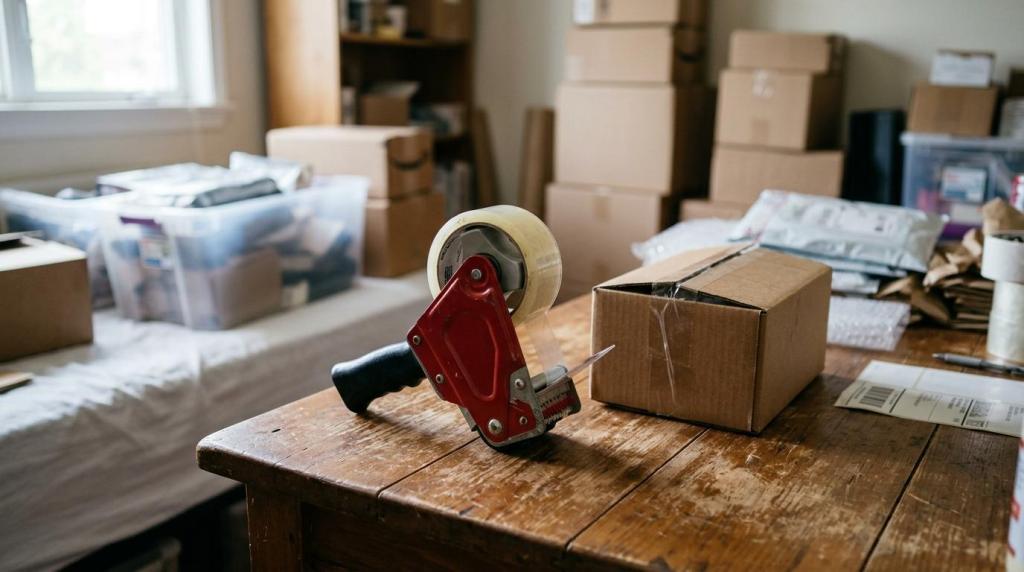
Your first stockroom often looks nothing like a stockroom.
It is a spare bedroom, a corner of the dining room, a garage shelf system that started neatly and then spread to every available surface. At the beginning, that setup can feel efficient and close to the action. You know every SKU, every box size, every tape gun, every regular customer name. Then growth arrives, and the same setup starts to pull against you.
A few more orders each day becomes a queue of labels, packing slips, stock checks, shipping tasks and daily Post Office trips. New product lines need space you do not have. Returns pile up. One missed dispatch turns into several, and the work that should support sales starts to swallow the day. That is usually the moment when fulfilment stops being a background task and becomes a business decision.
Signs you should outsource ecommerce fulfilment
Growth rarely breaks fulfilment all at once. It usually shows up in smaller signals first.
You may still be dispatching every day, but it takes longer. You may still know where the stock is, but only because you remember which overflow boxes are in the hallway and which are in the car boot. You may still be keeping customers happy, but only by answering “where is my order?” emails late at night.
For growing brands, the tipping point is not a magic order number. It is the point where accuracy, dispatch speed and returns handling begin to slip. Published 3PL case studies often point to this pattern: a business can cope well at one size, then a sudden rise in orders exposes every weak spot in storage, packing and carrier collection.
Common warning signs include:
- Overflow stock in more than one room
- Packing orders outside normal working hours
- Frequent runs to the Post Office
- Late dispatch after promotions or pay day spikes
- More picking mistakes or missing items
- Returns waiting days before being checked back in
If any of that feels familiar, fulfilment is no longer just a task list. It is now affecting customer experience, cash flow and the time available for product development, marketing, sales and the self-fulfillment that comes from building your brand.
Why delivery expectations matter for fulfilment for small businesses UK
Customers rarely separate your brand from the delivery experience. If the parcel arrives late, damaged, incomplete or poorly tracked, they see that as your service.
That matters even more now because parcel volumes are huge and expectations are high. Ofcom reported that people in the UK sent and received a record 4.2 billion parcels in 2024, up 7% year on year. The same research found that 68% of parcel recipients had experienced a delivery issue in the previous six months. Average overall parcel satisfaction was 78%, which leaves a lot of room for disappointment.
Convenience is also no longer a nice extra. Industry research from FedEx found that more than 80% of shoppers prioritise convenience, with home delivery, free shipping and real-time tracking now treated as table-stakes features by many buyers.
That changes the case for fulfilment for small businesses UK wide. This is not only about making the warehouse side easier. It is about protecting repeat purchase, reviews and trust.
A late parcel can cost more than postage and shipping.
How outsourced ecommerce fulfilment actually works
Many founders imagine outsourcing as handing over stock and hoping for the best. In reality, a good fulfilment setup is structured, measurable and visible.
At a basic level, an ecommerce fulfillment provider stores your products in its fulfillment centers, supports inventory management, receives orders from your online store, picks the right items, packs them to your rules, books the parcel with the right carrier and manages domestic delivery and international shipping, sending tracking details back to your store and your customer. Returns can also be processed, checked and put back into available stock if suitable.
For brands moving from a home setup or small unit, the biggest shift is onboarding with a fulfillment solution that uses warehouse fulfillment centers to manage logistics, ecommerce fulfillment, dropshipping and inventory as a system rather than a daily scramble. You are no longer buying shipping labels one batch at a time or working around domestic space. You are moving into a process built for volume, service levels, repeatability and scalability.
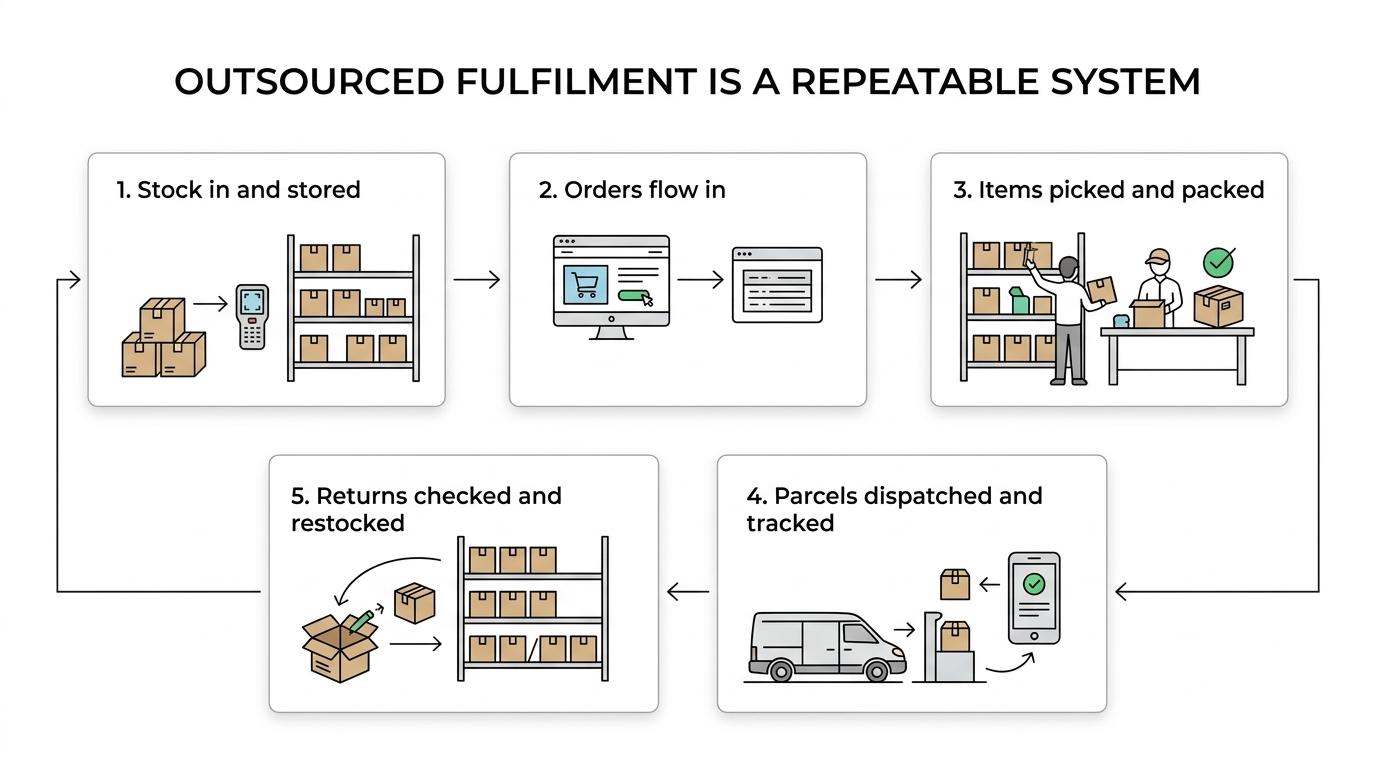
Here is what ecommerce fulfillment usually looks like:
| Stage | What happens | Why it matters |
|---|---|---|
| Goods in | Stock arrives at the fulfilment centre warehouse and is counted in | Your inventory starts from an accurate baseline |
| Storage | Products are assigned locations by SKU | Faster picking and better stock visibility |
| Integration | Your store, often Shopify, connect directly to your store | Orders flow through automatically |
| Pick and pack | Orders are picked, checked and packed to agreed rules | Fewer errors and a more consistent unboxing experience |
| Dispatch | Parcels are booked with suitable carriers and collected | Better cut-off times and more reliable dispatch |
| Tracking | Tracking data is sent to the customer | Fewer support emails and more confidence |
| Returns | Returned items are received, checked and updated in the system | Faster resale and cleaner stock records |
Published 3PL case studies give a useful picture of what can improve after a move. Some report order accuracy rising from 96.2% to 99.4%, same-day dispatch improving from 71% to 94%, and average returns processing time dropping from six days to two. The exact results will differ across fulfillment centers, though the direction is clear: a proper fulfilment process can remove the drag created by manual, overstretched setups.
That is why outsourcing ecommerce fulfillment is often less about giving up control and more about gaining operational discipline that supports your team’s self-fulfillment.
When Shopify fulfilment UK starts making sense
If your store runs on Shopify, you already have a strong base for outsourced fulfilment.
Most fulfilment providers offering Shopify fulfilment UK services will connect directly to your store so that orders import automatically, shipping updates feed back into Shopify, and inventory data stays more current across your products. That removes a lot of manual copying, spreadsheet checks and last-minute label creation.
The case becomes stronger when your store is selling across more than one channel. A brand might start with Shopify only, then add marketplaces, social commerce or wholesale orders. Once that happens, fulfilment gets harder very quickly because stock accuracy has to keep pace across all channels at once.
Shopify brands usually feel ready for outsourced fulfilment when a few conditions appear at the same time:
- Order volume: you are dispatching enough orders that packing now dominates the working day
- Sales peaks: launches, influencer activity or seasonal campaigns push service levels down
- SKU count: more variants mean more picking risk and more storage pressure
- Customer service load: tracking queries and delivery complaints are rising
- Growth plans: you want time back for buying, conversion work and retention activity
For many brands, the real trigger is not today’s volume. It is next quarter’s ambition.
What to prepare before asking for a fulfilment quote
A useful quote depends on detail. The more clearly you can describe your products and order profile, the more realistic the pricing and service proposal will be.
This is where many growing businesses hesitate because they assume they need perfect data. You do not. You do need organised data. A fulfilment partner can usually provide a tailored fulfillment solution using estimates where needed, as long as the key inputs are sensible and current, helping you plan your logistics more effectively.
Before requesting prices, pull together the following:
- Monthly order volume: current average orders, plus peak months and campaign spikes
- Sales channels: Shopify, marketplaces, wholesale, subscriptions or any other order sources
- Product count: number of SKUs, variants, bundles and any fragile or regulated goods
- Product dimensions: approximate size and weight of each item and packed order
- Storage profile: how many cartons, pallets or shelf bins you expect to hold
- Order profile: average items per order and any frequent multi-buy combinations
- Packing needs: branded inserts, custom boxes, gift notes, kitting or subscription assembly
- Delivery service: UK only or international shipping, with any target dispatch times
- Returns flow: expected return rate and what should happen to returned stock
It also helps to share a simple forecast. If you expect Black Friday to triple your normal order volume, or if a retail placement may drive a sharp increase, say so early. Capacity planning is part of the service.
A quote is only as good as the picture behind it.
What fulfilment costs usually cover and why pricing varies
One reason founders delay the move is fear of cost. That is understandable, especially when self-fulfilment feels “free” apart from boxes and postage. Yet self-fulfilment is never really free. It uses space, labour, management time and missed commercial opportunities.
Most outsourced fulfilment pricing includes a mix of charges for goods in, storage, pick and pack, packaging, shipping and returns handling. Some providers price very simply. Others break out each task in detail. Neither model is automatically better. The better model is the one you can map clearly to your order behaviour.
Pricing often varies because of:
- Order volume
- Number of SKUs
- Average items per order
- Storage footprint
- Packaging complexity
- Return rates
- UK versus international delivery mix
A low pick fee can look attractive until storage, inbound receiving or account support is added on top. Ask for a full cost view based on your normal month and your peak month. That creates a more honest comparison.
Keeping brand control with outsourced ecommerce fulfilment
A common concern is that outsourcing means giving up the customer experience you have built.
That only happens if the setup is vague.
Good outsourced fulfilment should be defined in practical terms: packing instructions, branded materials, carrier choices, cut-off times, gift options, bundle rules, returns checks and stock reporting. Many providers now support client portals, channel integrations and custom packing requirements, which helps keep fulfilment visible rather than hidden.
For a brand that has grown through care and attention, this matters. You may want tissue paper folded a certain way, inserts added to first orders only, or subscription boxes assembled in a precise sequence. Those details can be documented and repeated far more reliably in a controlled fulfilment process than in an overstretched spare room during a busy week.
This is often the most surprising part of the move. Control can increase when the process is written down, measured and supported by systems.
How to prepare for a smooth handover to a fulfilment partner
The strongest moves tend to happen before stock ever leaves your current space.
Clean your SKU data. Standardise product names. Check barcodes if you use them. Confirm which products are current, which are discontinued, and which are likely to spike. Create a simple packing guide with photos if presentation matters. If you sell bundles, write out exactly what goes into each one.
You should also review your delivery promise on site. There is little value in paying for same-day dispatch if your website still sets a slower expectation, and there is real risk in promising next-day delivery without the carrier setup to support it. Match the promise to the operation you are building.
A growing brand does not need to wait until fulfilment is failing completely; it can outsource ecommerce fulfilment by choosing fulfilment for small businesses in the UK, including Shopify fulfilment UK services.
The better moment is usually earlier, when orders are healthy, demand is rising and the current setup is beginning to limit what comes next. If the spare room is full, the packing table never clears and the Post Office run now shapes the day, that is not just a sign of progress. It is a sign that the business is ready for a more capable fulfilment model.