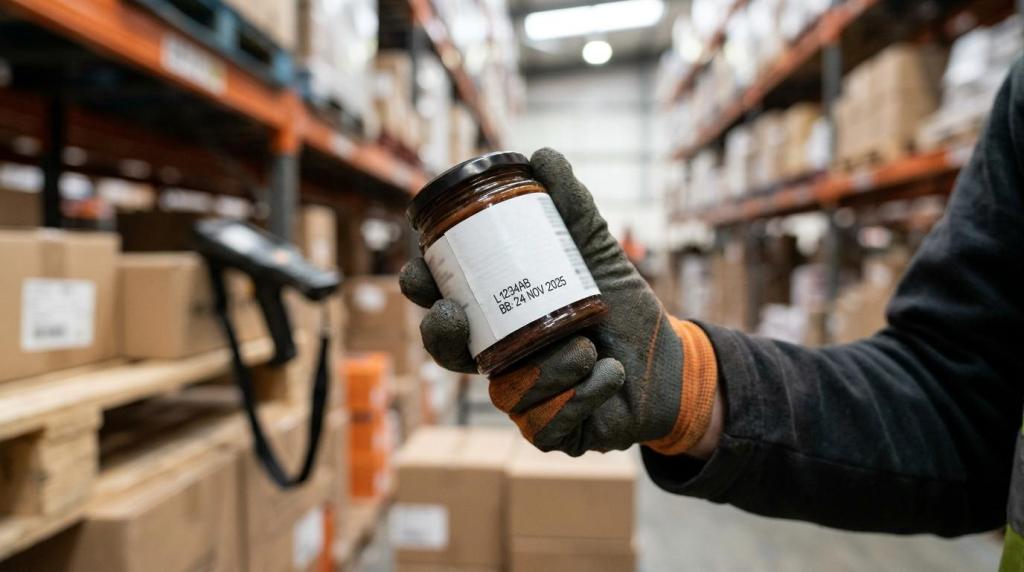
Choosing a warehouse for food fulfilment is not the same as choosing a warehouse for T-shirts, phone cases or stationery. Food and drink products bring a different level of scrutiny, more record-keeping, tighter storage discipline and a greater need for traceability at every stage of the order flow.
That is why the right partner is rarely defined by storage space alone. A strong food fulfilment setup combines warehousing, stock control, batch tracking, date management, accurate picking, careful packing and documented food-safety routines that stand up to inspection and daily pressure alike.
Why food fulfilment needs a specialist warehouse
A food warehouse does far more than hold cartons on racking. It becomes part of your compliance framework, your customer experience and your brand reputation. If stock is received without proper checks, stored without clear lot control or shipped without accurate records, the risk spreads quickly across your operation.
For shelf-stable brands, the pressure can be easy to underestimate. Dry food, tea and coffee may not need chilled storage, yet they still need disciplined handling. Batch and date processes matter. So do cleanliness, stock rotation, allergen awareness and traceability if a problem ever needs to be investigated.
A capable food fulfilment warehouse should give you confidence in the practical basics:
- clean storage conditions
- reliable goods-in checks
- batch traceability
- date-code visibility
- accurate pick and pack
- clear returns handling
Those fundamentals sound straightforward. In food and drink, they are the foundation of a professional operation.
UK food safety rules for fulfilment warehouses
In the UK, food businesses are required to make and follow a food safety management system. GOV.UK guidance states that this system should be written, used in practice and kept in a form that can show inspectors how food is being kept safe. That applies to more than production sites. Warehousing and fulfilment activities are part of the same chain of responsibility.
A food safety management system is built around HACCP principles. That means identifying hazards, setting critical control points where relevant, monitoring those points, taking corrective action when needed and keeping records. In warehouse terms, that can include storage checks, segregation rules, allergen controls, cleaning routines, stock checks and transport handling.
It also means food fulfilment cannot be treated as a generic logistics task with a food label attached.
What documented food controls look like in daily warehouse work
The strongest setups turn policy into repeatable warehouse actions. A written system should connect directly to goods-in procedures, storage rules, picker training, packing checks and dispatch records. If a brand sells products with allergens, controls should cover how those products are identified, separated and handled so cross-contamination risks are managed properly.
Records matter just as much as the physical work. If a customer raises a concern, or an inspection takes place, a warehouse should be able to show what arrived, when it arrived, where it was stored, which batch was shipped and what checks were completed.
- Goods-in checks: confirm packaging condition, quantities, date codes and batch details before stock is booked in
- Allergen controls: set rules for segregation, labelling awareness and handling procedures
- Storage rules: define where products can be placed, how stock is rotated and how cleanliness is maintained
- Temperature checks: record relevant ambient or controlled storage conditions where required
- Dispatch records: link shipped orders to stock movements and traceable batch information
Food warehouse processes that protect stock and customer trust
Good food fulfilment depends on disciplined process design. The first step is goods-in. Stock should not simply be unloaded and shelved. It needs checking against purchase or intake records, inspected for damage and entered into inventory with the right product identifiers, batch references and dates where relevant.
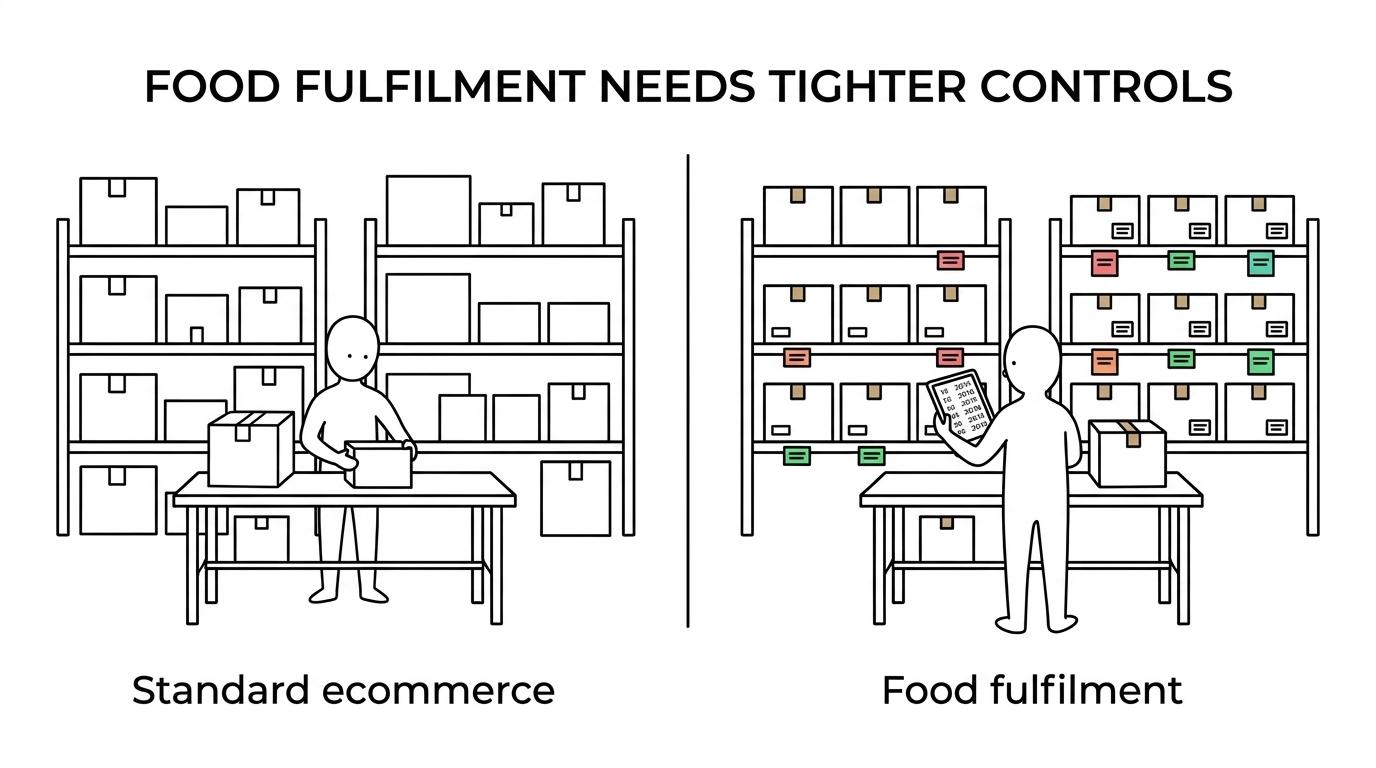
Inventory control then becomes the quiet engine of the whole operation. A food brand needs to know what stock is available, what is approaching date thresholds, which batch is stored in which location and how quickly each line is moving. Without that clarity, fulfilment errors become more likely and waste becomes harder to control.
Picking and packing need the same level of care. Food orders often include product bundles, subscription formats or mixed cases. That means the warehouse should be able to follow exact packing rules, add inserts when needed and keep the order accurate without losing traceability in the process. Returns handling matters too, especially if the business needs a clear policy for resalable and non-resalable stock.
The difference between standard ecommerce fulfilment and food fulfilment is often easiest to see in the detail:
| Area | Standard ecommerce fulfilment | Food fulfilment warehouse |
|---|---|---|
| Goods-in | Count and condition check | Count, condition, batch and date checks |
| Stock records | SKU and quantity | SKU, quantity, batch, date, storage status |
| Storage | General location control | Storage discipline with hygiene and traceability controls |
| Picking | Order accuracy | Order accuracy plus batch and date process compliance |
| Packing | Presentation and speed | Presentation, speed and safe product handling |
| Returns | Restock or dispose | Controlled assessment with food-safety rules in mind |
That table is where many brands start to see the gap. The operational model is similar, but the control framework is much stricter.
Dry food, tea and coffee fulfilment for growing brands
Not every food brand needs a chilled network. Many growing businesses sell shelf-stable lines where the main operational pressures are date management, batch control, cleanliness and accurate dispatch. That is the space where a specialist provider for dry food, tea and coffee can offer real value.
3PLWOW positions its food and drink service around those needs, focusing on shelf-stable products and documenting a workflow that can include goods-in, storage, inventory control, picking, packing, custom inserts, shipping, tracking and returns. That kind of structure suits brands that want a fulfilment setup built for repeatable food-handling routines rather than a generic pick-pack model.
The practical gain is speed with control. You want orders moving out promptly, but not at the expense of date visibility, batch accuracy or stock discipline. For many food and drink brands, that balance is what turns fulfilment from a strain on the business into a stronger platform for growth.
Temperature control in food fulfilment warehouses
Temperature still matters even when products are shelf-stable. Storage and transport need to keep food safe, and warehouse teams need to work in conditions that meet legal expectations. GOV.UK guidance on food hygiene covers storing and transporting food safely, while HSE guidance refers to maintaining a reasonable temperature in workrooms.
For open workrooms, HSE states that a reasonable temperature is normally at least 16°C, or at least 13°C where the work involves serious physical effort. That point is often missed when people talk about food warehousing only in terms of product condition. Staff welfare and safe working practice are part of the picture too.
Where chilled or frozen handling is involved, the operational demands become much higher. Thermal clothing, breaks and task rotation may be needed, and very low-temperature environments can require warming areas or time away from the cold. A brand selling ambient stock may not need those controls, though it should still check that its provider knows the difference between ambient storage and temperature-sensitive fulfilment.
A sensible question is not “Do you store food?” but “How do you manage the storage conditions relevant to my products?”
Batch and date processes are central to food fulfilment
Batch and date processes are not administrative extras. They are what allow a business to rotate stock properly, reduce waste, answer customer queries and act quickly if a product issue appears.
Without them, a warehouse may still ship parcels, but it cannot support a food brand with the level of control the category demands.
This is where software visibility matters as much as physical handling. If your fulfilment partner can show live inventory, incoming stock status and accurate dispatch records, your team can make better decisions on promotions, subscriptions, reordering and product launches. That creates a calmer, more resilient operation.
Questions to ask a food fulfilment warehouse
Before choosing a provider, ask how its daily routines match the needs of food products. The answers should be operational, not vague. You are looking for evidence of process discipline, stock visibility and documented controls, not just a promise to “handle food”.
Strong questions also help you compare ambient-only providers with more specialist operations. A warehouse may be perfectly suitable for dry food fulfilment and completely unsuitable for chilled lines. Clarity at the start saves time later.
- What stock data is recorded?: Ask whether the system captures batch numbers, date codes and exact stock locations.
- How are goods received?: Check the intake process for damage checks, date checks and booking accuracy.
- How is stock rotated?: Ask whether rotation rules are defined and followed for products with date sensitivity.
- What are the cleaning routines?: Look for documented hygiene procedures and clear responsibility.
- How are allergens handled?: Check what controls are used to reduce cross-contamination risk in storage and picking.
- What reporting is available?: Ask about inventory visibility, shipment tracking and exception reporting.
- How are returns managed?: Make sure the process reflects food-safety rules, not generic restocking habits.
What strong food fulfilment support looks like day to day
A well-run food warehouse gives a brand room to grow without losing grip on compliance. Orders leave on time, stock remains visible, date-sensitive lines are managed carefully and customer service has the information it needs when questions come in. That stability is valuable whether a business ships ten orders a day or ten thousand.
It also changes the internal workload. When the warehouse can receive stock accurately, control inventory properly and dispatch with traceability, the brand team can spend more time on product development, retail expansion, subscriptions, campaign planning and customer retention.
Providers like 3PLWOW present this model as a connected service, combining warehousing, order fulfilment, pick and pack, returns, integrations and dispatch support. For food and drink brands selling shelf-stable lines, that joined-up approach can be the difference between simply storing products and building an operation that is ready for scale.
The key test is straightforward: can the warehouse support food safety, stock control and customer fulfilment with the same level of consistency? If the answer is yes, the warehouse is doing far more than moving boxes. It is helping protect the product, the process and the brand behind it.