

Moving fulfilment can feel risky because the customer sees only one thing: did the order leave on time, and was it correct?
That is why the best fulfilment switch is rarely dramatic. It is planned, documented, tested and staged. When brands approach switching fulfilment providers in that way, the move becomes a controlled operational change rather than a gamble with service levels.
A successful change from one fulfilment company UK provider to another depends on four practical areas staying under control at the same time: stock accuracy, store connections, open orders and handover timing. If those areas are handled properly, dispatch continuity is very achievable, even during a busy period.
Why switching fulfilment providers needs a business continuity plan
When businesses change 3PL provider UK operations, the biggest mistake is treating the move as a single date in the diary. In practice, it is a short programme with dependencies, checkpoints and fallback options.
Official procurement templates used by government put strong emphasis on continuity planning, recovery steps and transfer arrangements during supplier change. That thinking is useful for ecommerce too. A fulfilment handover should set out what happens if stock arrives late, if order data is incomplete, or if one sales channel fails to connect on schedule. Calm execution comes from deciding those responses before go-live, not during it.
A simple business continuity plan for ecommerce fulfilment migration should answer a few direct questions. Who ships orders during the final overlap period? What happens to urgent orders placed during the cutover window? How will the team identify stock discrepancies fast enough to protect dispatch? Which party owns customer communications if a delay does occur?
That sounds formal, yet it saves time.
What to prepare before you change 3PL provider in the UK
Preparation usually determines whether the move feels smooth or chaotic. Before any warehouse stock transfer begins, gather one agreed master pack of operational data. This should be shared with the incoming provider and checked against the outgoing provider’s records.
The aim is simple: one version of the truth for products, stock, orders and channel rules. If brands skip this step, they often end up debating basic facts halfway through the move, which slows receiving, delays picking and increases the risk of backorders.
A useful pre-transfer pack often includes:
- Commercial details: notice period, exit date, final billing arrangements, remaining storage charges
- SKU master data: SKU codes, product titles, barcodes, bundle logic, case quantities, expiry or batch requirements
- Stock position: available stock, quarantined stock, damaged units, inbound purchase orders
- Sales channels: Shopify, marketplaces, wholesale portals, subscription tools, EDI feeds
- Packing rules: inserts, branded packaging, gift notes, hazardous goods handling, courier restrictions
- Outstanding work: open orders, returns in progress, replacement orders, pending refunds
This is also the moment to decide the cutoff point. That is the agreed time after which the outgoing warehouse stops processing new work, or handles only a tightly defined set of orders. The closer that cutoff point is to go-live, the less delta migration data needs to be moved and reconciled later. Shorter gaps tend to reduce admin and confusion.
Warehouse stock transfer steps and inventory reconciliation
Warehouse stock transfer is the operational centre of the whole move. If inventory accuracy slips, everything downstream becomes harder: dispatch promises, reorder decisions, returns handling and customer service.
Start with a stock count from the outgoing provider. That count should be matched to SKU level data, lot or batch information where relevant, and any reserved stock tied to open orders. Once stock arrives at the new warehouse, it should be checked again on receipt, not simply booked in against the transfer note without question.
3PLWOW’s switching checklist highlights a good discipline here: compare the outgoing stock list with the stock actually received, and investigate differences before fulfilment starts. That reconciliation step is essential. A new provider cannot protect service levels if the opening stock file is wrong.
The process below keeps the transfer controlled:
| Stage | What happens | Risk control |
|---|---|---|
| Pre-transfer count | Outgoing provider confirms stock by SKU | Freeze adjustments close to dispatch date |
| Packing and despatch | Pallets or cartons are labelled and loaded | Use clear transfer references and carton counts |
| Goods in at new warehouse | Stock is received and checked physically | Record shortages, overages and damaged units |
| Inventory reconciliation | Received stock is matched to transfer list | Investigate variances before live order flow |
| Location and setup | Products are put away and mapped in WMS | Confirm pick faces for fast-moving SKUs |
| Fulfilment release | Order processing begins | Start only after test orders pass |
If stock includes bundles, multipacks or kitted products, confirm whether the old provider stored them pre-assembled or built them on demand. That one detail can affect the opening stock picture far more than expected.
A short overlap period also helps. During that period, the old warehouse may stop normal fulfilment but remain available to answer stock queries, confirm transfer data or resolve any mismatch. That support window is often far more valuable than a hard stop.
Ecommerce fulfilment migration for store connections and open orders
Technology can look easier than stock, but only when it has been tested properly. Store connections, order routing rules, shipping methods and tracking updates all need their own validation before launch day.
Shopify’s own launch guidance stresses testing the fulfilment flow, whether fulfilment is handled in-house, by an app or through an ERP. That advice applies directly to any ecommerce fulfilment migration. A test order should confirm more than basic import. It should prove the full chain: order creation, payment status logic, address validation, picking, shipping label creation, tracking upload and customer notification.
Open orders need especially careful treatment. Some will sit in the old warehouse queue, some may need to be cancelled and re-imported, and some might be held for the new provider if stock is already on the move. The right decision depends on dispatch promise, stock availability and customer priority.
Before go-live, define these order groups clearly:
- Orders already picked
- Orders paid but not picked
- Pre-orders awaiting stock
- Priority replacements
- International orders with customs data
- Subscription or recurring orders
When a business is also changing ecommerce platform or domain as part of the same project, there is one extra risk: split order flow. Shopify guidance advises brands to think carefully about the old store during propagation or cutover periods so new orders are not divided between old and new systems. Even if the platform stays the same, the principle still matters. During the switch, there should be one unambiguous route for every new order.
Returns deserve the same attention. Confirm where returns should be sent from the cutover date, how return labels are generated, and which system becomes the record of truth for inspection outcomes and refund triggers.
How a phased handover protects order dispatch continuity
A phased handover is often the smartest way to change fulfilment providers, especially when order volume is high or the product catalogue is complex. Rather than pushing every SKU, every sales channel and every order type through the new operation at once, the transfer is broken into manageable stages.
That could mean moving one product family first, routing only one sales channel to the new warehouse for a few days, or starting with slower-moving stock while fast sellers remain with the incumbent for a short overlap. The goal is not caution for its own sake. It is to reduce the number of moving parts at any one time.
This phased transfer model suits many scenarios:
- Seasonal peaks approaching
- Bundled products with custom packing
- Subscription orders on fixed billing cycles
- Large marketplace catalogues
- High-value or regulated inventory
A staged cutover also makes testing far more meaningful. Instead of asking whether the entire new operation works in theory, the team can check whether it works with real orders, real labels and real customer notifications.
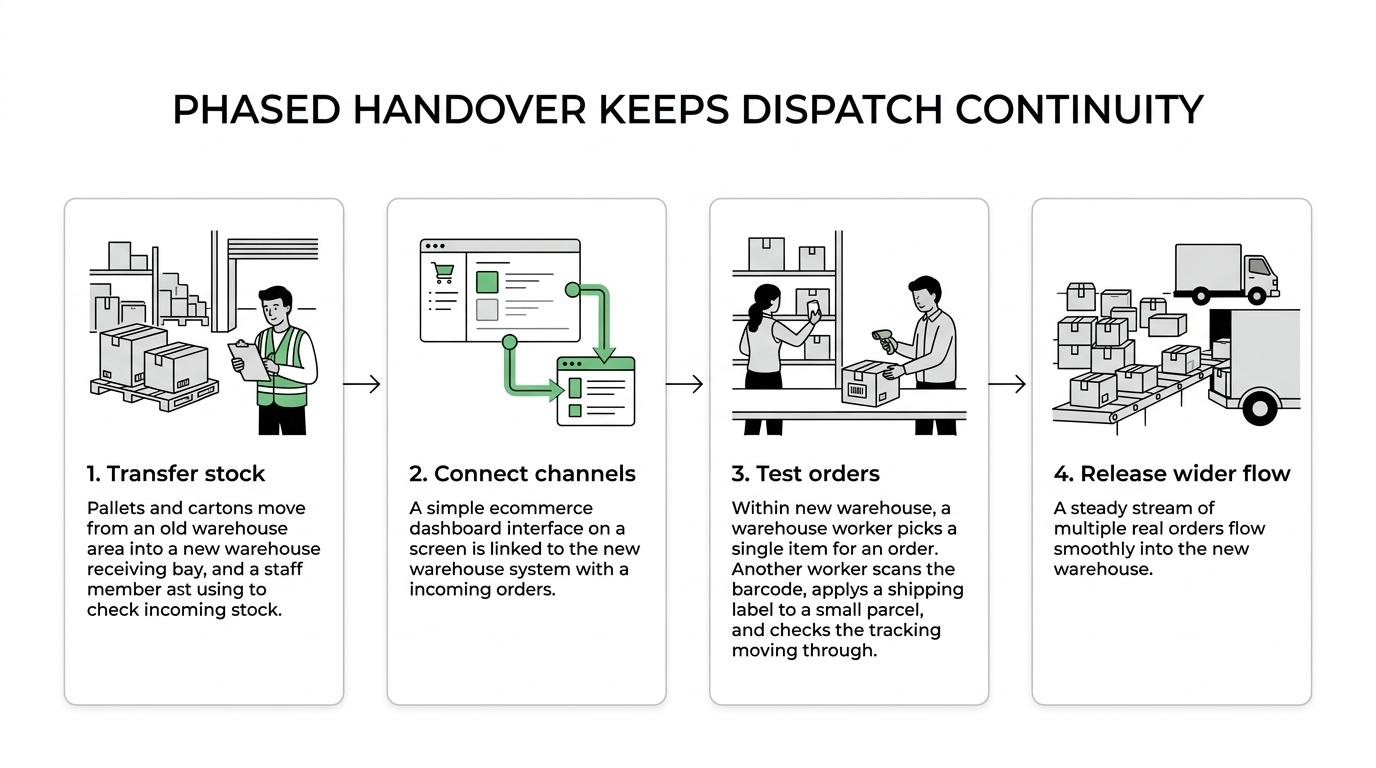
For brands moving to 3PLWOW, this approach can be especially practical. Stock can be transferred, channels connected, test orders processed and only then can wider order flow be released. If a small issue appears, it is far easier to correct when only part of the volume has moved.
Go-live checks with a new fulfilment company in the UK
Go-live should feel almost routine by the time it arrives. That is usually a sign that the preparation has been strong.
On the day itself, keep communication lines short and responsibilities clear. A single decision-maker on the brand side and a named operations lead at the warehouse can resolve issues quickly without lengthy escalation. Hourly reviews are often helpful during the first live window, even if they last only five minutes.
A practical go-live checklist might include:
- Order flow: are orders importing into the new system without delay?
- Stock visibility: do channel stock levels match the warehouse opening balance?
- Shipping rules: are the right services selected by destination, value and weight?
- Tracking data: are despatch confirmations and tracking numbers reaching customers?
- Exception handling: is there a process for address issues, failed labels and oversells?
- Fallback plan: can urgent orders still be shipped if one workflow fails?
Keep a close eye on the first test orders, then the first real orders, then the first returns. Small operational faults tend to appear in those moments first.
One more point matters here: customer service teams should be briefed before go-live. They need to know the cutover window, any temporary returns changes, and who to contact if a customer query relates to the old warehouse versus the new one.
Switching to 3PLWOW with a staged cutover plan
A move to 3PLWOW works best when the handover is treated as a planned operational transfer rather than a last-minute warehouse swap. That means agreeing data fields early, confirming the warehouse stock transfer timetable, testing store connections and deciding exactly how open orders will be split.
3PLWOW’s own switching guidance points towards the right sequence: confirm notice periods and current arrangements, prepare SKU and stock data, map sales channels, reconcile inventory on receipt and run test orders before wider release. That structure gives brands a practical route to stable dispatch continuity.
The handover can then be organised in a way that suits the catalogue and order profile. Some brands may prefer a clean cut on a quiet trading day. Others will benefit from a phased transfer, with selected SKUs or channels moving first. Either route can work well if the rules are documented and both sides know who owns each step.
When the transfer is planned with care, customers rarely notice anything beyond reliable delivery. Orders continue to flow, stock lands where it should, and the new fulfilment setup begins with confidence instead of firefighting. That is the real aim of switching fulfilment providers: not just a new warehouse, but a stronger operating model from day one.