

Moving to a new fulfilment partner can feel like a logistics task, but the stock move is only one part of the work. A well-run transition depends on clean product data, clear order rules, agreed packing requirements, tested integrations, coordinated warehousing, efficient distribution and a controlled go-live window.
That is why switching a 3PL provider in the UK should be handled as an operational handover, not a last-minute warehouse relocation, with third-party logistics services aligned to the new provider’s processes. When the plan is built properly, the first inbound is cleaner, the first orders are calmer, and the first stock report is far more reliable.
Why switching 3PL provider in the UK needs more than a stock move
Many brands start with the obvious question: how do we move pallets from one warehouse to another? It matters, of course, but it is rarely the risk that causes the real disruption. Problems usually show up in the gaps between systems, labels, product setup and live order routing.
3pl providers cannot pick accurately if the SKU master is inconsistent. They cannot pack correctly if gift notes, inserts or carton rules are missing. They cannot report stock confidently if the opening inventory position is disputed on day one.
A change fulfilment provider project works best when four areas are planned together:
| Workstream | Main aim | What should be signed off |
|---|---|---|
| Inventory transfer | Move stock without losing traceability | Final count, pallet list, intake booking |
| SKU and order data | Set products up correctly in the new WMS | SKU file, barcodes, bundle logic, dimensions |
| Channel and system setup | Route orders and updates correctly | Store connections, carrier rules, status mapping |
| Go-live control | Start dispatching with low risk | Test orders, escalation contacts, first-week checks |
This table looks simple, yet it is the discipline behind it that protects service levels.
Pre-transfer planning for a fulfilment provider change
Before any carton leaves the current site, build a transfer plan around dates, responsibilities and cut-off rules. That means deciding when the final outbound wave will leave the old warehouse, when stock counting will happen, when transport arrives, and when the new site starts receiving. If those points are vague, every later step becomes harder.
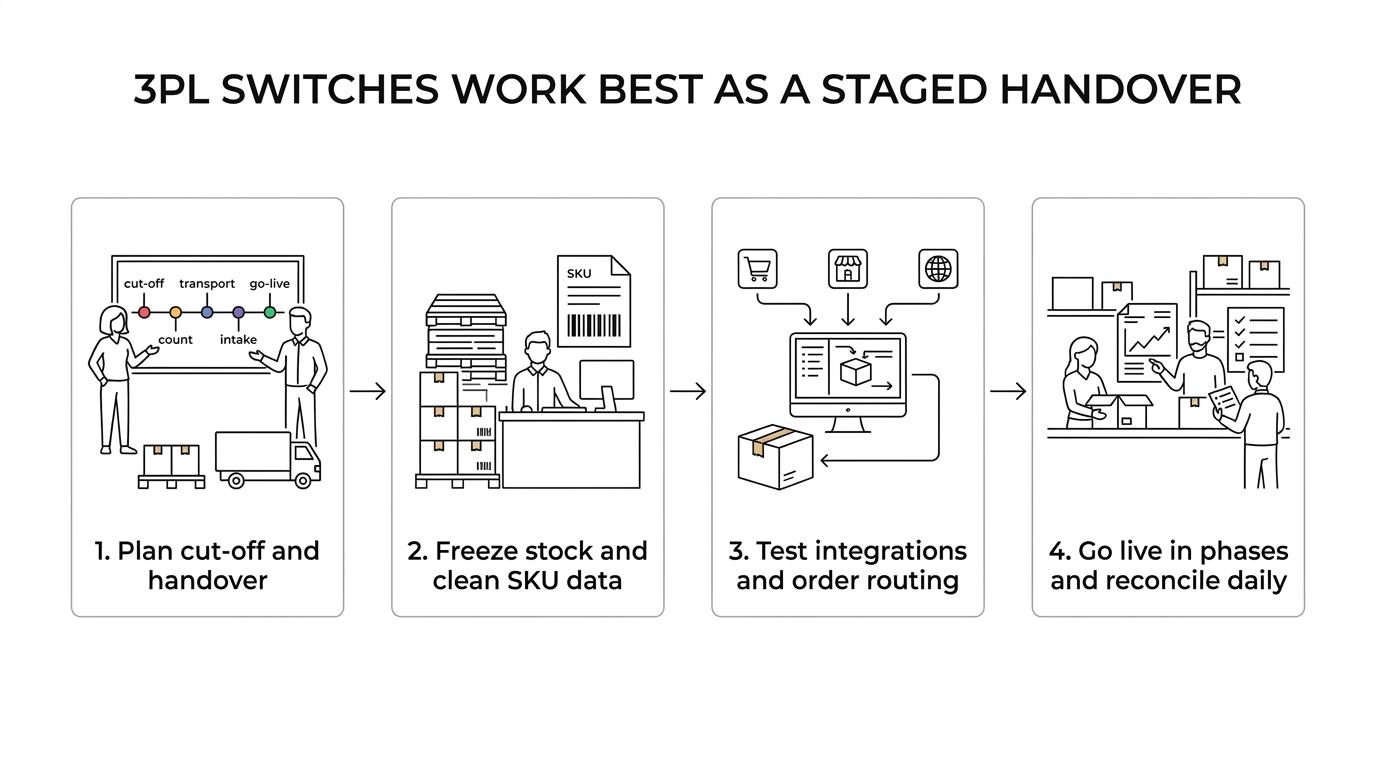
The handover should also define what “live” means across all sales channels. Some businesses want the new 3PL to receive stock one week before taking orders. Others want inbound and outbound to start almost at the same time. Either route can work, provided the stock profile, sales velocity and order backlog are taken into account.
One useful discipline is to split the migration into sign-off packs rather than relying on email threads. A pack for inventory, a pack for SKU data, a pack for integrations, and a pack for packing rules gives everyone a clear reference point.
A practical pre-transfer checklist, including the terms of the fulfilment contract, often includes the following:
- Timeline: cut-off date, count date, transport date, intake window, go-live date
- Contacts: operational lead, systems lead, warehouse lead, courier contact
- Stock scope: sellable stock, quarantine stock, returns stock, packaging materials
- Order rules: same-day cut-off, weekend handling, back-order policy
- Service levels: intake turnaround, dispatch SLA, reporting frequency
It is also wise to agree how exceptions will be handled. Damaged pallets, unlabelled cartons, mixed cases and short deliveries should not be left to improvisation on the dock.
SKU data, inventory counts and warehouse stock transfer controls
The cleanest warehouse stock transfer starts with a clean SKU file. Every active SKU should have one agreed code, one barcode where relevant, a clear description, and any handling notes the new warehouse team needs. If products are sold as kits, multipacks or bundles, that logic must be documented before onboarding starts.
Opening inventory is equally important. The outgoing provider’s stock figure should be checked against a recent count, then frozen at an agreed point. That stock position becomes the baseline for the new site’s goods-in reconciliation, helping 3pl providers maintain accurate inventory records from day one. Without that baseline, the first stock report turns into an argument rather than a control tool.
Accuracy beats speed here.
At a minimum, the transfer file should cover:
- SKU code
- EAN or barcode
- product description
- unit of measure
- case quantity
- batch or expiry details where relevant
- carton and pallet counts
- any quarantine flags
- storage notes
If the products need special packing instructions, add them to the same working set or to a linked operating guide. A picker should not have to guess whether a fragile line needs void fill, whether a subscription box needs a printed insert, or whether a premium item requires a branded sleeve.
This is also the stage to decide how discrepancies will be reported. Some operators reconcile at carton level on intake. Others receive by pallet, then count exceptions in detail. Neither method is inherently wrong, but both sides need to know what evidence will be used when the opening stock is signed off.
Systems setup, channel connections and order routing tests
A 3PL migration checklist should give as much attention to systems and sales channels as to stock movement. If orders are flowing from Shopify, Amazon, eBay, TikTok Shop, marketplaces or an ERP, each connection needs to be configured and tested. Shipping methods must map correctly. Order statuses must update correctly. Tracking data must return to the sales channel correctly.
Returns deserve the same care. Brands often spend weeks on outbound setup, then realise late in the process that return reasons, grading rules and restock logic were never agreed. That gap can distort stock figures within days of go-live.
Testing should move from simple to realistic. Start with product setup. Then run a small batch of sample orders. Then test edge cases: split shipments, bundles, address issues, out-of-stock lines, gift messages, and cancellations during pick.
A sensible testing round covers:
- Single-line orders: confirm SKU mapping, pick face, label output
- Multi-line orders: check packing logic and carton selection
- Bundles and kits: verify component depletion and customer-facing descriptions
- Carrier services: test tracked, signed-for and express options
- Status updates: confirm dispatch confirmations and tracking feeds return properly
It also helps to test the unpleasant scenarios, because real life rarely waits for a tidy launch. What happens if a label printer fails? What happens if a marketplace order imports with the wrong service code? What happens if stock is physically present but not yet released for sale in the system? Those answers should exist before the first live cut-over.
Order routing tests before moving fulfilment provider
Order routing is the point where technical setup becomes customer experience and a smooth transition depends on getting the details right. If the wrong warehouse is assigned, or if a channel remains connected to the previous provider for a few extra hours, duplicate dispatches and delayed orders can follow very quickly.
That is why many businesses use a short freeze window around go-live. New orders still enter the sales channels, but routing to the outgoing warehouse is paused while the final switch takes place. It is not glamorous, though it is very effective.
Customs warehouse checks and HMRC requirements for imported goods
If your stock includes imported goods, the switch may involve more than standard receiving paperwork. This matters most where stock is stored under a customs warehouse procedure or where the goods have duty and VAT implications that depend on their status in storage.
According to GOV.UK guidance on managing a customs warehouse, stock records for goods under the procedure must show the current stock in real time. HMRC also expects records of the goods’ movements and location, and permission must be in place before goods are removed from the warehouse. That makes warehouse stock transfer planning especially sensitive for businesses operating under customs controls.
If goods are held in a customs warehouse, confirm the status of the current site and the receiving site before any transfer date is agreed. A public or private customs warehouse has specific operating rules, and the operator of a private customs warehouse must be authorised as the warehousekeeper. If the move involves a new customs warehouse operation, GOV.UK says applications should be made at least two months before starting use.
For importers more generally, there are a few practical checks worth making early:
- GB EORI number: needed when importing into England, Scotland or Wales
- Customs agent role: confirm who is handling declarations and movement paperwork
- Real-time stock records: check whether the new site can maintain the required inventory visibility
- Removal permissions: make sure goods are not moved outside procedure rules
- Fulfilment House Due Diligence Scheme: review whether it applies to the storage model
Not every business switching 3PL provider in the UK will need these customs checks. Still, where they do apply, they should sit near the top of the project plan rather than in a late-stage legal folder.
Go-live planning, first dispatches and stock reconciliation
The first dispatch day should feel deliberately quiet. That does not mean low order volume. It means low ambiguity. Everyone involved should know who signs off the opening stock, who releases channels, who monitors order flow, who checks tracking events, and who handles urgent exceptions.
A phased start is often the safer option. Some brands move a smaller product range first. Others release one sales channel at a time. That approach may look slower, yet it often protects customer service and gives the new team room to confirm that pick accuracy and reporting are stable.
Keep the first 48 hours tightly managed. Watch for orders stuck in import queues, address validation failures, carrier mapping issues, and stock that is physically received but not yet available for sale. Most launch problems are not dramatic. They are small, repeated issues that compound if left unattended.
During the first week, focus on a short control loop:
- morning stock reconciliation
- live order queue review
- dispatch exception log
- returns intake check
- daily contact between brand and 3PL
That daily rhythm creates confidence quickly. It also gives both teams a clean path to refine packing instructions, courier selections and replenishment logic without disrupting service.
A moving fulfilment provider project is strongest when the opening week is treated as part of the migration, not the point where the migration ends. Stock has to land, yes, but data has to match, orders have to route correctly, and reports have to make sense from the start. When those pieces are prepared together, the switch becomes far more controlled, and the new operation has a much stronger base to build on.