

A fulfilment quote can look reassuringly simple when the headline rate is low. A first-item pick fee and a small additional-item charge are easy to compare, easy to repeat in meetings, and easy to drop into a spreadsheet.
Yet that headline can hide the bigger number that will actually hit the monthly P&L.
When businesses compare UK fulfilment quotes properly, they usually find that handling is only one layer of the bill. Storage, packaging, delivery services, returns work, software, goods-in, monthly minimums, and one-off setup charges can easily shift a quote from “cheap” to “costly”. The strongest way to compare providers is to price the same real order profile with each one and test every extra line.
Pick and pack pricing is only one part of UK fulfilment costs
Pick and pack pricing matters, of course. It reflects labour, workflow design, and how efficiently a warehouse can process orders. It is also the easiest number for a provider to place at the top of a quote.
That simplicity is exactly why it can distort decision-making.
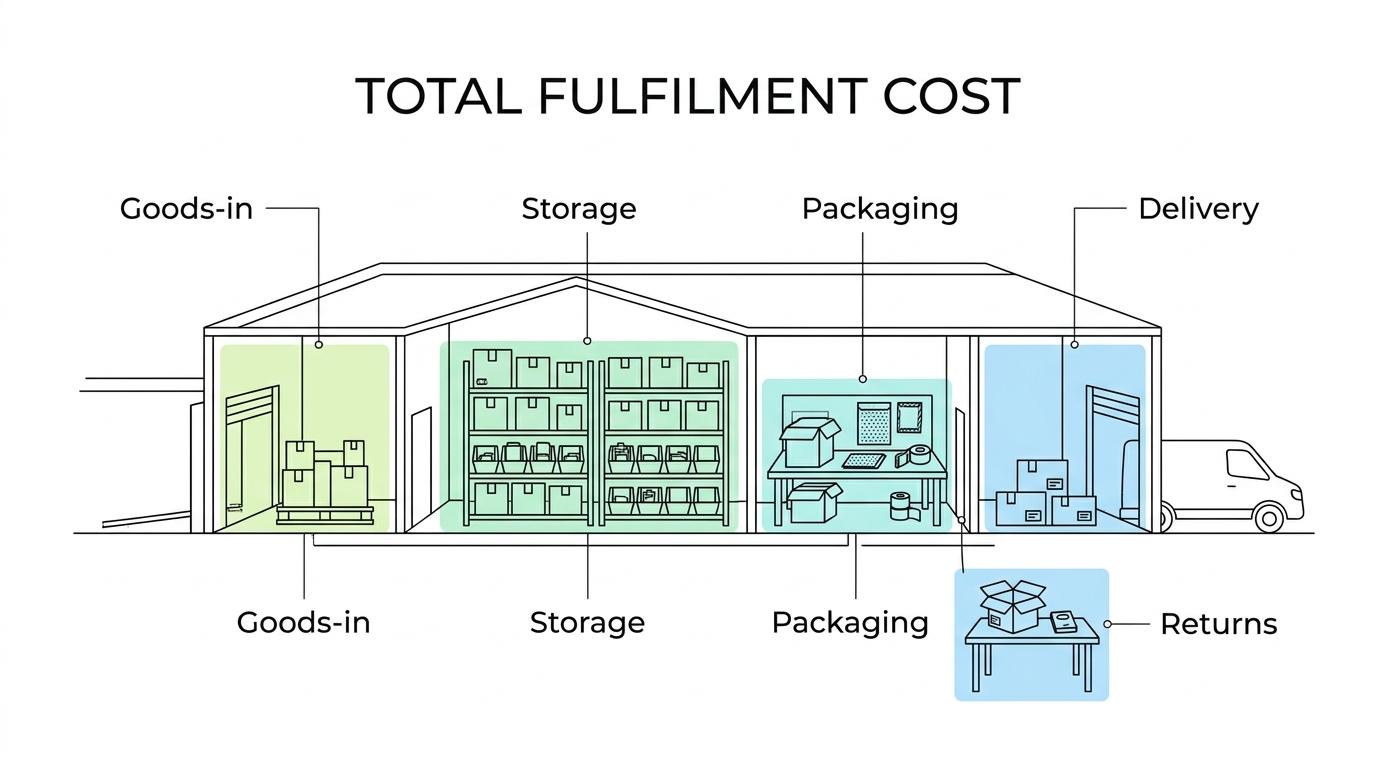
A warehouse might quote a very attractive first-item fee, but charge more for extra items, packaging materials, storage locations, goods-in handling, or carrier add-ons. Multi-item baskets make this especially important. If a first item costs £2.50 and each extra item costs £0.40, a three-item order already costs £3.30 in handling before packaging and postage are added. On a single-SKU sample, the same provider might look significantly cheaper than it does on your live basket mix.
Low handling rates can also distract from fees that sit elsewhere on the quote:
- Goods-in receiving
- Pallet or bin storage
- Packaging materials
- Carrier surcharges
- Returns processing
- Software or portal fees
- Monthly minimums
Use a real order profile to compare UK fulfilment quotes fairly
The cleanest comparison starts with one month of genuine orders. Not averages in broad terms. Not “most orders are small”. Real orders, real SKU counts, real parcel sizes, real dispatch services, and real returns volumes.
That means building a quote request around your actual trading pattern. Include order count, average items per order, top-selling SKUs, slow-moving stock, packaging needs, and dispatch mix. If one provider prices a one-item parcel assumption while another prices your true basket profile, you are not comparing the same service.
A published UK fulfilment comparison checklist from 3PLWOW makes this point well: the same month of orders should be costed by every provider, with the same stock, packaging, and delivery services. That approach removes guesswork and makes differences visible.
The table below gives a practical structure for a like-for-like comparison.
| Quote element | What to standardise | Why it changes cost |
|---|---|---|
| Goods-in | Pallets, cartons, SKUs, booking frequency | Some warehouses charge per pallet, others per box or per SKU receipt |
| Storage | Average stockholding, pallet count, bin count, oversized items | Slow movers and bulky products can make a cheap handling quote expensive |
| Pick and pack | Items per order, orders per month, kitting work | Multi-item baskets change labour cost fast |
| Packaging | Standard mailers, boxes, void fill, branded inserts | “Packaging included” can mean very different things |
| Delivery | Weight, dimensions, services, zones, claim cover | The carrier line is often the largest variable cost |
| Returns | Expected return rate and actions required | Inspect, restock, rebag, refurbish, or dispose all price differently |
| Tech and account charges | Integrations, portal access, setup, minimums | Monthly fees can wipe out a lower pack rate |
Delivery pricing transparency matters in every ecommerce fulfilment quote
Delivery charges deserve much closer attention than they often get. For many ecommerce brands, shipping is the biggest moving part in the fulfilment bill, and it is rarely static.
A quote should make it clear how delivery is priced, which services are included, what parcel assumptions have been used, and which surcharges may apply. If a provider says shipping is “from £x”, that may be useful as a starting point, though it is not enough for a decision.
This matters beyond budgeting. CMA guidance on price transparency says that where a mandatory delivery charge cannot reasonably be calculated in advance, the trader should explain that delivery charges are payable and how the cost will be calculated. It also warns against drip pricing, where the real total only becomes visible later.
Carrier surcharge schedules show why this detail matters. Business parcel networks can apply manual handling charges, incorrect induction fees, delivery-zone uplifts, or oversize surcharges. Those extras may not appear in a neat headline rate, yet they still land on the invoice.
When checking delivery pricing, ask for the assumptions in writing:
- Carrier tariff basis: dead weight, volumetric weight, or whichever is greater
- Delivery zones: mainland only, full UK, Highlands and Islands, Northern Ireland
- Surcharge triggers: oversized parcels, manual handling, address exceptions, incorrect induction
- Service mapping: economy, tracked, signed, next day, weekend
- Packaging impact: whether the quoted parcel band assumes your actual pack format
Storage, packaging and goods-in charges can outweigh cheap handling
Storage is often treated as a background cost, though it can be decisive. A small brand with fast stock turn may barely notice it. A business with seasonal swings, large cartons, slow movers, or promotional stock can feel it every month.
Quotes also present storage in different ways. One warehouse may charge by pallet space, another by shelf bin, another by cubic measure. None of these models is wrong. They are simply different. The only way to compare them is to map your stock profile to each method.
Packaging deserves the same discipline. “Standard packaging included” sounds positive, yet the real question is what standard means. A slim clothing mailer and a double-wall carton with void fill are not the same cost. Neither are gift inserts, tape requirements, fragile protection, or branded presentation elements.
Goods-in charges can create a quiet cost centre too. If your replenishments arrive in mixed cartons, with relabelling needs or frequent partial bookings, receiving work may be much heavier than the quote assumes.
That single line can alter the economics of a provider that looked attractive on dispatch rates alone.
Returns processing and monthly charges in 3PL pricing UK
Returns work is not simply the reverse of outbound fulfilment. It often takes more judgement, more handling time, and more decision points. A returned beauty item, garment, electronic accessory, or food-adjacent product may each need different checks before restocking.
A strong ecommerce fulfilment quote should say what happens when stock comes back: is the item inspected, rebagged, photographed, quarantined, restocked, or disposed of? Is the fee per parcel, per item, or per minute of work? If your category has a meaningful return rate, this section should be priced with care.
Then come the monthly charges that can sit outside the core operation. Some providers charge software fees, account management retainers, channel connection fees, or monthly minimums. Others may apply onboarding, integration, stock-count, project, or exit charges.
Watch these lines closely:
- Onboarding fee
- Integration charge
- Monthly minimum
- Returns per item
- Cycle count fees
- Rework or relabelling
- Exit admin charges
Service levels and warehouse processes affect quote value
A cheaper quote is not always better value if it is tied to a slower cut-off, weaker stock accuracy, limited support, or rigid exception handling.
This is where operational detail matters. Ask what same-day dispatch cut-off is assumed. Ask how order edits are managed, how stock discrepancies are reported, how urgent replenishments are booked in, and how returns are turned around. If a brand sells bundles, subscription boxes, gift sets, fragile items, or retailer-compliant cartons, check whether the workflow has already been priced or treated as an extra.
Even a strong price can become expensive if it creates avoidable customer service issues. A late dispatch, a missed gift note, or a poorly packed parcel often costs more than the few pence saved on a handling rate.
Service-level comparisons can feel less tidy than pure price comparisons. They still belong in the same spreadsheet.
A practical model to compare UK fulfilment quotes
A useful comparison model has three layers: monthly cost, pricing clarity, and operational fit. Monthly cost answers “what will this likely cost us?” Pricing clarity answers “can we predict and audit the invoice?” Operational fit answers “can this setup support the brand we are trying to build?”
The first layer should use one normalised month of data. Price every order, every return, every stock receipt, and the average storage footprint. Then total it. Do not stop at first-item pick and pack pricing.
The second layer looks at clarity. Are assumptions explicit? Are delivery zones named? Are surcharge rules stated? Are packaging and goods-in included or not? A quote with slightly higher rates can still be the stronger choice if it is transparent enough to budget with confidence.
The third layer looks at fit. Can the warehouse handle product complexity, seasonal peaks, marketplaces, retail prep, subscription work, or branded presentation? If the answer is no, a lower quote may only postpone a harder decision.
A simple process works well:
- Build a sample month from real orders, stock receipts, and returns.
- Ask each provider to price that exact profile and state every assumption in writing.
- Compare total monthly cost, then test the quote for storage rules, delivery surcharges, monthly fees, and service levels.
When teams compare fulfilment quotes this way, the decision usually becomes clearer. The aim is not just to find the lowest visible rate. It is to choose a cost model that stays sensible once the real business starts flowing through it.