

A fulfilment quote can look wonderfully tidy on page one and far less attractive by month three.
That is the trap. A low headline rate for storage or pick and pack often leaves out the charges that shape the real bill: receiving stock, packaging, extra item picks, carrier surcharges, returns handling, minimum monthly fees, and the cost of service errors. When those hidden costs appear later, the “cheapest” quote may turn out to be the most expensive option in practice.
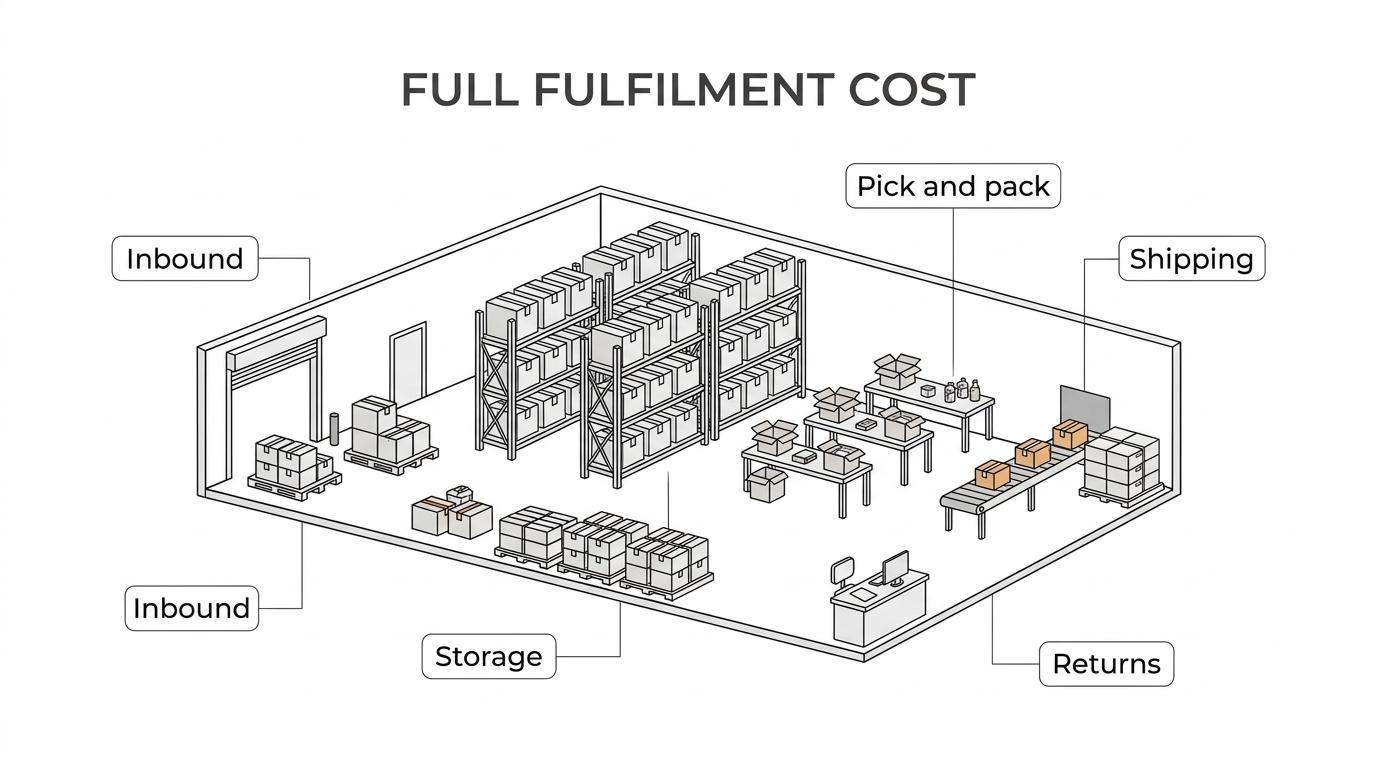
For UK ecommerce brands, the better question is not who has the lowest rate card? It is which quote gives the clearest view of average cost per order across the full workflow? Amazon Supply Chain Services uses that term to describe the combined cost of inbounding, storage, picking, packing, and shipping divided by total orders. That framing is far more useful than staring at one line item in isolation.
What a fulfilment quote should include in total cost
A sensible comparison of logistics costs starts with the full operating picture. If one provider charges £0.80 for pick and pack but bills separately for every extra touch, while another bundles more into a higher base rate, the second offer may be the better buy.
Here is a practical view of the nine cost areas worth comparing side by side.
| Cost area | What often looks cheap | What to check |
|---|---|---|
| Inbound receiving | Low or free onboarding | Pallet/container receiving, carton unloading, SKU setup, booking-in time |
| Storage | Low pallet rate | Bin fees, shelf fees, overflow, aged stock charges, minimum storage |
| Pick and pack | Cheap first-item fee | Additional item charges, insert fees, bundle fees, split order fees |
| Packaging | “Packaging included” | Type of packaging, branded materials, void fill, relabelling |
| Shipping | Strong base courier rate | Fuel, residential, remote area, oversized, failed delivery surcharges |
| 3PL minimum fees | Low transaction rates | Monthly minimums, account management, admin, subscription charges |
| Returns | Basic return receipt only | Inspection, grading, repacking, restocking, disposal fees |
| Service quality | Low quoted handling cost | Accuracy, reship costs, SLA penalties, stock discrepancy handling |
| Integrations and reporting | “No setup fee” | Channel integrations, custom reporting, API work, change requests |
A quote is only useful when it predicts the invoice.
Inbound receiving and onboarding costs in fulfilment pricing
Inbounding is often the first place where hidden fulfilment costs appear. A provider may price outbound fulfilment attractively while charging extra for unloading pallets, counting units, quality checking, labelling cartons, or creating SKU records. If stock arrives in mixed cartons or with inconsistent barcodes, the bill can rise quickly.
This is also where operational rhythm matters. A provider with slow dock-to-stock time can create indirect cost through stock being unavailable for sale even after it has physically arrived. That delay does not always appear on the quote, yet it affects launch dates, replenishment timing, and customer experience.
When comparing UK fulfilment pricing, ask how inbound stock is treated from booking to put-away. A cheap setup promise means little if every delivery triggers manual handling fees.
Fulfilment storage costs depend on stock profile, not just pallet rate
Storage looks simple until product shape, turnover, and seasonality enter the picture. One quote may advertise a very low pallet charge, but many ecommerce businesses do not store goods neatly as full pallets for long. Fast-moving SKUs break into pick bins. Slow-moving items sit longer. Odd-shaped products take awkward space.
A provider that charges by pallet, shelf, bin, and overflow location may produce a very different monthly total—and create an opportunity cost by tying up stock in expensive or poorly used space, reducing efficiency, putting pressure on profit margins, and limiting business growth—compared with one that uses a simpler inventory management model. Even the timing matters. Some charge on peak stock held at a point in the month, while others average it.
A few storage questions can change the economics of a quote:
- pallet storage
- pick-face bin charges
- long-term stock fees
- seasonal overflow rates
- stock count charges
The background numbers matter too. One public UK example from 3PLWOW shows the first pallet free in its sample model, then £8 per month for each additional pallet. That may suit some stock profiles very well, but not all. The key is matching the pricing method to the way stock actually behaves.
Pick and pack charges often rise with basket complexity
Pick and pack charges are commonly used as the headline hook in a quote. A very low first-item rate can look persuasive, especially for brands with simple single-line orders. Yet basket complexity changes the picture. If many orders contain two, three, or five items, each extra pick matters.
A public sample from 3PLWOW shows additional items at £0.30 each and the first pick and pack rate starting at £0.80 per order in the first volume tier. That is clear pricing, which is good. Still, the quote only makes sense when mapped against actual order mix.
There is also the matter of exceptions and hidden costs. Kits, subscription boxes, promotional inserts, gift notes, fragile handling, and split shipments can all sit outside the base rate. This is where a quote that looks efficient for a standard order can become expensive for a growing brand with merchandising plans.
If you are comparing fulfilment quotes, ask for pricing against a real sample month: order count, units per order, SKU count, and proportion of multi-item baskets.
Packaging materials and packing specification costs
Packaging is another line where “included” can mean almost anything. One provider may include only a plain mailing bag or standard box. Another may include void fill up to a set level but charge for premium materials, branded cartons, tape, inserts, or special protection.
That may sound minor, yet packaging choices affect more than cost. They influence damage rates, dimensional weight, customer perception, and return readiness. A cheaper packing method can create a more expensive shipping profile if parcels become bulkier than necessary.
Ask for detail, not broad reassurance.
- Included materials: box, mailer, tape, basic void fill
- Chargeable extras: branded inserts, stickers, tissue, gift wrap
- Packing rules: how the provider chooses parcel size and protection level
- Rework fees: relabelling, repacking, replacing damaged packaging
Carrier charges, shipping surcharges and accessorial charges
Shipping is the area most likely to produce invoice shock. A quote may list an appealing next-day or 48-hour rate, but carrier charges are rarely limited to a single published figure. Academic work on outsourced fulfilment notes that base shipping charges are visible, while accessorial charges and surcharges often appear only later in the billing cycle.
That matters because outsourced fulfilment creates a degree of information asymmetry. The merchant sees the rate card; the provider sees the real-world parcel profile, exceptions, and carrier invoice adjustments.
Common extras in UK fulfilment pricing include residential delivery surcharges, Northern Ireland or remote area fees, fuel surcharges, oversized parcel fees, address correction fees, failed delivery charges, and claims handling. A quote can look competitive until these are added back.
Before choosing a 3PL, ask for last-mile pricing based on your actual parcel data, not just service type and postcode averages, to understand the full logistics cost.
3PL minimum fees can outweigh cheap transaction rates
A low per-order charge does not always help if monthly minimums are high. Many 3PLs set a minimum billing threshold to protect warehouse capacity and account management time. That is reasonable, but it changes the true cost per order, especially for early-stage brands or strongly seasonal businesses.
This is where 3PL minimum fees deserve careful attention. A provider may quote attractive rates for storage and pick and pack while requiring a monthly spend commitment that effectively lifts the price of every order in quieter months.
Check the contract language on volume bands too. If discounts apply only after a fixed threshold, or if the rate resets when order count falls, your average cost may swing more than expected across the year.
Returns processing costs can erase margin very quickly
Returns are not a side issue in ecommerce. They are part of the model. Retail Economics forecasts UK non-food returns of £25.1bn in 2025, with a returns rate of 19.5%. Any fulfilment quote that treats returns as an afterthought is leaving out a serious cost centre.
The direct fees are easy to spot once you ask: return receipt, parcel opening, inspection, grading, photographing, repacking, restocking, disposal, and refund support. The indirect costs are often larger: inventory tied up, resale delays, damaged packaging, and customer service time.
A cheap outbound quote can become expensive if returned stock takes too long to process or is handled inconsistently. That affects resale recovery and stock accuracy. For fashion, beauty, consumer electronics, and gifting, this can make a noticeable difference to margin.
A useful returns comparison should include both price and policy.
- Receipt fee: cost to accept the return into the warehouse
- Inspection fee: quality checks, grading, and photos
- Restock fee: returning saleable stock to active inventory
- Exception handling: damaged goods, missing parts, disposal, quarantine
Service quality metrics expose the real cost of low fulfilment quotes
Price without service data is only half a quote.
Amazon states that leading ecommerce companies and 3PLs often record order accuracy rates of 98% and above. That benchmark matters because each pick error carries a chain of costs: reshipment, returns processing, customer support time, refunds, stock adjustment, and possible lost repeat business.
This is why metrics like order accuracy, inventory accuracy, first-time pick rate, and dock-to-stock time deserve a place in quote comparison. APQC also defines perfect order performance as a combined measure of on-time delivery, complete orders, damage-free orders, and accurate documentation. A provider with slightly higher base fees but stronger service performance can still produce the lower total cost.
Ask what happens when service slips. Is there proactive reporting? Are root causes tracked? Are stock discrepancies investigated quickly? Cheap handling is less impressive when the business ends up paying for avoidable errors.
Integrations, reporting and management time belong in the cost comparison
Some fulfilment quotes appear lean because they leave out the labour your team will absorb. If a provider has weak integrations, limited reporting, or manual exception handling, internal staff will spend more time reconciling orders, fixing stock mismatches, chasing carrier claims, and answering customer queries.
That internal effort is still a fulfilment cost, even if it never appears on the warehouse invoice.
Compare the practical setup: shopping cart integrations, marketplace connections, order status visibility, returns data, custom exports, and stock reporting cadence. A slightly higher monthly fee may save many hours of operational admin. For a growing business, that saved time often has more value than shaving a few pence off a headline pick fee.
How to compare fulfilment quotes on a like-for-like basis
The most reliable approach is to turn every quote into the same model and test it against your own trading data. Use a real sample month, or better still, a rolling three-month average that includes normal basket mix, returns activity, and seasonal stock peaks.
A simple review framework helps keep the comparison disciplined:
- Map the workflow: inbound, storage, pick and pack, packaging, shipping, returns, reporting
- Stress-test basket mix: single-item orders, multi-item orders, fragile orders, kits
- Model seasonal volume: quiet months, campaign spikes, peak trading weeks
- Ask for KPI evidence: order accuracy, dock-to-stock time, inventory accuracy, on-time dispatch
- Check billing detail: minimums, surcharges, exception fees, review periods
It also helps to request one more thing: a sample invoice. Rate cards can be neat. Invoices show reality.
The strongest fulfilment partnership is rarely built on the cheapest headline number. It is built on clear pricing, predictable billing, and service levels that protect margin as order volume grows.