

When food supplements move through a fulfilment centre, speed matters, but control matters more. A tub of vitamins, capsules, or powder is not just another SKU on a shelf. It carries a batch code, an expiry date, label requirements, and a traceability trail that may need to be produced quickly if a problem appears.
That is why batch control, accurate batch tracking, and a well-configured WMS sit at the centre of good supplement fulfilment logistics. It supports accurate stock handling, cleaner rotation, and a more confident response if a withdrawal or recall is ever needed. In Great Britain, that is not simply good warehouse practice. It is tied to food traceability expectations and the need to identify affected product clearly.
Why batch control matters for food supplement fulfilment
Food supplement fulfilment occupies an interesting space in fulfilment. They are often marketed with the pace and variety of consumer goods, yet they also carry food law obligations. A fulfilment centre handling these products needs to treat stock movement with discipline, not just efficiency.
Batch control gives that discipline structure. Rather than seeing a product only as a barcode and quantity, the warehouse system recognises a defined production group. That means the operation can distinguish one intake of a product from another, even if the outer packaging appears identical.
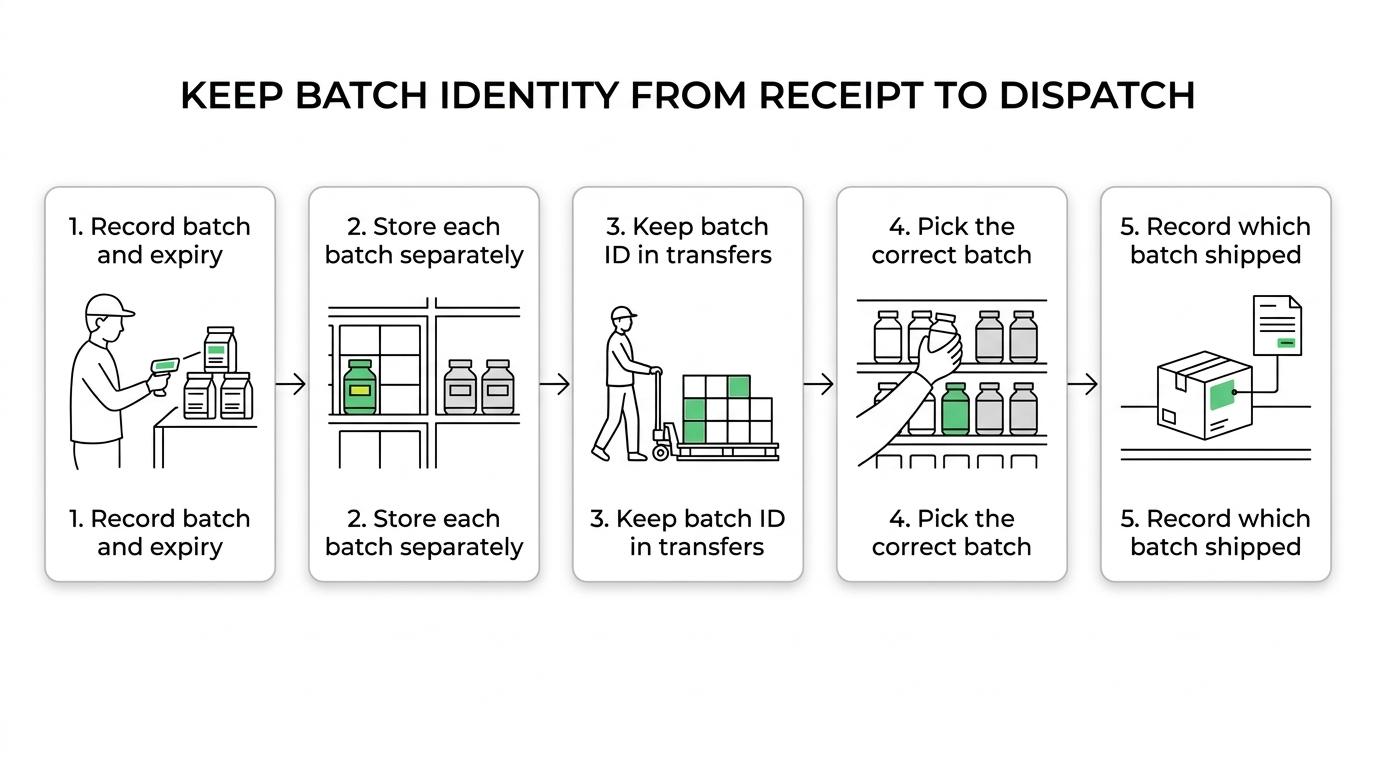
This becomes especially valuable when there is a product quality issue, a label problem, or an expiry concern. If the warehouse can isolate stock by batch code, the affected product can be identified without freezing every unit of that SKU across the building. That saves time and reduces disruption, while still protecting customers and supporting compliance.
UK guidance on food traceability expects businesses to know where food came from and where it went. In simple terms, records need to work one step back and one step forward in the supply chain. For dietary supplements, batch control strengthens that record set by adding a sharper level of product identification.
Batch control at goods-in for food supplements
The strongest traceability systems usually begin before stock ever reaches a pick face. Goods-in is where supplement fulfilment either gains control early or spends weeks trying to catch up.
At receipt, the fulfilment team needs to confirm product identity, check physical condition, record quantities, capture batch information and expiration dates where required, and support accurate order processing. This is also the best point to spot damaged seals, incorrect labels, or inconsistencies between the paperwork and the stock delivered.
A solid goods-in and inventory management routine often includes:
- SKU and product verification
- batch code capture
- expiry date capture
- packaging and seal checks
- quantity reconciliation
- put-away into batch-aware storage locations
This early control matters because mistakes become harder to fix once stock is mixed, split, or moved across multiple locations. A missed batch entry on day one can become a serious traceability gap by day twenty.
Some supplement fulfilment providers describe a workflow built around identity checks against SKU, product name, flavour, size, or variant, followed by condition review and batch-aware storage. That model reflects a sensible operational standard. It links physical stock to system records before customer orders begin drawing from it.
Batch traceability records in a fulfilment centre
A fulfilment centre does not replace the legal duties of the brand owner, but effective batch control of food supplements in a fulfilment centre often carries a large part of the day-to-day traceability burden. If the warehouse cannot produce reliable records, the wider supply chain becomes weaker.
For food products, UK expectations around traceability records are clear. Businesses should be able to identify suppliers and customers, and records should include names and addresses, the type and quantity of products, and the dates of transactions and deliveries. In a fulfilment setting, batch control helps connect those records to the exact stock handled and despatched.
The table below shows how that usually translates into warehouse practice.
| Fulfilment stage | Batch control activity | Traceability value |
|---|---|---|
| Inbound receipt | Record batch code and expiry against received quantity | Links delivered stock to supplier intake |
| Put-away | Store by batch in defined locations | Prevents mixing and supports later isolation |
| Stock movement | Retain batch identity during internal transfers | Preserves accuracy across the warehouse |
| Order picking | Pick from the correct batch according to stock rules | Connects despatched units to the batch supplied |
| Dispatch | Record order and shipment details | Supports one step forward traceability |
| Incident response | Search by batch code, order, or customer | Speeds withdrawal or recall action |
Good traceability is not only about data volume. It is about data that can be used quickly and with confidence. If a team needs three systems, two spreadsheets, and a manual shelf check to identify where a batch went, response time will suffer when it matters most.
Expiry control and stock rotation for supplements
Batch control and expiry control are closely linked to effective inventory management, but they are not identical. A warehouse can track batches poorly while still storing products by date, and it can record dates while failing to retain clear batch integrity. Strong supplement fulfilment needs both.
Expiry capture allows stock rotation rules to work as intended. In many operations, that means FEFO, first expiry, first out, rather than basic FIFO. That distinction is important when later receipts have shorter shelf life than earlier receipts, or when promotions, relabels, or reformulations change the profile of the stock on hand.
For supplements, shelf life is commercially sensitive as well as operationally important. Retailers, marketplaces, and direct customers may all have minimum life expectations. A fulfilment centre that can see expiry dates clearly is in a stronger position to prevent avoidable waste and reduce customer complaints.
Key stock rotation aims include:
- Freshness protection: despatch stock with suitable remaining shelf life
- Waste reduction: avoid forgotten short-dated inventory in reserve storage
- Order accuracy: stop mixed-date substitutions that create customer concern
- Recall precision: narrow the affected stock pool when a specific batch is flagged
When expiry data is captured properly, planners can also make better decisions around replenishment, kitting, and promotional activity. That turns batch control from a defensive measure into a useful planning tool.
Food supplement labelling and batch control requirements
Food supplement fulfilment is not only about the product inside the pack. The label itself matters, and batch control helps warehouses verify that the right labelled stock is being stored and sent.
In England, food supplement rules require the product to be labelled as a “food supplement” and to include key statements. These include the category of vitamin, mineral or other substance that characterises the product, the recommended daily portion, a warning not to exceed the stated dose, a statement that supplements are not a substitute for a varied diet, and a statement to store the product out of the reach of young children. Required particulars must also be clearly legible and indelible.
That makes label checking at intake more than a cosmetic exercise. A fulfilment centre may not be the party creating the label, yet it is still the point at which non-conforming stock can be noticed before it reaches customers.
Batch control strengthens this process in two ways, supporting accurate order processing and helping ensure each customer receives correctly labelled stock. First, it helps segregate any stock with a suspected label issue. Second, it avoids a situation where correctly labelled and incorrectly labelled stock become mixed under one inventory line.
A practical warehouse check may look at:
- Legibility: can the key statements be read easily on the unit sold
- Indelibility: is the print stable and unlikely to rub away in handling
- Batch identification: is the batch code present and readable
- Date marking: is the expiry or best-before information clear
- Pack integrity: are seals, lids, sachets, or cartons in saleable condition
For brands selling across several channels, this matters even more. Marketplace listing compliance, retailer intake rules, and customer trust all improve when the fulfilment centre protects the integrity of labelled stock batch by batch.
Withdrawal and recall readiness in Great Britain
No brand wants to use its recall process, but every supplement business should be ready for it. A fulfilment centre with mature batch control can turn a stressful event into a controlled operational response.
Official guidance in Great Britain distinguishes between a product withdrawal and a product recall. A withdrawal removes a product from the supply chain before it reaches consumers. A recall applies after it has reached consumers. In both cases, the ability to identify affected product accurately is central.
Food Standards Agency guidance also states that, during a food safety incident, a whole batch, lot, or consignment is treated as unsafe unless it can be shown otherwise. That point has real operational weight. If a warehouse cannot separate stock properly by batch, the affected population may become much larger than necessary.
A recall-ready fulfilment setup usually depends on three capabilities:
- Fast searchability: find stock by batch code, SKU, intake date, and order history
- Controlled isolation: quarantine affected on-hand inventory at once
- Customer traceability: identify which business customers or end orders received the product
This is where batch control stops being an internal warehouse preference and becomes part of legal readiness. A fulfilment centre should be able to support a recall notice with credible records, not rough estimates.
Batch-aware storage methods inside the warehouse
Technology helps, but physical layout and process discipline still matter. A warehouse management system can record perfect batch data, yet poor floor practice will still create risk.
Batch-aware storage usually means the operation decides how separate batches are held, replenished, and picked. In some settings, each batch has a dedicated location. In others, a location may hold more than one batch, but only with clear controls to stop mixing during replenishment and picking.
The right method depends on product volume, velocity, and storage format. Small, high-turn lines may need a different approach from pallet-stored reserve stock or fragile glass-pack supplements. What matters is consistency and auditability.
A sensible design often includes clear batch labels on locations, scanning at movement points, and exception handling when damaged or short-dated stock appears. These details are not glamorous, yet they are what keep the digital record matched to the real shelf.
Questions to ask a fulfilment centre about supplement batch control
When a supplement brand reviews fulfilment options, batch control should be tested in detail. Broad promises about accuracy are useful, but they do not reveal how the process behaves under pressure.
Ask direct questions about what happens at receipt, during pick face replenishment, and when an incident occurs. The aim is not to create paperwork for its own sake. The aim is to see whether the warehouse can prove batch integrity from inbound delivery to outbound order.
Useful questions include:
- Goods-in process: how are batch codes and expiry dates captured and verified?
- Storage rules: how are different batches of the same SKU kept separate?
- Rotation method: is stock picked by FIFO, FEFO, or another agreed rule?
- Order records: can despatched orders be traced back to the batch supplied?
- Incident handling: how quickly can affected stock and shipments be identified?
- Documentation: are traceability records kept current and available for inspection?
Clear answers to these questions often tell you more than a long sales presentation. They reveal whether the fulfilment centre sees supplements as ordinary stock, or as products that need disciplined food-grade traceability.
A strong operation treats batch control as part of customer service, stock quality, and compliance at the same time. That is a powerful position for a supplement brand aiming to grow with confidence.