

Peak season has a way of making every operational weakness visible. A slow booking-in process, patchy stock accuracy, clumsy system links or vague carrier rules can sit quietly through a normal month, then turn into missed dispatches the moment Black Friday volume arrives.
That is why the question is not simply whether it is possible to switch fulfilment partner before peak, but whether switching 3PL providers can be planned to protect peak season fulfilment and deliver reliable black friday fulfilment uk. The real question is whether your business can complete a controlled move, test it properly and still protect service levels when order volumes jump.
Black Friday fulfilment timing in the UK market
Black Friday is no longer a single-day event in practice. Promotions often begin early, customer expectations stay high throughout Cyber Week, and the knock-on pressure runs well into December and Christmas. Adobe reported Black Friday online spend of $11.8 billion in 2025 and Cyber Week spend of $44.2 billion, while the NRF forecast November to December retail sales of $1.013 trillion for 2026. Those figures are not UK-specific, yet they show the same pattern every fulfilment team sees locally: demand concentrates hard, and there is very little room for delay.
Carrier calendars tighten that pressure even more. In the US, UPS lists Black Friday as a normal pickup and delivery day after Thanksgiving closure, while USPS highlights mid-December cut-offs for economy and priority services. UK carriers operate on different schedules, of course, though the lesson is identical. Once the market moves into holiday shipping mode, every receiving delay, stock mismatch and failed integration costs more than it would in October.
A switch can still work late in the year, but only if outsourcing fulfilment logistics is treated as a staged operational change rather than a warehouse move done in one dramatic weekend.
A practical test for switching 3PL providers before peak season
A useful starting point is to judge the move by operational complexity, not by calendar date alone. A small catalogue with stable volumes, one sales channel and straightforward pick-pack rules may move quickly. A multi-channel ecommerce brand with bundles, kitting, custom packaging, subscription orders and marketplace service-level commitments needs far more care.
Published guidance from 3PLWOW reflects this staged operational change. Its switching process sets out migration planning, stock transfer support, SKU setup, ecommerce connections, workflow testing and go-live planning with a dedicated contact. That sequence matters because each step reduces uncertainty before orders are routed live.
If most of the points below are true, a pre-Black Friday move may still be practical:
- Stable SKU catalogue
- Reliable stock counts
- Clear packaging rules
- Limited sales-channel complexity
- Predictable inbound purchase orders
- Agreed carrier services
- Internal team available for rapid approvals
If the opposite is true, the move is not impossible, though it may need a partial migration rather than a full cutover.
Stock transfer planning for peak season fulfilment
Stock transfer is usually the first point where a late move becomes either sensible or risky. If inventory records are inaccurate before a transfer, they will rarely become more accurate afterwards. A new 3PL can only ship what is received, correctly identified and booked into the warehouse management system in time, making accurate stock management essential for reliable order processing.
This is why the transfer plan should begin with a product and volume map. 3PLWOW’s published process describes mapping products, SKUs, order volumes, channels, packaging and destinations before building the workflow. That is the right order. You need to know what is moving, how much of it is moving, and which items generate most of the peak demand.
There is also a strong case for separating fast movers from the long tail. Many brands assume the cleanest move is to transfer all stock at once. Near Black Friday, that can create a single large failure point. A staged transfer can be safer, with best sellers prioritised for receipt, verification and immediate availability.
The table below gives a simple decision view.
| Area to assess | Green light | Warning sign | Practical response |
|---|---|---|---|
| Inventory accuracy | Recent cycle counts match system stock | Frequent stock adjustments or missing location data | Recount priority SKUs before any transfer |
| SKU labelling | Barcodes are consistent and readable | Mixed labels, duplicate SKUs, old packaging versions | Re-label before dispatch to the new 3PL |
| Inbound timing | Stock can arrive in batches with booking slots | All inventory must land at once | Split the transfer by sales velocity |
| Product profile | Mostly standard pick-pack items | Fragile items, bundles, expiry dates or serial tracking | Run extra receiving and packing tests |
| Old provider exit | Clear final dispatch date and stock handover process | Contract dispute or unclear responsibilities | Keep overlap stock where possible |
| Safety stock | Buffer stock exists for top sellers | No reserve stock and unpredictable demand | Hold back emergency cover at one site |
A smart stock plan is less about speed and more about control.
Ecommerce integrations and workflow testing before go-live
An ecommerce fulfilment switch often looks straightforward until systems begin to talk to each other. Orders must import correctly. Shipping methods must map correctly. Stock must sync in the right direction. Returns, cancellations and order edits must behave as expected. None of this is glamorous, yet it decides whether peak season is calm or chaotic.
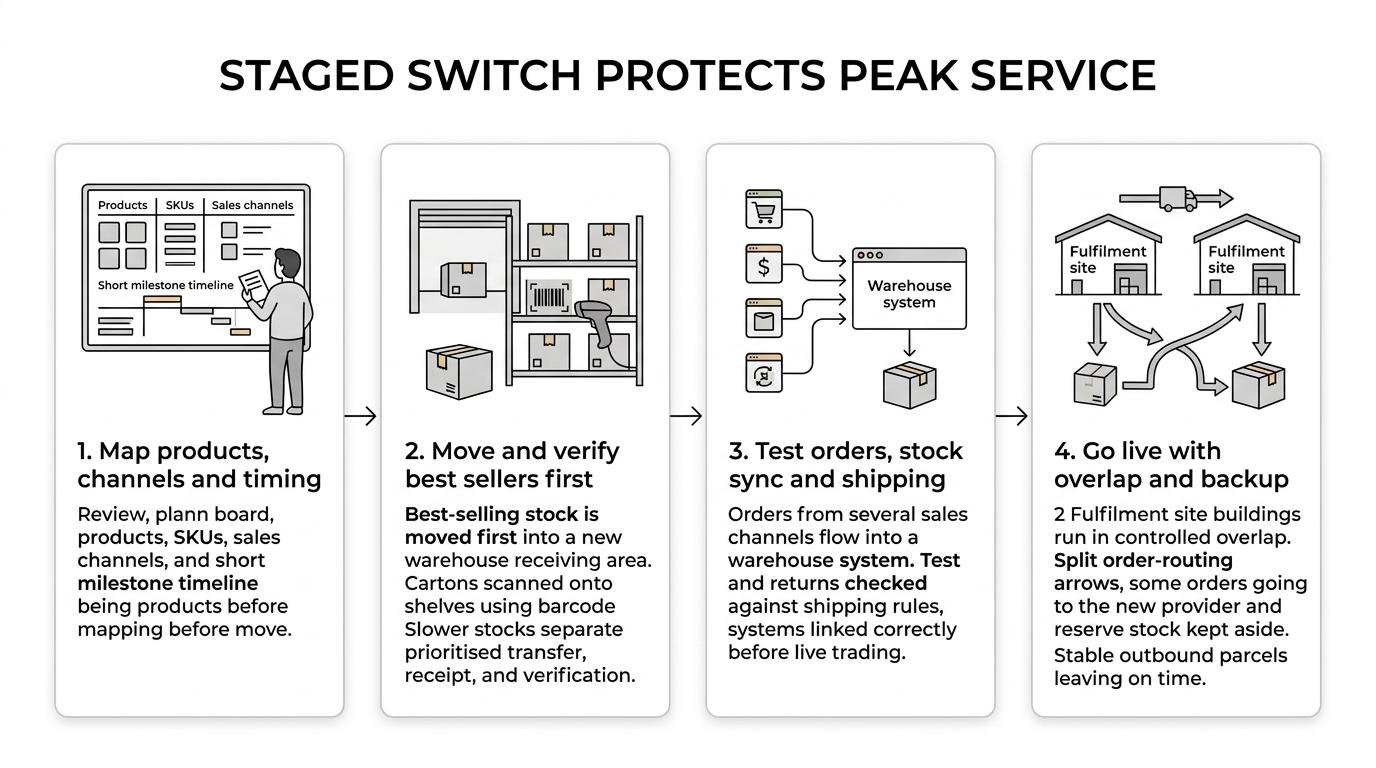
This is where many late-stage switches either succeed or fail. If your current setup includes Shopify, Amazon, TikTok Shop, eBay, wholesale orders, subscription tools or an ERP, every route into the warehouse needs to be checked. A feed that works for simple domestic orders may still break when a bundled promotion, Christmas gift note or marketplace shipping promise appears.
Workflow testing is the discipline that makes the change credible. Test orders should cover normal orders, high-value orders, split shipments, out-of-stock situations, returns and customer service edits. A provider that speaks clearly about workflow testing is usually a safer partner than one that focuses only on storage rates and pick fees.
Before go-live, the testing checklist should cover the following:
- Order flow: create, import, release, pick, pack and dispatch sample orders from every live channel
- Shipping logic: confirm service mapping for standard, express, marketplace and international orders
- Stock sync: verify timing for inventory updates after receipt, dispatch, cancellation and return
- Returns handling: check what happens when returned stock is sellable, damaged or incomplete
- Exception handling: agree the manual process for held orders, address errors and fraud checks
If even one of these areas remains vague, peak season will expose it very quickly.
Contingency plans when switching 3PL providers near Black Friday
A late switch without a fallback is not a confident move. It is an avoidable risk.
The strongest contingency plan is often a period of controlled overlap. That may mean keeping the current provider live for a defined set of SKUs, channels or geographies while the new partner handles another segment. It can feel inefficient for a short time, yet it creates resilience when volumes rise and unexpected issues appear.
There are several sensible ways to structure that overlap:
- Move only best sellers first and leave slower lines with the old provider.
- Shift one sales channel first, then add others after clean dispatch performance.
- Keep emergency stock outside the main transfer for rapid replenishment.
- Agree a temporary manual order file process if an API connection fails.
Contingency planning also needs an owner. Someone must decide who signs off daily stock variances, who approves carrier changes, who manages customer service updates and who can pause promotions if fulfilment capacity tightens. During Black Friday week, delays in decision-making are as damaging as delays in picking.
It helps to set trigger points in advance. If same-day dispatch falls below a defined threshold, if receiving slips by more than 24 hours, or if stock accuracy for top sellers drops below target, you already know what action follows. That kind of discipline creates confidence across the team.
Questions to ask a new 3PL provider about Black Friday fulfilment in the UK
A provider may be perfectly capable in general and still be the wrong fit for a late peak-season move. The sales conversation should move quickly from promise to proof. Ask how inbound stock is booked, how exceptions are escalated, what volumes the operation handled during last year’s peak and what the daily carrier collection cut-off looks like in practice.
Ask, too, how the provider plans capacity. A published 3PLWOW case study reports order capacity rising from 15,000 to more than 35,000 per month within 90 days, with order accuracy improving from 96.2% to 99.4% and same-day dispatch increasing from 71% to 94%. Metrics like those are useful because they show what operational improvement can look like after a structured move. They are most valuable when paired with details on staffing, warehouse processes and exception management.
Good provider questions tend to be precise:
- Receiving SLA: how many hours or days from delivery to book-in during November and December?
- Peak labour plan: what extra staffing is already committed, trained and scheduled?
- Carrier coverage: which UK services are collected daily, and what happens if one network is constrained?
- Packaging control: can branded packaging, inserts, bundles and gift options be handled without manual confusion?
- Reporting cadence: what daily peak-season reporting is available for orders, backlog, stock and returns?
- Escalation route: who owns urgent decisions during go-live and during Black Friday week?
The quality of the answers matters as much as the content. Clear, operationally grounded replies usually indicate a provider that has thought seriously about peak.
How to decide whether the move is practical this month
A practical decision can often be made within a few days if the right facts are gathered. Start with a narrow review: stock accuracy by top SKU, sales-channel count, packaging complexity, system links, current service issues and the volume expected across Black Friday and the first three weeks of December. Once that picture is clear, the move usually looks either manageable or premature.
If the move is manageable, move quickly into a staged plan with dated milestones for stock transfer, SKU setup, integrations, test orders and go-live approval. If the move is premature, that is still useful. You can ring-fence weak areas now, protect peak trading with the current setup, and schedule the switch immediately after the seasonal rush with far better odds of success.
Peak season rewards decisiveness, though only when it is backed by disciplined preparation. A 3PL switch can still be the right move before Black Friday. The businesses that get it right are rarely the ones that move fastest. They are the ones that know exactly what must be true before the first peak order is released.