

Growth in ecommerce rarely fails because demand disappears. More often, it gets messy. Orders pile up on a Monday morning, stock locations stop making sense, returns sit in tubs waiting to be checked, and a founder who should be planning the next product launch is taping boxes at 9pm.
That is usually the real question behind outsourcing fulfilment. Not “Can a third party ship my parcels?” but “Has fulfilment started to limit the business?”
For many growing brands, that point arrives earlier than expected. A business can look healthy on paper while the operation behind it is straining every day. If you are weighing up fulfilment vs in-house, the right timing depends less on ambition alone and more on pressure: order volume, customer expectations, stock complexity, and the cost of doing everything yourself.
Why ecommerce fulfilment pressure is rising in the UK
Online buying is not a niche behaviour anymore. Office for National Statistics data show that online spending accounted for 50.5% of total UK consumer card spend in September 2025, and the average UK cardholder made 35% more online transactions than the 2019 average. That matters because customer expectations rise with market maturity. Fast shipping, reliable tracking, predictable delivery times and easy returns stop feeling like premium extras and start looking like the baseline.
This creates a sharp challenge for growing brands. Marketing can still be agile. Product development can still feel exciting. Yet fulfilment becomes harder in a very physical way. More SKUs need space, and keeping accurate stock levels becomes more challenging. More orders need picking accuracy. More carrier collections need coordination. More returns need proper processing before inventory can be sold again.
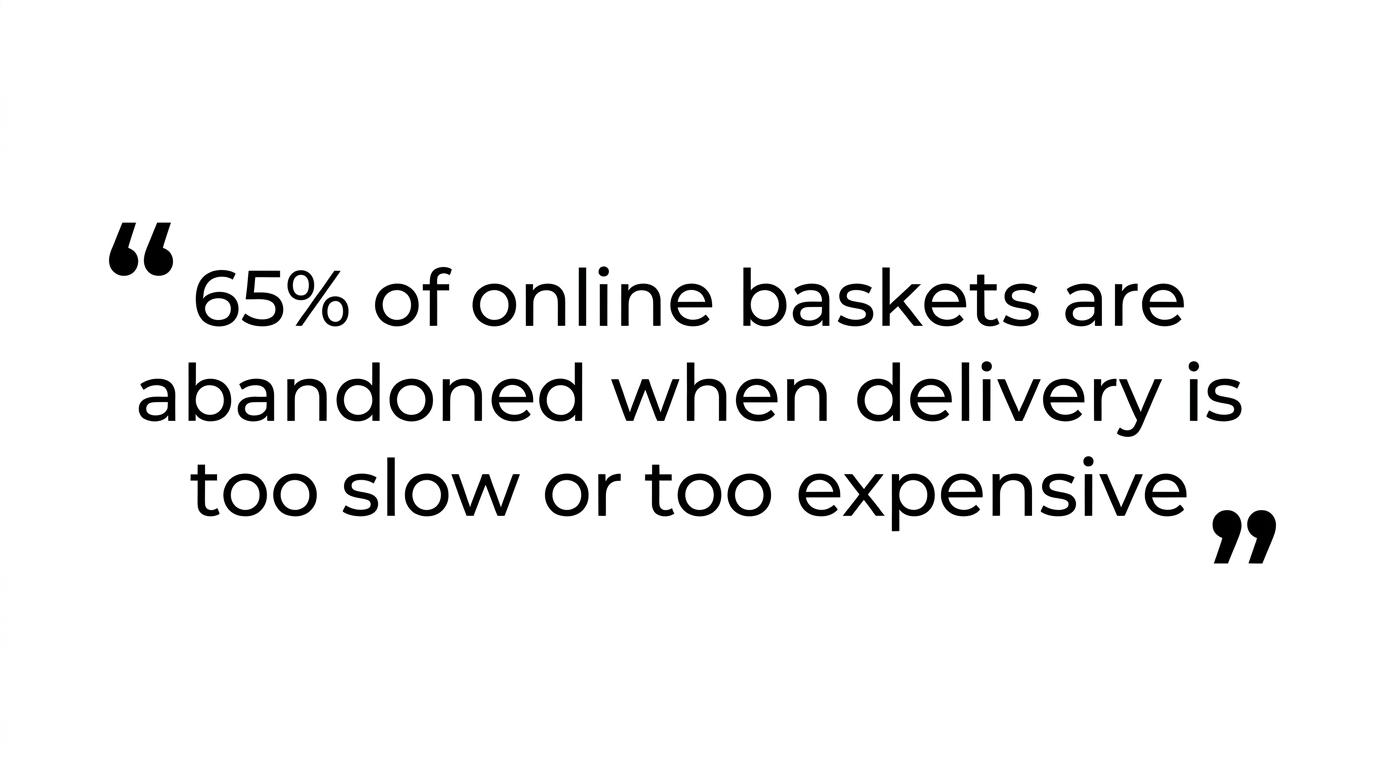
Delivery speed also affects conversion, not just customer service. DHL has cited research showing that 65% of online baskets are abandoned when the delivery timescale is too slow or too expensive. That single figure explains why fulfilment should be viewed as a revenue issue, not simply a warehouse task.
A small operation can cope for quite a long time through effort alone. It cannot do so forever.
Signs your in-house fulfilment is reaching its limit
Most businesses do not wake up one morning and suddenly “need a fulfilment centre”. The transition usually creeps in through operational friction. What starts as a few late dispatches becomes a pattern. What starts as temporary overflow stock becomes permanent clutter. What starts as a founder helping in the packing area becomes the founder running the packing area.
A useful way to judge when to outsource fulfilment is to look at symptoms rather than order count alone. A company case study from 3PLWOW describes a brand that grew from roughly 4,000 monthly orders to more than 14,000 before outsourcing. Before the move, the business was seeing late dispatches, rising pick-and-pack errors, overflow stock, and slower returns handling. The most expensive issue was not only warehouse performance. Senior time was being pulled away from product, marketing and commercial planning.
If several of the following feel familiar, fulfilment may already be holding back growth:
- Late cut-offs and missed same-day dispatch
- Stock stored in more than one room or location
- Frequent pick-and-pack errors
- Returns building up faster than they are processed
- Founders or senior staff covering warehouse tasks
- Seasonal peaks causing service failures
- Rising courier costs with little negotiating power
None of these problems is shameful. They are often signs that demand is working. Still, they do signal that the operating model may need to change.
Fulfilment vs in-house: a practical comparison for growing brands
The debate is not about whether in-house fulfilment or outsourcing to a 3PL (third-party logistics provider) is good or bad. In-house can work extremely well at the right stage. It offers control, close contact with stock, and direct oversight of packing quality. The question is whether it still fits the current shape of the business.
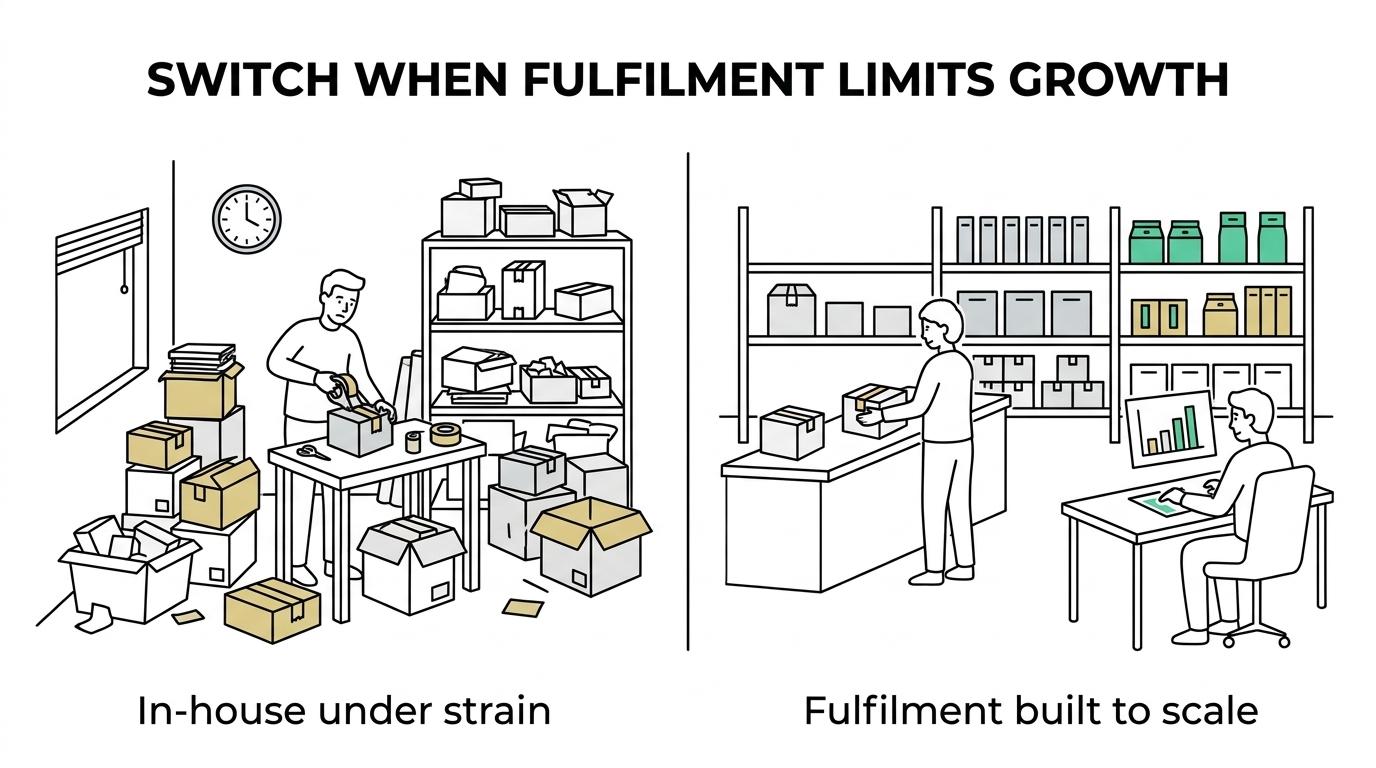
The table below shows where the balance often shifts.
| Area | In-house fulfilment often works best when | Outsourced fulfilment often works best when |
|---|---|---|
| Order volume | Daily orders are predictable and manageable | Daily volumes fluctuate or are consistently high |
| Stock profile | Small product range, simple picking | Many SKUs, bundles, variants or replenishment complexity |
| Space | Existing premises have spare room | Stock is crowding offices, studios or retail space |
| Dispatch speed | Current team can hit cut-offs comfortably | Same-day dispatch is becoming hard to maintain |
| Returns | Returns are occasional and easy to process | Returns volume needs a repeatable, fast workflow |
| Leadership time | Operations do not consume senior attention | Warehouse issues distract from growth priorities |
| Carrier options | Current rates and service levels are acceptable | Better rates, service levels or later cut-offs are needed |
A business can outgrow in-house fulfilment before it becomes “big”. That is why small business fulfilment in the UK has become such an active part of the market. Brands no longer need to wait until they resemble a national retailer before building a stronger logistics setup.
The strongest trigger is not usually one big failure. It is the steady cost of inefficiency that fulfillment centers can help reduce.
When outsourcing ecommerce fulfilment makes commercial sense
Outsourcing ecommerce fulfilment starts to make sense when the cost of doing it yourself is larger than the invoice suggests. Rent, packing benches and courier labels are obvious. Less visible costs can be more damaging: dead stock caused by poor stock control, refund delays, re-shipments after picking mistakes, and lost sales from weak delivery offers.
There is also the opportunity cost. If senior people are spending peak trading weeks solving warehouse bottlenecks, they are not spending that time on acquisition, product margin, retention, partnerships or forecasting. That can slow a business even when top-line demand remains strong.
A practical way to think about timing is to ask whether fulfilment has become a specialist operation inside a business that is not built to specialise in it—and whether partnering with a 3PL could improve capacity, accuracy and delivery speed. Once that happens, outsourcing becomes less of a big leap and more of a practical next step.
That value often shows up in a few places:
- Capacity: room for peak periods, promotions and seasonal spikes without emergency hiring
- Accuracy: tighter picking and packing processes that reduce avoidable errors
- Speed: later order cut-offs and more consistent dispatch performance
- Visibility: better stock data and order tracking across channels
- Focus: more management time for trading, brand and product decisions
The goal is not to give away control. The goal is to move execution into a system that can keep pace with the brand.
Delivery expectations and returns processing now shape brand perception
Customers do not separate fulfilment from the brand experience. If the parcel is late, the tracking is weak, or the return takes too long to clear, the customer rarely blames “operations”. They blame the brand.
That is one reason returns deserve more attention in the outsourcing decision. DHL has reported rising returns in retail categories, with fashion seeing especially strong pressure. For brands with size-based purchasing, gifting, subscription orders or multiple variants, returns processing can become a major operational stream in its own right.
In the UK, parcel experience and complaints handling are monitored through official survey work. That reflects how central delivery performance has become to customer confidence. A polished website cannot compensate for a poor post-purchase experience for very long.
Strong fulfilment supports three commercially important outcomes at once: conversion, repeat purchase, reliable shipping and lower service workload.
What small business fulfilment in the UK should include
Not every fulfilment provider is right for every brand. The best fit depends on product type, order profile, growth plans and channel mix. A cosmetics brand with light items and rapid launches has different needs from a homeware brand with fragile stock and higher average parcel weight.
That said, there are some basics worth expecting from a professional setup. If a provider cannot answer clearly on these areas, caution is sensible.
- Onboarding: a clear plan for stock intake, system integration and go-live timing
- Inventory control: real-time stock visibility and reliable cycle counting
- Dispatch standards: agreed cut-off times, service levels and carrier options
- Returns processing: defined workflows for inspection, restocking and exceptions
- Support model: named contacts and practical issue resolution
- Scalability: evidence that peak volumes can be handled without service decline
It also helps to ask how the operation deals with non-standard requirements. Kitting, inserts, subscription builds, fragile packing, marketplace orders and B2B shipments all add complexity. A provider should be open about what is standard, what is possible, and what costs extra.
Price matters, of course. Yet the cheapest quote is often not the best value if it creates poor delivery performance or weak stock control.
Questions to ask before choosing a fulfilment centre
Before speaking to providers, it helps to get your own numbers straight. Monthly order volume is only the beginning. A good decision depends on average daily orders, peak-day orders, SKU count, storage profile, return rates, channel mix, current error rates and desired delivery offer.
When those numbers are clear, conversations with providers become far more useful. Instead of asking general questions, you can test whether the operation fits your business model.
- What service levels are realistic? Ask about cut-off times, dispatch windows and peak-period performance.
- How are errors measured and handled? Accuracy claims mean more when backed by process.
- What happens with returns? Speed, condition grading and restocking discipline matter.
- How transparent is pricing? Storage, pick fees, packaging, inbound handling and project work should all be visible.
- How will communication work day to day? A strong account relationship can save a great deal of friction.
- What type of brands fit best here? A provider should know where it performs strongly and say so plainly.
A strong fulfilment relationship should feel like an operational extension of the brand, not a black box at the edge of it.
A sensible time to switch is often before a crisis
Many brands wait until fulfilment is painful enough to force a move. That is understandable, though it is rarely ideal. Switching providers, or moving from in-house to outsourced fulfilment, is easier when the business still has breathing room. Data can be cleaned. Stock can be organised. Integrations can be tested properly. Customer service messaging can be prepared in a calm way.
There is confidence in making the change before things break. It shows the business is planning for growth rather than reacting to operational strain.
If your team is still keeping up, but only through constant workarounds, late evenings and heroic effort, that may already be the signal. Fulfilment should support momentum. Once it starts absorbing too much time, space and leadership focus, outsourcing becomes less of a big leap and more of a practical next step.