

Choosing a fulfilment partner is no longer a back-office decision. For many ecommerce brands, it shapes delivery speed, stock accuracy, returns experience, customer reviews, and margin all at once.
That choice also sits inside a very active UK online market. Office for National Statistics data shows internet sales accounted for 27.5% of total UK retail sales in 2025, and 28.3% in September 2026. That is a large, persistent sales channel, and brands selling through multiple sales channels face ongoing pressure to coordinate warehousing, carrier management, and order visibility.
Why UK ecommerce fulfilment partner selection matters now
Outsourcing can be a strong move when order volumes rise, product ranges widen, or internal teams start spending too much time fixing dispatch issues. Industry data supports that view. In the 2025 3PL study, 87% of shippers said they had increased their use of outsourced logistics services, while 82% said 3PLs improve customer service. Those numbers matter because they shift the question from “Should we outsource?” to “Which provider fits our operation best?”
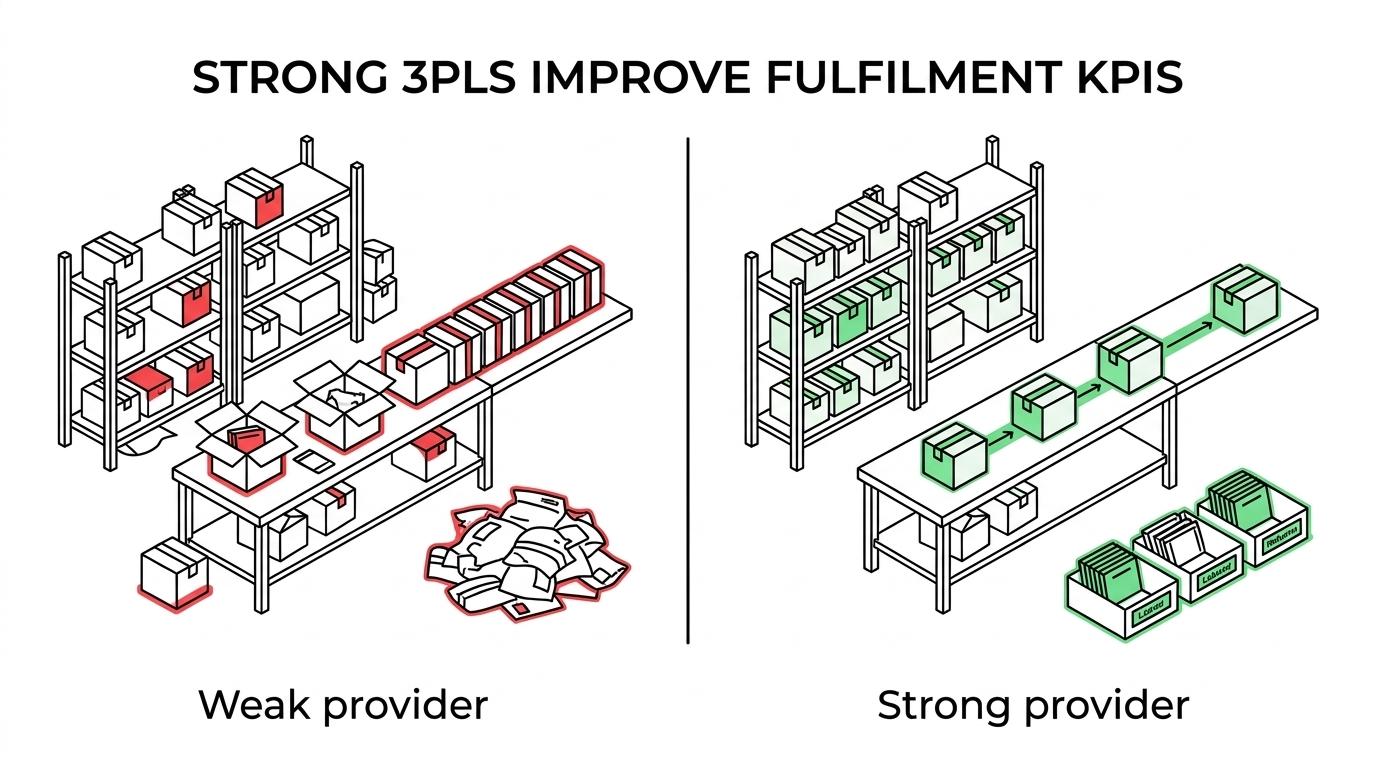
The best UK fulfilment companies do more than store stock and print labels; they manage reliable order fulfilment from checkout through dispatch. They provide capable IT services, clear service levels, dependable carrier options, and the discipline to manage exceptions without drama. A weak provider can still move parcels, yet a strong one gives you cleaner data, steadier dispatch, and fewer service fires.
The commercial gain often comes from fit, not scale alone, with the right partner supporting scalability as your operation grows.
12 questions to ask a fulfilment centre before signing
A shortlist becomes much clearer when every provider answers the same set of questions. That makes it easier to compare UK fulfilment companies on facts rather than sales language.
| Question to ask | What a strong answer sounds like | Why it matters |
|---|---|---|
| 1. Which platforms, marketplaces and systems do you integrate with? | Clear list of live integrations, API options, and onboarding steps | Prevents manual work and broken order flows |
| 2. How do you provide inventory visibility and reporting? | Live dashboard, exports, alerts, and audit trail | Better control over availability and forecasting |
| 3. What are your order cut-off times and same-day dispatch rates? | Specific cut-offs by carrier and channel, backed by KPI data | Protects customer promise and campaign planning |
| 4. What is your picking accuracy and how is it measured? | Recent KPI with method, sample period, and exception handling | Accuracy affects cost, reviews, and repeat purchase |
| 5. How do you handle returns and what is your average return processing time? | Defined workflow, reason codes, and resale rules | Faster refunds and cleaner inventory decisions |
| 6. What experience do you have with my product category and direct-to-consumer order profiles? | Relevant examples by SKU type, parcel size, and order mix | Reduces onboarding risk |
| 7. How does your pricing work? | Transparent fees for goods-in, storage, picks, packing, returns, inserts, and exceptions | Stops margin erosion from hidden charges |
| 8. Which carriers do you use and how do you route orders? | Named carrier mix, service rules, and support for premium options | Affects cost, delivery speed, and failed delivery rates |
| 9. How do you plan for peaks and sudden volume growth? | Labour model, overflow capacity, and peak calendar process | Tests resilience during promotions and seasonal spikes |
| 10. What happens when stock counts do not match? | Cycle count process, investigation path, and reporting cadence | Stock integrity is central to every channel |
| 11. Who manages the account and how quickly do you respond? | Named contacts, escalation route, and service hours | Good communication prevents small issues from spreading |
| 12. Can you show recent results from similar clients? | Case studies with before-and-after KPIs, not just testimonials | Proof matters more than promises |
How to compare UK fulfilment companies on cost and commercial fit
Price matters, but headline price often hides the real shape of the contract. One fulfilment company may look cheaper on pick and pack, then recover margin through goods-in fees, minimum monthly charges, packaging uplifts, or high returns costs. Another may quote slightly higher rates while removing enough friction to lower your total operating cost.
This is why choosing a 3PL provider should begin with your real order profile. Average order value, SKU count per order, storage format, seasonality, returns rate, and parcel destination mix all change what “good value” actually means. A brand shipping single-item beauty orders will need a different warehouse rhythm from a brand sending multi-line homeware bundles.
When you compare offers, ask each provider to cost the same month of historical data to see how their order fulfilment services compare. That should include inbound receipts, storage, dispatch, returns, packaging, and carrier spend. A like-for-like model is far more useful than a rate card.
Common cost areas to review include:
- Goods-in fees
- Storage by pallet, bin, shelf or cubic measure
- Pick and pack tiers
- Packaging extras
- Returns handling
- Carrier surcharges
Choosing a 3PL provider for systems, reporting and control tower visibility
Technology is often the dividing line between a warehouse that feels reliable and one that constantly needs chasing. In the 2025 3PL study, control tower visibility was the top must-have named by shippers, with 68% selecting it. That tells you a lot about buyer priorities. Live visibility is no longer a luxury.
When considering how to choose a fulfilment company, speak to potential ecommerce fulfilment partners and ask for a working demo rather than slides, including how the system integrates with Shopify. You want to see how orders appear, how stock updates, how returns are logged, and what happens when something fails. Good systems should make exceptions visible early, not bury them in email threads or spreadsheets.
A strong provider should also be able to show how their warehouse management system supports direct-to-consumer order profiles, order fulfilment, and shipping requirements. That means batch tracking where needed, channel-specific packing rules, inserts, gift messages, subscription workflows, and routing logic for different carriers.
When reviewing the system, focus on three checks:
- Check the sync: orders, stock, tracking and returns should update automatically
- Check the exception flow: failed orders, address issues and back orders should trigger alerts
- Check the reporting depth: SKU movement, ageing stock and carrier performance should be easy to export
If the provider cannot show live data during the sales process, the live service is unlikely to feel calmer.
Choosing a 3PL provider for warehouse operations and service levels
Operations are where sales claims meet daily reality. Ask how goods are booked in, where quality checks happen, how cycle counts are run, and what happens during late inbound deliveries. You are looking for consistency rather than theatre. A polished warehouse tour is pleasant; a disciplined operating method is far more valuable.
Service levels should also be specific. “Fast dispatch” means very little. “Orders received by 2 pm go out the same day on tracked services, with a measured same-day dispatch rate of 98%” means something. The same applies to accuracy. Ask how the number is calculated, how often it is reported, and how compensation works if targets are missed.
Published case studies are useful here because they show outcomes rather than features. One published UK 3PL case study reported monthly order capacity rising from 15,000 to more than 35,000 within 90 days after outsourcing. The same case reported order accuracy improving from 96.2% to 99.4%, and same-day dispatch moving from 71% to 94%. Numbers like that do not guarantee identical results for every brand, yet they do show the standard of evidence worth asking for.
You should also test peak resilience. Ask what happens on Black Friday, after a major influencer campaign, or when a retail launch drives a sudden online spike. A provider that handles normal weeks well but struggles under pressure can undo months of brand-building in a few days.
Questions to ask a fulfilment company about returns and customer experience
Returns are often treated as an afterthought during procurement, which is a mistake. A slow, opaque returns process ties up sellable stock, delays refunds, and leaves customers uncertain. That can weaken retention just as quickly as a late outbound parcel.
Ask how returns are triaged, how condition is recorded, and how quickly refund-ready decisions are made. Ask whether the warehouse can restock immediately, quarantine damaged units, bundle items for refurbishment, or dispose of stock to rule. A provider with a clean returns workflow can protect both margin and customer trust.
Published UK 3PL case material has shown return processing time dropping from 6 days to 2 days after a move to outsourced fulfilment. That is the kind of practical gain worth looking for, because returns speed affects inventory availability as well as service reputation.
Three useful markers of a mature returns operation are:
- Fast triage: resale, quarantine or disposal decisions should be clear
- Customer updates: refund and tracking status should not depend on manual chasing
- Reason codes: return data should help spot product, sizing or listing issues
What to look for during a UK fulfilment centre visit
A warehouse visit can tell you more about a provider’s order fulfilment operation in an hour than a pitch deck does in a week. Watch how stock is labelled, where inbound goods wait, how packed parcels are staged, and whether pick faces look organised. Cleanliness is part of it, though workflow clarity matters more.
Pay attention to signs of control. Are locations easy to read? Are returns physically separated from saleable stock? Are carrier collections structured or chaotic? Can the team explain what happens when stock is short, damaged, or late? Good operators tend to answer calmly and directly because the process already exists.
It is also wise to ask who will manage onboarding once the contract is signed. Sales teams are skilled at giving confidence. Operations teams are the ones who will carry your launch. Meeting both helps you judge whether the provider can turn a smooth pitch into a smooth go-live.
Red flags when comparing UK fulfilment companies
Some warning signs appear again and again. Vague language around service levels, weak data visibility, and pricing that excludes common activity usually signal trouble later. So does a provider that talks mostly about warehouse size while saying little about process quality, account management, or exception handling.
A few red flags deserve immediate attention:
- Vague SLA language
- No live demo: only slides, no working dashboard
- No exceptions process: stock discrepancies handled ad hoc
- Prices that exclude regular operational activity
- No evidence of peak planning
A sensible next step is to send the same sample data set to each shortlisted provider: six months of Shopify orders, SKU count, returns rate, carrier mix, and seasonal peaks. Ask each one to respond against the 12 questions above, price the same scope, and show the system in action. That turns a difficult buying choice into a much clearer commercial decision.