
How Third Party Logistics is changing the supplement ecommerce industry for the better
Supplement ecommerce has moved well beyond the stage of packing tubs and pouches on a spare table at the back of an office. The category is now shaped by speed, precision and control. Customers expect rapid delivery. Retail platforms reward reliable dispatch. Regulators expect food-law compliance. That mix has pushed fulfilment from a back-office task into a serious operational discipline.
This is where third party logistics providers are changing the industry for the better.
For supplement brands in the UK, a strong 3PL relationship can mean faster order turnaround, sharper picking accuracy and warehousing built around food products rather than generic merchandise. Providers such as 3PLWOW represent a wider shift in the market: specialist fulfilment partners are giving growing brands access to processes that would be difficult, expensive, or slow to build alone, contributing significantly to market growth.
UK supplement ecommerce growth is raising fulfilment expectations
Online retail remains a major part of consumer buying behaviour in Great Britain. The Office for National Statistics reported that online sales accounted for 28.3% of total retail sales in July 2026, with online spending values also rising across the period. That matters for supplement brands because a larger online market brings more orders, more competition and much less tolerance for poor fulfilment.
When a customer buys protein, vitamins, collagen or capsules online, the product is often repeat-purchase by nature. That makes the fulfilment experience more important than it may be in other sectors. If the first order arrives late, damaged, incorrect, or suffers from poor inventory control, the next order can go elsewhere with very little friction.
As order volumes rise, internal teams often hit a ceiling. A system that worked at 30 orders a day can begin to strain at 300. Picking errors start to appear. Dispatch cut-off times become harder to meet. Stock locations lose structure. Suddenly, fulfilment becomes the factor limiting sales growth rather than supporting it.
Supplement fulfilment in the UK comes with food compliance demands
Supplements are not just another ecommerce line. In the UK, they sit within food law and labelling rules that require proper care throughout storage and dispatch.
GOV.UK guidance states that food supplements sold in Great Britain must comply with general food law and food labelling requirements, including Regulation (EU) No 1169/2011 as it applies in Great Britain. Labels must identify the product as a food supplement, not a dietary supplement. They also need core information including date marking, storage instructions and ingredient information, with allergens clearly emphasised where relevant.
That means fulfilment is tied closely to compliance. Picking the right SKU is only part of the job. Warehousing teams also need to handle stock rotation, batch traceability, packaging checks and storage conditions in a disciplined way. If the outer packaging is part of how the product is sold, that packaging may also need required information to remain intact and visible.
A specialist 3PL can build these requirements into day-to-day operations with a focus on innovation, rather than treating them as occasional checks.
After a certain point, most supplement brands need systems that can support:
- Batch and expiry-date control
- Clear stock rotation
- Food-safe storage routines
- Traceability across goods in and goods out
- Label and packaging consistency
Third party logistics improves dispatch speed for supplement orders
Fast dispatch sounds simple. In practice, it depends on layout, staffing, software, carrier integration and timing. A specialist 3PL brings all five together.
Many supplement brands start with in-house fulfilment because it feels cost-effective and close to the customer. That approach can work in the early phase. Yet speed becomes harder to maintain when orders spike after a product launch, a marketplace promotion or a successful paid campaign. Internal teams are then forced into reactive fulfilment, which usually means longer lead times and more mistakes.
A dedicated 3PL runs fulfilment as its core function. That focus changes the pace of the whole operation. Orders can be imported automatically from storefronts and marketplaces, queued instantly, picked against live stock records and passed to carriers within fixed service windows. The result is not only quicker dispatch, but more dependable dispatch.
That reliability matters as much as raw speed.
For supplement brands, dependable same-day or next-day dispatch supports repeat buying. Customers taking a daily product do not want uncertainty. If a 3PL can keep orders moving predictably, the brand gains a commercial edge without having to grow its internal warehouse team at the same rate as demand.
Third party logistics increases picking accuracy in supplement fulfilment
Accuracy is where a specialist 3PL often delivers its clearest value.
Supplement catalogues can look deceptively easy to manage. In reality, they often contain very similar SKUs across flavour, size, strength or bundle format. A warehouse operative choosing between 500g and 1kg, or vitamin D3 with and without K2, can make a costly mistake if the process is manual or rushed.
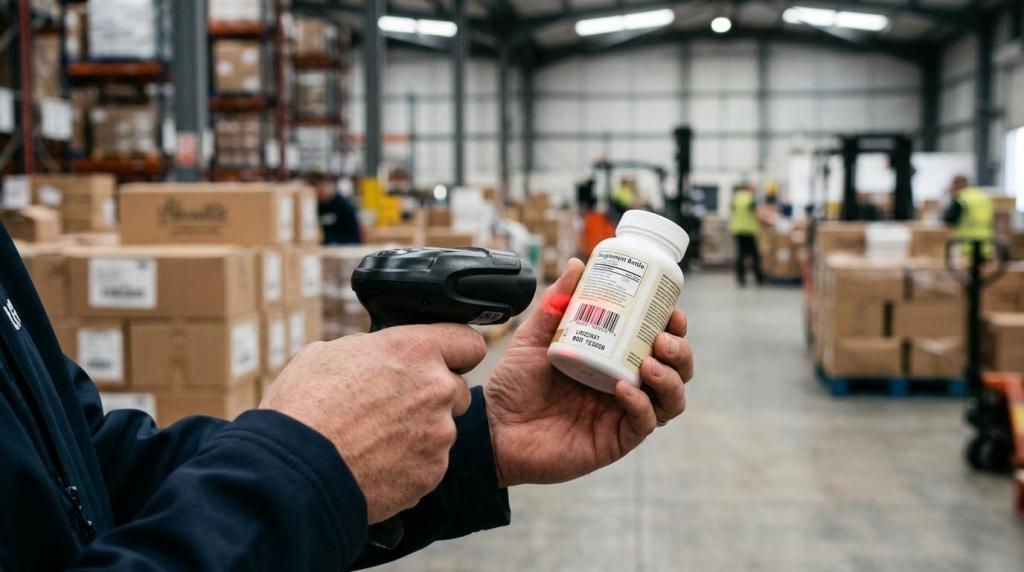
Better 3PL operations reduce that risk through barcode scanning, fixed bin locations, rule-based workflows and verification points before dispatch. Those controls raise consistency. They also create a stronger audit trail if a brand needs to check what happened to a specific order, batch or carton.
The gain is wider than fewer returns.
Correct orders protect customer trust, subscription retention, marketplace ratings and support workload. When accuracy improves, service teams spend less time fixing preventable issues and more time supporting market growth.
A well-run specialist fulfilment operation often includes:
- Barcode verification: each pick can be checked against the order and stock record
- Location discipline: products stay in defined bins rather than drifting around the warehouse
- Pack-stage confirmation: final checks help catch mismatched items before labels are applied
- Live inventory sync: overselling risk falls when stock levels update quickly across channels
Specialist supplement warehousing supports stock health and traceability
Warehousing is sometimes treated as a storage problem. For supplements, it is really an inventory control problem.
Products may need careful handling because of batch codes, best-before dates, packaging integrity and storage instructions. GOV.UK guidance on food labelling and food supplements makes clear that date marking and product information are not optional extras. The Food Standards Agency also distinguishes between use-by dates, which relate to safety, and best-before dates, which relate to quality. Even where most supplements fall under best-before rather than use-by, date management still matters for customer satisfaction, waste reduction and stock discipline.
Food safety management systems in the UK are expected to meet HACCP principles, and that includes allergen controls. A supplement-focused 3PL is better placed to build those controls into receiving, storage, picking and despatch routines. This can include quarantine areas, lot tracking, date rotation rules and procedures for damaged or non-conforming stock.
That is one reason providers like 3PLWOW are becoming more attractive to supplement brands. They are not simply renting shelf space. They are offering warehousing designed around category needs.
| Supplement fulfilment issue | In-house strain | Specialist 3PL response |
|---|---|---|
| Rising order volume | Dispatch slows during peaks | Scalable labour and structured workflows |
| Similar product variants | Higher risk of mis-picks | Barcode-led picking and location control |
| Batch and expiry tracking | Manual records become unreliable | System-led traceability and stock rotation |
| Food-law packaging checks | Quality checks become inconsistent | Repeatable intake and dispatch procedures |
| Storage discipline | Mixed practices across staff | Standard operating routines in managed warehousing |
Third party logistics helps supplement brands scale without operational drag
One of the strongest arguments for using a 3PL is focus. Brand teams should be spending more time on product quality, retention, channel growth and customer acquisition. Instead, many find themselves solving pallet booking issues, late collection problems and stock-count discrepancies.
Outsourcing fulfilment does not remove responsibility for product standards, though it can remove much of the daily operational drag. With the right partner, warehouse performance becomes more measurable. Dispatch metrics, inventory data and service levels are easier to monitor than in a makeshift internal set-up.
This also gives smaller and mid-sized supplement brands access to a more mature operating model earlier in their growth cycle, which can significantly contribute to market growth. They can offer delivery standards that feel competitive with larger brands, without carrying the full overhead of their own warehouse infrastructure.
That changes the tone of growth planning. Expansion becomes less about asking, “Can we physically cope with more orders?” and more about asking, “Which channels should we win next?”
What a strong supplement 3PL partnership looks like in practice
The best 3PL relationships are not based on storage or inventory control alone; they thrive on innovation and strategic fit. They are built on fit.
A supplement brand needs a partner that understands the category, can handle fast-moving ecommerce demand and respects the compliance side of food products. General fulfilment experience is useful, though category-specific discipline is often where real value appears. Supplement stock is too important to be treated as ordinary pick-and-pack inventory.
This usually shows up in practical areas rather than marketing claims.
A credible partner should be able to speak clearly about intake checks, date control, traceability, carrier management, returns handling and stock reporting. If the provider works with food supplements regularly, those answers tend to be direct and operational rather than vague.
Questions supplement brands should ask a third party logistics provider
Before moving fulfilment, brands should ask pointed questions. A polished sales pitch is not enough. The real test is whether the provider has processes that hold up under pressure.
Useful questions include:
- How do you manage batch traceability: from goods received through to dispatched orders?
- How do you control best-before stock rotation: especially when the same SKU arrives across multiple batches?
- What checks support picking accuracy: and how are errors investigated?
- What storage procedures apply to food supplements: including damaged stock and returns isolation?
- How quickly can you dispatch during peak trading: without service levels dropping?
Providers like 3PLWOW matter in this conversation because they reflect the wider improvement specialist 3PLs are bringing to supplement ecommerce. Faster dispatch creates a better customer promise. Greater picking accuracy protects trust. Purpose-built warehousing gives brands a stronger footing in a category shaped by traceability, labelling and food-safety discipline.
As the online share of retail stays strong and customer expectations keep rising, that combination is becoming less of an advantage and more of a standard. Brands that recognise this early put themselves in a much better position to grow with confidence.