
Growth feels exciting until the catalogue that once looked ambitious starts creating friction everywhere else. New SKUs arrive faster than shelf space. Bestsellers need constant replenishment. Slow movers still occupy valuable room. Order volumes climb, customer expectations tighten, and the operational model that worked at 200 orders a week starts to strain at 2,000.
That tipping point is common in ecommerce. A wider product range brings revenue opportunity, yet it also multiplies storage complexity, picking paths, stock checks, returns handling, packaging variation, and carrier decisions. More choice for customers can become less control for the business.
This is where a third-party logistics provider can shift a growing brand from reactive fulfilment to a more stable, scalable operation. Providers like 3PLWOW give ecommerce businesses the warehouse capacity, labour strength, stock visibility and shipping support needed when growth outpaces in-house logistics.
Signs your ecommerce product range is too big to manage in-house
A large product range rarely becomes unmanageable in one dramatic moment. It usually happens in stages. First, a few extra shelves appear. Then packing stations take over office space. Then stock counts take longer, dispatch cut-off times get harder to hit, and the team spends more time solving exceptions than moving orders forward.
When a business reaches this stage, the issue is not simply “more products”. The real problem is operational density. Each new line adds receiving tasks, putaway decisions, storage rules, reorder points, barcode checks and return scenarios. What looked like healthy range expansion can start reducing speed and accuracy.
Common warning signs include:
- Overflow storage
- Frequent stock discrepancies
- Late dispatches
- Rising pick errors
- Packed returns area
- Staff pulled away from higher-value work
Some brands try to fix this by renting extra space and adding temporary labour. That can help for a short period, though it often adds new layers of cost and complexity without solving the systems issue underneath.
Third-party logistics support for growing ecommerce brands
A good 3PL does more than store boxes and send parcels. It provides infrastructure that is difficult and expensive to build internally at speed. That includes warehouse and distribution centre management, trained operational teams, technology for stock control, dispatch processes, and carrier relationships that can lower shipping costs.
For a growing ecommerce business, this shift matters because fulfilment has a direct effect on customer experience. According to the 2025 CSCMP Third-Party Logistics Study, 82% of shippers said 3PLs contribute to improved customer service, 66% said they help reduce overall logistics costs, and 89% described their logistics service provider relationships as successful. Those figures suggest that outsourcing is not only about saving space. It is also about building a stronger service model.
That is especially relevant when product lines expand quickly. The more varied the catalogue, the greater the need for stock accuracy, location discipline, order visibility and dispatch consistency. A 3PL can absorb that complexity in a structured way.
One sentence matters here: growth is far easier to manage when fulfilment capacity is already in place.
Flexible warehouse storage and stock control with 3PLWOW
One of the clearest benefits of working with 3PLWOW is access to large, flexible warehouse storage space. That flexibility is important because ecommerce demand is rarely flat. A business might carry more stock before peak season, launch a new product collection, run a promotion, or open a new sales channel. In-house space tends to be rigid. A capable 3PL gives room to expand without long delays or disruptive warehouse reshuffles.
Space on its own is not enough, though. Storage only creates value when it is tied to reliable stock control. A growing range needs disciplined goods-in processes, accurate location management, inventory visibility, and cleaner reporting on inventory movements and order statuses. This is where third-party fulfilment becomes a management advantage rather than a simple overflow solution.
3PLWOW’s published case material points to this wider benefit. One case study notes that after moving fulfilment, a brand gained cleaner reporting on inventory movements, order statuses, and return volumes. That type of visibility helps a business make better purchasing and merchandising decisions, not just better packing decisions.
The difference can be summed up like this:
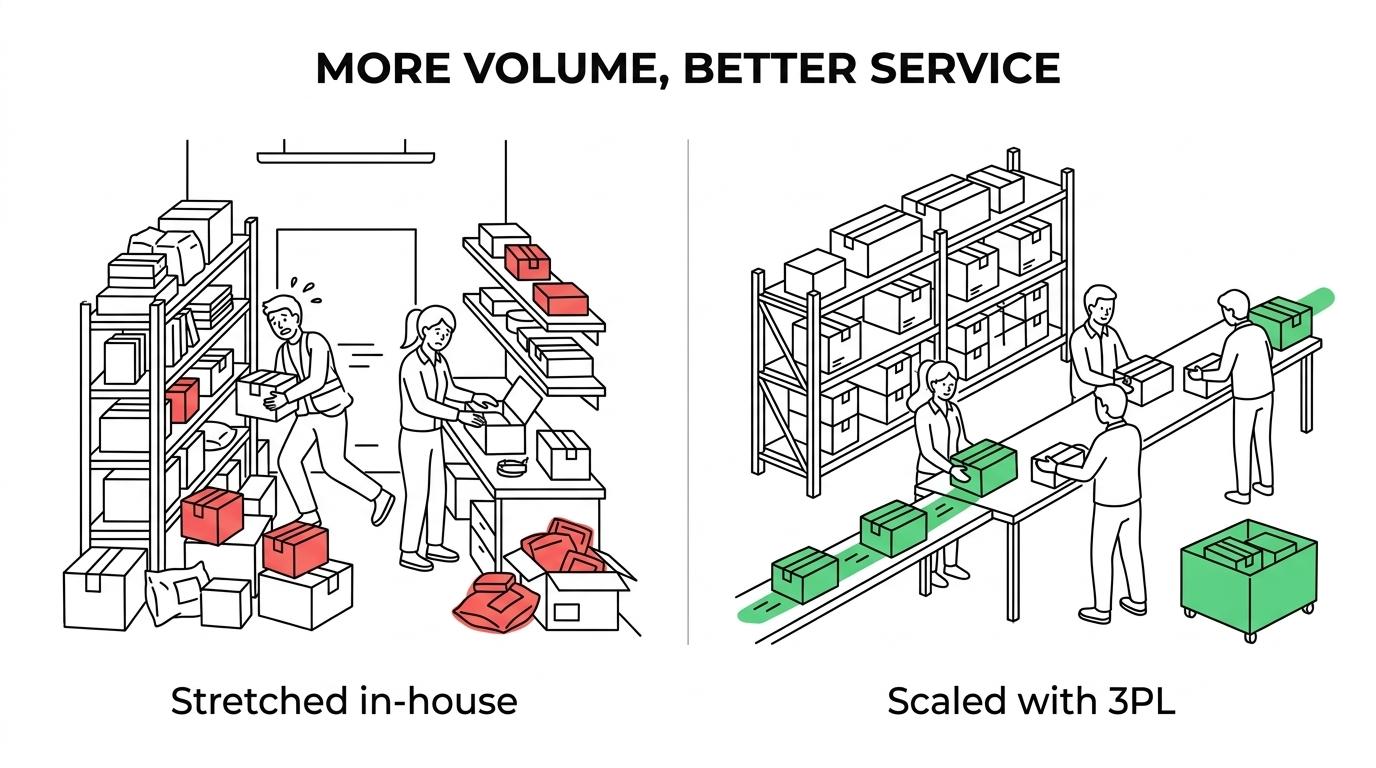
| Fulfilment challenge | What happens in a stretched in-house setup | What 3PLWOW support can offer |
|---|---|---|
| Storage capacity | Space fills quickly and expansion is awkward | Large flexible warehouse space that can adapt to range growth |
| Stock control | Higher risk of mispicks, duplicate locations and stock uncertainty | Structured inventory control and clearer stock visibility |
| Range changes | New lines disrupt existing layouts | A warehouse operation built to absorb catalogue changes |
| Reporting | Data spread across spreadsheets and manual checks | Cleaner reporting on movements, order status and returns |
When stock is visible and organised, many other pressures ease. Purchasing becomes more confident. Customer support has better answers. Marketing can run campaigns without fearing stock chaos behind the scenes.
Trained fulfilment teams, same-day dispatch and order accuracy
As order volume rises, fulfilment stops being a background task and becomes a specialist operational function. It needs consistency, pace and discipline. That is why the size and quality of the warehouse team matter so much.
3PLWOW offers access to a large team of highly trained staff. That matters for day-to-day throughput, but it also matters for resilience. Staff absence, peak surges, promotional spikes and seasonal campaigns can all destabilise a small internal operation. A larger trained team is better placed to keep service levels steady when demand jumps.
This is often where ecommerce leaders feel the greatest relief after outsourcing. Internal teams can return to product development, marketing, customer retention and channel growth while fulfilment is handled by people whose full-time focus is receiving, storing, picking, packing and dispatching orders accurately.
Key advantages include:
- Capacity: more people available to process higher order volumes without constant firefighting
- Accuracy: trained fulfilment staff working within defined warehouse processes
- Speed: same-day dispatch support that helps brands meet tighter delivery expectations
- Continuity: less operational risk when sales spike or staffing pressure hits
Published 3PLWOW figures help show what this can look like in practice. In one case study, monthly order capacity rose from 15,000 to more than 35,000 within 90 days. Over the same period, order accuracy improved from 96.2% to 99.4%, and same-day dispatch increased from 71% to 94%.
Those numbers tell an important story. More volume did not mean lower service. The process became faster and more accurate at the same time.
Cheaper shipping rates and stronger carrier performance for ecommerce
Shipping becomes more expensive and more complicated as a product range grows. Parcel sizes vary. Weight bands become less predictable. Some orders need premium delivery while others need an economy option to protect margin. If a business is managing these choices alone, it often pays more than necessary and spends too much time comparing services manually.
A 3PL can improve this because it works with shipping at scale. That usually means access to cheaper shipping rates than a smaller ecommerce brand could negotiate independently. Lower shipping costs can protect profit, support sharper retail pricing, or allow more flexible delivery offers to customers.
There is also an operational benefit. Carrier selection, label generation, collection timing, cut-off management and tracking updates all become part of a more organised flow. This reduces the number of weak points between checkout and doorstep.
When cheaper shipping rates are paired with same-day dispatch, the value is even stronger. Customers care about the total experience, not just the packing stage. Fast handover to carriers, consistent dispatch performance and sensible delivery pricing work together to improve satisfaction and reduce “where is my order?” contact volume.
A published 3PLWOW case study reported a 38% reduction in customer support contacts about shipping after the move to outsourced fulfilment. That gives a useful reminder that logistics quality affects more than the warehouse. It touches service teams, reviews and repeat purchase confidence as well.
Returns receipt and reverse logistics without the usual bottlenecks
Returns are one of the most neglected parts of ecommerce operations, especially when a business is focused on outbound growth. Yet as a product range gets broader, returns can become a major operational burden. Different product conditions, repackaging needs, resale decisions and refund timelines all add pressure.
If returns receipt is slow, the business loses twice. Customers wait longer for refunds or exchanges, and stock stays unavailable for resale longer than it should. That ties up cash and clouds inventory accuracy.
A 3PL with established returns processes can keep this part of the operation moving. Returned goods can be received, checked, recorded and routed in a more consistent way. This helps customer service teams respond faster and gives finance and stock teams better data.
3PLWOW’s published metrics point to meaningful gains here too. In the same case study that reported stronger capacity and dispatch performance, average return processing time fell from 6 days to 2 days within 90 days of outsourcing fulfilment.
That improvement matters for several reasons:
- Customer trust: refunds and exchanges feel faster and more reliable
- Stock recovery: resaleable products return to available inventory sooner
- Operational clarity: return volumes and causes become easier to track
For brands carrying larger ranges, this can be a quiet but powerful source of margin improvement.
Published fulfilment metrics that show what scale can look like
Decision-makers often want more than a theoretical case for outsourcing. They want evidence that the model can handle real growth while improving performance. 3PLWOW’s published case figures offer a practical benchmark.
| Metric from a published 3PLWOW case study | Before outsourcing | Within 90 days |
|---|---|---|
| Monthly order capacity | 15,000 | 35,000+ |
| Order accuracy | 96.2% | 99.4% |
| Same-day dispatch | 71% | 94% |
| Average return processing time | 6 days | 2 days |
These figures do not promise the same result for every brand, and any serious ecommerce operator will know that outcomes depend on product mix, systems, seasonality and sales channels. Even so, they show the kind of operational lift that can happen when fulfilment moves into a setup built for volume and control.
What stands out is the balance across the metrics. Capacity increased sharply, yet accuracy also improved. Dispatch sped up, and returns were processed faster. That mix is hard to achieve with a stretched in-house team, especially when the catalogue is still expanding.
How to assess whether 3PLWOW is the right next step for your ecommerce operation
The right time to move to a 3PL is often earlier than many brands expect. If the warehouse is already under strain, the business may be absorbing hidden costs in staff time, shipping spend, delayed dispatch, stock errors and customer service pressure.
A practical review can start with a few direct questions.
- Is storage limiting how many lines you can add?
- Are stock discrepancies affecting sales or replenishment decisions?
- Is same-day dispatch becoming difficult to maintain?
- Are shipping costs rising faster than revenue?
- Are returns receipt and processing taking too long?
- Is the internal team spending too much time on fulfilment admin rather than growth work?
If the answer is “yes” to several of these, outsourcing may no longer be a future option. It may be the next operational move needed to keep growth healthy.
A growing product range should be a sign of commercial strength, not a trigger for fulfilment stress. With large flexible warehouse storage, stronger stock control, highly trained staff, same-day dispatch, cheaper shipping rates and efficient returns receipt, 3PLWOW offers the kind of support many ecommerce businesses need once scale starts to test the limits of in-house logistics.