
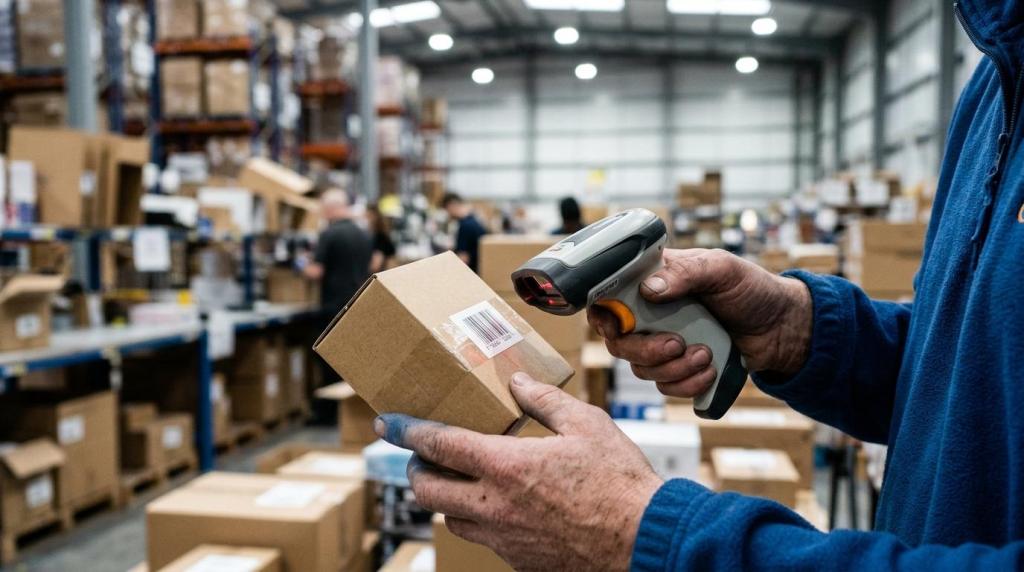
A Shopify store can look beautifully simple from the customer side. A product page, a basket, a checkout, then an order confirmation. What sits behind that smooth experience is far more operational: stock intake, storage, order import rules, warehouse location logic, picking, packing, label generation, dispatch scans, courier handover and tracking updates.
That physical layer decides whether a brand feels reliable.
For UK merchants, that matters more than ever. Office for National Statistics data show online retail still accounts for a large share of Great Britain retail sales, with 28.8% of sales made online in September 2026. Even with month-to-month movement, ecommerce remains a major route to market. When order volumes rise, fulfilment often becomes the point where growth either keeps its pace or starts to drag.
Why Shopify fulfilment UK matters for growing ecommerce brands
Many Shopify businesses begin by packing orders in-house. That can work well in the early stage, especially when product ranges are small and order patterns are predictable. The pressure builds when sales increase, campaigns land well, or seasonal peaks compress a week’s work into a single day.
At that point, ecommerce fulfilment stops being a back-office task and becomes a growth function. A late dispatch, a stock mismatch or a tracking delay can affect customer trust almost immediately. A well-run fulfilment setup does the opposite. It keeps orders moving, stock visible and customer communications current.
For UK brands, a local fulfilment partner can also support practical expectations around domestic shipping speed, returns handling and delivery cost control. That is where a dedicated UK Shopify fulfilment centre can make a measurable difference.
How Shopify order fulfilment works with a fulfilment partner
Shopify is built to work with third-party fulfilment services. According to Shopify’s help guidance, when a merchant requests fulfilment, Shopify sends a message to the fulfilment service to begin picking, packing and shipping the order. If automatic fulfilment is enabled, that request can be sent as soon as the order is paid.
That means the store does not need someone manually exporting order files and re-keying data into a warehouse system every time a customer checks out. Instead, approved orders can flow into the fulfilment process through a direct integration or app-based connection.
If the provider sends tracking information back, Shopify can add that information to the order automatically. That matters because customers do not think in terms of warehouse workflows. They simply expect to know where their parcel is, when it has shipped and whether it is on the way.
Here is the typical process from checkout to delivery:
| Shopify fulfilment stage | What happens | Why it matters |
|---|---|---|
| Order import | Paid orders are passed from Shopify to the fulfilment provider | Reduces manual data entry |
| Inventory check | The system confirms stock is available against the correct SKU or variant | Helps prevent overselling |
| Pick and pack | Warehouse staff pick the items and pack them to the required standard | Affects speed, accuracy and presentation |
| Dispatch | Labels are created and parcels are handed to the chosen courier | Sets the delivery service level |
| Tracking update | Tracking information is returned to Shopify | Keeps the customer informed |
| Returns handling | Returned goods are checked and processed | Supports refunds and stock control |
What a UK Shopify fulfilment centre does day to day
A fulfilment centre is not only a storage space. It is an operating environment designed to turn online orders into dispatched parcels with control and consistency. That begins the moment stock arrives.
Products are booked in, checked, assigned to locations and linked to the right SKUs. For Shopify stores, this is especially important where products have multiple variants. Sizes, colours, bundle combinations and promotional packs all need to match what the customer selected at checkout.
Once stock is in place, the warehouse manages the repetitive physical work that online growth creates. A solid Shopify pick and pack process uses automation to improve speed without sacrificing order accuracy. The aim is not just getting an item into a box. It is getting the right item, in the right quantity, packed to the right instruction, with the right carrier service.
A dependable operation usually includes:
- Goods receiving
- SKU and variant control
- Bin location management
- Pick and pack
- Dispatch scanning
- Returns processing
That frees the merchant to stay focused on product, marketing, pricing and customer acquisition rather than spending each afternoon printing labels and chasing courier cut-off times.
Shopify pick and pack: the detail that shapes customer experience
Pick and pack sounds simple until order variety increases. A small catalogue with single-SKU orders is one thing. A fast-moving store with bundles, limited editions, gift notes and service upgrades is another.
This is where operational detail becomes visible to the customer. If packaging is poor, the parcel arrives damaged. If pick accuracy is weak, the customer receives the wrong variant. If dispatch rules are unclear, premium shipping orders may be treated like standard ones.
Good fulfilment partners build repeatable instructions around these points, using automation where possible to keep processes consistent. They work from agreed packaging standards, shipping rules, exception handling steps and cut-off times. That keeps the process stable even when daily order volume changes sharply.
A strong pick and pack setup often includes two disciplines working together:
- Accuracy control: barcode scans, SKU checks and order validation before dispatch
- Presentation control: branded inserts, packaging rules, kitting steps and gift options
- Service routing: courier selection based on destination, value, weight or delivery promise
- Exception handling: back orders, damaged stock, address flags and order holds
How 3PLWOW supports Shopify fulfilment workflows
For brands looking at outsourced Shopify order fulfilment, the key question is rarely whether a warehouse can store stock. The more useful question is whether the provider can support the exact operating rhythm of the store.
3PLWOW publishes a Shopify-specific workflow designed around that need. It states that Shopify variants are matched to warehouse inventory, helping orders map correctly to the stock held in the warehouse. It also states that eligible Shopify orders can flow into fulfilment without repeated exporting and re-keying of order data.
That is valuable because manual re-entry tends to create avoidable friction. It slows dispatch, increases the chance of input errors and makes volume spikes harder to manage. When a fulfilment request moves through a connected workflow, the process becomes much easier to control.
3PLWOW also states that shipment and tracking information can be returned to Shopify for the customer journey. In practical terms, that means the store can keep the fulfilled status and tracking information up to date without relying on manual updates after dispatch.
Its published case study adds some helpful performance context. Over 90 days, 3PLWOW reports:
- Order capacity: increased from 15,000 per month to more than 35,000
- Order accuracy: improved from 96.2% to 99.4%
- Return processing time: reduced from 6 days to 2 days
Those figures are from the company’s own published material, so they should be read as provider-reported results rather than market-wide averages. Even so, they point to the operational gains many Shopify brands want from a 3PL arrangement: more throughput, fewer fulfilment mistakes and faster returns handling.
Can you keep control when you outsource Shopify order fulfilment?
Yes, and that point deserves emphasis.
Outsourcing fulfilment does not mean outsourcing the business itself. The merchant still controls product strategy, pricing, promotions, brand voice, advertising and customer relationships. The fulfilment provider handles the physical execution that follows an order.
Control comes from clarity. A warehouse can only follow the standards it has been given, so the handover needs to be precise. Packaging expectations, shipping services, bundle rules, gift options, return checks and stock exception procedures should all be documented early.
This is where a good fulfilment relationship feels less like distance and more like structure. The brand remains the decision-maker. The warehouse becomes the operating arm that applies those decisions consistently.
What to prepare before moving stock to ecommerce fulfilment
A smooth onboarding usually depends on preparation more than speed. If the data is messy at the start, fulfilment issues are likely to appear later in the form of stock mismatches, picking errors and customer service queries.
Before moving inventory into a UK Shopify fulfilment centre, prepare the core product and order information properly. That gives the warehouse team a clear reference point from day one.
A useful checklist includes:
- Product list: every item, variant and bundle currently sold
- SKUs: unique identifiers for each sellable unit
- Stock quantities: an accurate opening count
- Weights and dimensions: needed for storage and courier planning
- Packing instructions: fragile items, inserts, branded packaging or gift rules
- Order profile: daily averages, peak periods and promotional spikes
It also helps to share any special handling needs in advance. Subscription packs, multi-buy offers, expiry-dated stock, lot control, personalised inserts and kitting requirements should never be left as assumptions.
Common questions about Shopify fulfilment UK
Can I use a fulfilment company with my Shopify store?
Yes. Shopify can work with third-party fulfilment services and apps. The key point is to confirm what the integration covers before choosing a provider. Order imports, inventory updates, fulfilment requests and tracking information should all be part of the conversation.
Will I lose visibility if I move to a fulfilment partner?
Not if the setup is organised properly. The aim is to improve visibility, not reduce it. With a connected process, the merchant should still be able to monitor orders, stock positions, dispatch status and returns activity while leaving the physical handling to the warehouse.
What if my store sells bundles or products with many variants?
That is exactly where setup quality matters. Variant mapping and SKU control need to be right from the start. 3PLWOW states that Shopify variants are matched to warehouse inventory, which is the kind of process brands should ask about when assessing any provider.
Is outsourcing only suitable for large brands?
No. It can suit businesses at several stages, especially when order volume is rising faster than internal operations can keep up. The right point to move is usually when fulfilment work begins to interfere with trading priorities like stock planning, campaign execution and customer care.
Choosing the right UK fulfilment partner for Shopify
Not every fulfilment provider is an equal fit for every Shopify store. Some are strongest with simple order profiles, while others are better suited to high-SKU catalogues, kitting requirements or rapid volume changes.
When comparing providers, it helps to look beyond storage cost alone. The stronger questions are operational. How are fulfilment requests received? How is tracking information returned? How are variants handled? What is the process for returns? What happens when a product is out of stock, damaged or sold as part of a bundle?
A practical evaluation often comes down to a few essentials:
- Integration quality
- SKU and variant discipline
- Pick and pack accuracy
- Courier options
- Returns process
- Capacity during peak trading
For a Shopify merchant, the best fulfilment setup is the one that makes the physical side of ecommerce feel steady, visible and scalable. When that happens, checkout is no longer the end of the sale. It becomes the clean starting point for a fulfilment operation that keeps pace with the brand.