
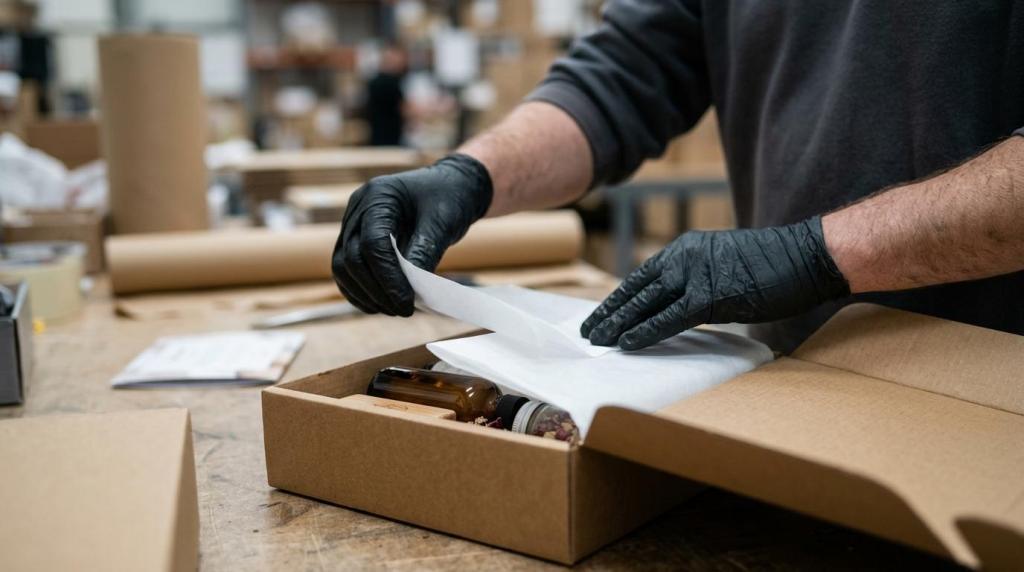
Selling three or four products as one offer looks simple on a product page. In the warehouse, it is a different discipline altogether.
A gift set, starter kit or multipack has to behave like a single saleable item while still being built from separate components, each with its own stock level, storage location, packaging needs and quality standard. That is why product bundle fulfilment sits somewhere between ordinary pick and pack and light assembly.
The timing matters as well. Online retail remains a major part of UK commerce, with the Office for National Statistics reporting internet sales at 27.4% of total retail sales in 2025. When bundles become a visible part of that sales mix, the warehouse process behind them has to be stable, repeatable and easy to scale.
What product bundle fulfilment means in warehouse operations
At its core, bundle fulfilment means selling several items as one defined offer and making sure the warehouse treats that offer correctly. The bundle may be a festive gift set, a starter kit for first-time buyers, a promotional pack, or a simple multipack designed to raise average order value.
That sounds close to ordinary pick and pack, but there is one key difference. Standard pick and pack starts with the order and gathers the items listed on it. Kitting starts with a set configuration. The warehouse needs a fixed component list, set quantities, packaging instructions and, where relevant, presentation rules.
This distinction is useful when brands are planning kitting services in the UK, because not every bundle should be managed in the same way.
- Single-SKU gift sets
- Starter kits with fixed contents
- Build-on-order ecommerce bundles
- Promotional multipacks
- Subscription-style welcome packs
When a fulfilment operation treats a bundle as controlled kitting work rather than an informal collection of items, it becomes much easier to train staff, manage stock, run checks and protect the customer experience.
Kitting vs ordinary pick and pack for gift set fulfilment
A straightforward way to separate the two is to look at the unit of work.
Ordinary pick and pack focuses on the customer order line. If an order contains shampoo, conditioner and a pouch, the warehouse picks those three items and packs them for dispatch. No new product is being created in storage.
Kitting focuses on a pre-defined set. Those same three items might exist as a “Haircare Starter Kit” with a dedicated SKU, branded sleeve, insert card and tissue wrap. The warehouse is now building or handling a kit, not simply picking separate products.
That difference shapes almost everything downstream, from storage layout to stock reporting.
- Ordinary pick and pack: picks the items shown on the order
- Kitting: combines items into a defined bundle with its own rules
- Ordinary pick and pack: usually needs less assembly work
- Kitting: often needs presentation checks, inserts or retail-style packaging
- Ordinary pick and pack: works well for varied baskets
- Kitting: works well for repeatable sets sold again and again
This is also why the FAQ answer is so practical. A bundle can be assembled in advance, or it can be built during order fulfilment. Both routes are valid. The right choice depends on volume, predictability and how often the same components are sold on their own.
Prepacked kitting and on-demand ecommerce bundle packing
The main operational choice is whether to assemble bundles before orders come in or wait until an order arrives and build the bundle then.
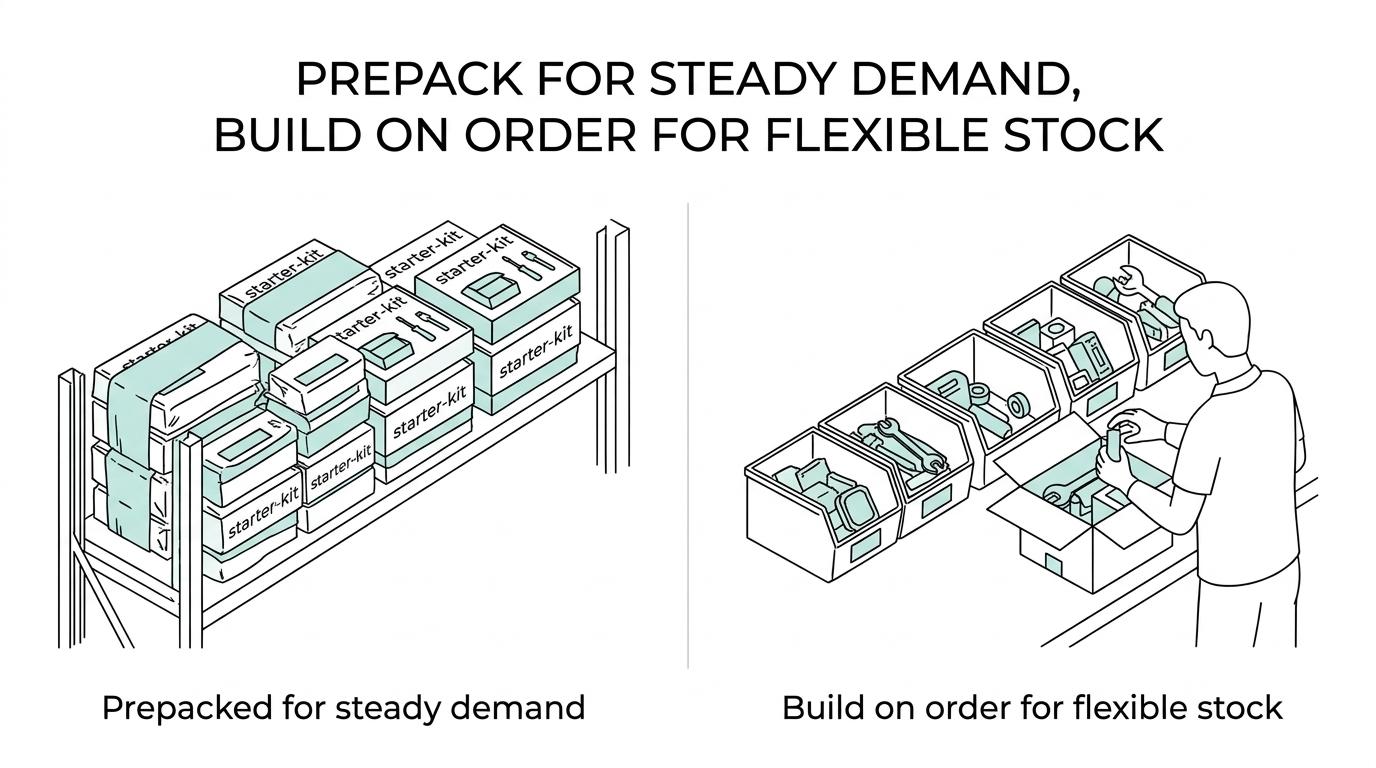
Prepacked kitting suits stable demand and fixed contents. If a brand expects steady sales of the same starter kit every week, pre-assembling those kits can improve speed and consistency. The pack bench is used in batches, staff repeat the same task, and the finished kits can sit in pick faces ready for dispatch.
On-demand bundle packing gives more flexibility. If the same serum, pouch and guidebook are sold individually as well as in several bundle variations, it may be smarter to keep them separate in stock and only combine them when an order lands. That reduces the risk of tying up stock inside kits that may not sell at the expected pace.
A good fulfilment partner will often use both methods at once. High-volume gift sets might be prepacked, while lower-volume promotional combinations are built to order.
| Approach | Best suited to | Main benefits | Main trade-offs |
|---|---|---|---|
| Prepacked bundles | Predictable demand, fixed components, seasonal gift sets | Faster dispatch, consistent presentation, efficient batch assembly | Uses more storage space, less flexible if contents change |
| Build on order | Shared components, many bundle variations, new product tests | Flexible stock use, easier changes, less risk of obsolete kits | Slower packing, more assembly at dispatch, higher risk of pick errors without clear controls |
| Hybrid model | Mixed catalogue with core bundles and occasional promotions | Balances speed and flexibility | Needs disciplined SKU mapping and process rules |
For brands working with 3PLWOW, this decision usually starts with data rather than instinct. If a bundle is repeatable and likely to move in volume, prepacking often makes sense. If it is linked to changing campaigns, limited-edition combinations or products with wide standalone demand, build-on-order can be the stronger option.
SKU mapping for starter kit fulfilment and bundle accuracy
SKU mapping is the quiet engine behind bundle accuracy.
Every bundle needs a clear identity inside the warehouse system. That means one bundle SKU, one exact component list and one rule set for how the stock should be allocated. Without that structure, the warehouse may see the bundle as a vague idea rather than a controlled product.
A reliable setup usually includes the following details.
- Bundle SKU: the saleable code used on the website, ERP and warehouse system
- Component list: every item inside the bundle, with required quantities
- Variant rules: size, colour, fragrance or edition choices where relevant
- Packaging specification: box type, insert, wrap, sleeve, leaflet or label
- Substitution policy: whether missing components can ever be replaced
- Quality checks: what must be verified before the parcel is sealed
This matters because stock movements can become messy very quickly. If a starter kit contains one cleanser, one moisturiser and one travel bag, selling one bundle must reduce the stock of each component correctly. If the system does not map those deductions properly, stock figures drift, oversells appear, and replenishment decisions become unreliable.
The same applies to bundles with variants. A “Starter Kit Blue” and “Starter Kit Green” may share four components and differ only by pouch colour. Unless those variant links are exact, the warehouse can send the wrong combination even when the picker has technically followed the order line.
For 3PL operations, bundle configurations are often created as agreed SKU rules with a bill-of-materials style structure. That gives the warehouse a repeatable recipe and gives the brand a cleaner audit trail when sales volumes rise.
Presentation standards in gift set fulfilment
Many bundles are bought for convenience. Many others are bought for how they look when opened.
Gift set fulfilment often needs a more visual standard than normal ecommerce orders. Items may need to sit in a certain order, labels may need to face forward, tissue may need a specific fold, and inserts may need to appear on top rather than underneath the products.
A strong bundle process turns those visual expectations into written instructions. Staff should not have to guess what “premium presentation” means.
Reference photos help.
So do sample packs held at the bench, pack maps showing item position, and clear acceptance criteria during quality control. Where 3PLWOW supports kitting, the practical value is in creating agreed bundle configurations and checking completed kits against both the component list and the presentation standard before dispatch.
Presentation controls often include:
- Product orientation
- Branded inserts
- Protective void fill
- Outer carton choice: plain shipper or retail-style gift box
- Sealing method: sticker, tape, belly band or sleeve
- Final check: count, condition, layout and labelling
These details affect more than appearance. They also affect damages, returns and customer trust. A starter kit that arrives tidy, complete and easy to unpack feels deliberate. One that looks hurried can weaken even a very strong product.
Packaging choices, UK compliance and bundle packing obligations
Bundle packing is not only a warehouse efficiency issue. It also sits close to UK packaging obligations.
Under UK extended producer responsibility rules for packaging, organisations can count as producers if they pack goods or fill packaging, supply filled packaging under their own brand, import goods in packaging, or supply unfilled packaging they manufacture or import. That matters for brands selling gift sets and multipacks, because the act of combining and supplying packaged goods is part of the compliance picture.
This does not mean every fulfilment decision is a legal problem. It means packaging choices should be recorded properly, and the roles of brand and fulfilment partner should be clear. Primary packaging, retail packaging and shipment packaging each have a place in the chain, and bundle work can touch all three.
The sustainability angle matters too. UK packaging waste recycling remained substantial in 2025, yet the rates were uneven by material. Provisional figures showed 80.3% recycling for paper and cardboard packaging waste, compared with 57.3% for plastic. That makes material choice a practical brand decision as well as an environmental one.
Brands planning ecommerce bundle packing usually get better results when they ask a few simple questions early:
- Is the bundle using retail-ready presentation packaging, shipping protection, or both?
- Can the outer format be right-sized to reduce void fill?
- Are fragile items separated well enough inside the set?
- Will the packaging still look smart after courier handling?
A polished bundle should survive the journey as well as impress at the door.
Stock planning for multipacks, shared components and seasonal peaks
Bundles create a planning challenge because one item can sit inside several sales paths at once. A single candle might be sold individually, placed in a two-pack and added to a Christmas gift set. If those demand streams are not modelled together, stock can disappear faster than expected.
Starter kit fulfilment is often the first place this becomes visible. A brand may think it has enough stock for four weeks based on standalone product sales, then launch a welcome bundle that quietly doubles component usage. The shortage appears at packing time, not on the forecast spreadsheet.
This is why shared-component planning is so important. The warehouse and the brand need a realistic view of how many units are reserved for bundle demand, how many remain free for single-item sales and what buffer should exist for peaks, campaigns and delayed inbound deliveries.
Useful planning habits include:
- Demand profiling: separate steady bundle sales from promotional spikes
- Component buffers: hold extra stock for the items used across several kits
- Assembly timing: prepack only the volume that data can support
- Rework rules: decide whether slow-moving kits can be broken down back into components
- Peak planning: set cut-off dates for seasonal gift set assembly
This is where hybrid fulfilment models often shine. Core bundles can be assembled in batches ahead of time, while slower or more variable sets stay component-based until ordered. That keeps storage use sensible and leaves room for late changes to marketing campaigns or product mix.
How brands working with 3PLWOW can set bundle rules clearly
Good bundle fulfilment starts long before the first order is picked. The cleanest projects usually begin with a short operational brief that the warehouse can turn into system rules and pack instructions.
That brief should cover the bundle SKU, component list, packaging spec, presentation standard, stock treatment and the action to take if one component is missing or damaged. If substitutions are not allowed, say so plainly. If a leaflet must always be added, make it part of the bundle recipe rather than an informal note.
For brands using 3PLWOW, this kind of setup supports repeatable starter kits, gift sets and ecommerce bundles without leaving key decisions to chance. Agreed SKU-based bundle configurations, quality-control checks and reference standards create a process that can handle growth rather than only the first few weeks of orders.
When that structure is in place, bundles become easier to launch, easier to replenish and easier to trust. That is what turns a bundle from a merchandising idea into a dependable fulfilment line.