
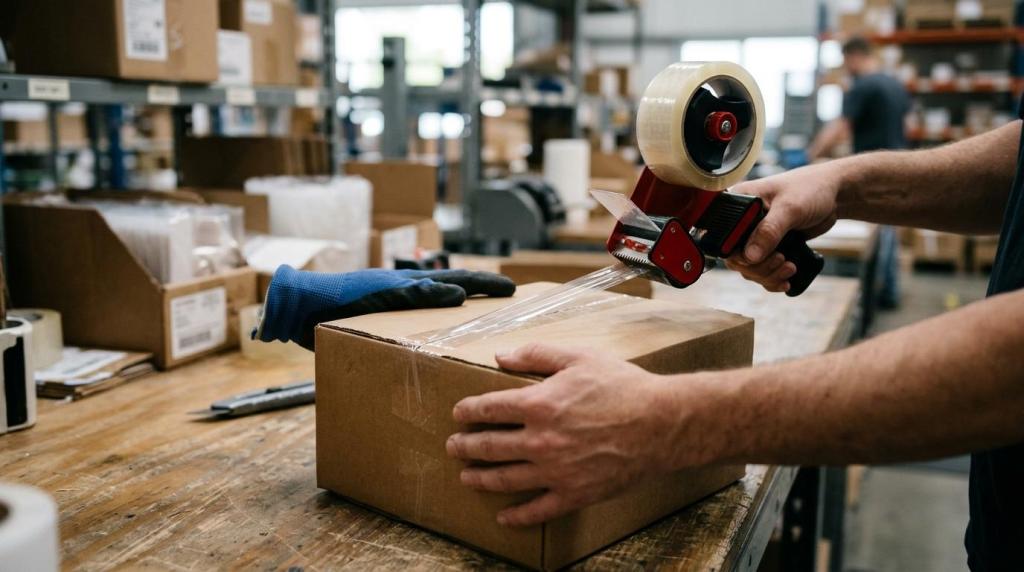
When an online order lands in a fulfilment centre, packing is only one step in a tightly managed chain of activity. By the time a parcel reaches a packing bench, the stock has usually been booked in, stored, located in the warehouse system, picked against the order, checked, and matched to the right carrier service.
That structure matters because good packing is not simply about putting products in a box. It is about accuracy, protection, speed, presentation, and cost control, all at once.
Ecommerce fulfilment workflow before packing starts
A typical fulfilment workflow begins long before the parcel itself is assembled. Stock arrives at the warehouse, is checked into inventory, assigned storage locations, and made available for sale through the order system. Once a customer order is received, warehouse staff pick the required items, move them to a packing area, prepare the shipment, print the shipping label, and hand the parcel to the selected carrier.
3PLWOW describes this as a connected process where orders flow from the sales platform into the fulfilment system, stock is received and stored, parcels are packed to agreed instructions, and tracking is pushed back to the store and customer after carrier handoff.
| Fulfilment stage | What happens | Why it matters for packing |
|---|---|---|
| Stock receipt | Goods are delivered, checked, and booked into inventory | Prevents missing or incorrect items entering the process |
| Storage | Products are placed in tracked warehouse locations | Makes picking quicker and more accurate |
| Order import | Sales orders feed into the fulfilment system | Reduces manual entry and keeps pace with order volume |
| Picking | Staff collect the items listed on the order | Sets the foundation for accuracy at the bench |
| Packing | Items are checked, protected, boxed, and labelled | Protects goods and presents the order properly |
| Carrier handoff | Parcels move into the agreed delivery network | Determines dispatch timing and tracking visibility |
| Returns processing | Returned goods are checked and booked back in | Keeps inventory accurate and improves customer service |
The key point is simple: packing is operational, not improvised.
Stock receipt and storage standards in a fulfilment centre
If stock is not received properly, packing teams inherit the problem later. Damaged cartons, unscanned goods, incorrect quantities, or unclear SKU labelling can all slow down dispatch or create avoidable errors. A strong fulfilment centre puts discipline into the first touchpoint, so every item has a recorded place and status before customer orders begin to flow.
Storage design also affects how well packing performs. Fast-moving products are usually positioned to reduce walking time. Fragile items may be held in areas where they are easier to handle safely. Multi-part product ranges often need clear bin locations to stop similar-looking variants being confused.
This is where outsourced fulfilment can create a visible step forward for growing brands. As order volumes rise, even a capable in-house operation can struggle to keep layout, stock control, and replenishment in step with demand. A dedicated pick and pack operation is built around that pressure.
Pick and pack accuracy in ecommerce operations
Once an order is released for fulfilment, the picking stage determines whether the packing team receives the right products in the first place. Many errors that appear to be packing mistakes are actually picking issues: the wrong size, the wrong colour, or the right item in the wrong quantity.
A well-run centre will typically combine system prompts with physical checks, including verifying items and their dimensions before printing shipping labels. That may include barcode scanning, order manifests, visual verification, and exception handling when an item does not match the order data. Packing benches then act as a second control point, giving the team a chance to catch mismatches before a label is printed and wrap items in kraft paper or bubble wrap for added protection, using suitable packing materials to secure the parcel with packing tape.
Accuracy is one of the clearest measures of fulfilment quality because it affects both cost and customer trust.
Common checks in the pick and pack process include:
- SKU match: the product picked matches the order record
- Quantity check: units are counted before sealing the parcel
- Condition review: items are checked for visible damage or packaging faults
- Special instructions: gift notes, inserts, bundles, or channel-specific rules are followed
- barcode scan confirmation
- visual match against the order
- parcel weight sense-check
These steps may sound basic, yet they make a real difference at scale. When hundreds or thousands of parcels move through the building in a short dispatch window, repeatable checks are what keep service stable.
Parcel preparation methods that protect goods in transit
Packing a shipment well means matching the packaging to the item, the carrier route, and the service level. Official carrier guidance is helpful here. FedEx advises using a box that matches the parcel’s size and weight, filling empty space with cushioning so items do not move or break, sealing the carton with tape in an H pattern, and placing the waybill with sender and recipient details clearly on top of the package.
That guidance reflects a wider truth across ecommerce fulfilment. Too much empty space invites movement and impact damage. Too little space can crush the product or the retail packaging. Oversized cartons may also increase shipping costs where carriers price using dimensional weight rather than product mass alone.
The best packing teams are not just quick. They are selective.
A practical packing approach often includes:
- right-sized boxes
- mailer bags for suitable soft goods
- cushioning for void fill
- tamper-evident sealing
- clear outer labelling
Different products call for different treatment. Apparel may move safely in poly mailers, while ceramics, cosmetics gift sets, and electronics need stronger protection and tighter box selection. Subscription shipments may require a branded presentation layer, while marketplace orders may focus more heavily on carrier compliance and cost.
This is also where packing instructions matter. Some brands want a premium unboxing feel. Others need plain packaging, recycled materials, paperwork suppression, or batch-specific inserts. A fulfilment centre that works to documented rules can keep that consistency across every shift.
Labelling, carrier handoff and same-day dispatch speed
A parcel is not ready just because the box is sealed. Labelling is part of the packing process, and it has to be correct. The shipping label or waybill needs accurate sender and recipient information, service selection, and barcode readability. If that data is wrong or obscured, the parcel may miss the carrier cut-off or enter the wrong route.
Courier handoff is often governed by strict service windows. 3PLWOW notes that pick and pack teams work against agreed service levels and cut-off times, with same-day or next-day release where available. That means the speed of packing is not measured in isolation. It is measured against the moment the trailer closes, the collection scan is completed, and the tracking number is returned to the store.
Customers usually feel this stage more than any other. They see the dispatch email, the tracking link, and the delivery promise.
A reliable operation tends to focus on three outcomes:
- Speed: orders released early enough to meet the carrier cut-off
- Accuracy: labels match the parcel and the destination service
- Visibility: tracking data flows back to the sales channel and buyer promptly
When those outcomes are consistent, the packing area becomes a driver of customer confidence rather than a bottleneck hidden at the back of the warehouse.
Published 3PL performance figures on packing quality and throughput
Public case-study data is often limited in fulfilment, so any published figures are useful when they are read carefully. 3PLWOW has published a published case study covering a direct-to-consumer home and lifestyle brand that had grown from around 4,000 monthly orders to more than 14,000 before moving fulfilment to an outsourced setup.
According to that published case study, results within 90 days included monthly order capacity rising from 15,000 to more than 35,000. The same source reports order accuracy improving from 96.2% to 99.4%, same-day dispatch rising from 71% to 94%, and returns processing time dropping from 6 days to 2 days.
Those numbers matter because they connect warehouse structure to customer-facing outcomes. Capacity affects whether demand can be absorbed during peaks. Accuracy reduces replacements, complaints, and wasted shipping spend. Faster same-day dispatch shortens delivery lead times. Quicker returns processing helps inventory get back into saleable stock sooner.
The figures should still be treated as one published example rather than a universal result. Yet they do support a broader point: when fulfilment is managed with clear workflow, trained packing teams, and disciplined carrier release processes, both quality and throughput can move in the right direction together.
Returns processing and the hidden link to better packing
Returns are often discussed as a separate function, though they also reveal how well orders were packed in the first place. If products arrive damaged, crushed, leaking, or incomplete, the returns team sees that failure directly. Better parcel preparation upstream can reduce a meaningful share of avoidable returns activity.
3PLWOW’s published case study reports returns processing time falling from 6 days to 2 days after the move to outsourced fulfilment. That suggests more than speed at the packing bench. It points to cleaner stock control, clearer booking-in routines, and stronger operational discipline across the warehouse.
For ecommerce brands, this matters financially as well as operationally. A return ties up stock, labour, packaging, and customer service time. When packing quality improves, the benefit does not stop at dispatch.
Questions to ask about packing a shipment with a fulfilment partner
A brand choosing a fulfilment centre should look beyond headline shipping rates. The real test is whether the operation can pack accurately, protect products properly, and hold service levels during peak demand. Process detail is where that answer lives.
Useful questions usually focus on workflow, materials, controls, and reporting.
A sensible shortlist might include:
- Packaging rules: can the centre follow brand-specific instructions for inserts, gift notes, or plain packaging?
- Protection standards: how is void fill chosen, and how are fragile products tested for transit risk?
- Accuracy controls: what checks happen between picking, packing, and label printing?
- Carrier cut-offs: what same-day dispatch windows are realistic by channel and service?
- packing material options
- tracking update timing
- returns booking process
The strongest fulfilment relationships are built on clarity. When stock receipt, picking, packing, labelling, and carrier release are all defined properly, packing a shipment stops being a basic warehouse task and becomes a repeatable service that supports growth.