
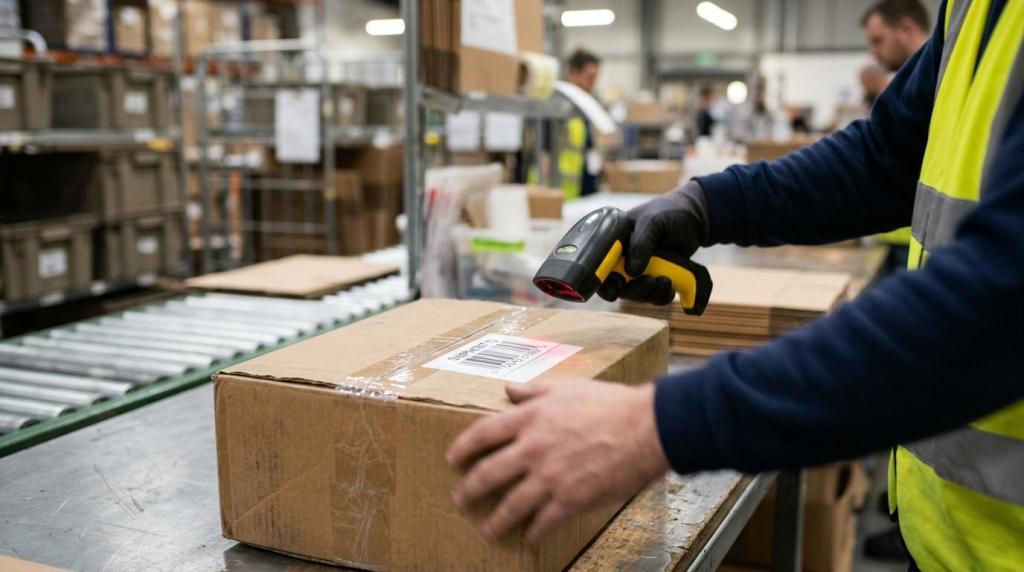
When order volumes rise sharply, fulfilment stops being a back-office function and becomes a defining part of commercial performance. Growth is welcome, including through bulk orders, but it carries a familiar risk: the sales curve can outpace the operating model behind it.
That tension is especially visible in ecommerce. A business can run well at 300 orders a day, then hit difficulty at 800, not because demand is unhealthy, but because picking, packing, stock control, carrier handovers and returns all start to compete for the same limited space, labour and systems capacity—even when using dropshipping. At that point, fulfilment is no longer about coping. It is about building a structure for high-volume fulfillment that can process high order volumes consistently, accurately and at speed.
Why high-volume order fulfilment matters in UK ecommerce
The UK remains a strong environment for online retail, and the scale of demand helps explain why fulfilment capacity has become a board-level issue for many brands. Office for National Statistics data shows that online spending accounted for 50.5% of total card spending in September 2025, up from 43.7% in September 2019. That is not a niche channel. It is a large share of consumer activity.
Parcel volumes tell a similar story. Ofcom reported that total measured parcel volumes increased by 7.1% to 4.2 billion items in 2024-25. It also noted that competition in the larger business-to-consumer parcel segment continued to focus on serving online retailer and ecommerce fulfilment demand. In plain terms, demand is high, parcel flow is high, and the requirement for dependable fulfilment remains very real.
High order volumes are not an occasional anomaly for many online sellers. They are the operating baseline.
| Market indicator | Reported figure | Operational meaning |
|---|---|---|
| Online spending share of card spend | 50.5% in Sept 2025 | Ecommerce is central to retail activity, not peripheral |
| Domestic online spending ratio change | Up 6.4 percentage points between 2019 and 2024 | Sustained digital buying behaviour supports long-term fulfilment demand |
| UK parcel volumes | 4.2 billion items in 2024-25 | Carrier networks and warehouse operations must handle sustained volume pressure |
| Parcel volume growth | 7.1% year on year | Capacity planning cannot rely on static order assumptions |
For brands that are expanding across marketplaces, direct-to-consumer channels and promotions, this market backdrop creates a simple reality: fulfilment systems and infrastructure need enough headroom to support scalability, manage distribution, and absorb both growth and volatility.
What changes when order counts outpace internal processes
A rising order count does not only mean more of the same work. It changes the shape of the work. Batch imports become time-sensitive. Stock discrepancies become more expensive. Carrier cut-off times become less forgiving. A packing bench that felt efficient at moderate volume may become the slowest point in the operation, making automation an important consideration as order volumes grow.
This is why high-volume fulfillment, effective order management and reliable inventory management are usually won or lost through process discipline and automation. Order routing, barcode scanning, warehouse layout, SKU slotting, replenishment rhythm, batch picking and packaging rules all affect daily throughput. Small delays compound quickly when hundreds or thousands of orders are in motion at the same time, so an account manager can help coordinate processes and keep fulfilment aligned with customer needs.
The pressure points are often predictable:
- Stock file lag
- Picking route inefficiency
- Packing station congestion
- Carrier label bottlenecks
- Returns backlog
- Inconsistent exception handling
These are not minor frictions. They can affect customer satisfaction and the customer experience in visible ways, from late dispatch notifications and delayed shipping to split shipments, cancelled lines and slower refunds.
A business does not need to be failing before it reviews fulfilment capacity. In many cases, the smartest move comes while service is still good, but demand trends suggest that the present setup is nearing its ceiling.
Operational pressure points in high-volume fulfilment
Speed matters, but speed without control creates expensive mistakes.
Accuracy tends to come under strain first. As order volume rises, manual checks become harder to maintain, and staff fatigue has a measurable effect on pick quality. That leads to reships, customer service tickets and avoidable carrier cost. What looks like a warehouse issue quickly becomes a margin issue.
Dispatch performance is the next major test. Same-day dispatch targets depend on the full chain working in sync, from order import through to packing completion and manifest handover. A delay at any stage pushes orders past the day’s final carrier collection, disrupting shipping schedules. In a high-volume setting, even a short systems interruption can leave a large block of high volume orders for fulfilment stranded until the next cycle.
Returns are often underestimated. Yet when order numbers rise, return volumes rise too. Without a clear returns process, stock remains unavailable for resale, refunds slow down, and warehouse space fills with unresolved items. That is one reason sophisticated fulfilment operations treat reverse logistics as part of the main service model rather than a secondary task.
Key capabilities to look for in scalable fulfilment services
When evaluating a fulfilment partner for very high order volumes, headline claims matter less than operational design. The core question is not whether a provider can handle “large volumes” in general. It is whether it can handle your order profile, SKU mix, packaging needs, service level targets and peak patterns.
A scalable model for high-volume fulfillment usually includes the following components:
| Capability | Why it matters at high volume | What to check |
|---|---|---|
| Throughput planning | Protects dispatch speed during surges | Daily capacity model, peak contingency, labour planning |
| Order visibility | Reduces uncertainty and manual chasing | Portal access to orders, stock and shipment tracking |
| Accuracy controls | Limits costly pick-pack errors | Barcode processes, scan validation, quality checks |
| Carrier coordination | Supports late cut-offs and reliable handover | Carrier mix, collection times, label workflow |
| Returns handling | Keeps stock and refunds moving | Processing times, inspection rules, stock disposition |
| Storage capacity | Prevents growth from outgrowing the site | Available pallet space, replenishment discipline |
It is useful to ask how onboarding is handled as well. A serious high-volume operation will review expected peaks, product dimensions, SKU velocity and order behaviour before go-live, not after the first surge has exposed weak points.
Technology is only part of the answer, with methods such as batch picking helping warehouses improve efficiency at high order volumes. High-volume fulfillment still depends on practical warehouse execution, especially when order profiles are mixed and promotional spikes can alter the daily flow with very little notice.
Published fulfilment results from outsourced high-volume operations
There is strong practical value in looking at published fulfilment results rather than general promises. One publicly available 3PLWOW case describes a direct-to-consumer brand that had grown from around 4,000 monthly orders to more than 14,000 before moving to outsourced fulfilment. According to that published case material, monthly order capacity increased from 15,000 to more than 35,000 within 90 days.
The same case reports an increase in order accuracy from 96.2% to 99.4%, same-day dispatch rising from 71% to 94%, and return processing time falling from 6 days to 2 days. Those figures matter because they show that outsourcing at higher order volumes can improve customer satisfaction, not just storage efficiency or labour costs. It can affect the full operating rhythm of the business.
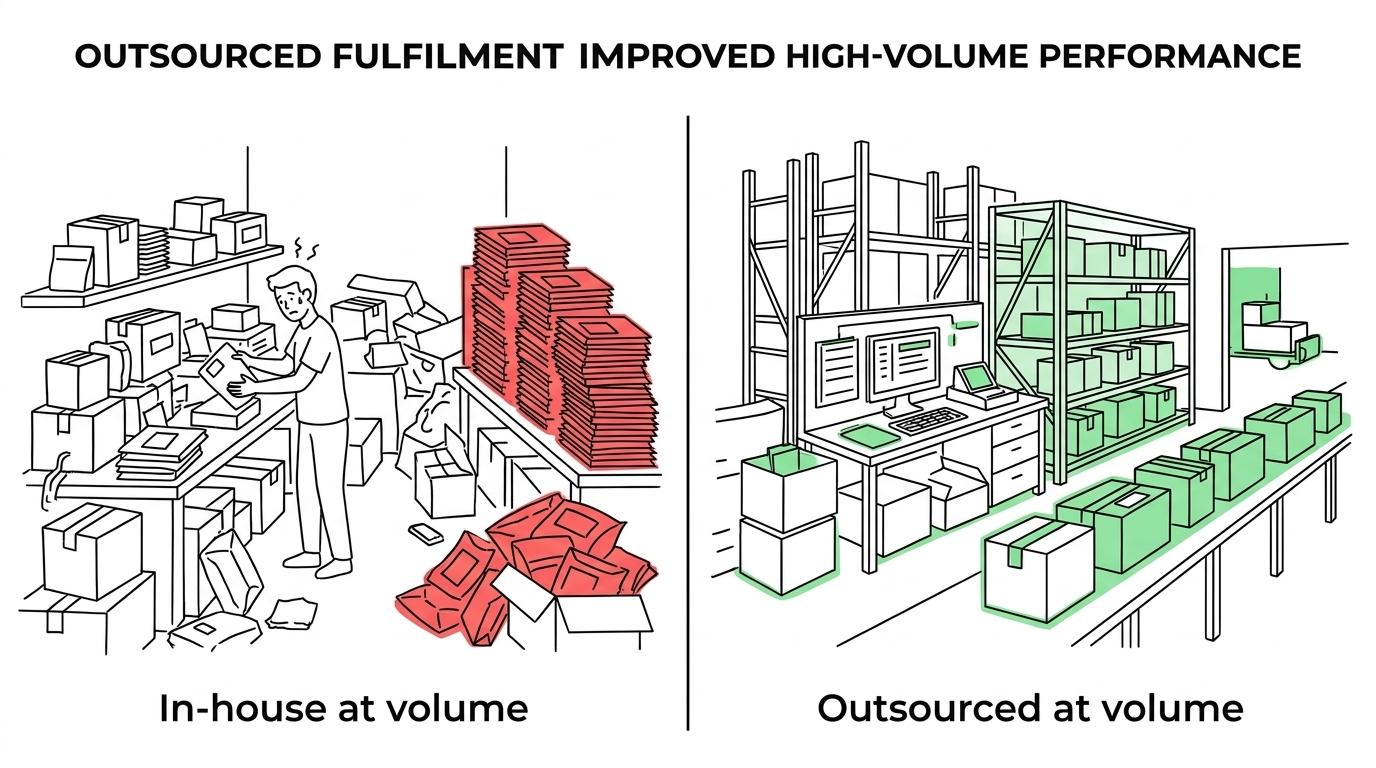
3PLWOW’s published material on high-volume fulfillment describes support for dependable daily throughput, operational visibility and the ability to adapt when order numbers move quickly. It states that capacity and expected peaks are reviewed during onboarding around the client’s actual product and order profile, and that the client portal is designed to show orders, stock, shipment tracking and related operational data as volume grows.
Other published information from 3PLWOW states that it operates from a 15,000+ pallet warehouse capacity, offers pick and pack from £0.40 per order, and ships precision-checked orders the same day.
That combination of warehouse capacity, process control and visibility is what many growing brands need once volume begins to move beyond the limits of an in-house setup.
Questions to ask before choosing a high-volume fulfilment partner
A good provider should be able to answer detailed operational questions clearly and without hesitation. General confidence is not enough when the order count is high and service failures become expensive very quickly.
A focused buying process usually includes questions like these:
- How is peak capacity assessed: Ask how expected spikes are modelled and what assumptions are used about labour, space and cut-off times.
- What visibility is available: Check whether you can view live orders, stock levels, shipment tracking and exceptions through a client portal.
- How is order accuracy protected: Look for scan-based processes, quality controls, batch picking procedures and a defined exception workflow.
- What dispatch service levels are realistic: Request actual same-day dispatch handling rules rather than vague speed claims.
- How are returns processed: Confirm target turnaround times and how returned stock is inspected, quarantined or returned to saleable inventory.
It is equally wise to ask about the order-import process, integrations and how the provider handles SKU growth. A warehouse may be fast with a stable catalogue and far less efficient when product count, bundle complexity or channel mix increases.
When to request a quote for very high order volumes
Many brands wait too long to review fulfilment. They act only when delays, stock errors or rising support tickets force the issue. A better approach is to assess options as soon as the trend line shows that current capacity is being stretched.
The right time is often earlier than expected:
- a promotional calendar is getting more ambitious
- daily orders are becoming less predictable
- new channels are being added
- SKU counts are climbing
- returns are starting to consume too much warehouse time
If those signals sound familiar, a structured quote process can give clarity quickly. It helps benchmark your current operation against a model designed for high-volume fulfillment, with higher throughput, stronger control and faster dispatch.
For businesses preparing for very high order volumes, a quote can be requested here: https://3plwow.com/very-high-volume-orders/
That step can turn fulfilment from a growth constraint into a growth platform, especially when demand is rising faster than in-house processes can realistically keep pace.