

Amazing 3PL prices are not simply the lowest figures on a rate card. The real value comes from clarity, control, and a charging model that matches the way an ecommerce business actually trades.
When 3pl costs are easy to read, easy to predict, and easy to connect to daily order volume, brands can plan with confidence. They can price products more accurately, protect margin, and make quicker decisions on marketing, stock, and shipping offers.
That is why the promise of no admin fees and no subscription fees stands out.
Why transparent 3PL pricing matters in UK ecommerce
Fulfilment logistics has moved from being a back-office function to a central part of ecommerce performance. A customer may never see the warehouse, but they feel its impact every time an order arrives quickly, correctly packed, and with clear tracking.
The UK market gives this even more weight. Office for National Statistics data shows that internet sales accounted for 27.1% of total retail sales in Great Britain in 2024. That is a substantial share of consumer activity, and it means fulfilment remains directly tied to a very large trading channel.
As online retail stays strong, brands need 3PL pricing that supports growth rather than obscures it. Hidden charges, minimum monthly subscriptions, and vague admin costs can distort the real cost per order. A quote may look competitive at first glance, then become far less attractive once invoice extras begin to appear.
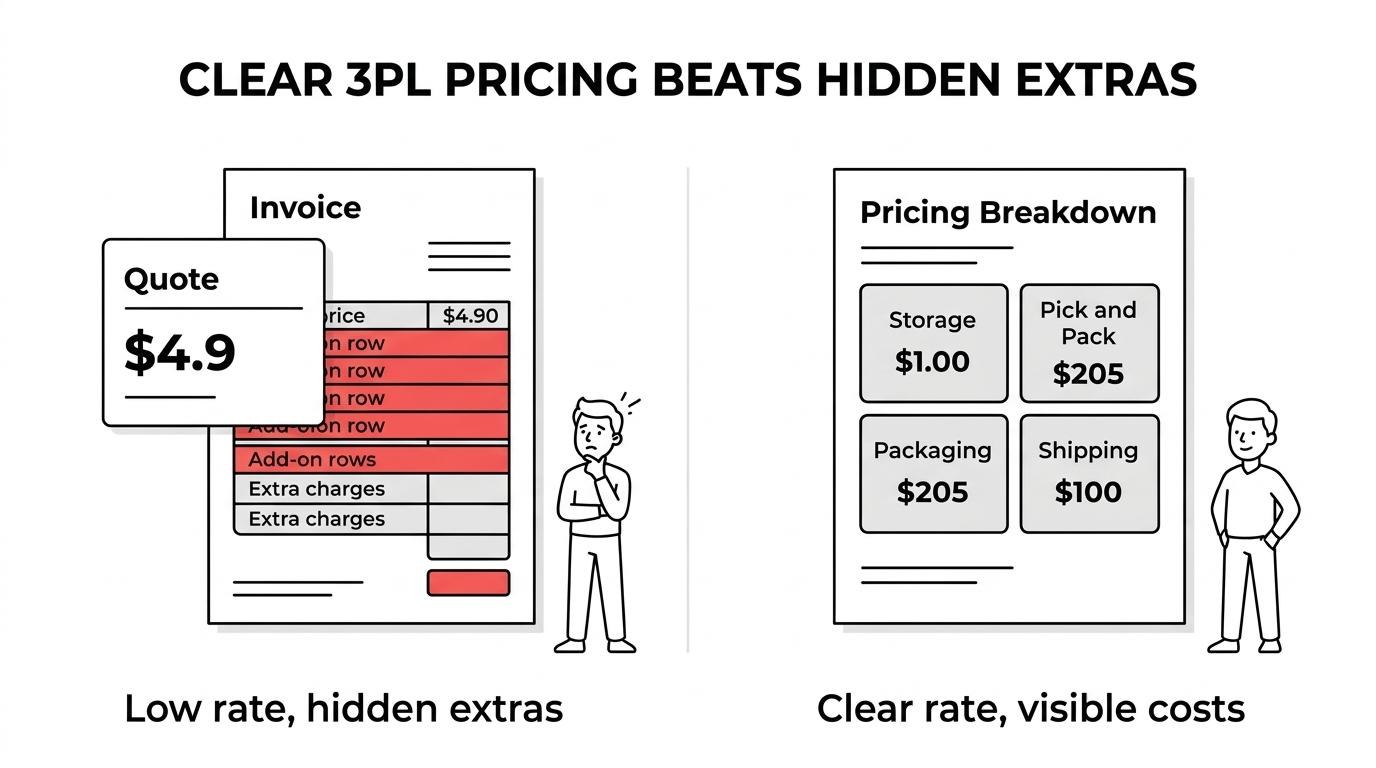
Clear pricing creates a different experience. It allows finance teams to forecast cleanly, founders to compare partners fairly, and operations teams to scale with fewer surprises.
What no admin fees and no subscription fees mean in fulfilment
A no-subscription model usually means a client is not paying a fixed monthly charge simply to keep their inventory in the warehouse. Instead, costs are more closely tied to real activity, such as storage, picking, packing, packaging, and shipping.
A no-admin-fee model usually means the provider is not layering unexplained extras over the agreed fulfilment services, including order processing. That matters because admin fees are often small enough to look harmless, yet frequent enough to chip away at margin over time.
One example in the market is 3PLWOW, which publicly states that it does not charge a monthly subscription simply for being a fulfilment client and does not add hidden admin charges. It also states that pricing is shaped around handling, storage, packaging, and shipping requirements rather than a single standard rate for every business.
That kind of structure can make onboarding smoother and make a major difference in practice.
- Subscription fee: a fixed recurring charge for access to the fulfilment service, even before order activity is counted
- Admin fee: an extra charge added for account handling, paperwork, support, or operational processing
- Usage-based charging: costs linked to real warehouse activity and shipment volume
- Pre-agreed scope: pricing discussed before launch, with cost areas visible from the start
Which fulfilment cost drivers shape 3PL prices
Good pricing for fulfilment and storage is rarely one flat number. Fulfilment is made up of separate operational tasks, and each one affects cost in a different way. A brand shipping lightweight letterbox products will have very different needs and shipping rates from one sending fragile multipack orders across several sales channels, or large orders that require a pallet.
That does not make pricing confusing by default. It simply means the quote should break down the moving parts in a sensible way.
Here is a practical view of the main cost drivers behind 3PL prices:
| Fulfilment cost area | What should be clear | Why it affects price |
|---|---|---|
| Goods-in | Receiving method, booking process, pallet or carton intake | Inbound stock handling takes time and warehouse labour |
| Storage | Charging unit, whether by pallet, bin, shelf, or cubic space | Products occupy space at different rates |
| Pick and pack | Per-order and per-item charging | Complex orders require more handling |
| Packaging | Standard materials, branded inserts, special protection | Packaging choices change material and labour costs |
| Shipping | Carrier options, zones, parcel weights, service speeds | Delivery spend is often the largest variable cost |
| Returns | Inspection, repacking, restocking, disposal rules | Reverse logistics takes labour and stock control |
| Integrations | Platform and marketplace connections | Order flow automation reduces manual work, but setup still matters |
A clear quote should show where each of these sits. If one cost area is missing, there is a fair chance it will reappear later in another form.
This is where amazing 3PL prices become more than a sales phrase. A strong pricing model makes each cost visible enough to assess, yet simple enough to use in planning.
What a clear fulfilment pricing model should help a business do
Price transparency is not just about avoiding unpleasant surprises. It should also improve decision-making across the business.
When costs are mapped properly, brands can see their true fulfilment cost per order, their cost by SKU range, and the effect of promotions on margin. A free-shipping campaign looks very different once the real pick, pack, packaging, and carrier costs are understood.
It also becomes easier to test growth ideas.
- faster UK shipping
- marketplace expansion
- multipack offers
- subscription products
- international dispatch
- returns policy changes
If the fulfilment partner can present the financial impact of those moves in advance, pricing becomes a planning tool rather than a monthly puzzle.
How flexible 3PL prices support ecommerce growth
Growth rarely happens in a straight line. Order volume can surge during promotions, soften after peak, and shift sharply when a new sales channel opens. A rigid fee structure can hold a business back in those moments.
A flexible model is often stronger because it adjusts with actual activity, including seasonal changes and peak surcharges. Brands are not carrying unnecessary fixed charges when order volume is modest, and they are not pushed into awkward workarounds when volume rises. This is especially useful for seasonal brands, product launches, and retailers with mixed channel demand.
The market context supports this need for agility. ONS data shows how significant ecommerce remains in UK retail, while related digital spending indicators show strong online purchasing activity as well. In a market shaped by ongoing online demand, fulfilment capacity and pricing structure both matter.
Predictability still matters just as much as flexibility, though. The best pricing models combine both. They let businesses scale while still knowing what each order is likely to cost.
That balance is powerful.
Which questions to ask a fulfilment centre about pricing
A quote should never be accepted on headline price alone. The right questions can quickly reveal whether the rate is genuinely competitive or only appears that way.
Price comparison becomes far easier when the same points are checked every time.
- Monthly charges: is there any standing subscription, account fee, or platform fee?
- Admin costs: are there any booking, reporting, support, or management charges outside the quoted rates?
- Storage method: how is space measured, and how often is it billed?
- Pick and pack rules: what counts as one item, one order, or an additional handling step?
- Packaging policy: which materials are included, and which are charged separately?
- Returns process: what happens to returned stock, and what does each step cost?
- Carrier mix
- Cut-off times
- Integration scope
- Billing frequency
These questions do not complicate the buying process. They simplify it by moving vague assumptions into clear commercial terms.
Which fulfilment services add value beyond the price
Price is vital, but service design still matters. A lower rate can lose its appeal quickly if stock visibility is poor, order tracking is delayed, or returns workflows create unnecessary friction.
That is why many brands now look for a broader operational package from a 3PL. Public information from 3PLWOW, for example, describes support for warehousing, order fulfilment, pick and pack, returns, ecommerce integrations, UK and international dispatch, and a client portal with live order status, stock visibility, tracking details, returns information, and downloadable reports.
Those service elements can have a direct commercial effect. Better stock visibility can reduce overselling. Faster order imports can reduce dispatch delays. Clear returns workflows can protect customer trust while helping stock get back into saleable condition more quickly.
A dedicated account contact can help too, especially when promotions, product launches, or marketplace expansion create operational pressure.
Why simple fulfilment pricing can strengthen brand confidence
Clarity changes the tone of the client and supplier relationship. When fees are agreed early and presented plainly, the conversation becomes more strategic. Teams spend less time questioning invoices and more time improving service, range, and delivery performance.
That confidence often carries into customer experience as well. Brands can set shipping thresholds with more conviction, communicate dispatch promises more accurately, and run campaigns without fearing that operational costs will undermine the return.
Simple pricing also makes it easier to compare growth paths. A business might ask whether to launch on another marketplace, offer a next-day option, or test international orders. With transparent fulfilment costs, those decisions can be modelled sensibly instead of guessed.
And when a 3PL removes subscription fees and hidden admin charges from the structure, the whole offer becomes easier to trust.
What strong 3PL prices should look like in practice
The most attractive 3PL prices usually share a few traits. They are easy to explain, tied to real activity, and supported by service capability that can keep pace with demand.
They should feel commercially fair rather than artificially cheap.
A practical pricing model will usually offer:
- visible charges for the main fulfilment tasks
- no vague admin additions
- no unnecessary standing subscription
- service options that match order profile
- room to scale across channels and seasons
For ecommerce brands seeking amazing 3PL prices, that is the standard worth aiming for: a fulfilment structure that is lean, readable, and ready for growth.