

January looks tidy on a planning calendar. The peak season has passed, a new budget is live, and teams want a cleaner fulfilment setup before spring trading picks up. Yet a changing fulfilment companies project in January carries its own pressure. The move lands right in the middle of heavy returns activity, late peak enquiries, and refund deadlines that do not pause because pallets are on the road.
That is why a smooth operational handover with a reliable logistics provider is essential to the transition, not just an ecommerce warehouse transfer. Stock has to land accurately, Shopify has to send the right data, outstanding orders need a clear owner, and returns must keep moving from day one.
Recent market data supports that view. ONS reported that online spending values rose in January 2026 versus December 2025, and were sharply up year on year. IMRG also reported another January peak in returns. In other words, January is active, not quiet.
January ecommerce handover risks in the UK
When you switch 3PL provider in the UK, changing fulfilment companies and arranging an ecommerce warehouse transfer after peak often starts with the obvious question: when can stock be transferred? A better opening question is this: what customer commitments must still be honoured while stock is moving?
For UK ecommerce brands, statutory returns rights shape that answer. GOV.UK states that online, mail and telephone customers can cancel within 14 days of receiving goods, then have another 14 days to send them back. Once the returned item is received, the refund must be issued within 14 days. Standard delivery costs must also be refunded on cancelled online orders, though any premium paid above standard delivery does not have to be.
That timing matters because a January handover usually overlaps with Christmas gift returns, carrier delays, and post-peak support tickets.
The practical point is simple. If a new 3PL cannot receive, inspect, route and report returns on day one, the brand is exposed almost immediately. Physical stock movement is only part of the job.
Pre-handover planning for a switch 3PL provider UK project
Before any cartons move to the new 3PL, the operating model should be pinned down in writing. That includes a hard cutover date, order ownership rules, returns routing, inventory freeze windows, and a single set of SKU masters. If any of those remain informal, exceptions will multiply during go-live.
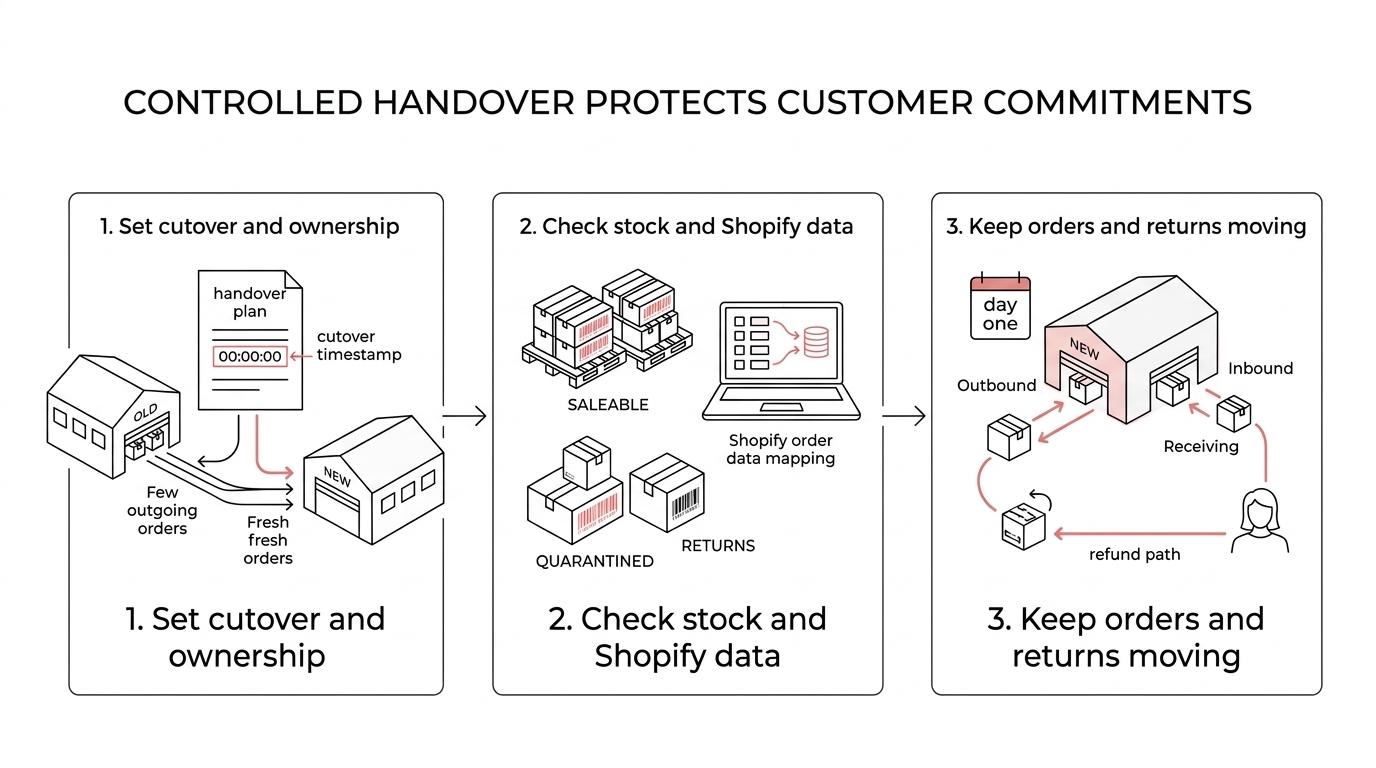
It also helps to split the project into three streams: commercial handover, systems handover, and warehouse handover. Teams often focus heavily on rates, storage and pick fees, then leave integrations, testing or returns logic too late. January does not offer much slack for that approach.
A practical handover pack normally needs the following controls:
- Cutover date: the exact timestamp when new orders begin flowing to the new fulfilment partner
- Order ownership: which provider ships orders already released before cutover, and which provider handles backorders
- Returns routing: where customer returns labels and portal instructions will point from each date
- SKU master: one approved file for barcodes, product dimensions, bundles, kits, and pack quantities
- Inventory freeze: the period during which stock adjustments are restricted and cycle counts are completed
- Exception rules: how cancelled orders, lost parcels, damaged units, and partial shipments are handled
One more point deserves attention. January projects benefit from a short period of dual running, even if only for reporting and returns. That does not mean two sites should both fulfil live stock indefinitely. It means there should be a controlled overlap so that in-flight orders and reverse logistics do not fall into a gap.
Stock transfer controls for an ecommerce warehouse transfer
Stock accuracy is the centre of the move. Without it, every downstream metric gets worse: dispatch speed, stock availability, marketplace health, and customer service response times.
The safest approach is to use technology to classify inventory before transfer, not after arrival. Saleable stock, quarantined stock, returns awaiting inspection, marketing packs, spare components, and customs-controlled goods should each travel with their own status. A single total quantity is not enough. The new warehouse must know what can be sold, what needs checking, and what must remain blocked to support accurate order fulfilment.
If goods sit within customs arrangements, control has to be tighter still. HMRC expects customs warehouse stock records to show current stock under the procedure in real time. That means any movement between fulfilment partners needs a clear audit trail, status continuity, disciplined receipt booking, and reliable order processing. If goods need processing or repair, the correct customs procedure may also need to change, including inward processing where relevant.
The table below is a useful way to structure the stock migration.
| Stock area | What to verify before transfer | Why it matters in January |
|---|---|---|
| Saleable stock | SKU, barcode, quantity, pallet ID, location | Fast relisting and fewer oversells |
| Quarantined stock | Reason code, photo evidence, disposition rule | Stops blocked units being sold by mistake |
| Returns in waiting | Return ID, item condition, refund status | Protects refund deadlines and customer service SLAs |
| Bundles and kits | Component mapping and build rules | Prevents broken bundle inventory after go-live |
| Customs-controlled goods | Procedure status, real-time stock records, transfer evidence | Protects HMRC compliance and stock traceability |
| Samples and non-sale stock | Separate codes and storage area | Avoids noise in live inventory reports |
A clean transfer also needs a count plan. Most brands will want a pre-move count, a transfer manifest, and a post-receipt count, with tolerance rules agreed in advance. If the catalogue is large, ABC prioritisation is sensible: count high-volume and high-value SKUs most often, then validate the long tail by sample.
Shopify connections and system mapping when changing fulfilment companies
Shopify can make a handover feel deceptively easy. Orders appear, fulfilments update, tracking emails send, and inventory numbers shift by location. Yet those basic flows only cover part of the live operation.
The real work sits in the mapping between Shopify and the 3PL. SKUs must match exactly. Shipping methods need translation between checkout labels and warehouse carrier services. Order tags, gift messages, bundle logic, fraud holds, order edits, subscriptions, and VAT data all need to land in the right place. If the brand uses marketplaces or an order management platform, the mapping gets wider again.
Testing should go beyond “order in, dispatch out”. It should include awkward cases, because January creates many of them.
- Standard order
- Express order
- Split shipment
- Backorder release
- Bundle or multipack
- Edited address
- Cancel before dispatch
- Return and refund
- Exchange or replacement
- International order with customs data
Shopify location logic deserves special care during the switch. If both old and new warehouses remain live in the platform at the same time, allocation rules can create overselling or route orders to the wrong site. A short stock freeze, plus careful control of active locations, usually prevents that.
Returns portals, carrier APIs, and finance exports should be tested too. A fulfilment switch that leaves tracking updates intact but breaks refund reconciliation is still a failed handover.
Outstanding orders and customer service during a UK 3PL handover
In-flight orders create most of the avoidable friction in a January move. These are the orders already paid for, often already promised to a customer, but not yet fully shipped or not yet fully delivered.
There are two sensible models. The first is a hard cut where the old provider handles fulfilment for every released order and the new provider starts only with fresh orders after a defined timestamp. The second is a staged cut where certain channels or product groups move first. Both can work. Problems appear when ownership is unclear or changes by exception.
Customer service should have a live view of four order groups: awaiting pick, shipped but not delivered, likely to be returned, and at refund risk. That view should sit outside the warehouse systems if possible, so the support team can keep working even if there is a temporary sync issue.
Good handover communication often includes:
- Internal scripts: answers for “where is my order?”, “where do I send my return?” and “why has my tracking not updated?”
- Customer messaging: temporary website copy for dispatch expectations, returns addresses, and support response times
- Carrier visibility: a daily report of collections, missed manifests, and delayed scans
- Escalation route: named contacts for order failures, stock discrepancies, and refund blockers
A January switch does not need dramatic customer messaging. In many cases, the best outcome is that shoppers never notice the change. Yet support teams do need clear language ready, because a small spike in “where is my parcel?” tickets is common during the first week.
Returns processing and refund deadlines after changing fulfilment companies
Returns are the part of the move that most often gets squeezed into the background. That is a mistake in any month, and especially in January.
Peak returns pressure is real. IMRG reported that January 2026 peak returns were materially higher than the previous year. Pair that with ONS reporting continued strength in online spending, and the message is clear: inbound operational load remains high after Christmas.
The new provider should be ready to process returned items immediately, with clear condition grading and reason codes to support efficient returns fulfilment. A return that arrives without a matching order reference still needs a path. A gift return still needs handling rules. A partially used bundle still needs a disposition decision.
The returns checklist should cover more than labels and bins:
- Cancellation period: customer service and warehouse teams need the same rules for online cancellations
- Refund trigger: define whether refunds are released at receipt, after inspection, or after exception review
- Standard delivery costs: make sure cancelled online orders refund the standard delivery charge where required
- Condition grading: approved codes for resaleable, repack, damaged, incomplete, and reject
- Restock rules: when returned items re-enter available inventory, and who approves exceptions
- Legacy returns: a clear rule for parcels sent back to the previous warehouse after cutover
If the catalogue includes customs-controlled stock, returns need an added layer of care. Status, location, and permitted handling must stay accurate. A returns bench is not just a worktable in that setting. It is part of the stock control record.
First-week testing after a switch 3PL provider UK go-live
Go-live is not the finish line. The first trading week is where hidden mapping errors and process gaps come to the surface.
A daily control routine helps. Review order import counts, pick success rates, same-day dispatch performance, stock adjustments, carrier scans, return receipts, refund ageing, and customer tickets every morning. Keep the review short, numerical, and action-led.
A focused first-week test plan often looks like this:
- Reconcile Shopify orders against warehouse imports twice daily.
- Check top SKUs for available stock, allocated stock, and physical count variance.
- Validate carrier tracking events from manifest to first scan to delivery.
- Review every return received that day for receipt time, grading, refund release, and restock outcome.
- Sample finance outputs against orders and refunds, including VAT and delivery charge treatment.
Single-SKU success is not enough. The move is only settled when exceptions flow cleanly as well.
If a brand has prepared its January handover with its 3PL around returns processing, stock accuracy and data discipline, the warehouse transfer becomes much more manageable. The move stops being a risky reset and becomes a controlled change in operating model, with customer promises still intact.