

Many online brands start in the same way: stock on spare-room shelves, labels printed from a desktop printer, and evenings spent packing parcels on the floor. It is a practical, low-cost way to begin, and for a while it works brilliantly.
Then growth changes the equation. More orders should feel like a clear win, yet they can quietly turn into delayed dispatch, stock confusion, and less time spent on sales, product development, and marketing. That is often the moment when outsource order fulfilment in the UK to a 3PL becomes a smart operational move, particularly for small businesses seeking ecommerce fulfilment services to support a growing online business.
Signs in-house fulfilment is holding back a growing online business
The first warning sign is rarely dramatic. It is usually a pattern. Shelving fills up. New stock arrivals have nowhere sensible to go. Packing materials take over valuable space. A business that once felt agile starts to feel cramped.
The second sign is time pressure. Dispatch cut-off times begin to run the day. Instead of focusing on growth, the founder or small team spends long stretches picking, packing, checking addresses, chasing couriers, and answering delivery emails. Revenue may still be rising, yet strategic work gets pushed into evenings and weekends.
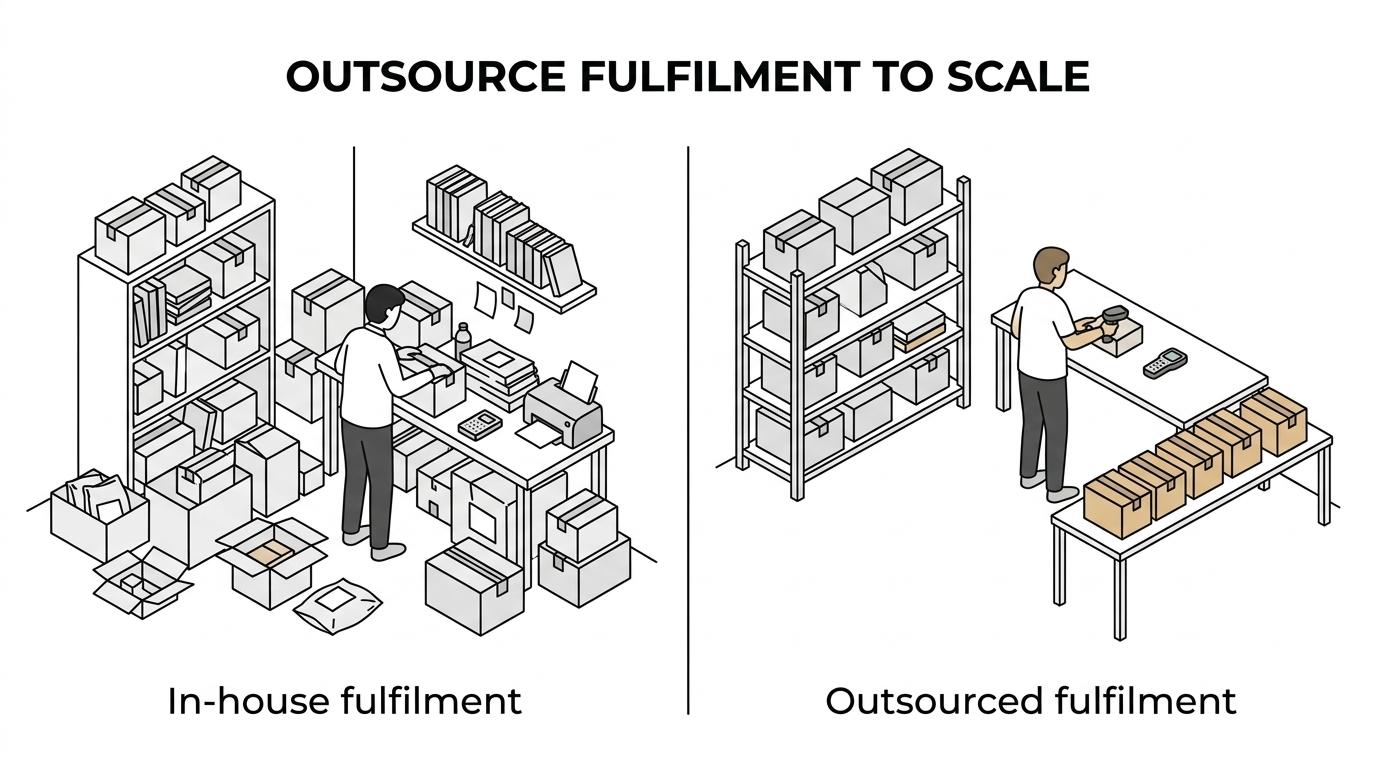
That is usually the real tipping point.
A few common signals tend to appear together:
- Stock in more than one room
- Packing benches doubling as office space
- Late collection stress
- More delivery queries from customers
- Sales campaigns delayed because fulfilment needs attention first
None of these issues means a business has failed. In fact, they usually mean demand is healthy. The challenge is that a small in-house setup often reaches its limit before the brand reaches its market potential.
Small business fulfilment metrics that show capacity is running out
Operational strain becomes easier to spot when it is translated into measurable signals. A founder may feel busy for months without realising that fulfilment performance is already slipping.
The table below shows where in-house fulfilment often starts to lose ground.
| Operational signal | What it looks like in-house | Why it matters |
|---|---|---|
| Storage capacity | Overflow stock, split inventory locations, harder stock counts | Increases mis-picks and slows replenishment |
| Dispatch speed | Orders bunch up near cut-off, next-day promises become harder to keep | Affects customer trust and repeat purchase |
| Order accuracy | More picking mistakes, wrong sizes, missing items | Raises replacement costs and support volume |
| Returns handling | Returned goods pile up waiting for inspection | Delays refunds and ties up sellable stock |
| Team focus | Sales and marketing time gets swallowed by packing | Growth activity slows while workload rises |
| Customer-service contacts | More “where is my order?” and “has my return arrived?” messages | Signals pressure in the fulfilment workflow |
Capacity is not only about how many parcels can be packed in a day. It is also about consistency. A business may manage a peak week through sheer effort, but if every promotion creates operational strain, the model is fragile.
Published 3PL case studies point to the scale of the difference. One reported monthly order capacity rising from 15,000 to more than 35,000 within 90 days after switching to outsourced fulfilment, while order accuracy moved from 96.2% to 99.4%. Numbers like that will vary by brand, though they show why process and infrastructure matter once volume grows.
What ecommerce fulfilment services actually include
Some founders still think fulfilment outsourcing simply means renting warehouse space, but it can also support sales channels such as Amazon FBA. In practice, a third-party logistics provider, or 3PL, usually handles a much broader set of tasks.
Industry guidance from Shopify describes a 3PL model for ecommerce businesses as outsourced warehousing, inventory management, picking and packing, shipping, and returns handling. In other words, the value is in the full workflow, not just the storage.
That distinction matters because the problem is rarely shelf space alone; working with a 3PL can help address operational strain that affects customers through delayed deliveries, inaccurate orders, and slower returns.
When a business outsources order fulfilment in the UK to a 3PL, it is often buying access to systems, labour planning, courier relationships, scanning processes, and order sync technology as much as physical room for stock. That is where many of the gains come from.
A typical 3PL setup can include support for Amazon FBA sellers:
- Goods receiving: stock is booked in, checked, and put away against SKU data
- Order sync: orders flow from the ecommerce platform into the warehouse system automatically
- Pick and pack: trained 3PL teams follow barcode-led processes and packing rules
- Shipping: carrier services, label generation, tracking, and dispatch management are handled centrally
- Returns handling: returned items are inspected, sorted, and processed faster than most small in-house teams can manage during busy periods
For a growing online business, working with a 3pl can remove a surprising amount of friction from the day-to-day operation, helping customers receive their orders reliably.
Customer experience pressures that push fulfilment outsourcing higher up the list
Customers do not separate marketing from fulfilment. To them, the brand promise includes dispatch speed, delivery reliability, packaging quality, and the ease of making a return.
That is why fulfilment becomes a commercial issue, not just a warehouse issue.
DHL’s 2025 ecommerce trends reporting found that delivery and returns remain major conversion drivers, and 75% of shoppers will leave if the return process does not meet expectations. That has direct implications for small business fulfilment. If returns are slow, unclear, or hard to process, the damage shows up long before the finance team totals the cost.
Returns are also still a major UK retail reality. Retail Economics forecasts UK non-food returns at £25.1bn in 2025, with the overall returns rate easing from 21% to 19.5%. Even with that slight improvement, returns remain large enough to shape fulfilment strategy, especially for fashion, lifestyle, gifting, and other high-volume ecommerce categories.
A small brand can absorb occasional returns friction. It is much harder to absorb it at scale while maintaining fast outbound fulfilment.
Why outsource order fulfilment UK brands often see better results
The clearest benefit is capacity, though capacity alone is not the whole story. A good fulfilment partner also brings repeatable process. That usually means more stable service during promotions, peak season, and unexpected spikes.
Accuracy is another major factor. In-house teams often do excellent work at low volume because the founder knows every product and every customer order feels personal. Once volume climbs, memory and goodwill stop being enough. Scanning, location control, and standard operating procedures become more valuable than heroics.
Published case examples in the sector have linked outsourcing to a 3pl (third-party logistics) provider with faster dispatch, stronger order accuracy, and quicker returns processing. One example reported a 38% drop in support contacts about shipping after the move. That reduction matters because customer-service pressure is often a hidden cost of in-house fulfilment.
The benefits usually show up in several places at once:
- Better use of management time
- More predictable dispatch performance
- Cleaner stock control
- Less strain during promotions
- Faster turnaround on returns
For many founders, the most valuable gain is focus. When fulfilment no longer takes over the working day, there is room again for sales, partnerships, merchandising, paid media, and product planning.
What moving to a fulfilment partner involves
The switch is usually more structured than people expect. It is not a matter of dropping pallets at a warehouse and hoping for the best. A professional 3PL onboarding process covers systems, stock data, packaging rules, shipping options, and return handling before the first live order is dispatched.
That makes the move feel much more manageable.
Order sync, stock transfer, and fulfilment workflow setup
A typical transition tends to follow a sequence. First comes discovery: order volumes, SKU count, product dimensions, sales channels, seasonality, and special requirements are reviewed. Next comes systems setup, where the ecommerce platform and marketplaces connect to the warehouse system for automatic order sync.
After that, inventory is transferred in, booked into storage locations, and checked against product data. Packing instructions are configured, courier services are chosen, and test orders are run before go-live.
The core steps usually look like this:
- Data review: SKU codes, barcodes, bundle logic, and reorder information are checked
- Integration setup: sales channels connect to the warehouse management system
- Inbound planning: stock delivery dates, pallet profiles, and goods-in procedures are agreed
- Packing rules: branded inserts, packaging types, kitting, or gift options are defined
- Launch checks: test orders verify labels, tracking, and dispatch timing
A well-run transition does not remove every decision, though it does replace ad hoc fulfilment with a controlled operating model.
How to prepare your business before outsourcing small business fulfilment
Preparation makes a huge difference to the first few weeks. Brands with tidy data and clear rules tend to settle into outsourced fulfilment faster than those trying to fix stock issues during onboarding.
Start with the basics. Make sure each SKU has a unique code. Confirm dimensions and weights where shipping cost depends on them. Check that bundles, variants, and promotional packs are clearly mapped. If some items need fragile packing, age checks, or special labelling, document that early.
It also helps to review customer promise. If the website offers next-day delivery, same-day dispatch, or easy returns, the fulfilment operation must be set up to support those promises consistently.
A few practical preparation tasks often pay off quickly:
- Clean SKU list and barcode records
- Clear carrier and service requirements
- Documented returns rules
- Packaging specifications
- Forecasts for promotions and seasonal peaks
These details may feel administrative, yet they shape whether the partnership starts strongly or stumbles in the first month.
How to choose ecommerce fulfilment services that fit your next stage of growth
Not every provider is right for every brand. The right fit depends on order profile, product type, growth rate, and customer expectations. A business shipping lightweight beauty products has very different needs from one sending bulky homeware or multi-item subscription boxes, so choosing the right 3PL is essential.
Questions around service design matter as much as headline price. A lower storage rate can lose its appeal if returns are slow, integrations are limited, or support is weak during busy periods.
When reviewing ecommerce fulfilment services from a 3PL (third-party logistics provider), it helps to ask about:
- Order profile fit: does the operation suit your average basket size and product mix?
- Dispatch capability: what cut-off times, same-day options, and carrier services are available?
- Accuracy controls: how are picks verified and exceptions managed?
- Returns process: how quickly are returns inspected and reported back?
- Reporting access: what visibility is available for stock, orders, and service levels?
A strong 3PL partner should be able to explain its workflow in plain terms. If the process sounds vague, the service may prove vague once live orders are flowing through it.
Growth often starts at a packing bench. Lasting growth usually needs something stronger behind it. When storage is tight, accuracy pressure is rising, and fulfilment is stealing time from sales, outsourcing is less about stepping back and more about giving the business room to move properly.