

Many ecommerce brands begin with a folding table, a label printer, and stock stacked wherever it will fit. That setup can work brilliantly at the start. It keeps costs tight, gives founders control, and makes every order feel personal.
Then growth changes the picture. UK online retail demand has stayed strong, with the Office for National Statistics reporting that internet sales accounted for 28.8% of total retail sales in Great Britain by August 2026, up from 27.4% in 2025. More orders should be good news. Yet when those orders start taking over the spare room, the hallway, and the working day, in-house fulfilment can quietly become the constraint that limits the next stage of growth.
Why fulfilment for small businesses is under more pressure in the UK
The pressure is not only about order volume. It is about the standard customers now expect. ONS data showed online sales values in August 2026 were 8.9% higher than a year earlier. That means more brands are competing in a busy market where dispatch speed, stock accuracy, and reliable delivery services shape repeat purchase behaviour.
At the same time, parcel operations remain far from perfect. Ofcom reported that 68% of UK consumers had experienced a delivery issue in the previous six months, and 4.2 billion parcels were sent and received in the UK over the last year. When so much can go wrong after dispatch, brands need the part they control most directly, picking, packing, and sending, to run with real discipline.
Costs add another layer. ONS business data from May 2026 showed that 66% of firms with 10 or more employees had seen staffing costs increase over the previous three months. SMEs have also pointed to the cost and availability of suitable premises as a genuine obstacle. For growing brands, that combination can make in-house fulfilment steadily harder to justify.
Growth should feel exciting, not cramped, and your fulfilment setup should offer the flexibility to adapt as the business expands.
Signs your in-house ecommerce fulfilment in the UK is reaching its limit
The turning point rarely arrives as a single dramatic failure. More often, it shows up as a pattern of small frictions that keep getting worse. Dispatch moves later into the evening. Stock checks take longer. Returns sit untouched. The founder spends more time managing boxes than building the business.
A published guide from UK fulfilment provider 3PLWOW lists several common warning signs, including stock split across multiple rooms or sites, rising pick-and-pack errors, and founders stepping back into warehouse tasks to keep orders moving. Those symptoms are familiar because they appear in businesses just before fulfilment becomes a brake on growth.
Some warning signs are easy to recognise:
- Stock in more than one room
- Overflow into the garage or office
- Orders packed late at night
- Returns waiting days to be processed
- Customer service time swallowed by delivery queries
Other signs are less visible until they start affecting revenue:
- Late dispatches: paid orders miss the promised cut-off
- Pick-and-pack errors: the wrong item, size, or quantity goes out
- Poor stock visibility: products show as available when they are not
- Founder dependency: the operation only works when key people jump in
- Lost selling time: marketing, buying, and product work keep being delayed
Storage pressure and suitable premises costs
A spare room can absorb only so much success before storage space becomes a constraint. The first problem is obvious: physical space. Shelving expands, cartons pile up, and a room designed for domestic life starts carrying the demands of a warehouse. Once stock is spread across several areas, accuracy tends to slip because the operation is no longer built around a single clear flow.
The second problem is less obvious and often more expensive. Businesses facing storage pressure are pushed towards larger premises or temporary fixes, neither of which is always sensible. Government and ONS data point to premises costs and availability as a real constraint for SMEs, making outsourced fulfilment services worth considering as a business grows. If a brand is considering a bigger unit mainly to store stock and pack orders, that is often the moment to compare warehouse outsourcing and outsource order fulfilment in the UK, especially when seeking fulfilment for small businesses or ecommerce fulfilment in the UK, instead of taking on a longer lease.
Late dispatches and delivery expectations in ecommerce fulfilment UK
Customers may never see the packing bench, yet they feel its limits quickly when the operation lacks the flexibility to keep pace with demand. When order cut-off times are missed, same-day dispatch becomes next-day dispatch, and next-day dispatch can become a growing backlog. In a market where online sales keep rising, those delays matter more than ever.
A fulfilment delay also weakens everything that follows. Carrier performance may still be acceptable, but the parcel entered the network too late to meet the service promise. From the customer’s point of view, the distinction hardly matters. The brand made the promise, so the brand carries the reputational cost.
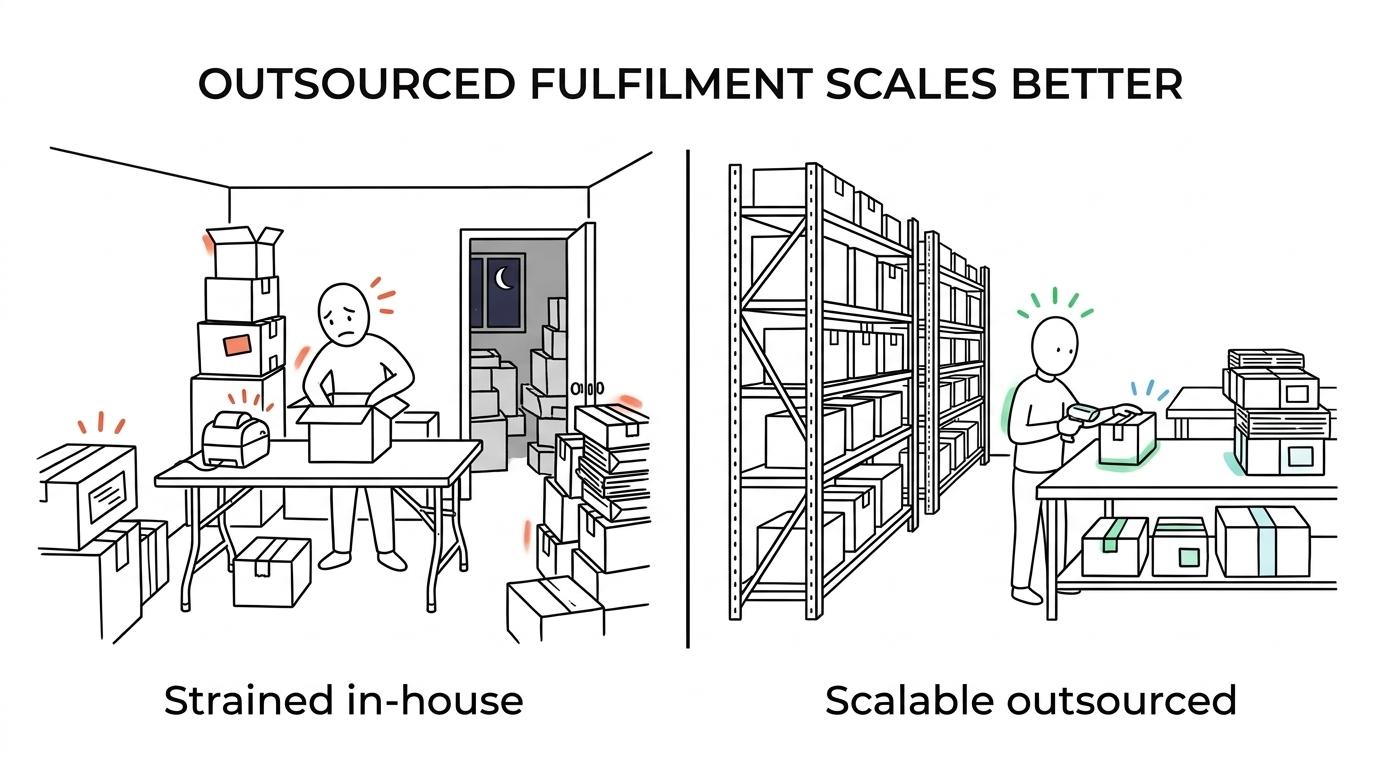
This is one reason outsourced ecommerce fulfilment in the UK appeals to growing businesses. A specialist operation is built around dispatch windows, scanning, bin locations, batch processing, and labour planning. Those details sound operational, because they are, yet they have a direct effect on customer trust.
When founders become warehouse staff instead of business builders
In the early stage, owner involvement in fulfilment makes sense. It keeps feedback close to the product and teaches a business how customers buy, return, and react. Later, the same hands-on approach can become expensive.
If the founder is spending afternoons printing labels, resolving stock mismatches, or driving emergency collections to a courier depot, those are not simply busy tasks. They are high-value hours being spent on low-leverage work. Sales, product development, partnerships, and customer retention usually suffer first because they are easier to postpone than today’s dispatch queue.
That is often the clearest signal that it may be time to outsource order fulfilment in the UK. The issue is no longer whether the team can keep up this week. It is whether the business can grow while its most strategic people are tied to daily warehouse work.
Returns handling is often the hidden tipping point
Returns handling rarely gets the same attention as outbound orders, yet they are a serious test of operational maturity. When volumes are low, a small team can inspect returned items, update stock, and issue refunds without much strain. As order counts rise, that process can stall.
Slow returns handling locks up stock, slows cash recovery, and can frustrate customers who want prompt refunds or exchanges. It also distorts inventory accuracy. A product may be physically back on site but unavailable to sell because nobody has processed it yet.
Published case studies from UK 3PL providers point in that direction. Results vary by business, though the pattern is consistent: when returns are treated as part of the fulfilment system rather than an afterthought, stock moves back into circulation faster.
A practical test for outsource order fulfilment UK decisions
A simple way to judge the situation is to look at what happens during your busiest seven days. If the business only performs well when everyone works longer hours, skips strategic work, and accepts a higher error rate, the model is under strain.
The table below captures the shift many growing brands face.
| Operational sign | What it usually means | What a fulfilment partner can change |
|---|---|---|
| Stock stored in several places | Poor flow and higher mis-picks | Centralised warehousing and location control |
| Dispatch runs late after promotions | Labour capacity is too thin | Dedicated pick, pack, and carrier cut-off management |
| Customer emails about missing or wrong items rise | Accuracy is slipping | Scanning, process checks, and reporting |
| Returns pile up | Reverse logistics is under-resourced | Structured intake, checks, and restocking |
| Founders step into packing every week | The operation depends on key people | A scalable team and repeatable processes |
| Considering a larger premises mainly for stock | Space is becoming a logistics cost | Shared warehouse space matched to volume |
This is why fulfilment decisions should be based on operating pressure, not pride. Packing in-house is not automatically better because it feels more direct. What matters is whether it still serves the business well.
What an ecommerce fulfilment UK partner can improve
A good fulfilment partner does more than take boxes off your hands, offering fulfilment services designed to support business growth. It replaces a fragile setup with one designed for scale. That usually includes warehouse space, trained warehouse staff, carrier relationships, software integrations, order tracking, and a defined returns process.
For small businesses using fulfilment services, that matters because growth is rarely smooth. Demand spikes after promotions, influencer activity, payday periods, and seasonal events. A business packing from its own site may manage average volume reasonably well, but average volume is not the true test. Peak demand is.
The strongest operational gains often come from a few core areas:
- Space: secure storage for stock in a warehouse built for efficient inventory movement
- Labour: pick-and-pack capacity that expands during busy periods
- Systems: clearer stock data across channels and SKUs
- Carrier access: service options that fit parcel type and urgency
- Returns: faster inspection, restocking, and exception handling
There is also a customer experience gain. Better fulfilment tends to mean more accurate orders, more reliable dispatch, and fewer support tickets chasing late or incorrect parcels. That frees internal teams to spend more time on sales and service, rather than apology emails.
The cost question behind fulfilment for small businesses
Many brands delay outsourcing because the fee structure looks more visible than the cost of doing it themselves. Pick fees, pack fees, storage charges, and carrier rates sit clearly on a quote. In-house fulfilment costs are spread out and easier to underestimate.
The true comparison should include rent or home space lost to stock, warehouse equipment, packaging supplies, labour, management time, software, courier collections, and the cost of errors. It should also include the commercial cost of slow growth. If stock handling absorbs the founder’s week, the business may be paying a hidden price that never appears in an operations spreadsheet.
Staffing pressure makes this even sharper. ONS data from 2026 showed many UK businesses were already dealing with increased employment costs. Adding more internal fulfilment labour may still be the right choice in some cases, though it is not the only route to capacity. Shared warehouse operations can give smaller brands access to labour and systems without building everything themselves.
How to assess a fulfilment partner in the UK
Choosing a partner deserves the same care as choosing a major supplier. The goal is not simply to move stock out of the house or office. It is to build an operation that supports the next phase of the business.
Ask practical questions about service levels, technology, and day-to-day handling. The strongest conversations are very specific.
- Accuracy targets: how they are measured, reported, and corrected
- Dispatch cut-offs: the latest times for same-day despatch by channel
- Stock visibility: what data you can see in real time
- Returns workflow: how quickly returned items are checked and restocked
- Carrier mix: which services are available for standard, tracked, and express orders
- Peak planning: how labour capacity changes during promotions and seasonal surges
It is also sensible to ask how onboarding works, how inventory is booked in, and what support exists if an order file fails or a product launch runs above forecast. Good ecommerce fulfilment in the UK depends as much on clear communication as on warehouse space.
What usually changes after outsourcing fulfilment
When outsourcing works well, the first change is often operational calm. Orders leave on time more consistently. Stock data becomes clearer. Customer service spends less time firefighting. The team starts planning ahead because every day is no longer dominated by the dispatch queue.
Published case studies from UK 3PL providers point in that direction. One reported a move from around 15,000 monthly order capacity to more than 35,000 within 90 days, with order accuracy rising from 96.2% to 99.4% and same-day dispatch improving from 71% to 94%. Those figures come from a provider’s own case material, so they should be treated as illustrative rather than universal. Still, they show what can happen when process, labour, and systems are built for scale.
For many brands, the biggest shift is simpler than any metric. The office becomes an office again. The founder gets time back. Marketing plans are not interrupted by a stock delivery. Product launches no longer trigger dread in the packing room. Fulfilment stops competing with growth and starts supporting it.