

Changing fulfilment and logistics partners can feel risky because order flow, stock accuracy and customer promises are all tied together. Yet a well-run move does not depend on luck. It depends on planning the switch as a continuity exercise, not just a warehouse change.
That mindset matters when switching 3pl fulfilment providers in the middle of live trading. A brand may be shipping every day, running paid campaigns, taking pre-orders and managing returns at the same time, so choosing a reliable logistics partner is essential. If any one of those threads is missed, the move can create oversells, delayed dispatches or missing stock records.
Official business continuity guidance in the UK is useful here. The strongest advice is consistent: identify business-critical services, map dependencies, involve suppliers and delivery partners early, and test the plan before disruption occurs. That logic fits ecommerce fulfilment perfectly.
Why switching fulfilment providers needs a business continuity plan
When a business decides to change 3pl (third-party logistics) and fulfilment company UK operations, the obvious focus is the new warehouse. The less obvious focus is everything connected to that warehouse: ecommerce platforms, marketplaces, courier services, packaging stock, returns handling, customer service messaging, reporting and sustainability requirements. Those are the supply chain dependencies that keep orders moving.
A clean handover starts with one question: what must keep working every single day? Usually the answer is simple. Customers must still be able to place orders, stock must remain saleable and visible, and teams must maintain visibility over inventory and ensure parcels leave on time with valid tracking to protect the customer experience.
That is why moving 3PL providers is usually safer as a phased transition rather than a single cutover. A staged approach allows stock transfer in controlled waves, workflow testing in a live environment, and clear go or no-go decisions before full volume moves. It gives the team room to spot issues while the old process still exists as a fallback.
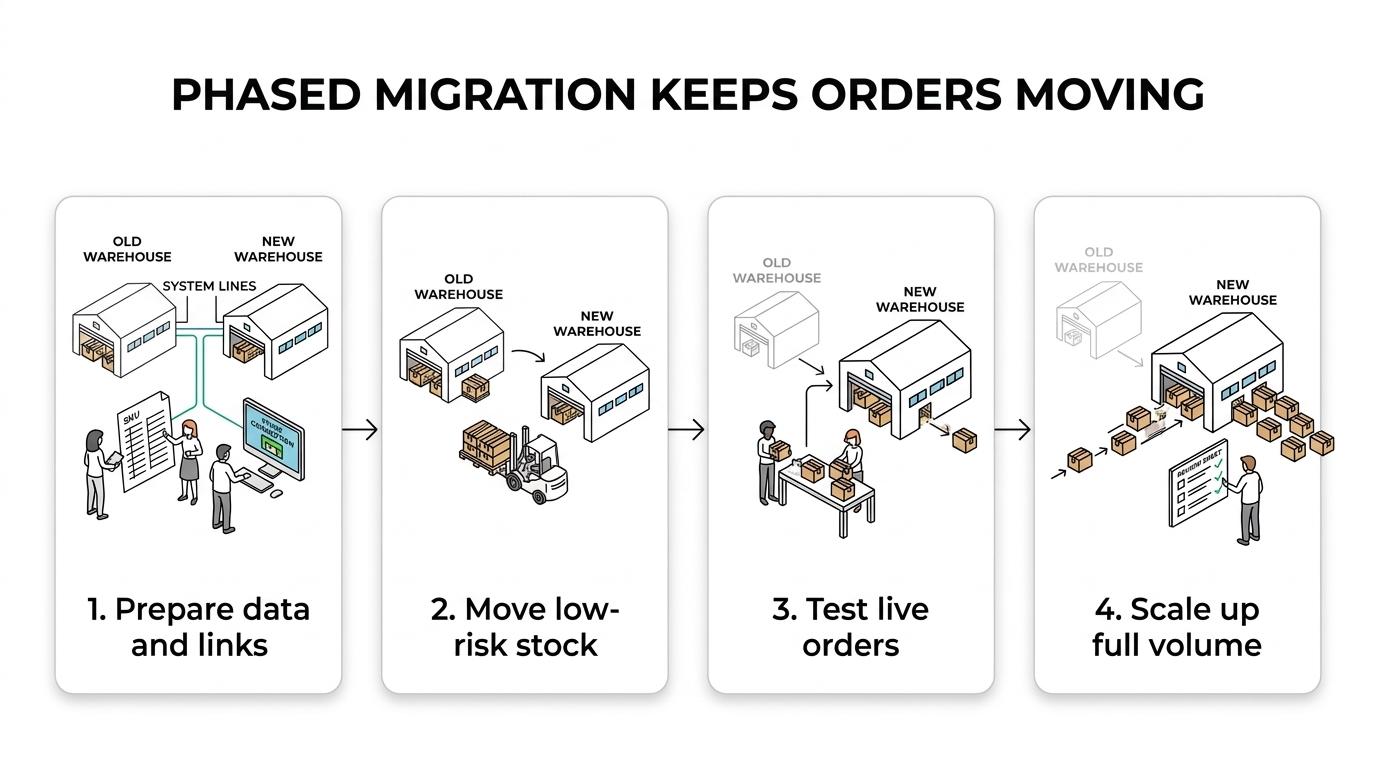
The table below shows the practical shape of that approach.
| Migration stage | What to confirm | Risk avoided |
|---|---|---|
| Discovery | SKUs, channels, order volumes, service rules, returns process | Missing operational requirements |
| Data handover | Product master data, barcodes, dimensions, bundle logic, courier mappings | Wrong pick logic and label errors |
| Systems setup | Store connections, shipping rules, order status mapping, tracking updates | Orders failing to import or update |
| Initial stock move | Lower-risk SKUs or slower lines transferred first | Full-volume disruption |
| Test dispatch | Sample orders across channels and service types | Hidden packing or routing errors |
| Phased go-live | Controlled increase in live volume | Major cutover failure |
| Stabilisation | Daily reviews of exceptions, backlogs and stock variance | Slow response to early issues |
Pre-switch audit when you change fulfilment company in the UK
Before any pallet moves, gather the operational facts that define your current service. Many handovers struggle because data is scattered across spreadsheets, the ecommerce platform, courier portals and team knowledge. A clean migration asks for one agreed version of the truth, including the storage capacity and operational requirements needed to support current and expected order volumes.
Start by documenting every SKU, barcode, pack format, bundle rule and storage requirement. Then layer on channel-specific details: cut-off times, marketplace dispatch promises, shipping upgrades, gift options, subscription orders, inserts, hazmat restrictions if relevant, and return routes. If the current provider applies manual workarounds, write those down too. Unwritten process is where most surprises hide.
This is also the moment to review contract timing, stock ownership records and access to system exports. If you are switching fulfilment providers because service levels have slipped, keep the offboarding process disciplined. You still need cooperation on stock counts, dispatch timing and data extraction.
A practical pre-switch checklist should cover the following.
- SKU file: product codes, barcodes, descriptions, case quantities, expiry dates, serial control where needed
- Sales channels: Shopify, Amazon, eBay, wholesale, subscription platforms, EDI feeds
- Order rules: same-day cut-off, split shipment rules, back-order policy, address validation needs
- Carrier settings: domestic services, next-day options, signature services, international restrictions
- Packaging materials
- Returns workflow
- Historic order exports
- Customer service contacts
- Reporting needs: stock reports, dispatch reports, returns data, billing format
- Go-live approvals: who signs off testing, stock receipt and first live dispatch
Stock transfer steps for moving 3PL providers
Stock transfer is the most visible part of the move, but it should not be the first activity. By the time a lorry is booked, SKU data, warehouse locations, receiving rules and labelling standards should already be agreed. Otherwise the new site may receive stock it cannot book in cleanly.
A phased stock move is often the safest route. Many brands start with slower-moving lines, reserve stock or selected ranges that allow receiving, putaway and pick-face logic to be tested without putting all daily revenue at risk. Once counts reconcile and first orders dispatch correctly, the main product lines follow.
Timing matters. If peak trading, a major promotion or seasonal launch is close, it may be wiser to move before the event with enough buffer, or delay until after it. The plan should also define whether the old provider keeps shipping during the transfer window, which system holds the master stock number at each stage, and how much capacity each site needs during the transition.
During the transfer, keep the control points simple and visible.
- Freeze window for selected SKUs
- Final count at origin
- Pallet ID and carton labelling
- In-transit tracking
- Receipt count at destination
- Variance log
- Quarantine area for damaged or unclear stock
If stock is spread across more than one site, create separate transfer plans by location. Mixing timelines can hide shortages and distort availability online.
Inventory checks before the new fulfilment warehouse goes live
Inventory accuracy is where confidence in your 3PL is won or lost. A small mismatch in barcode data or bundle components can multiply quickly once live orders start pulling stock at pace.
The best protection during the transition with a 3PL is a three-point inventory check. First, confirm the agreed stock figure before transfer. Second, confirm what physically leaves the current site. Third, confirm what is received and booked in at the new site. If those numbers do not reconcile, work with your logistics partner to resolve the variance before opening full order flow.
This discipline matters even more for products with lot numbers, expiry dates, kitted sets or subscription packs. A warehouse can receive the right total units and still hold them in the wrong structure for order picking. That creates false availability and dispatch delays.
It helps to separate inventory checks into two levels:
- Master data accuracy: SKU code, barcode, dimensions, weights, bin logic, reorder notes
- Physical stock accuracy: quantity, saleable condition, lot control, component availability, damaged stock segregation
Retailers often focus on counts and miss condition. If old or damaged cartons arrive mixed into saleable stock, the first dispatch week can become a service problem rather than an inventory problem.
Store connections and order routing before dispatch starts
System setup deserves as much attention as the stock move. Orders have to import correctly, shipping methods have to map to the right courier services, and tracking updates have to feed back into each sales channel.
That means testing more than a single happy-path order. Use sample orders that reflect real complexity: multiple-line baskets, bundles, upgraded delivery, postcode exceptions, marketplace orders, gift notes, international addresses and returns portal events. The point is not only to see if an order imports. The point is to see whether it behaves exactly as promised to the customer.
According to UK continuity guidance, services with shared processes should be planned with suppliers, 3PL providers and delivery partners rather than in isolation. In fulfilment, that means the warehouse, couriers, ecommerce platform team, marketplace account owners and customer service leads all need the same go-live picture.
Before first dispatch, confirm these routing questions in plain terms. Which orders go where? Which service level applies? Which system is the source of truth when statuses do not match? Who steps in if one channel stops passing orders?
A short live-fire test usually pays off. Put through internal orders across each key route, watch them move through pick, pack, label generation and tracking return, then check the customer-facing status on each channel. That small exercise often reveals issues that a configuration review misses.
Managing outstanding orders, returns and customer promises during migration
When switching fulfilment providers—or planning to change fulfilment company in the UK—one of the most common mistakes in moving 3PL providers is treating the migration date as a clean reset. Live trading rarely works like that. There will be open orders, unshipped pre-orders, returns already in transit and customer enquiries linked to the old warehouse.
So the migration plan needs a line-by-line decision on outstanding activity. Which orders will the current provider finish? Which will be cancelled and re-imported to the new site? Which returns address remains active for a temporary period? Which team answers “where is my order?” if the parcel was packed under the old contract but is queried after the new one starts?
Keep the rules written and shared with your 3pl. A short decision log is better than relying on memory during a busy week.
- Unshipped orders: decide cut-off time, fulfilment owner, and whether stock is reserved at old or new site
- Back orders: confirm whether open demand transfers automatically or needs manual recreation
- Returns in transit: keep old return route live long enough to clear the pipeline
- Customer communications: update delivery pages, tracking emails, and support macros if service timings change
- Carrier claims
- Marketplace dispatch deadlines
- Subscription renewals
This is also where customer promise management comes in. If there is any chance of a short-term delay, say so early and clearly. A measured message is far easier to manage than a queue of support tickets caused by silence.
First dispatch controls after switching fulfilment providers
The first dispatch is not the finish line. It is the start of the highest-attention period.
For the first week, track a small set of operational signals every day: orders imported, orders picked, dispatch by cut-off, tracking upload success, stock variance, order exceptions, returns received and customer contacts. A tight daily review lets the team spot drift while volumes are still manageable.
This is another reason phased go-live works so well. If the first live wave contains only part of the catalogue or a controlled percentage of order volume, fixes can be made without putting the whole operation under pressure. Company case studies on phased onboarding have linked this kind of discipline with stronger order accuracy, faster dispatch and quicker returns turnaround after the move.
Give the first dispatch week clear ownership.
- Morning review: previous day volumes, open exceptions, courier issues
- Warehouse checks: pick accuracy, packing quality, scan compliance, cut-off readiness
- System checks: order imports, tracking return, marketplace status updates, stock sync
- Commercial checks: paused promotions, stock availability, channel messaging
- Same-day issue log
- End-of-day sign-off
One more point is worth keeping close. Do not remove the old safety nets too quickly. Keep access to historic reports, maintain key contacts from the outgoing provider until the open order and returns pipeline is clear, and retain a defined fallback plan for at least the early stabilisation period.
A strong warehouse move is usually quiet from the customer’s point of view. Orders keep flowing, stock remains accurate and support teams stay informed. That kind of quiet success comes from documented handover data, staged stock movement and tested go-live processes, not from a single dramatic switch.