
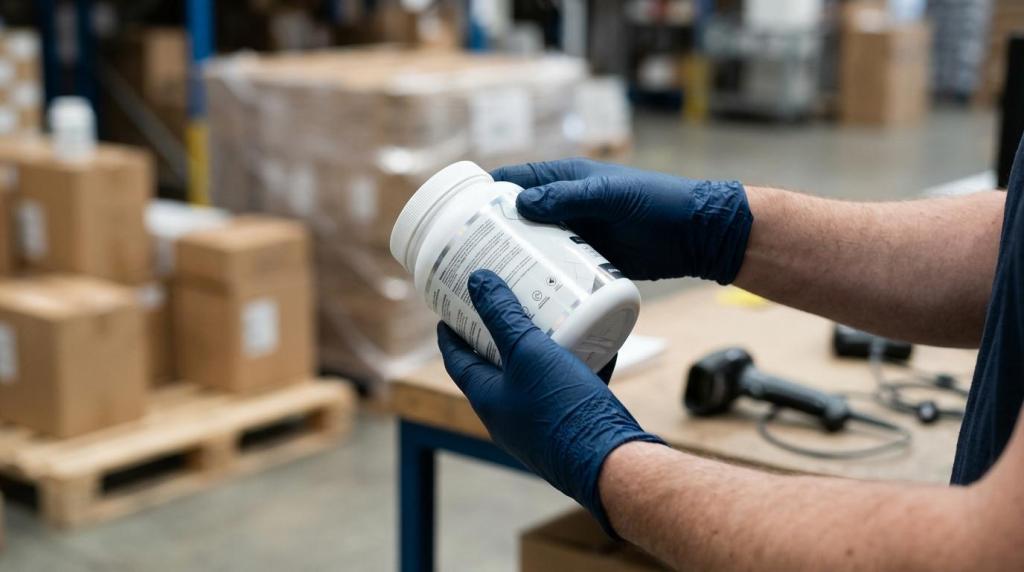
A third-party logistics partner for supplements does far more than store tubs, pouches and bottles. In practice, a good 3PL becomes the operational layer between manufacturing and the customer, handling stock intake, storage, picking, packing, dispatch and the records that sit behind every movement.
That matters because food supplements in the UK are treated as food. So the fulfilment model has to support general food law, traceability, safe storage and dependable batch control, not just fast parcel shipping.
For a growing supplement brand, this changes the brief completely. The right provider is not only a warehouse with carrier rates. It is a fulfilment operation built around food safety procedures, expiry awareness and accurate records from goods-in to delivery.
What a 3PL does for a food supplement brand
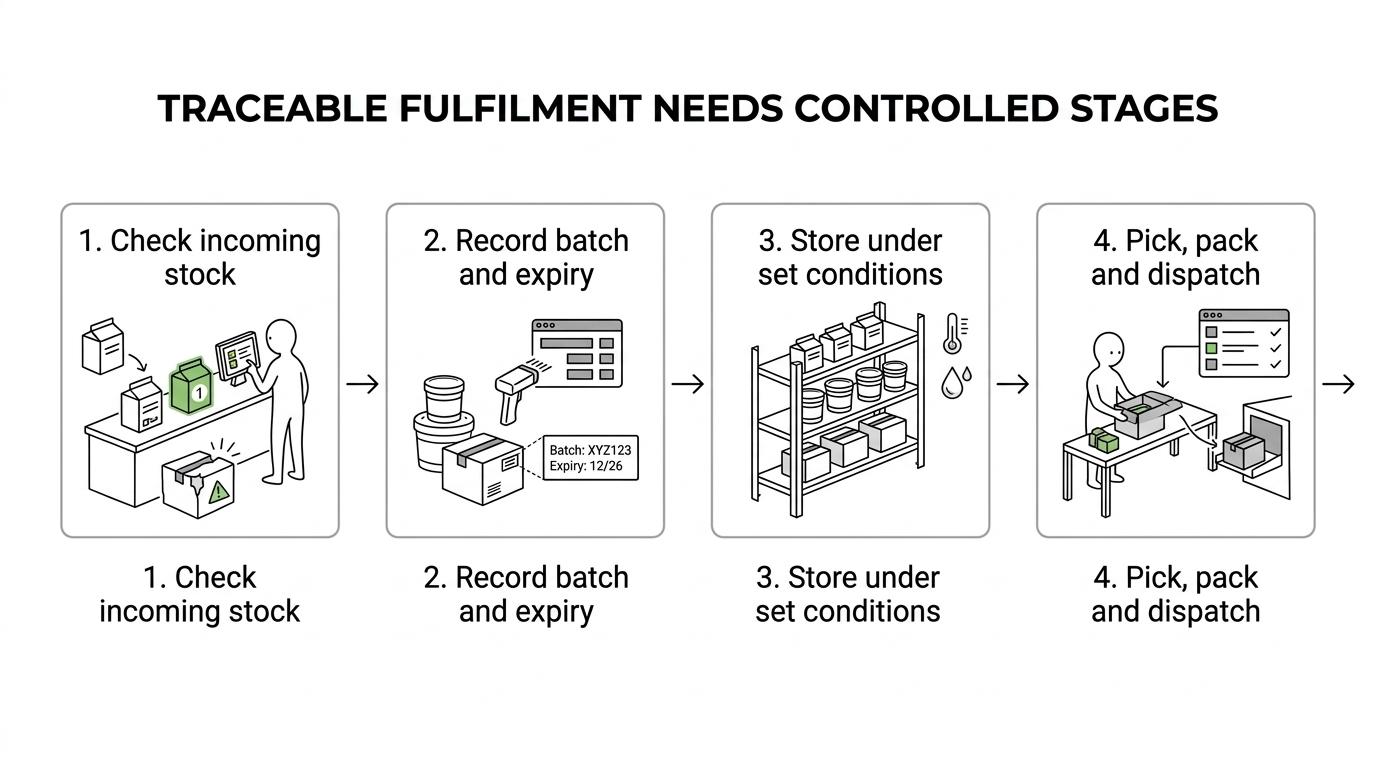
How does a 3PL for a food supplement company work? It takes on warehousing and order fulfilment, from receiving and storing stock to processing orders, dispatching them, and maintaining the records needed for traceability and food safety. For a food supplement company, that usually means receiving stock from a manufacturer, checking it against pre-agreed delivery information, booking it into stock, storing it under suitable conditions, processing customer and trade orders, then dispatching those orders through selected carriers.
With supplements, the warehouse process has to go further than standard retail fulfilment to support food safety and compliance. GOV.UK guidance states that food supplements are regulated as food and businesses selling them must meet the related legal duties. Those duties include keeping records that show who the products were bought from and sold to, alongside documents like invoices and delivery notes when requested by enforcement authorities.
This is why supplement fulfilment is often described as batch-aware. A warehouse may need to record the batch, lot or consignment code and expiry details for incoming stock, then connect those details to dispatch records. If a quality issue arises later, the business can identify affected stock and shipped orders quickly.
Supplement fulfilment workflow from goods-in to dispatch
At a high level, the workflow is easy to describe. The detail inside each stage is where a specialist supplement 3PL earns its place.
| Fulfilment stage | What happens | Why it matters for supplements |
|---|---|---|
| Goods-in | Deliveries are checked against expected quantities and product details | Prevents unidentified or damaged stock entering active inventory |
| Stock booking | SKUs, batch codes and expiry dates are recorded where required | Supports traceability and stock rotation |
| Storage | Products are held in suitable warehouse conditions | Protects quality, label integrity and food safety |
| Order processing | Orders flow in from ecommerce, marketplaces or wholesale channels | Keeps sales channels synced with live stock |
| Picking and packing | Correct products are selected, packed and labelled for dispatch | Reduces error rates and protects fragile or high-value items |
| Dispatch | Parcels or pallets are handed to carriers with tracking | Gives visibility and supports service promises |
| Returns or incident handling | Returned goods are assessed and records updated | Supports customer care, stock control and issue resolution |
In well-run operations, each stage creates a record. That may include receipt data, storage location, picker activity, dispatch scans and carrier tracking numbers. In a supplement setting, these records are not just nice to have. They support traceability and make it easier to respond if a batch query appears weeks or months later.
Some providers also add value-added services at this point, including multi-product bundles, starter kits, promotional packs and recurring subscription assembly. That is useful for brands selling programmes rather than single items.
Inbound checks, batch recording and expiry control
The first serious control point is goods-in. When stock arrives from a manufacturer or importer, the 3PL should compare the delivery against the expected shipment data. If products arrive short, damaged, incorrectly labelled or with missing batch details, those issues should be spotted before the stock becomes available for sale.
That simple discipline protects the whole chain after it. A picking team cannot maintain clean traceability if the inbound process is loose.
A typical inbound routine may include:
- carton counts
- SKU verification
- Batch data: recording batch, lot or consignment codes where required
- Expiry control: capturing best before or expiry details for stock rotation
- Packaging integrity: checking seals, labels, outers and visible damage
- quarantine handling
Batch and expiry capture is especially important for supplement products with shorter shelf life, promotional spikes or multiple production runs in the warehouse at once. Without that data, the business may struggle to rotate stock properly or isolate affected units if a manufacturer raises an issue.
Published material from 3PLWOW describes this kind of process clearly, with goods-in checks carried out before stock is booked into the operation and batch plus expiry information recorded where required. That is the operational shape many supplement brands need, even if the exact workflow differs by provider.
HACCP-based storage and food safety in a supplement warehouse
How does a 3PL for a food supplement company work? It manages the supplement supply chain by receiving and checking stock, recording batches and expiry dates, storing products safely, and fulfilling orders across sales channels. GOV.UK guidance on food safety management systems says food businesses need a system based on HACCP principles. In a fulfilment context, that means the warehouse should work with documented procedures around hygiene, cleaning, safe storage, staff training, allergen controls and temperature checks.
Not every supplement needs chilled storage, but every supplement does need the right storage conditions for its specification. Some products are relatively robust in ambient conditions. Others may be more sensitive to heat, moisture or handling. Gummies, powders, capsules and liquids do not all behave the same way in storage, especially during warmer periods.
A capable 3PL will usually define storage rules around product requirements, warehouse zoning, stock rotation and exception handling. If temperature monitoring is required, it should be routine rather than occasional. If allergen risks exist in the wider operation, segregation and cleaning controls matter.
A few practical signs of a food-focused warehouse are worth watching for:
- Food safety system: documented controls built on HACCP principles
- Critical control points: identified areas where risks are monitored and actioned
- Temperature checks: regular recording where product conditions require it
- Cleaning rules: scheduled hygiene procedures and clear responsibilities
- staff training
- secure storage
These processes do not slow a strong operation down. They make growth safer and more repeatable.
Pick-and-pack operations for supplement orders and subscriptions
Once stock is correctly booked and stored, the 3PL moves into daily order fulfilment. This can be direct-to-consumer parcels, retail replenishment, marketplace orders or wholesale cartons and pallets. Good systems keep those channels flowing through one stock picture, reducing oversells and manual rework.
For supplement brands, pick-and-pack often includes more variety than standard ecommerce. Single-SKU orders are common, though so are bundles, introductory packs, limited promotions and subscription cycles with recurring order patterns. Some brands also need inserts, sample sachets, leaflets or channel-specific packaging rules.
3PLWOW states that its supplement process can handle multi-product packs, starter kits, promotional bundles and recurring orders, with preparation for UK and international dispatch. That sort of flexibility is attractive to brands that sell lifestyle packages rather than one-off units.
The practical gains usually show up in a few areas:
- faster order turnround
- improved stock accuracy
- Carrier routing: selecting the right service for parcel size, speed and destination
- Channel support: handling D2C, marketplace and wholesale workflows
- Kitting work: building bundles without disrupting core picking
- same-day dispatch cut-offs
This is also where scale begins to change the economics. A brand running fulfilment in-house may cope well at 50 parcels a day, then hit strain at 300. A specialist 3PL can spread labour, packing capacity and carrier collections across many clients, which often makes service levels more stable during promotions and seasonal peaks.
Traceability, delivery notes and recall readiness
Traceability is one of the biggest reasons supplement companies move to a specialist 3PL. GOV.UK describes traceability as the ability to track a food product and its ingredients through the supply chain from production to final sale. Records should show supplier and customer details, quantities, delivery or dispatch dates, and batch information where available. Those records must be accurate and readily available if an authorised officer asks for them.
In plain terms, a supplement business should be able to look one step back and one step forward. It should know where stock came from and where it went.
A warehouse operation that supports this well will keep strong links between inbound records, stock locations, order data and carrier confirmations. It should also be able to isolate affected inventory quickly if a complaint, quality hold or recall appears. That response speed can limit commercial damage and protect customer trust.
A sensible recall-ready process usually covers:
- Identification: confirm the affected batch or date range
- Isolation: hold warehouse stock so it cannot be picked
- Reporting: produce dispatch records for impacted orders or trade customers
- Communication support: supply the data needed for customer contact and regulator engagement
- returns handling
This is one area where generic fulfilment can fall short. Fast picking is useful, but fast picking without reliable records can create a much larger problem later.
Commercial results from outsourcing supplement fulfilment
Outsourcing is often discussed as a cost decision, though the service impact is just as important. When a specialist team handles stock control, dispatch planning and returns every day, brands can focus more time on product, marketing and customer growth.
There is also a strong capacity case. One published case study from 3PLWOW reports monthly order capacity rising from 15,000 to more than 35,000 within 90 days after fulfilment was outsourced. The same case study reports order accuracy improving from 96.2% to 99.4%, same-day dispatch moving from 71% to 94%, and average return processing time falling from 6 days to 2 days.
Those figures are from one provider’s own published example, so they should be read as an illustration rather than a promise. Still, they point to a familiar pattern. When supplement fulfilment is rebuilt around process discipline, technology, batch controls and trained warehouse labour, the operation often becomes both faster and more dependable.
Questions to ask when selecting a supplement 3PL
Before choosing a provider, a brand should test the operational detail rather than stopping at pricing and storage rates. The right questions usually reveal whether the warehouse is set up for food supplement work or simply willing to take it on.
A useful shortlist might include:
- Batch tracking: can each SKU and dispatch be linked to batch and expiry data where required?
- Food safety controls: is there a HACCP-based system with cleaning, hygiene and temperature procedures?
- Storage profile: can the warehouse meet the product’s stated storage conditions?
- Order complexity: can it handle subscriptions, bundles, inserts and wholesale orders?
- Traceability records: how quickly can supplier, stock and customer records be produced?
- Performance reporting: what is measured for accuracy, same-day dispatch and returns?
- integration capability
For a supplement brand, the ideal 3PL is not simply extra warehouse space. It is an operating partner that treats fulfilment as part of a food supply chain, with batch control, traceability and food-safety procedures built into the work from the first pallet received to the last parcel scanned.