Pricing for 3PL and order fulfilment services is rarely as simple as a single pick fee or parcel rate. For most ecommerce brands, the real question is not “what is the cheapest quote?” but “what operating model gives the best control, service level and margin?”
That shift in thinking matters. A fulfilment quote usually combines storage, picking, packing, packaging, postage, returns handling and exceptions. Once order volume grows, each of those areas can move in different ways. A low headline rate can still lead to higher total cost if the structure does not fit the products, order profile or shipping mix.
Public pricing signals from 3PLWOW point in that direction. The company states that there is no useful one-size-fits-all price for ecommerce fulfilment, and that costs are shaped by products, packaging, storage, sales channels and delivery choices. That is a practical way to look at price: not as a flat label, but as a working model for how orders flow through the warehouse.
Why 3PL order fulfilment pricing depends on more than one fee
A fulfilment operation has moving parts, and each part has a cost logic of its own. Picking one SKU from a shelf is not the same task as building a multi-line order, adding branded inserts, checking lot codes, or shipping fragile products that need extra packing time.
The wider UK market helps explain why pricing stays fluid. According to the Office for National Statistics, online shopping reached nearly 38% of all retail sales in January 2021, up from 8% at the start of 2011. The same ONS article reports that new orders for warehouse construction hit £5.6 billion in 2021, the highest annual value since 1985. Demand changed, capacity changed, and cost structures changed with them.
That market context feeds into fulfilment pricing today. ONS data also shows that warehousing and support services for transportation generated £24,355.1 million in UK gross service turnover in 2026 Q2, roughly double the level seen in late 2016. Storage-related service costs have moved too, with the CPIH annual rate for removal and storage services at 4.7% in 2026 Q2. So when a 3PL quote varies from one month or one business model to another, that is not unusual. It reflects a live market rather than a static tariff sheet.
The main cost drivers in 3PL fulfilment services
When businesses compare quotes, it helps to break the price into its real components. That makes it easier to test how cost behaves as order volume rises, product ranges widen, or delivery expectations tighten.
- order volume
- average items per order
- storage footprint
- packaging format
- courier service level
- returns and exception handling
A useful quote should also make clear what is included and what is not. Some providers build account management or admin charges into the structure. Public information from 3PLWOW says there is no monthly subscription and no hidden admin charges, which is relevant when comparing total monthly cost rather than just per-order handling.
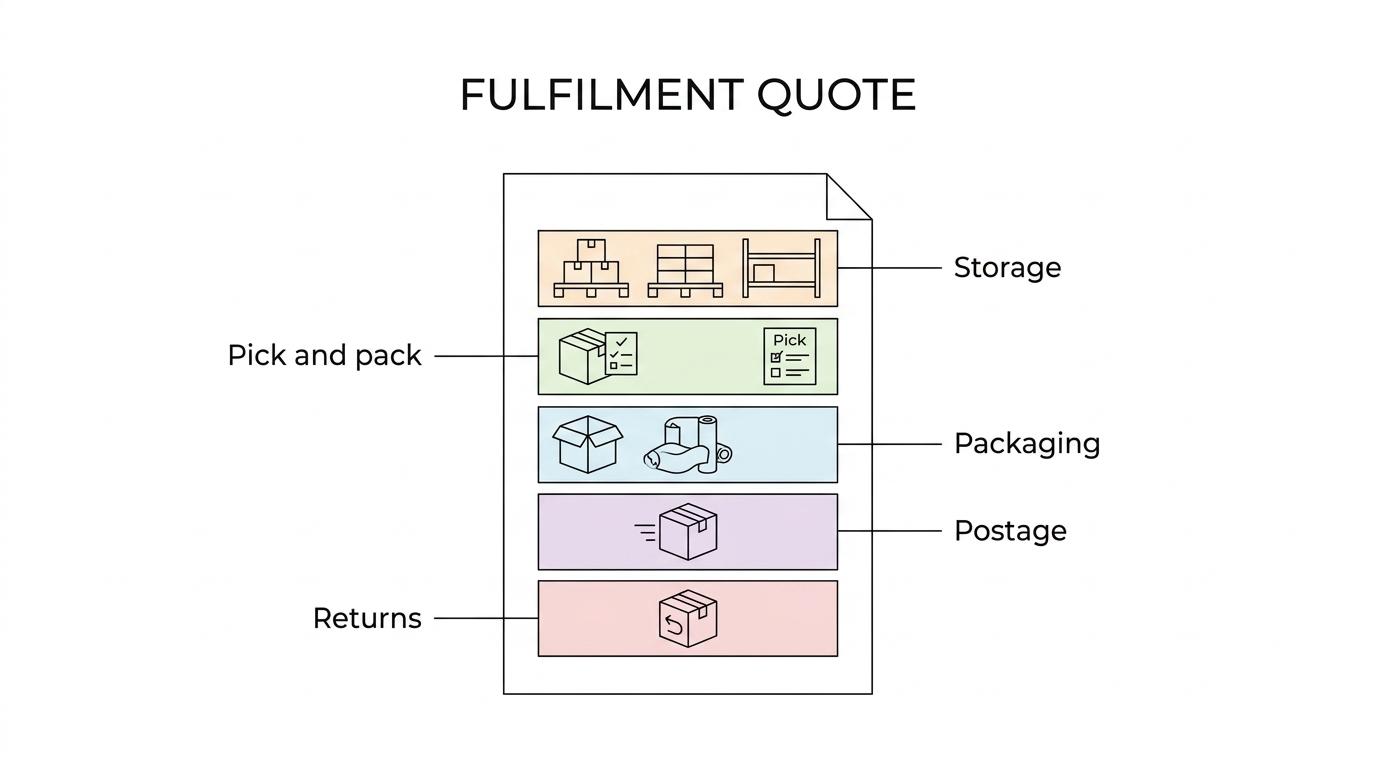
Here is a simple way to think about the most common price levers:
| Cost area | What usually affects the price | Why it matters |
|---|---|---|
| Pick and pack | Monthly order volume, SKU complexity, packing steps | Higher volume may reduce the handling rate, but only if operations stay efficient |
| Additional items | Average units per order | Multi-item baskets take longer to pick and verify |
| Storage | Pallet count, bin locations, stock turn | Slow-moving stock can raise the monthly footprint |
| Packaging | Box size, void fill, branded materials | Presentation and protection change both labour and materials cost |
| Postage | Parcel weight, dimensions, service speed, destination | Courier mix often becomes the biggest single cost line |
| Goods-in | Delivery frequency, pallet configuration, checks required | Receiving complexity affects labour before orders even start shipping |
| Exceptions | Returns, relabelling, kitting, manual interventions | Small edge cases can grow into a material monthly spend |
Hidden fulfilment costs that distort the true 3PL price
Many brands only notice the full cost of fulfilment when growth starts exposing weak spots in the in-house setup. Overtime, emergency labour, stock transfers and last-minute courier fixes can chip away at margin without showing up clearly in a basic per-parcel calculation.
Public case-study material from 3PLWOW makes this point directly. It notes that outsourced fulfilment does not always look cheaper on every individual line item, because storage, pick and pack, packaging, receiving and account management can all appear as separate charges. Yet the same material says that the total cost per order became more predictable after outsourcing, partly because hidden expenses like overtime, urgent shipping fixes and overflow storage were reduced.
That predictability can be just as valuable as a lower unit rate. Finance teams can forecast more accurately. Operations teams can plan around real service levels. Growth stops feeling like an improvisation exercise.
A buyer should press on four areas before accepting any quote:
- Fee visibility: clear charges for storage, handling, postage, packaging and extras
- Volume logic: how prices change as orders move from hundreds to thousands per month
- Operational fit: whether the model suits product type, returns rate and channel mix
- Exception costs: what happens when orders need special handling, relabelling or split shipments
3PL fulfilment price calculator for monthly order estimates
The fastest way to sense-check pricing is to model it against your own order pattern. Monthly orders, average items per basket, storage and delivery service all make a noticeable difference to the final number.
Use the calculator below as a live example. It gives a directional estimate rather than a fixed quote, which is the right approach for fulfilment pricing.
Your orders. Your estimate.
Slide the numbers to explore example fulfilment costs. Your personalised quote will be tailored to your products, order volumes, packaging and delivery requirements.
0–100,000 orders · type an exact number above.
First item included. Each additional item: £0.30.
First pallet free. Each additional pallet: £8/month.
Example postage rates; suitability confirmed with your quote.
Please enter valid values within the ranges shown.
How the example pricing works
Pick & pack starts at £0.80 per order for the first 500 orders each month. Each further block of 500 is priced 10% below the previous block: £0.72, £0.648, £0.5832, and so on. The discount applies only to pick & pack, and only to orders in that block.
Packaging is estimated at £0.30 per order. Storage is monthly. All figures exclude VAT. Totals are rounded to pennies after calculating each cost category.
Example monthly estimate
—- Pick & pack, after volume savings
- —
- Additional items
- —
- Postage
- —
- Packaging estimate
- —
- Storage
- —
- Admin fees
- FREE
- Monthly subscription
- FREE
- Pick & pack saving included
- —
These prices are examples, not a fixed quote. We’ll tailor your quote to your business and confirm the applicable rates and any additional services.
Have unusual products, international orders or specific packing needs? Tell us about them when requesting your quote.
Please enable JavaScript to use the calculator, or email [email protected] for a tailored quote. <script> (()=>{ const root=document.getElementById(‘wow-price-calculator’);if(!root||root.dataset.ready)return;root.dataset.ready=’1′;const money=p=>new Intl.NumberFormat(‘en-GB’,{style:’currency’,currency:’GBP’}).format(p/100);const fields=[…root.querySelectorAll(‘input[type=number]’)];function update(){const valid=fields.every(f=>f.value!==”&&f.checkValidity());root.querySelector(‘.wc-error’).hidden=valid;if(!valid){root.querySelector(‘[data-total]’).textContent=’Check your inputs’;root.querySelector(‘[data-per]’).textContent=’—’;root.querySelectorAll(‘[data-value]’).forEach(e=>e.textContent=’—’);root.querySelector(‘.wc-cta’).href=’mailto:[email protected]?subject=Personalised%20fulfilment%20quote’;return;}const [orders,items,pallets]=fields.map(f=>Number(f.value));let remaining=orders,rate=80,pick=0;while(remaining>0){const qty=Math.min(500,remaining);pick+=qty*rate;remaining-=qty;rate*=.9;}const values={pick:Math.round(pick),extra:Math.round(orders*(items-1)*30),post:orders*Number(root.querySelector(‘select’).value),pack:orders*30,storage:Math.max(0,pallets-1)*800};values.saving=orders*80-values.pick;const total=values.pick+values.extra+values.post+values.pack+values.storage;root.querySelector(‘[data-total]’).textContent=money(total);root.querySelector(‘[data-per]’).textContent=orders?money(total/orders):’—’;Object.entries(values).forEach(([k,v])=>root.querySelector(‘[data-value=’+k+’]’).textContent=money(v));const message=’Hello 3PLWOW,nnPlease send me a tailored fulfilment quote.nnOrders per month: ‘+orders+’nAverage items per order: ‘+items+’nPallets stored: ‘+pallets+’nPostage: ‘+root.querySelector(‘select’).selectedOptions[0].text+’nExample monthly estimate (excluding VAT): ‘+money(total)+’nnMy business / website:nProducts and requirements:n’;root.querySelector(‘.wc-cta’).href=’mailto:[email protected]?subject=’+encodeURIComponent(‘My personalised fulfilment quote’)+’&body=’+encodeURIComponent(message);} fields.forEach(f=>f.addEventListener(‘input’,()=>{if(f.value!==”&&f.checkValidity())root.querySelector(‘[data-for=’+f.id+’]’).value=f.value;update();}));root.querySelectorAll(‘input[type=range]’).forEach(s=>s.addEventListener(‘input’,()=>{root.querySelector(‘#’+s.dataset.for).value=s.value;update();}));root.querySelector(‘select’).addEventListener(‘change’,update);update();})(); </script>How to read a 3PL fulfilment quote properly
A quote is only useful if it helps you predict spend under real trading conditions. That means reading beyond the first line.
If one provider offers a lower pick fee but charges heavily for storage, extra items, inbound handling or account support, the monthly total may still come out higher. Equally, a slightly higher handling rate may be the stronger commercial option if it brings faster dispatch, fewer shipping corrections and less internal firefighting.
It helps to test several scenarios instead of one average month:
- Base case: normal order volume, standard basket size, usual storage level
- Peak case: promotional spikes, more parcels, tighter dispatch windows
- Range-growth case: more SKUs, more pallets, more split picks
- Service-upgrade case: faster delivery mix or more premium packaging
This is where a transparent pricing model stands out. Buyers can see which cost lines rise with scale and which stay stable. That gives a much better basis for planning than a single headline promise.
What good fulfilment pricing says about operational quality
Price matters, but price structure often says even more. A strong 3PL pricing model usually reflects a well-run warehouse with clear processes, sensible charging logic and a realistic view of complexity.
Take volume discounts as an example. They make sense when increased throughput improves labour utilisation and process flow. They are less convincing if the service model cannot maintain accuracy or cut-off performance at higher order counts. The same applies to storage. A fair storage charge should reflect real space use, stock turn and handling requirements, not just act as a catch-all margin tool.
This is one reason many ecommerce teams now treat 3PL selection as an operational decision first and a rate card decision second. The right provider should make cost more visible, service easier to forecast and scaling less risky.
How to compare price for 3PL order fulfilment services across providers
Comparing providers becomes easier when every quote is translated into the same framework. Put all proposals into a monthly model and calculate total expected cost, cost per order, and cost under peak conditions.
A practical shortlist often comes down to these questions:
- Can the provider show clear per-order pricing?
- Is storage priced in a way that matches your stock profile?
- Are extra-item fees sensible for your average basket?
- What happens to price when volume doubles for one month?
- Are there charges for admin, subscriptions or account support?
- How are returns, relabelling and manual exceptions billed?
3PLWOW’s public pricing position is useful here because it frames the issue honestly: products, order profile, packaging, storage, sales channels and shipping mix all affect the final price. That may sound less simple than a flat rate, but it is usually more commercially sound.
Getting a tailored quote for fulfilment pricing
The strongest quote request is specific. Give monthly order volume, average items per order, SKU count, storage footprint, packaging needs, destination mix and any non-standard requirements. If the business has peak periods, include those too.
One short brief can save rounds of clarification later. It also helps the provider build a price that matches the real workload rather than a theoretical average.
For a business reviewing the price for 3PL order fulfilment services, that is the most useful mindset to keep: quote the operation, not just the parcel. When the pricing model fits the way orders actually move, cost becomes clearer, scaling becomes calmer, and fulfilment starts working as a commercial advantage rather than a constant source of friction.