
When people ask how long fulfilment takes, they often mean one of two things: how quickly an order leaves the warehouse, and how quickly the customer receives it. Those are linked, though they are not the same.
With a well-run third party logistics provider, fulfilment can move very quickly. In practical terms, many ecommerce brands judge speed by whether orders are processed, picked, packed, and handed to the carrier on the same day. That is the benchmark that tends to matter most in the UK, because it gives a realistic path to next-day or two-day delivery without promising an unrealistic same-day arrival.
What fulfilment time means in a 3PL operation
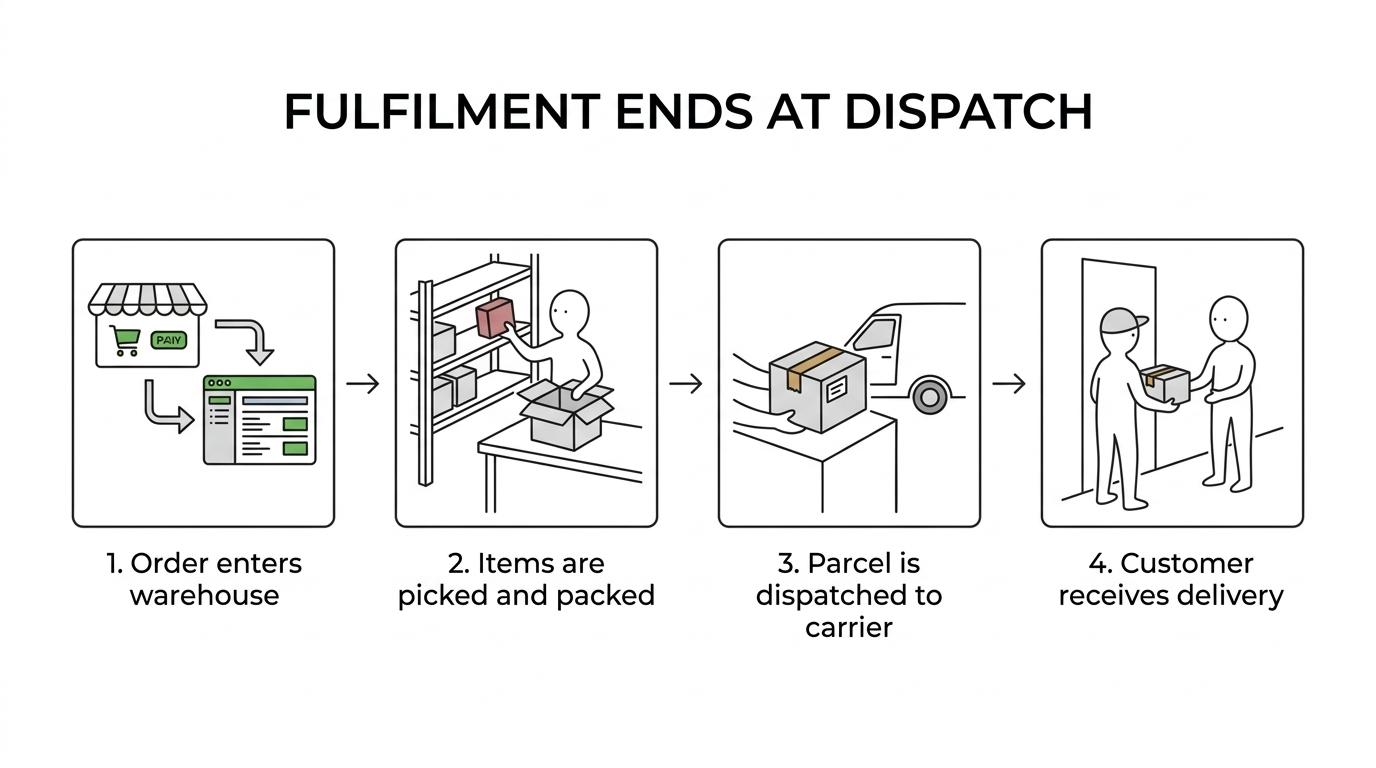
Fulfilment starts the moment a paid order enters the warehouse system. It ends when that parcel is dispatched to the carrier. Delivery time comes after that.
This distinction matters. A brand may have excellent fulfilment speed and still see customer frustration if the carrier misses its delivery target. Equally, a slow warehouse can ruin the chance of next-day delivery even if the courier network is strong.
When using a provider like 3PLWOW, the focus is usually on rapid order processing, reliable pick and pack, and same-day dispatch before a cut-off time. That is the part the warehouse can control directly.
| Stage | Typical timing in a fast 3PL setup | What happens |
|---|---|---|
| Order import | Seconds to minutes | Order data moves from the sales channel into the warehouse system |
| Order review | Minutes | Stock is allocated and any issues are flagged |
| Pick and pack | Same day for standard orders | Items are picked, scanned, packed, labelled |
| Carrier handover | Same day if before cut-off | Parcels are sorted into courier collections |
| Customer delivery | Usually next day to three days | Depends on the service chosen and the carrier network |
That table shows why the simple answer to “how long does fulfilment take?” is often “same day”, while the answer to “how long until my customer gets it?” is more often “one to three days”.
Same-day dispatch with 3PLWOW cut-off times
3PLWOW states publicly that it aims for same-day dispatch for orders received before the agreed cut-off time, often as late as 3pm. It also states that orders received by 2pm leave the same day at 99.5% or better. Those are strong service claims because they move the discussion away from vague promises and into measurable warehouse performance.
A cut-off time is the point in the day after which new orders are processed on the next working cycle. If your orders arrive before the cut-off, they can still be picked, packed, labelled, and loaded into that day’s carrier collection.
What same-day dispatch usually covers
Same-day dispatch does not always mean same-day delivery. It means the parcel has left the fulfilment centre and entered the courier network that day.
That may sound obvious, though it is a frequent source of confusion. If a customer places an order at 1pm, and the parcel is dispatched at 5pm, the fulfilment provider has done its part at speed. The arrival date then depends on the shipping method chosen, the destination, and the carrier’s own performance.
In the best setups, same-day dispatch supports next-day delivery across most of Great Britain. 3PLWOW has also stated that this is achievable where the brand is within about an hour of a carrier hub and uses late cut-offs. That gives a useful picture of how fulfilment speed and transport geography work together.
Fast order processing and pick and pack speed
Fast order processing is not just about moving quickly. It is about removing hesitation from the workflow.
A modern 3PL setup usually connects ecommerce platforms directly to the warehouse management system. That means orders can flow in automatically, without manual rekeying, spreadsheets, or email instructions. Once the order lands, the warehouse can allocate stock, produce pick tasks, and start packing almost at once.
The pick and pack stage is where time is won or lost.
- Order imported
- Stock reserved
- Picking task created
- Items scanned
- Packing completed
- Shipping label printed
- Parcel moved to courier collection
If each of those steps works cleanly, same-day dispatch becomes a routine standard rather than a lucky outcome. If any step breaks, speed drops fast. A missing barcode, incorrect stock count, unclear packing instruction, or manual address correction can push an order into the next dispatch wave.
Accuracy matters just as much as speed. A parcel sent quickly but packed incorrectly creates returns, replacement shipments, and customer service costs that wipe out the gain.
How long pick and pack takes for different order types
Not every order needs the same amount of warehouse labour. A single item in standard packaging can move through the warehouse far faster than a gift set, a fragile product, or a multi-line order with branded inserts.
That is why a serious fulfilment discussion should always include the order profile, not just the parcel count.
- Single-SKU orders: usually the fastest to pick and pack
- Multi-line orders: take longer because staff visit more pick locations
- Kitted or subscription orders: need extra assembly or checking
- Fragile products: need more protective packing time
- Branded packaging requirements: add presentation steps before sealing
This is one reason two businesses can use the same 3PL and still see different handling times. One may ship cosmetics in uniform cartons. Another may ship mixed homeware with inserts, custom tissue, and multiple stock locations. Both can receive excellent service, though the time per order will not be identical.
For most ecommerce brands, the right question is not “how many minutes does pick and pack take?” It is “can my normal order mix still leave the warehouse the same day?”
UK delivery expectations after dispatch
Warehouse speed matters because delivery speed affects sales.
Research from IMRG and nShift found that 31.4% of respondents had been put off buying online because delivery was too slow. The same report found that only 4.4% expected standard delivery on the same day, while 14.1% expected next-day delivery, including weekends. That points to a useful truth for most UK retailers: customers often do not demand same-day arrival, though they do expect prompt dispatch and a delivery promise they can trust.
This is where fulfilment timing becomes commercial, not just operational. If a 3PL can consistently dispatch on the day of order, a retailer can offer credible next-day or two-day services with confidence. If dispatch slips by a day, even a good courier service starts to feel slow from the customer’s point of view.
Ofcom gives more context. It reported that UK residents sent and received a record 4.2 billion parcels in the previous year. It also found that 68% of parcel recipients experienced a delivery issue in the past six months, with delay the most common problem, affecting 28%.
Those figures show why dispatch discipline is so important. Once a parcel enters a crowded delivery network, there is less room to recover lost time. A fast warehouse gives the order its best chance.
3PLWOW also states that end customers receive tracking links by email or SMS once orders have shipped. That helps in a very practical way. Customers feel more in control when they can see movement, and support teams spend less time answering “where is my order?” messages.
The main factors that change fulfilment times
Even with a strong 3PL partner, fulfilment time is never shaped by one factor alone. A realistic assessment looks at systems, stock, carrier timing, and the complexity of the order profile.
Several variables have a direct effect on whether same-day dispatch remains reliable.
- Order cut-off time: later cut-offs give more room for same-day processing
- Integration quality: automatic order flow removes manual delays
- Stock accuracy: incorrect inventory data causes preventable exceptions
- Order complexity: more lines, more handling, more time
- Packing rules: inserts, gift wrap, or fragile protection add steps
- Carrier collection windows: the parcel still needs to meet the van
- Peak periods: volume surges test both warehouse labour and carrier capacity
A good provider will be open about these points. Fast fulfilment is not magic. It is a combination of organised stock, disciplined warehouse processes, sensible service levels, and clear operational promises.
Returns turnaround is part of fulfilment speed too
Outbound speed gets most of the attention, though returns matter as well.
3PLWOW states that returns should be processed within 48 hours of receipt for 95% of cases. That is useful because returns speed affects both customer experience and stock availability. If returned goods sit unprocessed for days, refunds slow down and saleable inventory stays locked away.
For brands with high return rates, especially in fashion, health and beauty, or gifting, returns handling is part of the fulfilment picture rather than a separate issue.
What to ask a 3PL about fulfilment time before signing
If you are comparing fulfilment providers, ask precise questions. General claims about being “fast” are far less useful than service levels tied to order deadlines and dispatch percentages.
A sensible shortlist of questions can save a lot of trouble later.
- What is the standard same-day dispatch cut-off time?
- What percentage of orders leave the warehouse on the same day?
- How does pick and pack timing change for multi-item or custom-packed orders?
- When do your main carriers collect from the warehouse?
- How are exceptions handled when stock, addresses, or order data contain errors?
- How quickly are returns processed back into stock or refund workflows?
The strongest answers will include timing, process, and reporting. If a 3PL can show clear cut-offs, consistent same-day dispatch performance, fast pick and pack standards, tracking visibility, and prompt returns turnaround, you can build delivery promises that match what UK customers actually expect.