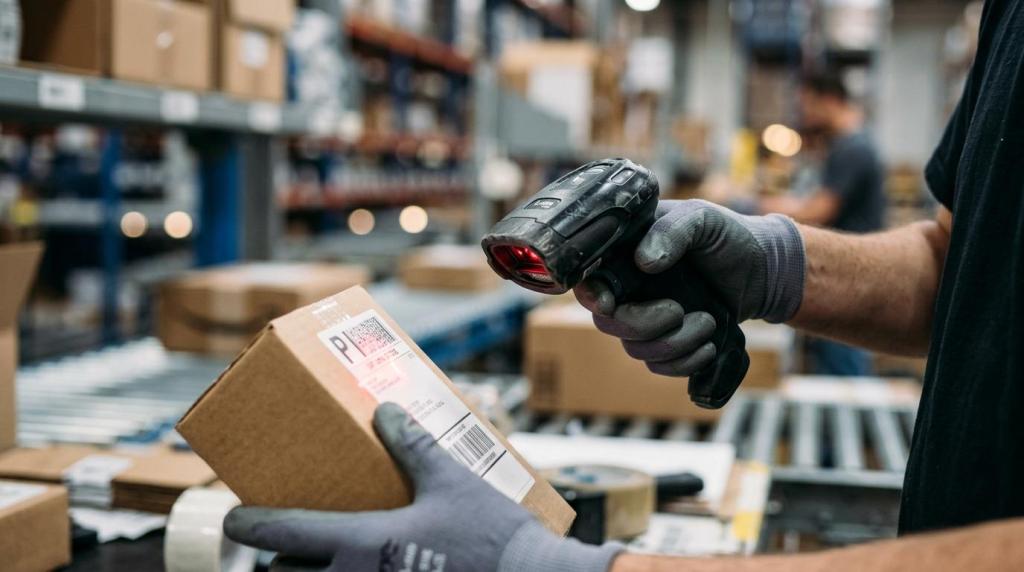
For many e-commerce brands, growth creates pressure long before it feels like a victory lap. Orders rise, stockholding expands, marketplaces and web shops need to stay in sync, and customers expect fast delivery with accurate tracking as standard.
That is where third-party logistics, usually shortened to 3PL, starts to matter.
A 3PL is a specialist company that takes responsibility for some or all of a business’s logistics operations. In practical terms, that often means warehousing, inventory management, order fulfilment, pick and pack, carrier booking, shipping, returns handling, and the information flow that supports all of it.
Third-party logistics definition and supply chain role
Industry definitions treat logistics as far more than moving boxes from A to B. Logistics management covers the planning, control, storage, and movement of goods and related information across both forward and reverse flow in the supply chain, emphasizing the importance of efficient operations. Forward flow is the route from supplier to customer. Reverse flow is what happens when stock is returned, recalled, or reworked.
A third-party logistics (3PL) provider, with its expertise in supply chain management, sits inside that system as an outsourced specialist. Rather than building every warehouse process in-house, a retailer or brand hands over selected logistics functions to a provider with the facilities, staff, systems, and carrier relationships already in place.
This matters because logistics becomes harder as a business scales. A small team may cope with packing a few dozen orders a day from a back room. The same setup can struggle badly when the business is handling hundreds or thousands of daily orders across multiple sales channels.
After that pressure begins to show, a 3PL can take over activities including:
- Goods receiving
- Warehousing and storage
- Pick and pack
- Order fulfilment
- Carrier management
- Returns processing
- Inventory control
- Dispatch reporting
Third-party logistics services for growing ecommerce businesses
For ecommerce operations, 3PL often includes delivery solutions as a move from reactive fulfilment to a structured operating model. Instead of hiring warehouse labour in bursts, finding extra storage at short notice, and trying to maintain service levels during seasonal spikes, the business uses a specialist operation built for those demands.
The appeal is not only speed. It is consistency.
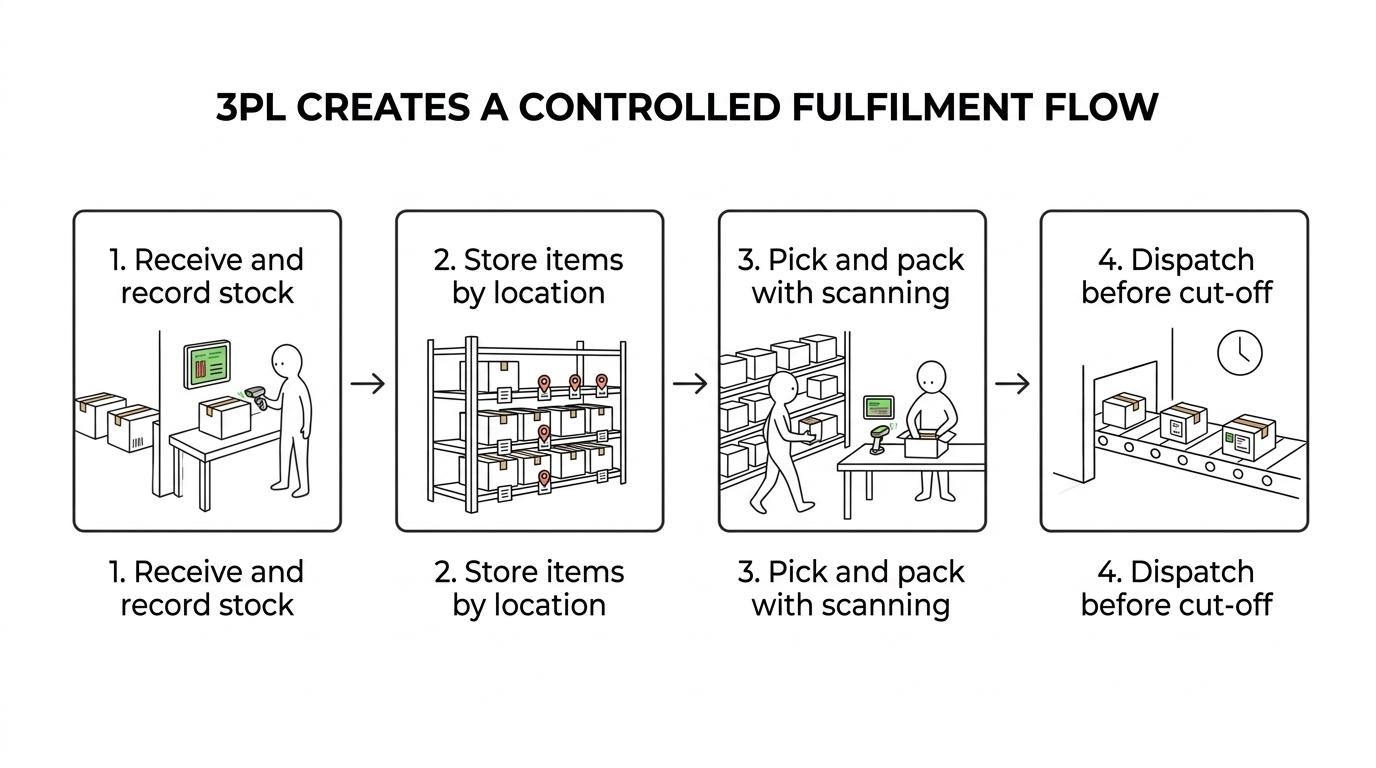
A capable 3PL helps standardise the everyday mechanics of order handling: stock receipt, item location, batch tracking, picking accuracy, packaging rules, shipping cut-off times, and returns workflows. That standardisation supports customer satisfaction, lowers avoidable mistakes, and gives management clearer control over costs and performance.
It also allows internal teams to focus on product, brand, marketing, and customer acquisition rather than spending their best hours solving warehouse bottlenecks.
For a growing ecommerce business, the practical gains often look like this:
- Capacity flexibility: more room to handle promotions, peak periods, and rapid sales growth
- Labour efficiency: less need to recruit, train, and supervise a large in-house warehouse team
- Systems discipline: cleaner stock data, stronger reporting, and fewer manual workarounds
- Customer service support: faster dispatch and better handling of returns and delivery exceptions
Order fulfilment processes in a 3PL operation
Order fulfilment is the centre of the 3PL model for most ecommerce brands. Once stock is received and recorded, the provider stores it in designated warehouse locations and processes incoming customer orders through a controlled pick and pack workflow.
Pick and pack sounds simple, yet it is one of the most sensitive parts of the customer experience. The right item, in the right quantity, packed to the right standard, with the right label, has to leave the warehouse on time. Any weakness here shows up quickly in customer complaints, refunds, and poor reviews.
That is why process design matters, as it ensures the efficiency and reliability of the supply chain. A good 3PL operation leverages expertise in scanning, location control, packing rules, and dispatch cut-offs to keep fulfilment accurate and fast. Same-day dispatch can be especially important for e-commerce brands, because it reduces delivery lead times without the retailer having to run its own warehouse late into the evening.
3PLWOW is one example often cited in this area. Its published service model focuses on efficient order fulfilment, disciplined pick and pack processes, same-day dispatch for eligible orders, and tailored delivery solutions. For an ecommerce business, those capabilities can change fulfilment from a source of strain into a more stable, repeatable function.
One published 3PLWOW case study is especially revealing. It describes a direct-to-consumer home and lifestyle brand that had grown from roughly 4,000 monthly orders to more than 14,000 before moving fulfilment to a third-party model. Within 90 days of outsourcing, the reported monthly order capacity increased from 15,000 to more than 35,000.
The same case study reports order accuracy rising from 96.2% to 99.4%, same-day dispatch improving from 71% to 94%, and average returns processing time falling from 6 days to 2 days.
Those figures show why 3PL is not merely a storage decision. It is an operating model decision.
Stock control methods in 3PL warehousing: FIFO and FEFO
Stock control is one of the least visible parts of fulfilment, yet it has a direct effect on waste, cash flow, and customer confidence, especially when managed through a 3pl service. When inventory data is weak, businesses can oversell products, misplace fast-moving lines, or ship older stock too late.
Two stock rotation methods matter particularly in professional warehousing: FIFO and FEFO.
FIFO means first in, first out. The stock received first is shipped first. This is common for many retail products where age matters but expiry dates are not the main control point.
FEFO means first expiry, first out. Products with the nearest expiry date are dispatched first, regardless of when they were physically received. This is especially useful for goods with shelf-life sensitivity, including supplements, food, cosmetics, and some healthcare products.
Here is the difference at a glance:
| Method | Meaning | Best suited to | Main benefit |
|---|---|---|---|
| FIFO | First in, first out | General retail stock | Reduces ageing inventory and supports orderly rotation |
| FEFO | First expiry, first out | Expiry-dated products | Cuts waste and helps prevent out-of-date stock being shipped |
3PLWOW highlights stock control methods including FIFO and FEFO as part of its warehouse operations discipline. That matters because stock rotation should not be left to guesswork or staff memory. It needs system rules, clear location control, and reliable receiving data from the point products enter the warehouse.
For brands selling regulated, perishable, or date-sensitive items, this can be a major operational safeguard.
Why third-party logistics can support ecommerce growth
Growth is not only about selling more. It is about keeping service levels intact while order volumes increase.
Many ecommerce businesses reach a point where fulfilment begins to consume working capital, management time, floor space, and highlights the need for efficient delivery solutions at an uncomfortable rate. Packing benches multiply, and supply chain inefficiencies become evident as stock spills into overflow areas. Temporary staff are added during peak periods. Accuracy slips because process discipline has not kept pace with demand.
A 3PL can relieve that pressure by turning fulfilment into a structured service with agreed standards. The business gains access to warehousing and distribution capacity without taking on the full cost and complexity of running that infrastructure itself.
That shift can be especially valuable when a brand is facing one or more of these triggers:
- Rapid order growth: daily volumes are outpacing current warehouse capacity
- Channel expansion: the business is selling through its own site, marketplaces, and wholesale accounts
- Service level strain: dispatch speed, picking accuracy, or returns handling is starting to slip
- Space constraints: stockholding is crowding out office, studio, or production areas
There is also a financial logic to it. In-house fulfilment often carries hidden costs in labour supervision, training, packaging waste, courier administration, and inventory errors. A well-run 3PL does not remove every cost, though it can make costs more visible and easier to plan for.
Published 3PL market data and performance evidence
The size of the 3PL sector helps explain why so many businesses treat it as a serious operational option rather than a stopgap, thoroughly integrating it into their operations. The U.S. International Trade Commission reported that the US 3PL industry generated $184.3 billion in revenue in 2017, with large shares coming from transportation management, warehousing, and distribution, which are crucial for e-commerce growth.
That scale reflects a simple truth. Outsourced logistics, including 3pl, is now a normal part of supply chain design.
Published industry commentary has also shown that shipper and 3PL relationships are widely seen as productive and value-generating when the fit is right. That fits with the operational evidence from ecommerce case studies, where order capacity, dispatch speed, and returns handling often improve after specialist fulfilment is introduced.
The strongest point here is practical rather than theoretical: third-party logistics can raise throughput while tightening service quality.
What to look for in a third-party logistics partner
Choosing a 3PL is less about finding a warehouse and more about finding an operating partner. A provider may look suitable on paper, yet still be a poor fit if its systems, service windows, or product handling rules do not match the brand’s needs.
The best assessment usually starts with process questions. How are goods received and checked? How are pick errors prevented? What are the cut-off times for same-day dispatch? How are returns booked back into stock? Can the warehouse support FIFO or FEFO where needed? How visible is stock data to the client team?
Service level agreements deserve close attention as well. If fast fulfilment is a selling point for the brand, dispatch performance needs to be measurable rather than assumed. The same applies to accuracy, returns processing time, and stock integrity.
For ecommerce brands, a good partner will usually show strength in several areas at once:
- disciplined order fulfilment
- reliable pick and pack processes
- clear stock control methods
- responsive customer support
- scalable warehouse capacity
- strong dispatch performance
When those pieces are in place, a 3PL with expertise in logistics becomes more than an outsourced warehouse. It becomes part of the engine that helps an ecommerce business grow without losing control of the customer experience.